What Is Nearshore Outsourcing and How Does It Work
August 7, 2026

Nearshore outsourcing is contracting work to teams in nearby countries with small time-zone gaps, and for U.S. companies the most common example is Latin America. In practice, the bigger question isn't where the team sits, it's who runs the operation day to day.
You may be trying to add support, sales, or admin capacity without expanding domestic headcount, and the spreadsheet only tells part of the story. A nearshore setup can look simple on paper, but the key decision is whether you want a vendor who only supplies people, or a partner who also handles vetting, payroll, contracts, and compliance.
A U.S. operations leader often reaches this topic after the same pressure point, more work is coming in, the team is already stretched, and another domestic hire would raise fixed costs again. Nearshore outsourcing offers a different path, one that feels closer to adding an extension of your team than handing work to a distant vendor.
At its simplest, nearshore outsourcing means contracting work to a team in a nearby country with a small time-zone gap. For U.S. buyers, that usually means Latin America, because the overlap with the U.S. workday makes live collaboration practical, not just possible, as described in the provided guide on nearshore software development outsourcing.
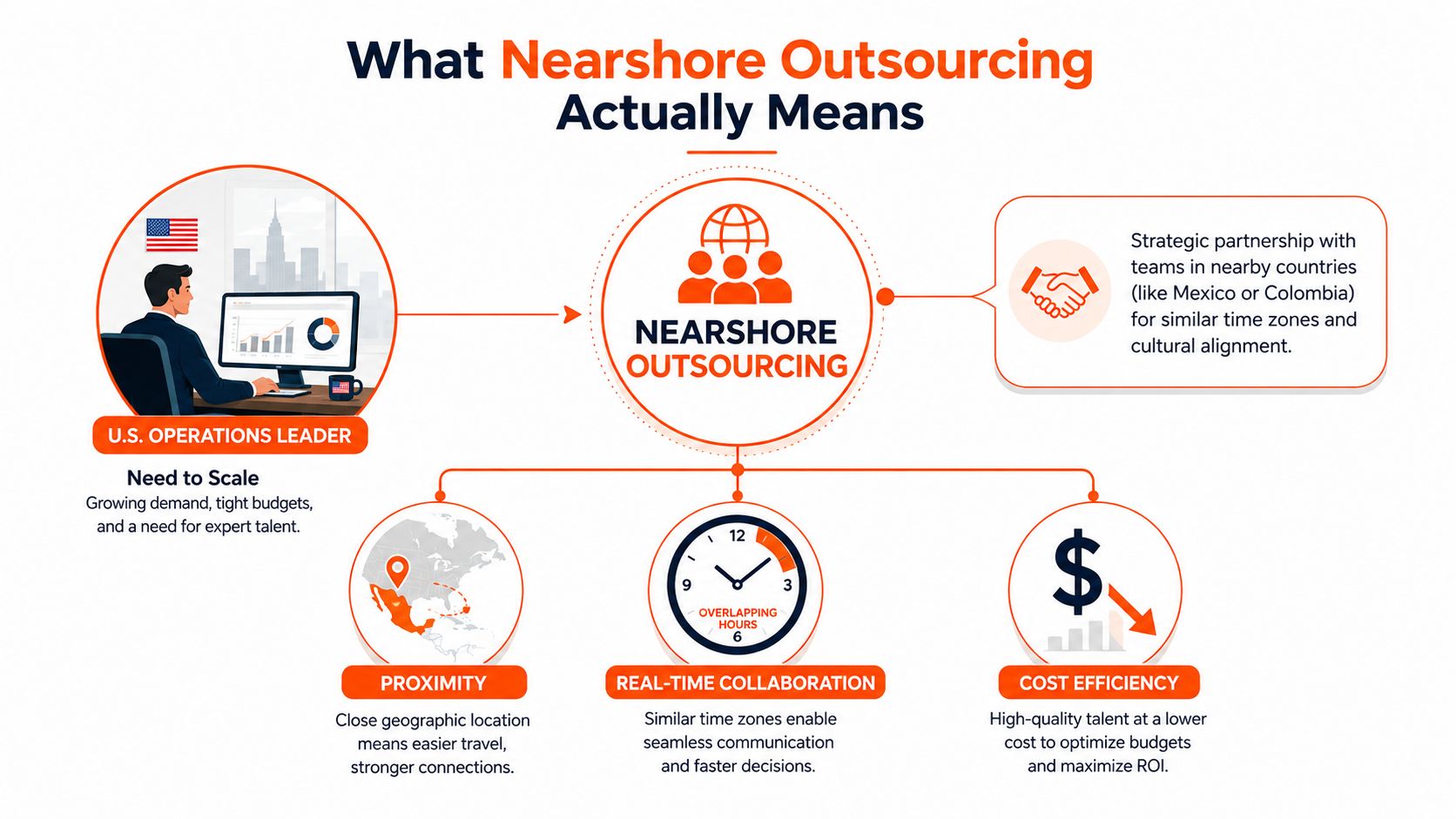
The useful test is simple. If your team in the U.S. can message, meet, review, and approve work during a normal business day, the relationship is probably nearshore. If the work lands while everyone is asleep and gets handled for tomorrow's handoff, that's a different model.
That distinction matters because many buyers confuse geography with operating reality. A nearby country can still be a poor fit if the provider can't staff your hours, communicate clearly, or manage the work in real time. Nearshore only becomes nearshore in the operational sense when the overlap lets issues get solved the same day.
Practical rule: if a vendor can join your standup, answer escalations before lunch, and close feedback loops before end of day, you're looking at nearshore behavior, not just a nearshore location.
You can now define it in plain language: nearshore outsourcing is buying capacity from a nearby market so the team shares most of your working day. The model matters because it reduces coordination drag, and it becomes especially valuable when the work depends on fast feedback, not just low labor rates.
The easiest way to understand nearshore is to compare it with the two other familiar models. Onshore keeps work in your own country. Offshore moves it far away. Nearshore sits in the middle, close enough for overlap and travel, but far enough to improve the cost structure.
That middle position is why the model gets used so often for customer-facing and coordination-heavy work. The buyer keeps visibility, the team keeps overlap, and the vendor still brings a different labor market into the equation. The practical tradeoff is usually less about one model being “good” and more about which friction you're willing to accept.
DimensionOnshoreNearshoreOffshoreGeographySame countryNearby country or regionDistant countryCollaboration styleEasiest in person and in real timeReal-time collaboration stays workableMore handoff-based and asynchronousCost positionHighestLower than onshoreOften lowest on hourly rateTime-zone fitFull overlapSmall gap, same-day overlapLarge gap, limited overlapManagement feelFamiliarClose to an extension of your teamMore process-heavy and scheduled
For a deeper side-by-side discussion, the comparison in nearshore vs offshore outsourcing is a useful companion. The point of the table isn't to crown a winner. It's to show that the choice changes how your team works every day.
A low rate is only useful if the work lands on time, gets reviewed quickly, and doesn't create a pile of rework later.
Nearshore sits in a useful middle zone because it preserves the human rhythm of a normal workday. That's why it often feels less like “outsourcing” in the old sense and more like staffing through a different labor market.
The main reason U.S. companies choose nearshore is not a single headline savings number. It's the combination of same-day collaboration, lower total labor cost, and less coordination friction than a far-offshore setup usually creates. That combination shows up in the market data too, since nearshore BPO is estimated at US$61.57 billion in 2025 and projected to reach US$120.11 billion by 2033 at an 8.8% CAGR according to Grand View Research's market snapshot, with North America identified as the largest revenue-generating region in 2025. The wider BPO ecosystem is also large, with an overall global market around US$525 billion annually and growing 8–9% per year in a separate 2026 report, which helps explain why nearshore keeps gaining traction rather than staying niche.
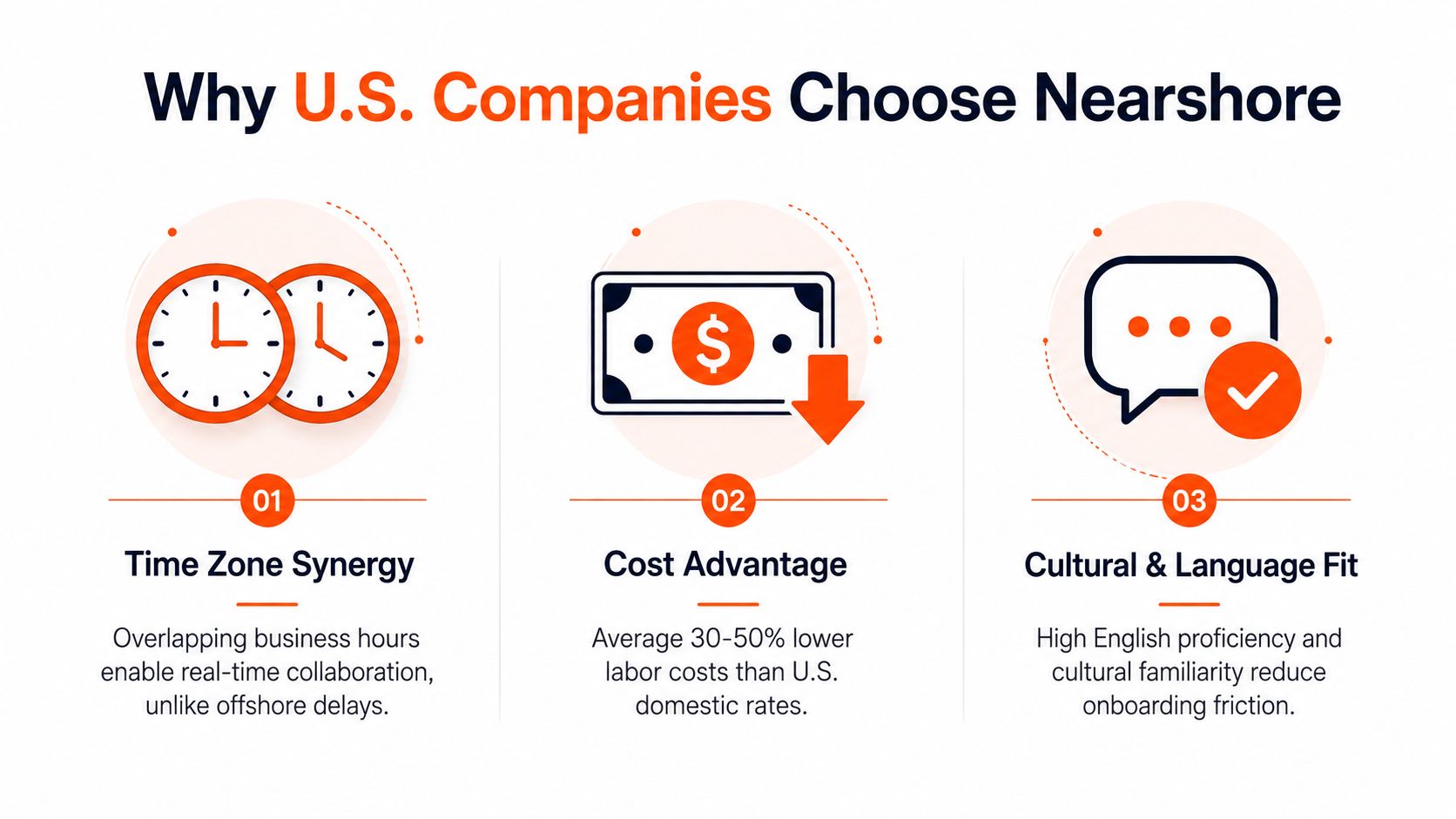
The most obvious appeal is time. One 2026 industry compilation says 85% of companies choose nearshore for time-zone alignment, and another source says nearshore teams can deliver 40–60% cost savings versus onshore U.S. equivalents, while still keeping 6–8 hours of daily overlap. A separate source says U.S. companies often save 30–50% versus onshore outsourcing, with hidden management overhead of only 5–10% on nearshore deals compared with 15–20% offshore, which is why the model gets treated as an operational efficiency choice, not just a wage arbitrage move. Those numbers matter because they explain why meetings, escalations, and approvals happen in the same workday instead of getting pushed into tomorrow.
Cost alone doesn't close the deal. Teams also care about language comfort, cultural familiarity, and how fast people can adapt to customer expectations. That's why nearshore works especially well when the work requires frequent feedback, repeated context switching, or a lot of small adjustments from managers.
If you're setting up the communication layer for that kind of team, a guide on unified communications for global teams can be helpful because it shows how tooling affects collaboration when people are split across countries. The tooling won't fix a bad operating model, but it can make a good one easier to run.
For buyers evaluating the financial side, nearshore staffing costs helps frame why all-in pricing matters more than the initial hourly rate. The lowest rate on a quote isn't useful if the team creates delays, repeated handoffs, or management overhead later.
Nearshore tends to work best where the job depends on live interaction, quick feedback, or a steady stream of small decisions. Customer support is the clearest example, because supervisors can listen, coach, and adjust scripts while the work is happening. Sales support and inside sales fit too, since prospect replies, meeting scheduling, and objection handling all benefit from the same business-day overlap.
For executive assistants and virtual assistants, overlap matters in the simplest possible way, calendars move in real time. Inbox triage, meeting booking, and travel coordination work better when the assistant can ask a question, get an answer, and close the loop before the meeting window disappears. The same logic applies to recruiters and coordinators who need fast approvals from U.S. managers.
Marketing and creative roles use the overlap differently. A designer can send a draft in the morning, get feedback before lunch, and post the revised version the same day. Social media teams can react to campaign changes or customer comments while the U.S. team is still online, which keeps the brand voice tighter and the turnaround shorter.
Bookkeeping, data, and developer roles also benefit, but for a different reason. Those jobs often involve follow-up questions, exception handling, or sprint-level coordination. When the person doing the work is online during your workday, it's much easier to catch a problem before it turns into a backlog item.
Nearshore is strongest when the handoff is not the work. If the job needs conversation, then time-zone overlap becomes part of the deliverable.
A few common fits show the pattern clearly:
That mix is why nearshore is often chosen for roles that need both structure and conversation, not just task completion.
Nearshore gets oversold when buyers focus only on geography and ignore operating quality. A nearby team can still fail if the provider's vetting is thin, the pricing hides add-ons, or the compliance setup is vague. The label on the proposal matters less than the machinery underneath it.
Mis-hires are common when a vendor sends polished candidates but doesn't test for the actual job. The resume may look right, but the person may struggle with client communication, follow-through, or the specific tools your team uses. If you want to screen for fit beyond credentials, a resource on improve team cohesion hiring is useful because it shows why alignment tests need to go beyond a quick interview.
Hidden fees are another failure mode. Some vendors lead with an hourly rate and then layer on setup charges, replacement costs, payroll handling, or administrative add-ons later. That makes it hard to compare providers on a like-for-like basis, which is exactly where many first-time buyers get trapped.
Compliance is the third blind spot. If contracts, payroll, and HR live in too many places, someone on the buyer side ends up carrying risk they didn't plan for. That's especially dangerous when the team is handling sensitive customer data or operating in a regulated environment.
The last issue is internal. A distributed team still needs clear handoffs, written ownership, and a manager who knows how to run remote work. Without that, nearshore doesn't reduce coordination costs, it just moves them into a different country.
If a vendor can't explain who owns payroll, who handles replacement, and who is accountable when the work slips, the geography isn't the problem. The operating model is.
The safest response is skepticism toward broad claims. Ask how work gets staffed, how failures get replaced, and how much of the operating burden stays with the provider.
The best way to evaluate a partner is to inspect the process, not the pitch. A serious nearshore provider should be able to show you how it sources people, how deep the vetting goes, how quickly it can produce candidates, and who owns the employment side once someone is hired. Those details tell you whether you're buying staffing or buying managed operations.
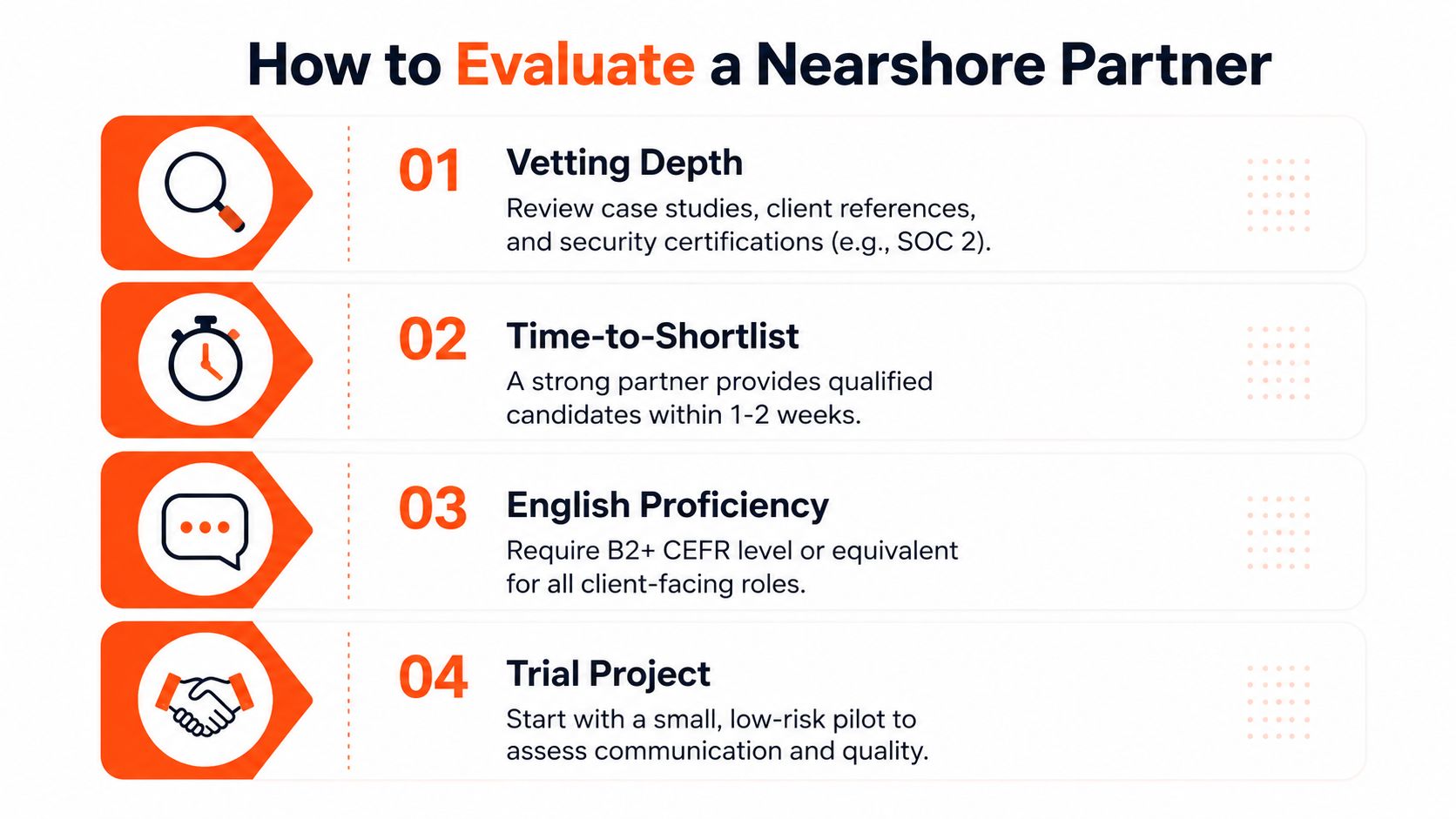
A mature setup should be able to return a shortlist quickly, because speed is part of the value. Virtustant, as one example of a managed nearshore staffing model, says it delivers shortlists within 48 hours, uses a four-stage vetting process, offers all-in hourly pricing starting at $7, and includes a lifetime replacement guarantee. It also handles contracts, payroll, HR, and compliance under a single invoice, which is exactly the kind of structure buyers should look for when they want one party to own the operational layer. For the compliance side of that model, the provider's own discussion of nearshore payroll compliance is the kind of documentation a buyer should ask for before committing.
A careful buyer should check five things:
If you're evaluating providers for client-facing work, English proficiency should be measured, not assumed. Ask how they screen for it and whether the standard is consistent across candidates, because weak communication usually becomes a management problem later.
A trial project also tells you more than a slide deck. Give the vendor a small, low-risk assignment and watch how they communicate, escalate, and document work. That's often the fastest way to see whether the operating model is real or just well marketed.
Nearshore fits fastest when your team needs live collaboration, bilingual or customer-facing capacity, and meaningful labor cost relief without losing the workday overlap that keeps managers sane. It's often a strong fit for U.S. companies that need the team to feel present, not merely available later. The market data above helps explain why the model keeps growing, but the decision still comes down to the shape of your workload.

Use nearshore when the work needs same-day feedback, regular client contact, or coordination that would be painful across a large time gap. Use onshore when regulation, sensitivity, or proximity outweighs savings. Use offshore when the work is highly standardized, the schedule can absorb delay, or you're optimizing for a different operating rhythm.
The deeper question is still the one from the opening, who owns the operating layer. If the provider sources, vets, contracts, pays, and supports the hire, you're buying managed execution. If your team has to assemble those pieces itself, you're still carrying much of the complexity, even if the worker sits abroad.
For most first-time buyers, that distinction is the test. Nearshore isn't just a location choice. It's a decision about how much of the workforce problem you want to solve in one place.
If you're comparing staffing models and want a nearshore setup that includes sourcing, vetting, payroll, and compliance under one process, Virtustant can help you evaluate what that looks like in practice. Explore Virtustant’s nearshore staffing to see how U.S. businesses match with vetted Latin American professionals, or book a discovery call to scope your team.