10 Sales Closing Techniques for 2026, With Scripts
August 27, 2026


Pick the close from the buyer's blocker, not from a favourite script. Assumptive and alternative closes when intent is already clear; objection-based or Ben Franklin when uncertainty remains; urgency, takeaway and impending-event only when the constraint is genuine and verifiable. Stacking three techniques into one call is not persistence, it is a sign the qualification never happened.
Closing is not a verbal manoeuvre. It is the transition from evaluation to an agreed next step with a named owner and a date. For U.S. founders and hiring leaders evaluating LATAM talent, the blocker is usually one of six things: internal alignment, communication, candidate quality, compliance, timing, or trust. Five questions locate it:
The technique should reduce decision friction, not manufacture pressure. Before selecting one, review how to spot buying signals. In staffing conversations the strongest signal is usually practical: asking when candidates can be interviewed, or how contracts are handled. That is the point to move from explanation to commitment.
Most articles on this topic open with a closing statistic. We checked the ones that circulate most, and the majority do not survive contact with a primary source. This matters operationally: a sales team that builds a follow-up cadence on an inverted number builds the wrong cadence.
| Commonly repeated claim | Status | What the primary source actually says |
|---|---|---|
| "Sequences of 4 to 7 emails get a 27% reply rate, versus 9% for 1 to 3" | Not supported | Woodpecker's analysis of more than 20 million cold emails reports 8.3% for sequences with 3 to 5 follow-up steps against 4.1% with no follow-up. Follow-ups roughly double reply rate; they do not triple it into the high twenties. |
| "Follow-up emails generate 58.6% of all replies" | Inverted | The figure is real but points the other way: 58% of replies come from the first email and 42% from follow-up steps. Persistence helps; it is not where most replies come from. |
| "6 to 10 minute calls convert at 29%, versus 22% above 10 minutes" | Contradicted | Gong Labs analysed 30,000 first calls and found no statistically significant correlation between first-call duration and getting a second meeting. What did show up: prospects are 12% more likely to attend a meeting booked for 30 minutes than one booked for 60. |
| "35% to 50% of sales go to the vendor that responds first" | Unverifiable | Repeated across hundreds of blogs, usually attributed to InsideSales.com, with no published methodology or sample. Speed to lead does matter, and the credible reference is Harvard Business Review's 2011 audit The Short Life of Online Sales Leads, which found most companies respond far too slowly. Use that, not the folklore percentage. |
| "A single follow-up email lifts reply rates by 11%" | No primary source | Traces only to statistics-aggregator sites that cite each other. |
| "The average B2B close rate is 20% to 21%" | Treat as folklore | Widely published, no primary study behind it. Win rates vary enormously by deal size, segment and how a company defines a qualified opportunity, so a single industry average is not a useful benchmark for your team. Measure your own. |
The operational read: follow-up works, but the first message carries most of the load, and call length is not the lever anyone claims it is. Build the cadence around a strong first touch and three to five structured follow-ups, and stop optimising call duration.
Primary sources: Woodpecker cold email statistics (20M+ emails, June 2026) · Gong Labs on first-call length (30,000 calls) · Harvard Business Review, The Short Life of Online Sales Leads.
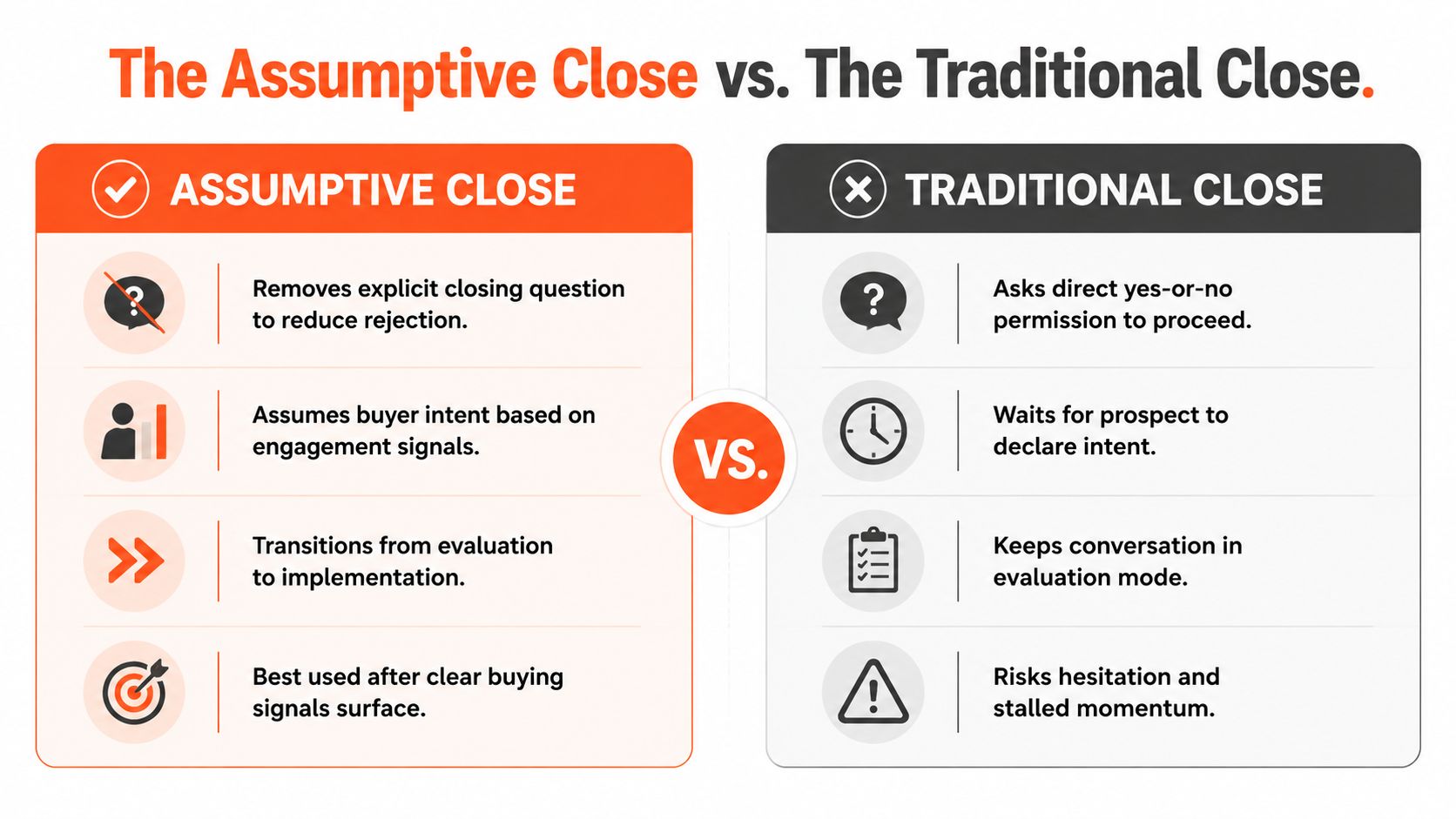
The assumptive close treats commitment as sufficiently established and moves the conversation toward logistics. Instead of asking "Would you like to proceed?", the rep asks which implementation path the buyer prefers. It is appropriate only when the buyer has demonstrated intent through questions about timeline, budget, scope or delivery.
For a hiring manager evaluating a remote professional:
"We'll prepare your first candidate shortlist within 48 hours. Would Tuesday or Wednesday afternoon work better for the review call?"
The assumption is concrete: it names the next deliverable and asks for a scheduling decision. A weaker version jumps to contract language before the buyer has confirmed fit, which reads as inattentive rather than confident.
Use it late in discovery, after material objections are addressed. Repeated implementation questions, confirmation of budget ownership, or discussion of interview timing all indicate the buyer may be ready to advance.
The failure mode is premature certainty. If the buyer says "we're still comparing providers," don't keep acting as if the decision is complete. Pivot to a diagnostic question:
"Understood. What remains unresolved before you can choose a provider?"
SDRs should use assumptive language only after recording the buying signal in the CRM. Closers should separate a logistics assumption from a purchase assumption: "Which day works for interviews?" is safer than "Which payment method should we use?" when authority or approval remains unclear.
For teams building a remote sales function, the difference between an appointment setter and an SDR is where most role-design mistakes start.
The objection-based close uses the buyer's stated concern as the path to commitment. The rep doesn't deflect or offer generic reassurance. They clarify what the concern means, answer that specific issue, and check whether it still blocks action.
A hiring manager might say, "I'm worried a remote professional won't integrate with our team." The response:
"That's a real consideration. Is the concern communication, time-zone responsiveness, management capacity, or something else?"
The question matters because "integration" describes several different risks. A buyer worried about communication needs a different answer from one worried about accountability or compliance.
The readiness signal is an explicit objection paired with continued engagement. A buyer who explains the concern is handing over the information needed to earn the next step.
The failure mode is rebuttal before understanding. A rep who immediately lists benefits often answers a question nobody asked. The sequence that works:
A buyer questioning candidate quality might hear:
"Our four-stage vetting funnel is a live English screen, a cognitive assessment, a role-specific skills test, and experience and reference verification. That process produces the top 1% of applicants. Which capability would you like us to test most closely?"
SDRs should practise staying silent after the objection. Closers should distinguish a resolved objection from a postponed one. If the concern persists, ask: "What would need to change for this not to be a blocker?"
For teams comparing recruiting channels, this guide to hiring a remote SDR is a useful starting point on role fit and sourcing models.
The alternative close turns a binary decision into a preference between two workable paths. Both options must lead to a legitimate next step, and neither can be a disguised penalty. The buyer chooses scope, timing or implementation pace rather than answering an exposed yes-or-no question.
"Would you prefer to begin with one remote professional and a defined trial period, or should we source for the full open role and stagger onboarding?"
The rep isn't removing the buyer's ability to decline. The technique fits only after the buyer has confirmed the staffing need exists and the solution is credible.
Use it when the buyer is interested but stuck between paths. Questions about candidate specialisation, interview timing or team structure suggest they are choosing how to proceed rather than whether to proceed.
The trade-off is simplicity against transparency. Choice architecture reduces friction, but it feels manipulative when the options aren't equally valid. Never present a slow, unsuitable option purely to make the preferred one look better.
"Should we focus the initial vetting on sales development reps with your current tech-stack experience, or on candidates with broader SaaS go-to-market backgrounds?"
Offer alternatives only when both paths are operationally possible. Frame options around scope, timing or onboarding, not arbitrary discounting. Then pause: the buyer's reason for choosing an option often reveals a hidden objection.

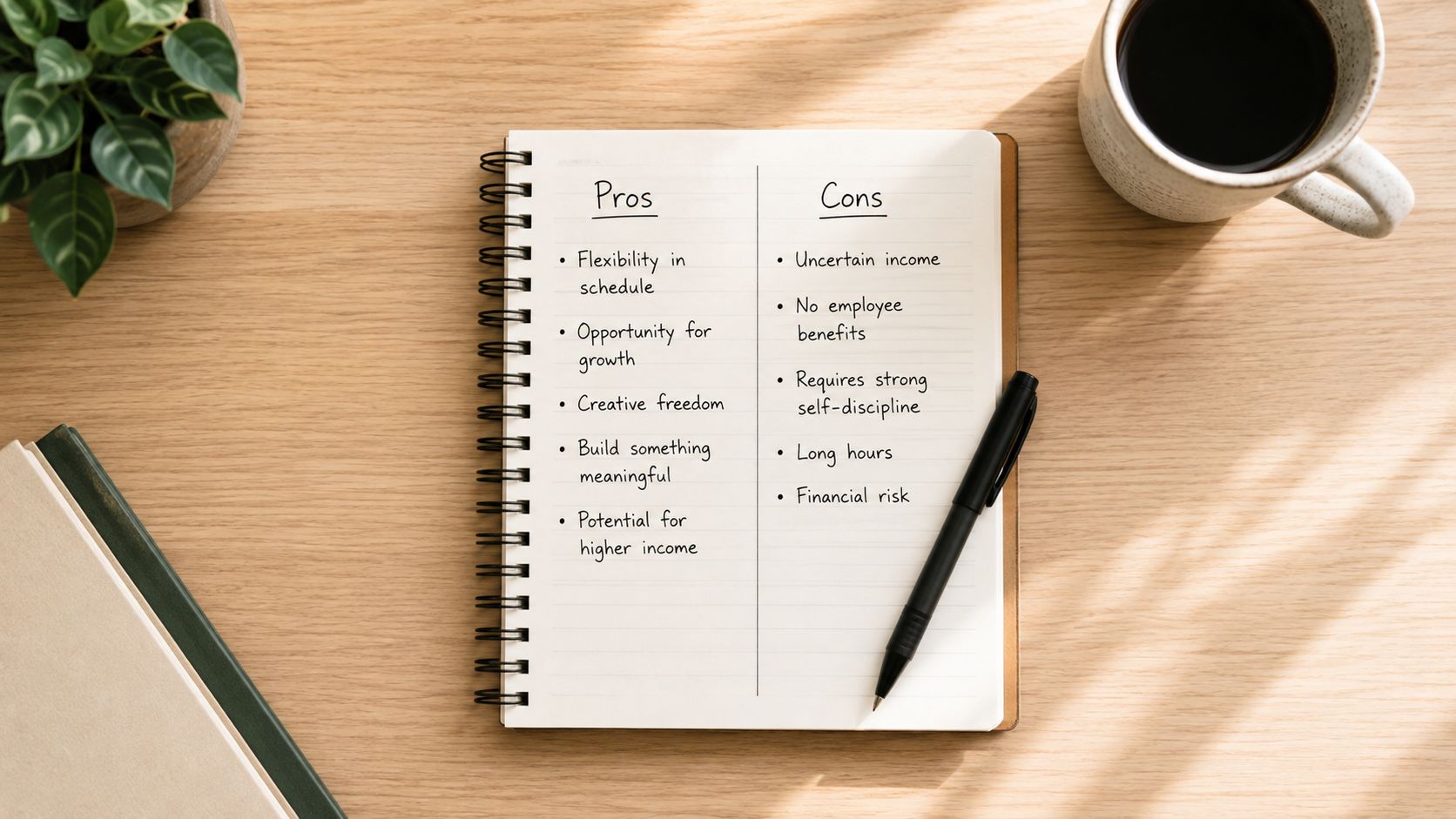
The Ben Franklin close externalises an uncertain decision into a structured comparison: reasons to proceed in one column, concerns in another. The value isn't in making the positive side win. It is in making vague hesitation specific enough to evaluate.
"Let's map this out. On one side, the gains from moving forward: saving up to 70% against a comparable US hire, faster access to candidates, no foreign entity to set up. On the other, every concern you have. What belongs in each column?"
This fits analytical buyers who want to inspect the decision rather than respond to persuasion. It is especially useful when the buyer says they need to "think about it" but cannot name what they need to think through.
The trade-off is time. A structured map slows the conversation, but it prevents a vague follow-up from becoming indefinite delay. Don't use it as a closing hammer: if the concerns clearly outweigh the benefits, reposition the offer or go back to discovery.
An asynchronous version works in email or Slack:
"Here's the value map from your side: a curated shortlist, vetted bilingual professionals, consolidated administration, and a replacement guarantee. What am I missing on either column?"
Ask the buyer to write or edit the list rather than presenting a finished sales argument. Add known benefits, then ask neutral questions about each concern: "That's real. What would need to change to remove it?"
The buyer's own language should shape the next step. A prospect who names compliance as the only remaining concern is ready for a focused operational explanation. One who names decision-maker alignment needs a consensus plan instead.
The puppy dog close replaces promises with a controlled experience. The buyer gets a low-risk opportunity to evaluate fit through actual work rather than deciding from a sales call. In remote staffing the trial has to be defined carefully: duration, role scope, review process, and what happens if the match fails.
"Let's begin with a defined trial period. Your team can evaluate communication, work quality and time-zone overlap through real assignments. At the review point, you decide whether to continue, adjust the scope, or replace the match."
The readiness signal is risk language. "What if the person isn't a fit?" or "How will my team know whether this works?" means the buyer needs proof, not another feature list.
The failure mode is an ambiguous trial. Without explicit success criteria a pilot becomes an unstructured engagement that frustrates both sides. Define the operating test before the candidate starts:
A trial should create learning for both parties, not make the worker feel tested without support.
SDRs should confirm the buyer can actually provide work, access and feedback during the trial. Closers should avoid promising outcomes the agreed process doesn't support. The close gets stronger when the buyer knows exactly how the decision will be made afterwards.
This guide to the pros and cons of an outsourced SDR helps sales leaders think through role expectations before proposing a trial structure.
The impending event close ties the decision to a deadline the buyer owns: a product launch, budget review, expansion, seasonal workload or planned onboarding window. The rep isn't claiming the offer expires. They are showing what action is required if the buyer wants to meet a date that already exists.
"You said the new market launch is eight weeks away and customer support needs to be ready by then. To leave time for sourcing, interviews and onboarding, we should scope the role this week. Would tomorrow work for the scoping call?"
Use it when discovery has surfaced a specific event and the buyer has acknowledged the consequence of missing it. The failure mode is importing the seller's quota into the buyer's calendar. "We need a decision by Friday" means nothing unless the buyer has a reason to decide by Friday.
Ask early:
Then explain the operational sequence required to meet the event. Don't exaggerate what happens after the deadline: state the likely consequence, such as a delayed onboarding window or a later planning cycle.
SDRs should capture the event, date, owner and consequence. Closers should turn those into a mutual timeline covering both buyer and seller actions. A genuine deadline creates coordination. It shouldn't create fear.
The urgency close accelerates a decision by showing that delay has a real cost: an unfilled role, a missed onboarding window, a narrowing pool for a specialised profile. The rep must distinguish factual urgency from manufactured pressure.
"You need this role supporting customer operations before the next growth phase. If we begin scoping now, we can work toward a curated shortlist within the stated timeline. If the start date moves, the onboarding plan moves with it. Should we schedule the intake call?"
The readiness signal is an engaged buyer who has already acknowledged the consequence of delay. The boundary is simple: disclose what is known, qualify what is uncertain, and never claim scarcity that hasn't been verified.
A usable urgency statement has three parts:
Avoid "act now" or "spots are disappearing" unless you can explain the underlying condition. The evidence points the same way: as the statistics section above shows, disciplined follow-up structure and a strong first touch are more credible levers than a clever final phrase. This discussion of closing the sale makes the same process-led argument.
SDRs should never create scarcity to compensate for weak qualification. Closers should ask whether the buyer's stated urgency is operational, financial or personal. If there is no real consequence attached to delay, urgency is the wrong technique: continue discovery or set a reasoned follow-up.
This close connects the decision to an outcome the buyer cares about beyond the transaction: founder focus, team sustainability, customer relationships, the ability to work on higher-value priorities. Draw it from discovery rather than imposing a dramatic narrative.
"You said hiring is taking you away from product and customer conversations. If we place the right remote professional into the repeatable work, what would you redirect your time toward?"
The question lets the founder articulate the value instead of receiving an inflated promise.
The readiness signal is a personal frustration or a stated value. A buyer who says "I need my team focused on strategic work" has supplied the language for you.
The failure mode is emotional manipulation. Don't exaggerate burnout, promise a complete transformation, or reach for invented productivity figures. Connect the staffing decision to the buyer's own priorities, then support it with practical detail: role scope, collaboration hours, onboarding ownership.
"Your team wants to spend more time on customer relationships and less time repeating basic answers. Would assigning tier-one support to a bilingual remote professional create the focus you're trying to protect?"
SDRs should listen for frustration, not just business goals. Closers should pair the value statement with rational proof: candidate profile, management plan, next operational step. Emotional relevance opens the decision; evidence makes it safe to act.
The takeaway close sets a boundary around readiness or fit. The rep doesn't threaten the buyer or pretend the opportunity is disappearing. They explain that continued work requires a buyer who can review candidates, involve decision-makers, or move within a defined process.
"I want to make sure the timing is right for your team. We can pause the search until you're ready to review and interview candidates promptly, then restart when the internal process is in place."
Use it after value has been demonstrated and the buyer has repeatedly delayed without naming a solvable concern. It also fits when the buyer's requirements clearly don't match the service model.
The failure mode is performative rejection. Saying "we don't need your business" to provoke a reaction damages credibility. A legitimate takeaway needs:
SDRs should flag stalled opportunities rather than escalating pressure indefinitely. Closers should document the condition for reactivation and close the loop professionally. A buyer who isn't ready today can become a good opportunity later, but only if trust survives.
The best use of the takeaway close is qualification. It separates a genuine project from a conversation with no owner, timeline or decision process.
The standing room only close uses genuine limits in supply, capacity or availability. In staffing those limits show up around specialised skills, bilingual communication requirements, or a provider's onboarding bandwidth. Explain what is constrained and how the buyer can respond, and keep it factual.
"We're reviewing several requests for this candidate profile. If your team can complete interviews promptly after receiving the shortlist, we can assess whether the role fits the current intake capacity. If not, we can discuss a later start window."
The script doesn't promise priority that hasn't been earned. It makes the buyer's responsibility visible.
This fits a buyer with a specific requirement and a credible need to move. The failure mode is confusing general demand with confirmed scarcity. Don't claim a profile is rare, that capacity is nearly full, or that other buyers are competing, unless you can substantiate it.
For Virtustant, the operational distinction is the combination of sourcing, assessment, placement, nearshore US-time-zone overlap, and managed contracts, payroll, HR and compliance. That combination can be positioned as an operating model, but no single component should be described as unique.
SDRs should record the constraint and its source. Closers should state when more capacity may become available rather than forcing an immediate decision. This guide to remote closing is useful for adapting final-stage conversations when buyer and seller teams work across locations.
Used properly, SRO attracts prepared buyers and discourages tyre-kicking. If the buyer can't meet the process requirements, the honest next step is a later review, not artificial pressure.
| Technique | Use when the blocker is | Rep skill required | Main failure mode | Best-fit buyer |
|---|---|---|---|---|
| Assumptive | Nothing: intent is already clear | Timing judgment | Premature certainty | Late-stage, discussing logistics |
| Objection-based | A named, unresolved concern | Clarifying and listening | Rebuttal before understanding | Sceptical, consultative buyers |
| Alternative | Choosing between viable paths | Script discipline | One option is a disguised penalty | Indecisive buyers, committees |
| Ben Franklin | Unnamed hesitation | Facilitation | Using it as a hammer | Analytical, finance and ops leaders |
| Puppy dog | Perceived risk | Trial design | Trial with no success criteria | Risk-averse hiring managers |
| Impending event | A real date the buyer owns | Discovery depth | Importing the seller's quota | Buyers with launches or budget cycles |
| Urgency | An acknowledged cost of delay | Credibility discipline | Manufactured scarcity | Buyers already aware of the consequence |
| Emotional / value-based | A stated personal priority | Deep discovery | Emotional manipulation | Founders, mission-driven leaders |
| Takeaway | Repeated delay with no named cause | Precise timing, calm tone | Performative rejection | Serial delayers, low-fit prospects |
| Standing room only | A verifiable capacity limit | Substantiation | Claiming unconfirmed scarcity | Niche profiles, peak hiring periods |
The earlier version of this table scored each technique with star ratings and "expected outcomes." We removed them: there is no dataset behind a claim that one closing technique produces measurably better outcomes than another, and inventing one would contradict the whole point of the statistics section above.
The sequence is straightforward: diagnose the blocker, select one technique, state the next step, confirm ownership and timing. A rep shouldn't stack three closing techniques into one conversation. That usually signals a team trying to overcome uncertainty with pressure instead of resolving it.
Start with the blocker. Intent clear and the buyer discussing logistics, use an assumptive close. Choosing between viable paths, use an alternative close. Uncertainty with a named cause, use objection-based or Ben Franklin. Risk, use a controlled trial. A real constraint in the buyer's calendar, use impending event. Reserve urgency, takeaway and standing room only for verified conditions.
A strong next step has four parts:
"We'll send the shortlist" is incomplete. "Virtustant will send the curated shortlist, your hiring manager will review the candidates, and both teams will meet on the agreed date to select interviewees" creates accountability. That governance matters because B2B deals fail through internal misalignment even when the primary contact is convinced.
Role-play by buyer scenario, not by script name. A manager can evaluate whether the rep:
Email follow-up should reinforce the agreed process rather than repeat the pitch, and the verified data changes how you should build the cadence. Woodpecker's analysis of more than 20 million cold emails found sequences with three to five follow-up steps reply at 8.3% against 4.1% with no follow-up at all. Follow-up roughly doubles the reply rate, which is a real effect and worth building for.
But 58% of replies arrive from the first message and only 42% from the follow-up steps. That is the opposite of how the statistic is usually quoted, and it changes the priority: the first touch deserves most of the effort, and the follow-up sequence exists to catch the remainder, not to carry the campaign.
On call length, stop optimising it. Gong Labs analysed 30,000 first calls and found no statistically significant correlation between duration and whether the deal advanced to a second meeting. The one usable finding is about the invitation rather than the call: prospects are 12% more likely to attend a meeting booked for 30 minutes than one booked for 60. Book shorter, then let the conversation take the time it needs.
There isn't one, and any article that names a single best technique is guessing. The right close is determined by the buyer's blocker: assumptive when intent is clear, objection-based when a concern is named, alternative when they're choosing between paths, a controlled trial when the issue is perceived risk. Diagnose first, then choose.
Use an objection-based close when the hesitation has a stated cause. If the buyer can't identify the cause, use a readiness question or a Ben Franklin exercise to make the uncertainty specific. Don't use an assumptive close until intent is clear.
When it reflects the buyer's real deadline, verified capacity, candidate availability or an implementation constraint. Explain the condition and the consequence. Never invent a deadline or imply competing demand without evidence.
Three to five follow-up steps, based on Woodpecker's analysis of more than 20 million cold emails, which reports 8.3% reply rates at that cadence against 4.1% with no follow-up. Note that 58% of replies still come from the first email, so the first message deserves the most effort.
No. Gong Labs found no statistically significant correlation between first-call duration and getting a second meeting across 30,000 calls. Scheduling matters more than duration: prospects are 12% more likely to attend a 30-minute meeting than a 60-minute one.
The figure usually quoted is 20% to 21%, but no primary study supports it. Win rates vary enormously by deal size, segment and how a company defines a qualified opportunity, so an industry average is not a useful benchmark. Measure your own close rate by stage and segment instead.
Write down the decision process, stakeholders, action owners and dates. Remote buying often includes asynchronous review, so send a concise recap and make the next meeting responsible for a defined decision rather than another general discussion.
When the buyer can't explain the problem, the decision-maker is absent, the business event is unclear, or a stated objection remains unresolved. No technique compensates for insufficient trust or qualification.
A close that treats commitment as established and moves to logistics, asking which implementation path the buyer prefers rather than whether they want to proceed. It works only after the buyer has shown intent through questions about timeline, budget, scope or delivery, and it fails when the rep assumes a purchase rather than a next step.
A structured comparison in which buyer and rep list reasons to proceed in one column and concerns in the other. Its purpose is not to make the positive column win but to turn vague hesitation into something specific enough to evaluate. It suits analytical buyers and works asynchronously over email.
Every technique above assumes a rep with the discipline to diagnose before closing. Virtustant places bilingual sales development reps across Latin America from $8/hr all-in. Remote closers are quoted according to the role, experience and agreed schedule. Your hourly quote is the total price you pay, with no additional recruitment or placement fees. Virtustant offers a first shortlist of 3 to 5 vetted candidates in 48 hours and a lifetime replacement guarantee with no time cap.
See sales development representatives and nearshore staffing for U.S. companies, or book a discovery call to scope the role.