How to Hire Offshore Developers Without Losing Control
August 11, 2026

Most advice on how to hire offshore developers starts in the wrong place. It obsesses over sourcing channels, country lists, and hourly rates, then acts surprised when the work drifts, the feedback loop breaks, and the low-rate hire turns expensive through rework and management drag.
The better question is simpler. Do you have the management bandwidth to turn a remote developer into a productive teammate, or are you just buying distance and hoping for the best? The offshore hire itself isn't the hard part. The hard part is running a system that keeps requirements tight, decisions visible, and accountability real.
If you've ever paid for a bad hire, you already know the hidden cost lands long before termination. The MyCulture.ai bad hire guide is a useful reminder that the damage shows up in time, morale, and cleanup work, not just payroll. Offshore hiring works when leaders treat it as an operating model, not a bargain hunt.
To hire offshore developers without losing control, treat it as an operating model, not a bargain hunt: freeze the role in a one-page brief, choose an engagement model that matches your management bandwidth, vet with a paid trial instead of resumes, onboard for time-zone overlap, and lock down IP, payroll, and replacement terms before work starts. For US teams, nearshore Latin American developers capture most of the offshore cost saving while keeping same-day overlap for live code review.
Most offshore hires don't fail because the developer couldn't code. They fail because the company couldn't manage. If the brief is vague, the stack is half-decided, and nobody owns feedback, a strong developer will build the wrong thing quickly. If the hire is mediocre, a weak manager will keep them too long because replacing them feels harder than tolerating the loss.
That's the core mistake in most offshore advice. It treats sourcing as the main event, when the actual failure point is management bandwidth. A remote engineer needs sharper inputs, faster decisions, and more disciplined review than a local hire who can grab someone by the desk and resolve ambiguity in five minutes.
Practical rule: If your team can't define the work in writing, you're not ready to outsource the work.
The first archetype is the polished interview performer who gets a loose backlog and starts shipping confidently in the wrong direction. The second is the quiet underperformer who survives because nobody wants to restart the search, eat the ramp-up cost, and explain the miss. Both are management failures dressed up as hiring problems.
A better way to think about the problem is this. Offshore hiring increases efficiency only when the leader can keep the work narrow, inspect it early, and force clarity before code spreads. That's why the hiring process has to start with role design and end with ownership rules, not with LinkedIn browsing.
A good companion resource for this mindset is the cost of a bad hire discussion from MyCulture.ai, because the expensive part is rarely the salary line. It's the drag on the people who have to absorb the mistake. Offshore hiring magnifies that truth, which is exactly why the management layer matters more than the geography.
The market is large because the economics are obvious. One 2026 industry summary says offshore software development rates are typically 40% to 70% lower than onshore rates, with average offshore pricing around $20 to $50 per hour versus $80 to $150+ for comparable onshore talent, and that companies using offshore staffing can save 40% to 70% on fully loaded labor costs (Devico). That's not a niche arbitrage anymore. It's a structural labor strategy.
You will also see a precise-sounding percentage of U.S. businesses “using offshore software development” quoted across dozens of statistics roundups. We chased it to its source, and it dead-ends in vendor blogs citing other vendor blogs rather than in a published survey with a sample size and a field date, so we won't repeat it here as a fact. If you want to see the figures that circulate, this Joingenius roundup collects them in one place — just check what each one is actually sourced to before you put it in a board deck.
What we can report is our own hiring mix rather than someone else's estimate. Across Virtustant's last 427 placements, developers were 6% of the roles staffed — a real but minority share, behind appointment setters, social media, and general virtual assistants. Engineering is a normal part of a nearshore hiring plan, not the whole of it.
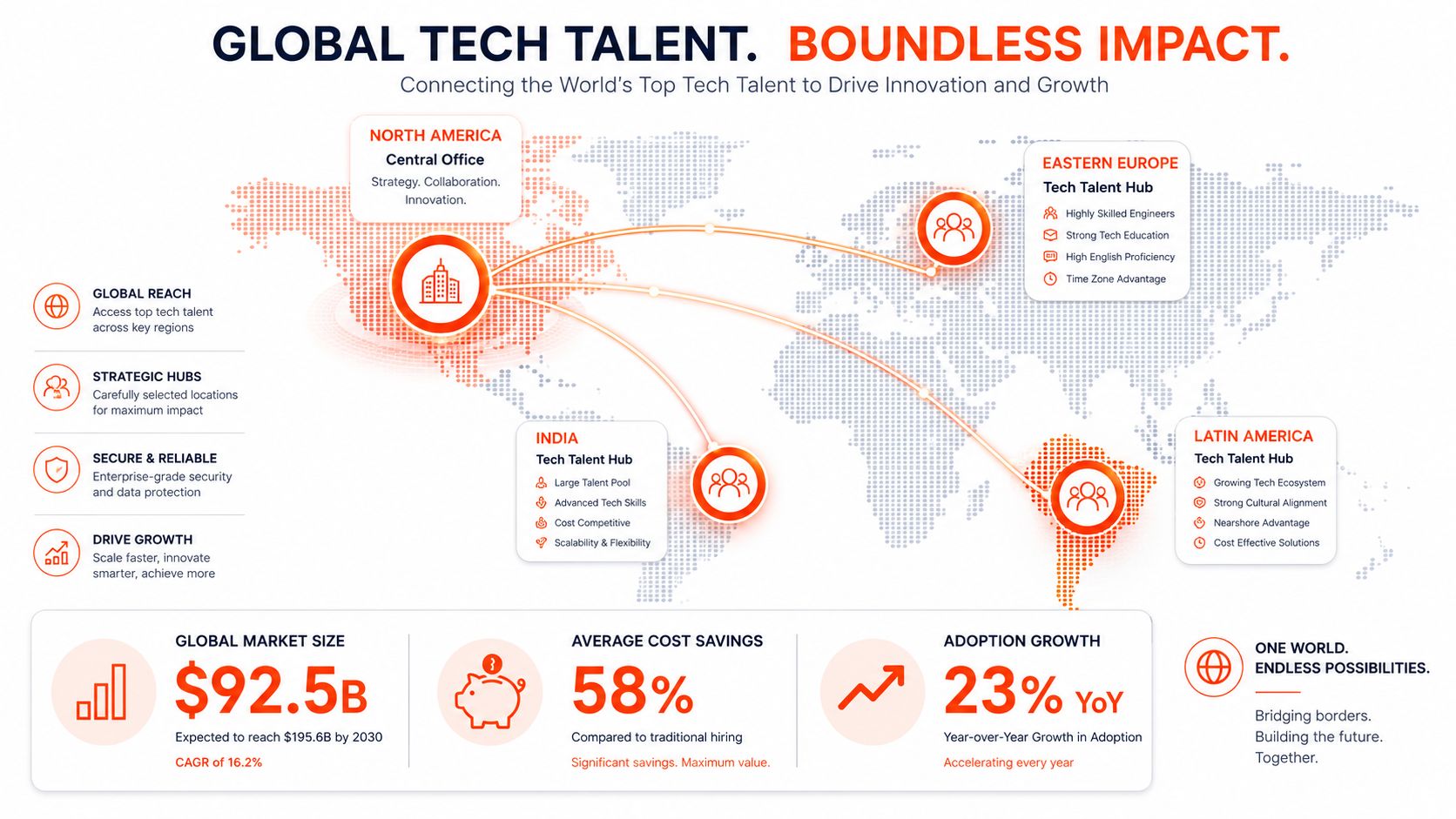
The scale matters because it changes the question. You're not deciding whether offshore exists, you're deciding whether your operating model can absorb the coordination cost that comes with lower labor spend. A team with strong engineering managers, clear product rituals, and disciplined review can make the economics work. A team that treats a remote hire like a plug-in contractor usually burns the savings in rework and delay.
For teams weighing region choice, the nearshore tradeoff is worth comparing against a broader geographic model, and this nearshore outsourcing overview is a useful reference point for that decision. The main takeaway is straightforward. In 2026, offshore hiring is still worth it, but only when savings are paired with management discipline, not when leaders chase the lowest sticker price.
"Offshore" is a location, not a strategy. The three models trade cost against time-zone overlap, and for US teams the right pick usually comes down to how much real-time collaboration your work needs.
| Model | Typical 2026 rate | US time-zone overlap | Best for |
|---|---|---|---|
| Onshore (US in-house) | $80 to $150+/hr contract; $135,980 median salary (BLS, May 2025) | Full | Teams that need someone in-region with budget to match |
| Offshore (Asia, e.g. India) | $20 to $50/hr | Little to none | Well-defined, handoff-friendly work packages |
| Nearshore (LATAM) | $10.50/hr all-in (Virtustant published developer rate), dedicated full-time | Same business hours (Eastern to Pacific) | Teams that need daily collaboration and live code review |
For most US teams, nearshore Latin America is the sweet spot: you can save up to 70% versus a comparable US hire while keeping the same-day overlap that makes code review, live debugging, and fast decisions possible. That is the model Virtustant runs through its nearshore staffing service, placing full-time LATAM developers who work in your time zone. For the fuller tradeoff, see our nearshore vs offshore comparison.
One clarification, since this guide targets the offshore question: Virtustant is not an offshore provider. We are a remote staffing agency that places nearshore professionals across Latin America, in your working hours. We wrote this guide because most teams searching for “offshore developers” are really searching for cost relief, and nearshore delivers that without giving up the overlap.
Start with a one-page role brief before you talk to a single candidate. If you can't define the business outcome, tech stack, milestones, and success metrics on one page, the role is still fuzzy. Offshore hiring punishes fuzziness because a remote developer can't infer intent from hallway context.
Keep the brief tight and concrete. Name the product area, the primary deliverable, the systems the developer will touch, and what success looks like after the first month. That sounds basic, but basic is where most failed searches fall apart.
Use this structure:
Operational standard: If the role brief can't guide a paid trial task, it isn't specific enough yet.
Then source through channels that can produce evidence, not just volume. Niche talent platforms can work for narrow technical needs, vetted agencies help when your internal team has no screening capacity, referrals reduce noise, and community channels can uncover strong specialists who never apply through job boards. The channel matters less than whether it can surface people who have already done adjacent work.
The benchmark I use is simple. If a sourcing partner can't produce three to five candidates within 48 hours, the pipeline is broken. That doesn't mean every search should finish in two days, but it does mean the top of the funnel should move fast if the role is real and the partner is competent.
The five-stage workflow infographic is a clean shorthand for the sequence: define the outcome, specify the stack, set milestones, define success, publish the brief. That order matters because sourcing before definition is how teams end up interviewing the wrong people for the wrong job.
The model you choose shapes the amount of control you'll need to exercise later. Traditional outsourcing, staff augmentation, and managed nearshore are not interchangeable. They create different decision rights, different communication paths, and different failure modes.
| Offshore Engagement Models Compared | Client Control | Typical Cost | Best For |
|---|---|---|---|
| Traditional outsourcing | Low | Lower direct management burden, but less direct control | Teams that can hand off defined work packages |
| Staff augmentation | High | Direct spend is usually visible, while management effort stays with the client | Teams with strong internal engineering leadership |
| Managed nearshore | Medium | Higher all-in service cost, lower internal coordination load | Leaders who want delivery support and less admin |
The success-rate data makes the control question hard to ignore. One 2025 analysis reports 37% success for traditional outsourcing, 60% for hybrid models with some direct access, and 83% for staff augmentation (FullScale). That's not a vote for one universal model. It's a warning that the more direct access and ownership you keep, the better your odds get.
Choose staff augmentation if you already have an engineering manager who can run standups, review work, and make technical calls without drama. Choose traditional outsourcing only if the scope is tightly bounded and your team can accept a handoff model. Choose managed nearshore if you need delivery support, but don't have the internal bandwidth to supervise every detail.
A simple way to say it is this. If your founders are still making technical decisions in chat threads, don't pick a model that requires daily management discipline unless you're ready to enforce it. If your organization already has strong process, don't pay for extra management you won't use.
The nearshore payroll and compliance guide is useful context here because model choice changes who owns payroll, local compliance, and contract structure. The wrong model creates hidden admin work. The right one makes responsibility obvious.
Resumes tell you where someone has worked. They don't tell you how they behave when requirements are fuzzy, feedback is delayed, or code review gets hostile. For offshore hiring, that gap is too expensive to ignore. Start with a short written problem before live interviews, then move quickly to a paid pilot on real work that's small enough to contain.
Expert hiring guides consistently recommend a 2 to 4 week paid trial on a real but contained task because it lets you observe code quality, blocker communication, and how the developer handles ambiguous requirements (AgileSoftLabs). That trial is doing the heavy lifting. It tells you more than a polished portfolio ever will.
During the pilot, verify three things. The developer writes clean code, explains tradeoffs clearly, and raises blockers early instead of hiding them. If they can't do that in a limited task, they won't magically improve after a six-month contract starts.
Use a 30/60/90-day scorecard with real metrics instead of vibes:
A paid pilot costs far less than a bad full-time commitment, because it turns unknowns into observed behavior.
Don't ask references whether the person was “good.” Ask what broke, how they handled access discipline, and whether communication held up when production issues hit. If you want a separate reference-checking workflow, the Digital Footprint Check background guide is a practical starting point for structuring that diligence.
Time zone and language still matter here, but only as collaboration screens, not as substitutes for technical proof. If the overlap is weak or communication is forced, the pilot should fail fast. That's the point.
Choose the region by time zone first, cost second. For teams in the U.S., Latin America often wins because you get same-day collaboration while still paying well below U.S. levels. Use published numbers on both sides of that comparison. On the U.S. side, the Bureau of Labor Statistics put the median annual wage for software developers at $135,980 as of May 2025, with senior and staff-level roles running above it (BLS Occupational Outlook Handbook). On the nearshore side, Virtustant publishes a single all-in developer rate of $10.50 per hour — the median across the developers we place, with payroll in the professional's country, compliance, and replacement already inside the number rather than added later. Third-party guides such as DistantJob quote their own LATAM salary bands; we would rather you compare against a rate we actually publish. That gap matters, but overlap matters more because it determines whether the team can move in sync.
The highest-value rituals are boring, and that's exactly why they work. Set daily overlap hours. Require written handoffs. Keep a shared product context document. Assign one U.S.-side owner for technical decisions so the offshore developer isn't trapped in a committee.
Overlap is a solved problem in LATAM, and not because anyone says so in a blog post: the region spans UTC−3 (Argentina, Brazil, Uruguay, Chile) to UTC−6 (Mexico City, Costa Rica, Guatemala), which puts a normal local workday inside U.S. business hours. In our own candidate base, 42,716 candidates have confirmed they can work U.S. business hours.
The common trap is hiring the person, then dumping a backlog on them and disappearing for two weeks. That's not onboarding. That's abandonment with a calendar invite. Remote hires need tighter sequencing at the start, not less attention.
Use the same onboarding logic you'd use for any high-trust operator. Give the developer a current architecture map, access to the right repos and environments, and a clear list of who answers what. The goal is to remove friction from the first pull request, not after the first incident.
The management-bandwidth theme becomes real here. If nobody on your side can review code the same day, resolve product ambiguity, and unblock decisions, the hire will sit idle or drift. Offshore teams don't fail because they're remote. They fail because the local side doesn't create a usable operating cadence.
A solid remote onboarding sequence helps, and this onboarding playbook is useful if you want a more structured version of that setup. But the core rule doesn't change. Time-zone overlap is not a perk. It's the substrate that makes code review, live debugging, and decision-making possible.
The lowest hourly rate can still be the most expensive hire if the legal structure is weak. Contracts, IP assignment, local compliance, and payroll all need to be solved before work starts, not after the first invoice. If you're doing everything yourself, you're usually also setting up a foreign entity, handling country-specific tax filings, and building HR infrastructure around a single hire.
A managed nearshore provider changes that equation by handling contracts, payroll, and compliance under one all-in hourly rate. That's not a cosmetic difference. It's a transfer of operational burden from your team to the provider. For many smaller U.S. companies, that alone is the difference between scalable and messy.
If you want a broader framework for entity-light hiring, the employer of record platforms overview is a useful reference. The point isn't that every offshore hire needs an EOR. The point is that someone has to own the legal and payroll plumbing, and pretending otherwise is how teams create avoidable risk.
Replacement language matters just as much as rate. A lifetime, unlimited replacement guarantee shifts downside away from the client in a way that short agency windows don't. A 30 to 90 day replacement limit can leave you exposed right when onboarding cost and project context are highest, which is the worst time to start over.
If you're evaluating a provider, ask who owns the contract, who processes payroll, how IP assignment is documented, and what happens if the hire quits or underperforms. Those aren't legal niceties. They're operating questions.
A managed service path can also simplify compliance when the team sits in Latin America and the client wants U.S.-friendly overlap without building a local entity. The nearshore staffing and payroll page is relevant if you want to see how that model is typically packaged. I'd still run the same checklist every time:
Virtustant provides nearshore staffing for full-time remote roles in Latin America, including developers, with sourcing, vetting, placement, payroll, and compliance handled in one managed workflow. If you want help building a controlled offshore hiring process instead of gambling on resumes, visit Virtustant and compare your current process against a model built for same-time-zone collaboration and operational control.
Book a discovery call to scope your role, and Virtustant will build a shortlist of vetted nearshore developers who overlap your working hours, with payroll, compliance, and a lifetime replacement guarantee handled for you.
Freeze the role in a one-page brief, source three to five candidates who have done adjacent work, vet with a paid trial on real but contained work instead of resumes, onboard for time-zone overlap with a single decision owner, and lock down IP assignment, payroll, and replacement terms before work starts.
Offshore developers in Asia typically run $20 to $50 an hour, versus $80 to $150 or more per hour for comparable onshore US contract talent; the U.S. salary anchor is the BLS median of $135,980 for software developers as of May 2025. Nearshore Latin American developers are priced hourly and all-in: Virtustant's published developer rate is $10.50 per hour, covering payroll, compliance and replacement, which lets US teams save up to 70% versus a comparable US hire while keeping same-time-zone overlap.
Onshore means hiring in your own country at full cost and full overlap. Offshore means a distant region such as Asia with the lowest rates but little or no time-zone overlap. Nearshore means a nearby region such as Latin America that keeps most of the cost saving while overlapping US business hours, so work moves in real time. Virtustant is a remote staffing agency working the nearshore model, not an offshore provider.
Set daily overlap hours, require written handoffs, keep a shared product-context document, and assign one owner for technical decisions so the developer is not stuck in a committee. The failure point is rarely the developer; it is a local side that cannot review code the same day and unblock decisions.
Choose staff augmentation if you already have an engineering manager to run reviews and standups; it shows the highest success rate when you keep direct access. Choose traditional outsourcing only for tightly bounded, handoff-friendly scope. Choose managed nearshore when you want delivery support and less internal admin.
A competent sourcing partner should produce three to five qualified candidates within 48 hours for a real, well-defined role. The full process still includes a paid trial, so plan for a two to four week evaluation before a long-term commitment.
You should, but only if the contract says so. Confirm written IP assignment, confidentiality, and access controls before work starts. A managed nearshore provider typically handles this under one agreement so the IP, payroll, and compliance sit in a single, documented workflow.
The top risks are weak management bandwidth, vetting on resumes instead of real work, thin time-zone overlap, and loose legal or replacement terms. Avoid them with a written brief, a paid trial, daily overlap, and a provider that owns contracts, payroll, and a lifetime replacement guarantee.