Virtual Assistant Pricing in 2026: 5 Models Compared
September 25, 2026


Virtual assistant pricing in 2026 comes in five models: hourly marketplace rates, block-of-hours packages, managed monthly units, an in-house salary, and all-in hourly staffing. On Upwork, 201 virtual assistant profiles show a median of $14.50 an hour before platform fees. Published US package plans run $36 to $65 an hour. Across Virtustant's last 462 placements, the median all-in rate was $12.75 an hour, with no placement fee.
Most buyers compare the hourly number and stop there. The better comparison is what a month costs at the hours you will actually buy, and in our placement data that is almost always exactly 20 or exactly 40 hours a week. This guide prices every model at both.
Third-party figures are those each source publishes on its own site, checked September 2026. Virtustant figures are first-party placement and intake data, with the sample size and window stated next to each one. Looking for hourly rates by country and experience level instead of pricing models? Our guide to how much a virtual assistant costs covers rates in depth.
Each model below is priced from what its provider publishes. Providers are described by model rather than by name; our side-by-side comparison of 22 staffing providers names each one with its published terms.
| Pricing model | How you pay | Published price (checked Sep 2026) | Effective per hour | What you still carry |
|---|---|---|---|---|
| Hourly marketplace freelancer | Tracked hours, paid through the platform | Median $14.50/hr across 201 Upwork VA profiles, plus a 5% client fee on the Basic plan or 10% on Business Plus | $15.23 at the median with the 5% fee | Vetting, backup, replacement, contracts |
| Block-of-hours package (US service) | Prepaid monthly plan of 10 to 60 hours | $390 for 10 hours up to $2,160 for 60 hours; unused hours roll over on the 20-hour plan and up | $36 to $39 | Scope must fit the plan hours |
| Premium package (US service) | Monthly plan in 20-hour steps | $2,600 for 40 hours up to $6,500 for 100 hours; 40-hour minimum | $65 ($79 for specialist tasks) | The 40-hour minimum |
| Managed units (fractional dedicated) | Monthly units of 55 hours | $1,600 per unit; full-time from $3,600 a month; 90-day minimum per unit; $250 setup, waived on an annual contract | $29.09 per unit hour | The 90-day minimum |
| In-house US administrative assistant | Salary plus benefits | Median wage $23.23/hr, $48,310 a year (BLS, May 2025) | About $33.19 per paid hour with benefits | Recruiting, payroll taxes, equipment, turnover |
| All-in hourly staffing (Virtustant) | One hourly rate, billed for the hours scheduled | From $7/hr; median $12.75/hr across 462 placements; no placement fee | $12.75 at the median | Day-to-day direction of the work |
Effective hourly rates divide the published monthly price by the plan's hours. The in-house figure divides the BLS median wage by 0.70, because wages were 70.0% and benefits 30.0% of private-industry compensation costs in June 2026 (BLS, Employer Costs for Employee Compensation). Upwork's help center lists a Basic-plan client fee of up to 7.99%, so the 5% on its pricing page is the lower bound. Virtustant: placements from 22 September 2025 to 22 September 2026, n=462.
You find a freelancer on a marketplace, agree an hourly rate, and pay for tracked time. The rate is the freelancer's, and the platform adds its fee on top: Upwork's pricing page lists a 5% client marketplace fee on the Basic plan (3% for eligible US clients paying by bank account), 10% on Business Plus, and a contract initiation fee of $0.99 to $14.99 per new contract on Basic. Fixed-price projects work the same way, priced per deliverable instead of per hour, and fit one-off work better than ongoing support.
It is the most flexible model and the one that leaves the most with you. Vetting, backup cover and replacement are your job, and every new hire restarts the search.
A subscription service sells a monthly bucket of hours. One US service publishes four plans: 10 hours for $390, 20 for $760, 40 for $1,480 and 60 for $2,160, with larger plans quoted on consultation. That is $39 an hour on the smallest plan and $36 on the largest. Another publishes $65 an hour in plans from 40 to 100 hours, $79 an hour for specialist work such as project management or design, and a 40-hour monthly minimum.
Packages suit work that is steady but small. The trade-off is that the price per hour rises as the plan shrinks, which is covered below.
A managed provider sells fixed units of capacity. One publishes $1,600 a month for a 55-hour unit, a full-time dedicated assistant from $3,600 a month at three or more units, a 90-day minimum per unit, and a $250 setup fee that is waived on an annual agreement. Per unit hour that is $29.09; at the full-time tier of 165 hours it falls to about $21.82.
Hiring directly means a salary plus everything that rides on it. The BLS puts the median wage for secretaries and administrative assistants at $48,310 a year, or $23.23 an hour, in May 2025, and $76,590 for executive secretaries and executive administrative assistants. Benefits were 30.0% of private-industry compensation costs in June 2026, so the median administrative hire costs about $69,014 a year, roughly $5,751 a month, before recruiting, equipment and the cost of an empty seat while you search. Our breakdown of cost per hire shows how that vacancy line adds up.
A staffing agency places a dedicated remote professional and bills one hourly rate that already includes their pay, payroll, compliance and HR support. That is Virtustant's model: an all-in published rate, with no separate markup to calculate, no placement fee, a shortlist in 48 hours and lifetime replacement. Candidates come from the top 1% of applicants, after a vetting funnel that narrows every 100 applicants to 22, then 9, then 3, then 1. Across our last 462 placements the median rate was $12.75 an hour and half landed between $10.67 and $14.50. Rates start at $7.00.
Staffing agencies charge in very different ways, from one-time placement fees to recurring markups. Our guide to what staffing agencies charge compares them, and freelance vs agency vs managed VA covers who does what in each model.
Pricing pages invite you to compare plans by hours: 10, 20, 55, 60, 100. Buyers do not hire that way. Of Virtustant's 332 most recent placements, 74.1% asked for exactly 20 or exactly 40 hours a week, and only 7.2% fell strictly between the two. The median was 35 hours.
| Hours per week | Placements | Share |
|---|---|---|
| 40 | 150 | 45.2% |
| 20 | 96 | 28.9% |
| 10 | 29 | 8.7% |
| 15 | 18 | 5.4% |
| 35 | 14 | 4.2% |
| All other schedules | 25 | 7.5% |
| Total | 332 | 100% |
Virtustant first-party placement data, n=332, placements with start dates from 29 June to 19 October 2026 (including signed placements not yet started), pulled 23 September 2026. The system's own part-time and full-time classification matches a 35-hour cut exactly: 158 part-time, 174 full-time.
So the fair way to compare quotes is to price each one at 20 and at 40 hours a week and look at the monthly total. Here is every model on this page at those two points, using 80 and 160 hours a month (four weeks).
| Pricing model | 20 hours a week (80 h/month) | 40 hours a week (160 h/month) |
|---|---|---|
| Hourly marketplace, median $14.50 + 5% fee | $1,218 | $2,436 |
| Block-of-hours package, $36 to $39/hr | No published plan; largest is 60 hours for $2,160 | Quoted on consultation |
| Premium package, $65/hr | $5,200 | Quoted on request (160+ hours) |
| Managed units, $1,600 per 55 hours | $3,200 (two units, 110 hours of capacity) | From $3,600 (full-time tier, 165+ hours) |
| In-house US administrative assistant | Not comparable | About $5,751 (annual cost divided by 12) |
| All-in hourly staffing, Virtustant median $12.75 | $1,020 | $2,040 |
Two things jump out. At 20 hours a week, the unit model sells you 110 hours to cover 80, and the four-plan package tops out at 60. At 40 hours a week, two of the four third-party models stop publishing a price at all. If a model has no clean price at 20 and 40 hours a week, it is priced for a buyer who does not exist in most of the market.
Package pricing rewards volume. On the four-plan US service above, an hour costs $39 on the 10-hour plan and $36 on the 60-hour plan, so a small buyer pays about 8% more per hour for the same work.
All-in hourly staffing behaves differently, and our data shows it. Across Virtustant's last 462 placements, 46% were part-time, and the part-time median rate was $12.41 an hour against $12.93 for full-time. Part-time did not cost more per hour. The schedule split in that window was 49% at 40 hours a week, 26% at 20 hours, 8% at 10 hours and 7% at 15 hours.
The practical takeaway: if you only need 20 hours, a model that charges you less per hour for buying more is steering you toward hours you do not need. Buy the hours the work requires and check that the rate holds at that size.
Role moves the rate more than any other factor. These are the median all-in hourly rates US companies paid across our last 462 placements, with the middle half of placements and the sample size for each role.
| Role | Median all-in rate | Middle 50% (p25 to p75) | Placements (n) |
|---|---|---|---|
| Virtual assistant | $10.73/hr | $9.23 to $12.00 | 42 |
| Executive assistant | $11.94/hr | $9.88 to $13.68 | 16 |
| Appointment setter | $12.00/hr | $10.46 to $13.50 | 68 |
| Social media manager | $12.00/hr | $10.66 to $12.89 | 46 |
| Cold caller | $12.00/hr | $10.00 to $12.00 | 9 |
| Recruiter | $11.82/hr | $10.38 to $14.55 | 12 |
| Sales development rep (SDR/BDR) | $13.00/hr | $12.00 to $13.00 | 41 |
| Legal assistant or paralegal | $13.00/hr | $13.00 to $15.00 | 13 |
| Customer service representative | $14.00/hr | $9.00 to $16.00 | 33 |
| Graphic designer | $14.50/hr | $10.93 to $14.80 | 7 |
| Bookkeeper | $15.00/hr | $12.64 to $16.38 | 12 |
| Dispatcher (small sample) | $9.00/hr | $8.75 to $9.25 | 4 |
| Administrative assistant (small sample) | $10.50/hr | $9.50 to $11.00 | 3 |
| All placements | $12.75/hr | $10.67 to $14.50 | 462 |
Virtustant first-party placement data, n=462 placements with a derivable rate, 22 September 2025 to 22 September 2026. The rate is the client's all-in hourly rate. The 13 roles shown cover 306 of the 462 placements; the rest are roles with fewer than three placements each. Full table and method on our pricing page.
Our video walks through the same data for assistants hired from Latin America:
Hourly rates tell you what a placement cost. Intake budgets tell you what buyers planned to spend before they talked to anyone. These are the monthly budgets US companies stated when they came to us to fill each function.
| Function | Searches reviewed | Median monthly budget | Range | Bought part-time |
|---|---|---|---|---|
| Bookkeeping and accounting | 25 | $2,072 | $866 to $3,464 | — |
| Administrative and assistant | 79 | $1,818 | $346 to $2,947 | 58% |
| Sales development and lead gen | 20 | $1,732 | $1,040 to $2,513 | 35% |
| Customer service and support | 22 | $1,648 | $345 to $2,535 | 21% |
| Marketing and social media | 23 | $1,212 | $216 to $5,196 | 61% |
Virtustant first-party intake data: searches opened in our recruitment system through 23 September 2026, deduplicated by company, covering open, hired, declined, ghosted and on-hold roles. Each figure is the midpoint of the monthly client budget the company stated; internal roles and roles without a stated budget are excluded. Each function is a separate sample, so these compare as prices, not as shares of demand.
The function that task lists put first, social media, carries the lowest median budget and the highest part-time share, because it is bought in slices. Bookkeeping carries the highest, because a monthly close is bought as a seat. Our guide to virtual assistant tasks breaks down what to delegate first, and bookkeeper pricing goes deeper on the finance seat.
Low hourly rates are easy to find. An analysis of 201 Upwork virtual assistant profiles, updated in May 2026, found a median of $14.50 an hour and an average of $20.50, with rates from $5 to $89 an hour. Half the profiles sat under $15, 18% between $15 and $30, and 32% above $30. US-based assistants had a median of $38 an hour against $11 for overseas assistants (Source data on VA rate distributions).
That spread is why buyers arrive anchored low. In one of our September 2026 discovery calls, a buyer raised a concern that our rates were higher than the $6 to $10 an hour their own research had found. Their research was not wrong. It was measuring the sticker, not the month.
The number that decides the month is the effective rate:
Effective rate = (hourly rate × hours billed + platform, setup and processing fees + your time spent vetting, managing and replacing) ÷ hours of useful work delivered.
A $10 freelancer who takes three weeks to find and leaves after two months can cost more per useful hour than a $13 professional who stays, because the search and the ramp are billed to you either way. That is also why speed belongs in the price comparison: across 468 placements in the 12 months to 23 September 2026, Virtustant averaged 11.2 days from opening a search to the professional's start date. Our analysis of time to hire shows how that compares with published benchmarks.
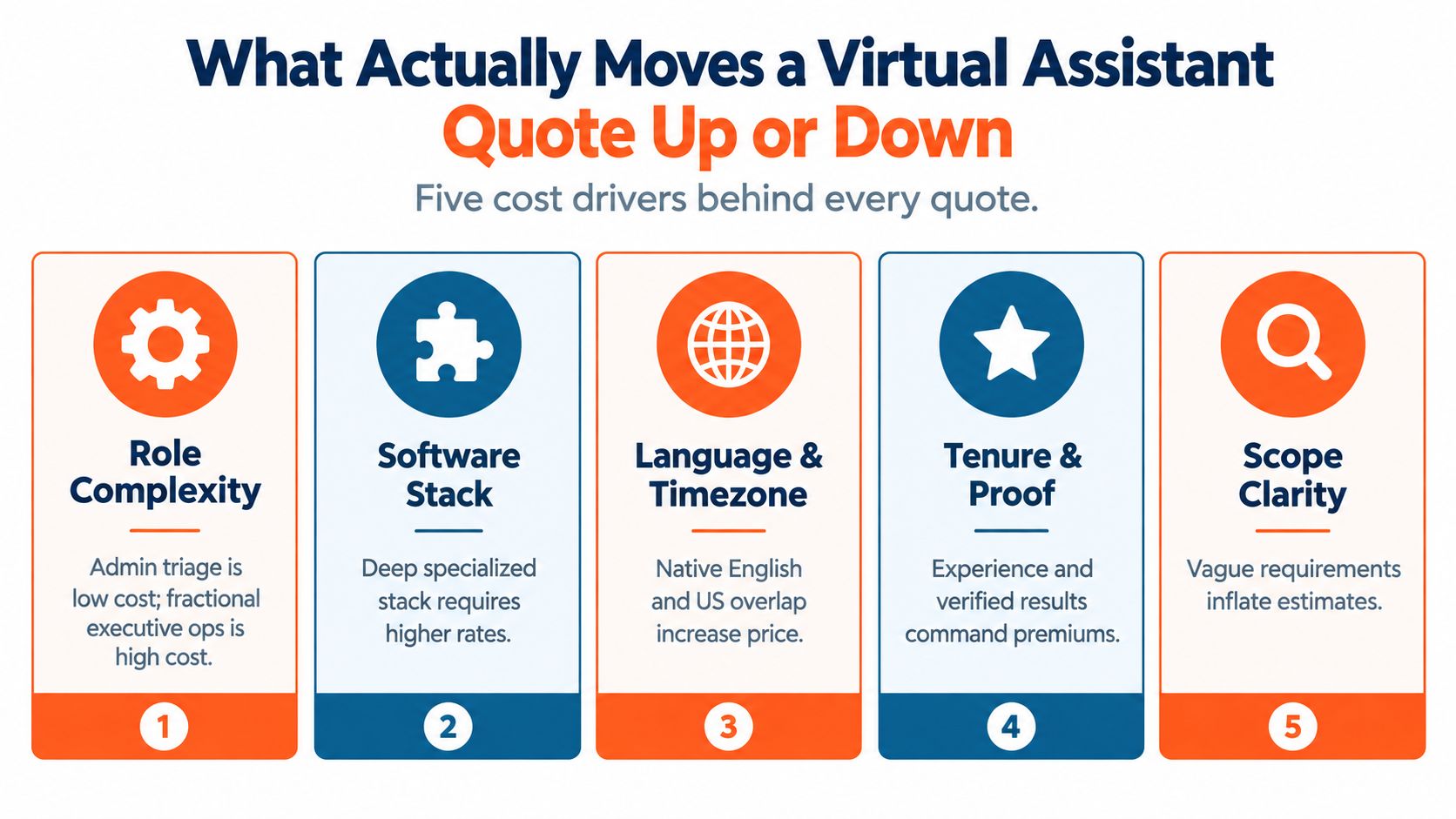
Overlap is also where working with professionals in Latin America earns its keep: the benefits of nearshore staffing for US teams come from sharing the business day, not from the rate alone. For how rates are set on the professional's side, see our fair pay strategies for remote LATAM hires and the published 2026 nearshore rate report.
If your business does not run a monthly operating budget yet, a simple monthly template is the fastest way to get started with budgeting before you add a new recurring line. Then add these lines for the assistant:
Worked example at Virtustant's median: 20 hours a week at $12.75 is $12.75 × 80 = $1,020 a month, with no platform, placement or setup line. At 40 hours it is $2,040. Your rate will depend on the role, which is why the pricing page includes an estimator.
Against a US in-house hire, the published $7.00 starting rate is 69.9% below the $23.23 median administrative wage alone, which is how Virtustant clients save up to 70%.
Everything else, meaning ongoing work at 20 or 40 hours a week during US business hours, is where an all-in rate is easiest to compare and hardest to beat. See how it works on our virtual assistant services page.
Price the hours you will actually buy, usually 20 or 40 a week. At Virtustant the median all-in rate across 462 placements was $12.75 an hour, which is $1,020 a month at 20 hours and $2,040 at 40. On Upwork, 201 VA profiles show a $14.50 median before a 5% to 10% client fee.
It depends on the model. Upwork profiles show a $14.50 median and $20.50 average, with US-based assistants at a $38 median. Published US package plans run $36 to $65 an hour. Virtustant's all-in rates start at $7.00, with a $12.75 median across 462 placements.
Hourly pricing bills tracked or scheduled hours at a set rate. Package pricing sells a prepaid monthly block of hours, such as 10, 20, 40 or 60, and usually charges more per hour on the smaller plans: one published US plan goes from $39 an hour at 10 hours to $36 at 60.
Only if you use the hours. A retainer or unit plan fixes the monthly price, so the effective rate rises for every hour you do not use. Compare the monthly total at your real schedule, 20 or 40 hours a week, rather than the headline rate.
On package plans, often yes, because smaller plans carry a higher hourly price. In Virtustant's last 462 placements, no: 46% were part-time, and the part-time median was $12.41 an hour against $12.93 for full-time.
At 160 hours a month, Virtustant's $12.75 median works out to $2,040. A managed unit provider publishes full-time from $3,600 a month, and a median US in-house administrative assistant costs about $5,751 a month with benefits, based on BLS wage and compensation data.
Check for marketplace client fees (5% to 10% on Upwork, plus $0.99 to $14.99 per new contract on the Basic plan), setup fees ($250 per unit at one managed provider), card processing fees (2.9% at one package service), minimum terms and placement fees. Virtustant charges no placement fee.
With one all-in hourly rate that includes the professional's pay, payroll, compliance and HR support, and no placement fee. Rates start at $7.00 an hour; the median across 462 placements was $12.75. If you pay your agent $10 an hour, we give them $9 and keep the dollar in the middle.
Virtustant sends a shortlist within 48 hours. Across 468 placements in the 12 months to 23 September 2026, the average was 11.2 days from opening a search to the professional's start date.
Tell us the role and the schedule, and we will send a shortlist within 48 hours with one all-in rate and no placement fee. Start on our pricing page or book a call at Virtustant.