How Much Does a Bookkeeper Cost? 2026 Rates and Monthly Fees
August 26, 2026


Outsourced bookkeeping costs $250 to $2,500 per month in 2026, and seven independent published sources converge on that band. A US in-house bookkeeper is a different purchase: the wage is about $20.94 to $24.36 an hour, but the fully loaded cost of the role runs roughly $90,000 to $105,000 a year, or $7,500 to $8,800 a month. Dedicated nearshore capacity starts from $7.00 an hour all-in, which is $1,120 a month at 160 hours; in Virtustant's H1 2026 placement data (441 starts, January to June 2026) the median client-side rate for a bookkeeper was $12.85 an hour (n=7, a small sample), or $2,056 a month at 160 hours.
The reason those numbers look irreconcilable is that the market sells two different things under one name, and almost every pricing guide compares them as if they were the same. Getting that distinction right is what turns a quote into a decision.
Third-party figures are those each source publishes on its own site, checked September 2026. Virtustant figures are first-party placement data.
Pay for the work your books need, not for the title. A small business with clean books and no payroll should expect to pay $250 to $500 a month. Payroll, sales tax, several entities or a hard close date move a package to $1,000 to $2,500 a month. If the work happens every day, you are no longer buying a package: you are buying a person, and the first question is how many hours, not what rate.
| Your books | What you are buying | What to expect to pay |
|---|---|---|
| Under 100 transactions a month, one or two accounts, no payroll | A basic monthly package | $250 to $500 a month; Relay reports the most common fee at $250 to $499 |
| Up to about 200 transactions a month, a few accounts | A standard monthly package | $250 to $700 a month |
| Payroll, sales tax, several entities or a fixed close date | A comprehensive package | $1,000 to $2,500 a month; The Fino Partners publishes $1,000 to $1,500 and up for comprehensive service |
| Daily work: invoicing, payables, receivables and reconciliations every day | A dedicated person, part-time or full-time | Through Virtustant, from $680 a month at 20 hours a week or from $1,360 full-time (from $8.50 an hour all-in); a US in-house hire costs $7,500 to $8,800 a month fully loaded |
What clients actually asked for. Of the 25 bookkeeper positions clients most recently opened with Virtustant, the 22 with a stated schedule split evenly: 11 full-time and 11 part-time, and 6 of the 11 part-time roles asked for exactly 20 hours a week. Across 332 positions in every role, 45.2% were full-time. Bookkeeping splits down the middle: half of the companies that decided they needed a person did not need a full-time one. Scope the hours before you compare rates, because a 20-hour seat and a 40-hour seat are different budgets at the same hourly price.
Prefer to watch? The video below prices the two purchases separately, service against service and person against person, sets what a bookkeeper earns against what one costs, and walks through the hours our clients asked for across our 25 most recent bookkeeper positions.
Video: How Much Does a Bookkeeper Cost in 2026? A Service or a Person, and Why the Wage Is Not the Cost (14:36). Chaptered: a service or a person, the seven published sources, wage versus cost, four ways to get a dedicated bookkeeper, part-time or full-time, the three pricing models, and where retainers creep.
Seven sources published bookkeeping cost figures in 2025 and 2026. Set side by side, they agree far more than the range suggests.
| Source | Published monthly cost | Published hourly | As of |
|---|---|---|---|
| QuickBooks | $300 (software-led) to $4,200 (full-time hire) | — | Jun 2026 |
| Pilot | $250 to $2,500 | — | Apr 2025 |
| FlowFi | $300 to $2,500; starter packages $200 to $300 | — | Jan 2026 |
| NEWITY | $500 to $2,500 | — | Mar 2026 |
| NerdWallet | From about $300 | $23.66 (BLS 2024, as published by NerdWallet) | Mar 2026 |
| The Fino Partners | $300 to $500 basic; $1,000 to $1,500+ comprehensive | — | Aug 2026 |
| Relay | $300 to $2,500, modal fee $250 to $499 | $30 to $90 | Aug 2026 |
Two things are worth pulling out of that table. The first is the convergence: whatever the headline range, the centre of gravity for outsourced bookkeeping is a few hundred dollars a month, and Relay is the only source that publishes a modal figure rather than a range. Its mode of $250 to $499 says most buyers are paying at the bottom of the published band, not the middle.
The second is what the band does not include. A $300-a-month package is not a person; it is a few hours of attention on a defined set of accounts. QuickBooks is the only source in that list that names the full-time comparison at all, and it puts it at $4,200 a month.
The reason bookkeeping quotes appear to span an order of magnitude is that "bookkeeping" is sold in two structurally different shapes, and comparing across them produces nonsense numbers.
| Buying a service | Buying a person | |
|---|---|---|
| What you get | A defined package: named accounts, an assumed transaction volume, a monthly close | Dedicated capacity, usually 20 to 40 hours a week, working inside your systems |
| Typical monthly cost | $250 to $2,500 | $1,120 to $8,800 depending on where the person sits |
| Who owns the process | The provider, on their calendar | You, on yours |
| Scales by | Tier and transaction count | Hours and seniority |
| Fits when | Books are clean and volume is predictable | The work is daily, or it touches AP, AR, payroll and reporting together |
Most pricing pages set a $300 package against a $7,500 in-house hire and call it a 96% saving. It is not a saving; it is a different purchase. The comparison worth running is service against service, and person against person. Below, both are priced on the same basis. On the person side, the like-for-like alternative to a US hire is a dedicated remote bookkeeper in Latin America, priced by the hour rather than by package.
Each structure transfers cost and delivery risk differently. Hourly pricing buys recorded labour. A retainer buys a recurring service boundary. Per-project pricing buys a defined result.
| Pricing model | Typical band | What you pay for | Best fit when |
|---|---|---|---|
| Hourly | $30 to $90 per hour for common freelance and outsourced work, higher for specialised or controller-level tasks | Logged labour time | Scope is variable, exploratory or temporary |
| Monthly retainer | $250 to $2,500 per month, with most published engagements clustering at $250 to $499 | A defined recurring scope | Volume and close requirements are stable |
| Per-project | Fixed fee for a defined deliverable | Completion of a specific outcome | Cleanup, migration, setup or catch-up work has a clear endpoint |
Hourly work fits uncertain books. A cleanup engagement may need an initial review before anyone can estimate the effort. It also suits temporary coverage, occasional support, or transaction volume that changes sharply each month.
The trade-off is clear. The buyer carries the risk of inefficiency, repeated questions and scope expansion, because the invoice follows time rather than outcome. Require a written estimate, a not-to-exceed cap, and a rule for approval before the provider works beyond that cap.
For steady-state bookkeeping, a monthly retainer is usually the right structure. It gives the buyer predictable spending and lets the provider build a repeatable close process instead of restarting the work every month.
A retainer is only as reliable as its scope. "Monthly bookkeeping" does not define delivery. State the number of accounts, transaction assumptions, reconciliation duties, financial reports, close date, support channel, exclusions and overage rules. If those terms are missing, the low quoted fee is a starting point rather than a price.
Per-project pricing works when the result can be inspected and accepted. A system migration, prior-period cleanup or chart-of-accounts redesign has a clearer fixed price than an open-ended monthly service.
Define the covered periods, included accounts, deliverables, client dependencies, acceptance standard and treatment of newly discovered issues. A fixed fee without those terms only hides uncertainty inside the contract.
Here the two purchases are priced separately, so the numbers mean something.
| Provider type | Published monthly cost | What it usually covers | What sits outside |
|---|---|---|---|
| Software-led bookkeeping | From about $300 | Categorisation, reconciliation, standard statements | Payroll, sales tax, cleanup, advisory |
| US bookkeeping firm, standard package | $300 to $500 | Named accounts, monthly close, basic reporting | Setup, catch-up, multi-entity, filings |
| US bookkeeping firm, comprehensive | $1,000 to $1,500+ | Higher volume, payroll support, fuller reporting | Audit support, CFO-level analysis |
| Upper end of the published band | $2,500 | High volume, multiple entities, tighter close | Varies by contract |
| Sourcing model | Rate | Monthly at 160 hours | What the buyer still carries |
|---|---|---|---|
| US in-house hire | $20.94 to $24.36 per hour in wage alone | $7,500 to $8,800 fully loaded | Recruiting, payroll taxes, benefits, software, equipment, supervision, replacement risk |
| US freelancer | $30 to $90 per hour | $4,800 to $14,400 at full time | Coverage, continuity, contracting, classification, no backup |
| Nearshore, all-in | From $7.00 per hour | From $1,120; typical full-time band $1,500 to $5,000 | Managing the work. Payroll, HR and compliance sit with the agency |
| Remote bookkeeper, Latin America (Virtustant placement) | $12.85 per hour all-in at the H1 2026 median (n=7, small sample), with rates from $8.50 | $2,056 at the median (160 hours) | Managing the work. Recruiting, payroll, HR, compliance and replacement sit with the agency |
Two notes on reading that table honestly. Very few businesses buy 160 freelance hours a month, so the freelance row is a full-time equivalent rather than a typical invoice; most freelance bookkeeping engagements are a handful of hours a week and land inside the service band above. And the nearshore figure is a floor: $7.00 is where Virtustant's all-in rate starts, bookkeeping is a specialised role that prices above the entry band (the H1 2026 median client-side rate for a bookkeeper was $12.85 an hour, n=7, so a full-time remote bookkeeper at the median costs about $2,056 a month), and the typical monthly range for a full-time placement across all roles and seniority is $1,500 to $5,000. Against a comparable US hire, a managed nearshore placement can save up to 70% once payroll, benefits and overhead are counted rather than just the hourly rate.
"All-in" is the term to interrogate before signing anything. Confirm in writing that it covers the professional, local payroll administration, benefits coordination, cross-border contracting, equipment expectations, working-hour overlap, replacement coverage and account management. If any of those sit outside the rate, the rate is not the cost. Virtustant charges no placement fee, no setup fee and no recruitment fee, and the engagement runs month to month.
Choose a package when the monthly scope is genuinely limited and the books are clean. Choose dedicated capacity when the work is daily, spans AP, AR, payroll and reporting, or needs someone inside your systems rather than visiting them once a month. For that comparison, see nearshore staffing for U.S. companies, or the remote bookkeeper cost analysis for the wage-versus-bill-rate view. For broader third-party bookkeeping labour-cost benchmarks, separate the quoted hourly rate from the monthly cost of ownership.
Buyers ask the same cost question under four different labels, and the label changes the answer less than the shape of the purchase does. The short answers below use the same sources as the tables above.
A virtual bookkeeper is priced like any outsourced bookkeeper: $250 to $2,500 a month for a package, or $30 to $90 an hour on a freelance basis. If "virtual" means a dedicated remote person rather than a service, a nearshore bookkeeper costs from $8.50 an hour all-in, with a median client-side rate of $12.85 in Virtustant's H1 2026 placement data (n=7), or about $2,056 a month full time.
Hiring adds one-time cost on top of the rate. For a US in-house bookkeeper, recruiting, onboarding and the weeks the seat sits empty come before the $7,500 to $8,800 a month the role then costs. A managed remote placement removes that layer: Virtustant charges no recruitment, placement or setup fee, sends a shortlist within 48 hours, and the all-in rate from $8.50 an hour is the only recurring cost.
The working day. "Offshore" usually describes providers in time zones with little or no overlap with the US working day; "nearshore" means Latin America, working your hours in real time. Virtustant is a remote staffing agency, not an offshore service: its bookkeepers sit in Latin America, work US business hours and are billed at an all-in rate from $8.50 an hour (H1 2026 median $12.85, n=7). Compare any offshore quote on the same three items: hours of overlap, who carries payroll and compliance, and whether replacement is included.
Hourly rates differ because the work differs. Three factors set the quote: capability, engagement complexity and labour market.
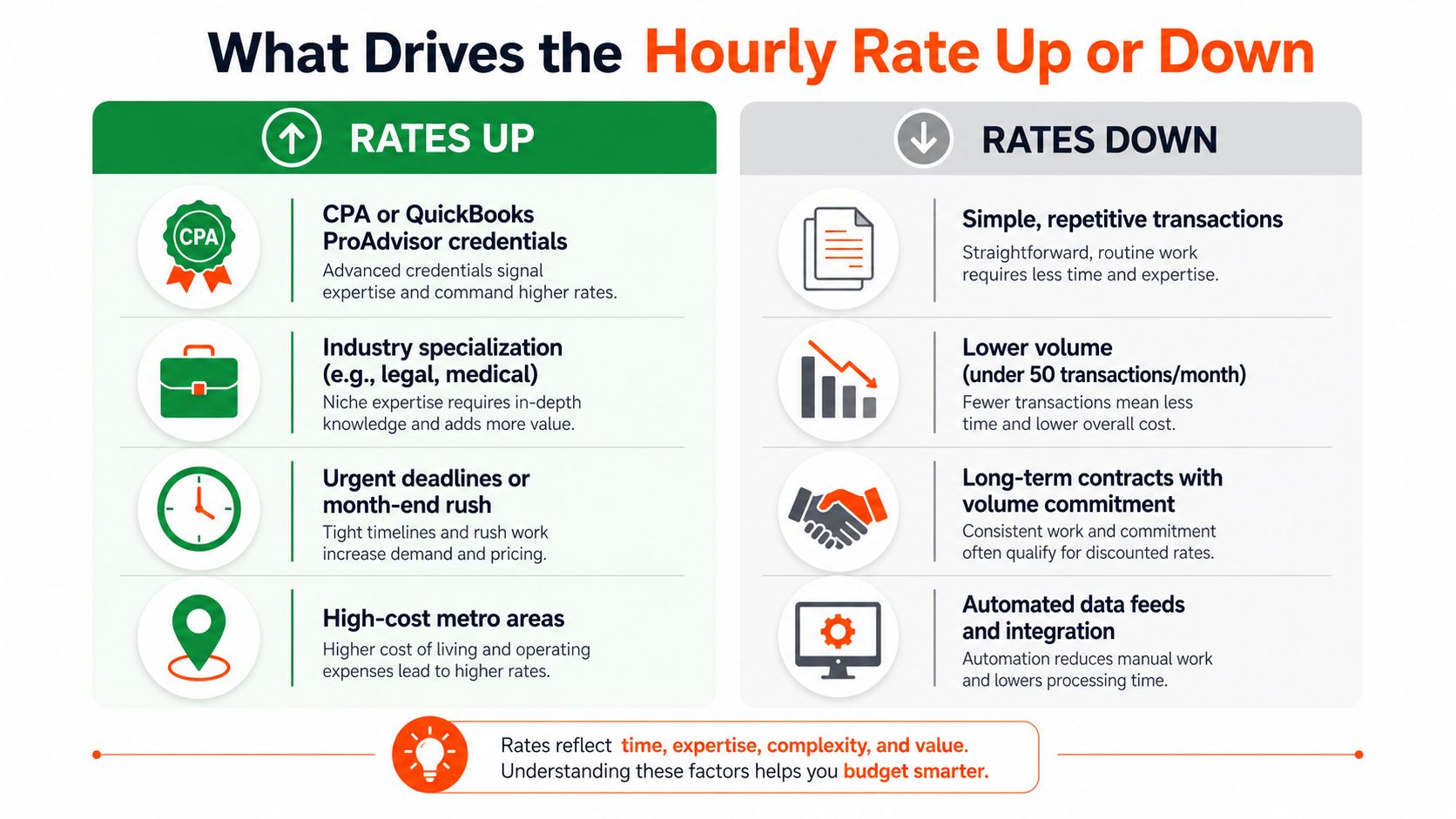
Entry-level transaction support sits near the lower end of the market. Mid-level bookkeeping costs more when the person owns reconciliations, closing tasks or reporting. Certified, specialised, senior and controller-level work commands progressively higher rates because it requires more judgment and review responsibility.
Credentials matter only when they match the assignment. QuickBooks ProAdvisor experience shortens training for a QuickBooks Online client. CPA credentials add little value for routine coding but become useful for advanced reporting, complex reconciliations or controller-level review. Construction, legal, medical and SaaS experience also raise a quote, because the bookkeeper already understands the operating workflow.
US metro markets carry higher labour costs. Nearshore staffing lowers the labour component while preserving US time-zone overlap and English-language communication. Use the 2026 nearshore rate report to test regional assumptions against comparable roles, rather than comparing a local US quote against an unrelated international offer. A dedicated nearshore bookkeeper through Virtustant is the person-shaped version of that: one named professional, US hours, one all-in rate.
Automated feeds and repetitive categorisation support a lower rate. Multiple bank and credit-card accounts, payroll support, month-end journal entries, intercompany activity, audit support and catch-up cleanup require more time and judgment.
Transaction count is only one input. One hundred routine transactions may require less work than a smaller set of entries involving multiple entities, accruals or project accounting. Ask what decisions the bookkeeper must make, which reconciliations they own, and whether they are responsible for closing the books.
Operator rule: compare quotes by decision complexity, reconciliation responsibility and close ownership. Transaction volume alone is a weak scope definition.
Set the rate from the operating burden, not the title. A basic transaction role belongs in a different rate band from an accounting operations role. Accounting firms considering client-facing reporting or practice-growth support can review NewsletterAsAService for accounting firms as a separate add-on, rather than letting communications work hide inside the bookkeeping rate.
A retainer works only when the buyer defines the monthly close as a workflow rather than a label. A standard baseline includes bank and credit-card reconciliation, AP and AR posting, monthly journal entries, financial statement preparation, management report delivery and one close call.
Put the covered accounts, expected transaction volume, reporting package and delivery timing in writing. "Financial statements" can mean a profit and loss statement, a balance sheet, a cash-flow report or a combination, so specify the exact deliverables.
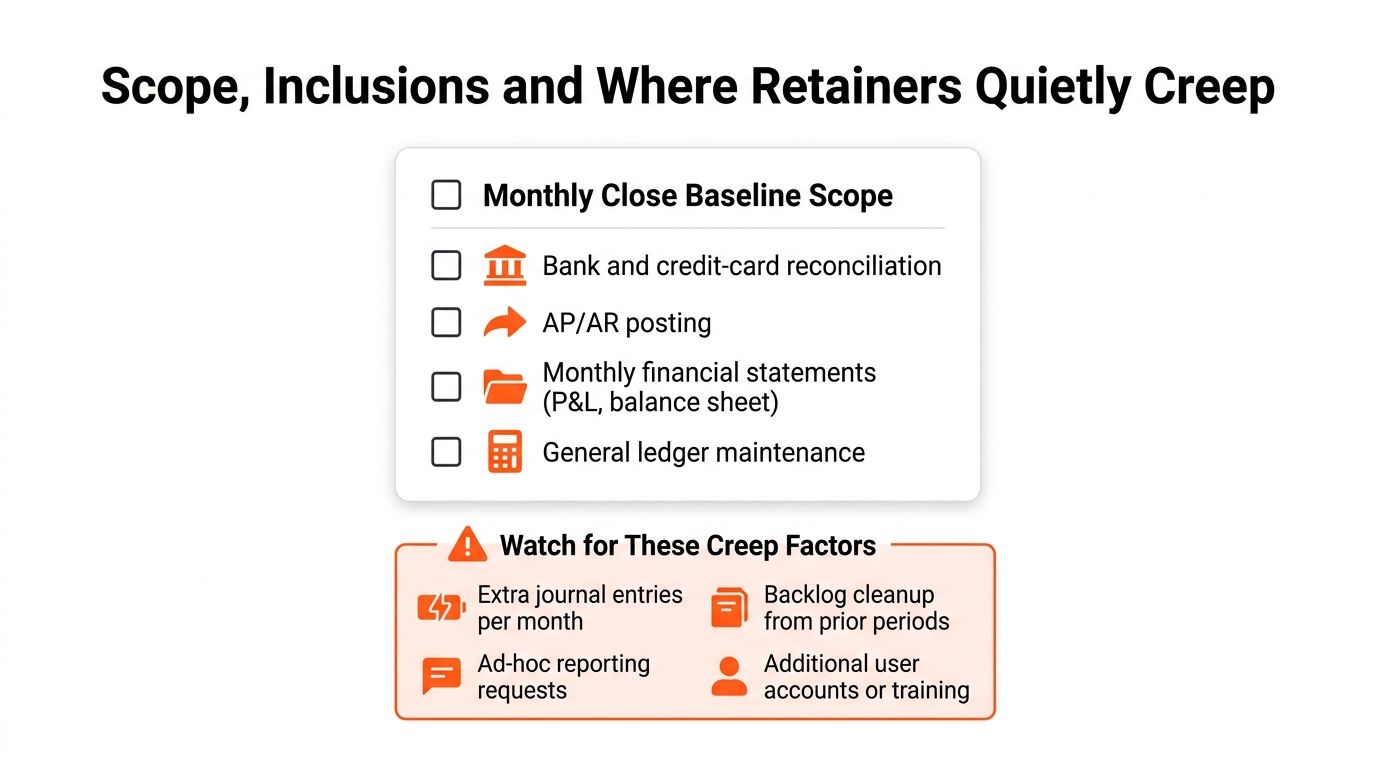
The first invoice usually fits the original assumptions. By the third month, buyers often find several tasks fall outside the package:
Separate recurring bookkeeping from cleanup, tax compliance and advisory work. A low retainer that nominally includes every possible service hides the real cost of each function and makes scope disputes more likely.
A clearly defined remote bookkeeper role helps separate bookkeeping from optional accounting services. Use that distinction to assign responsibilities before the engagement starts.
Three variables decide it: transaction volume, forecastability and tolerance for management overhead. The model should fit the work pattern, not the provider's preferred billing method.
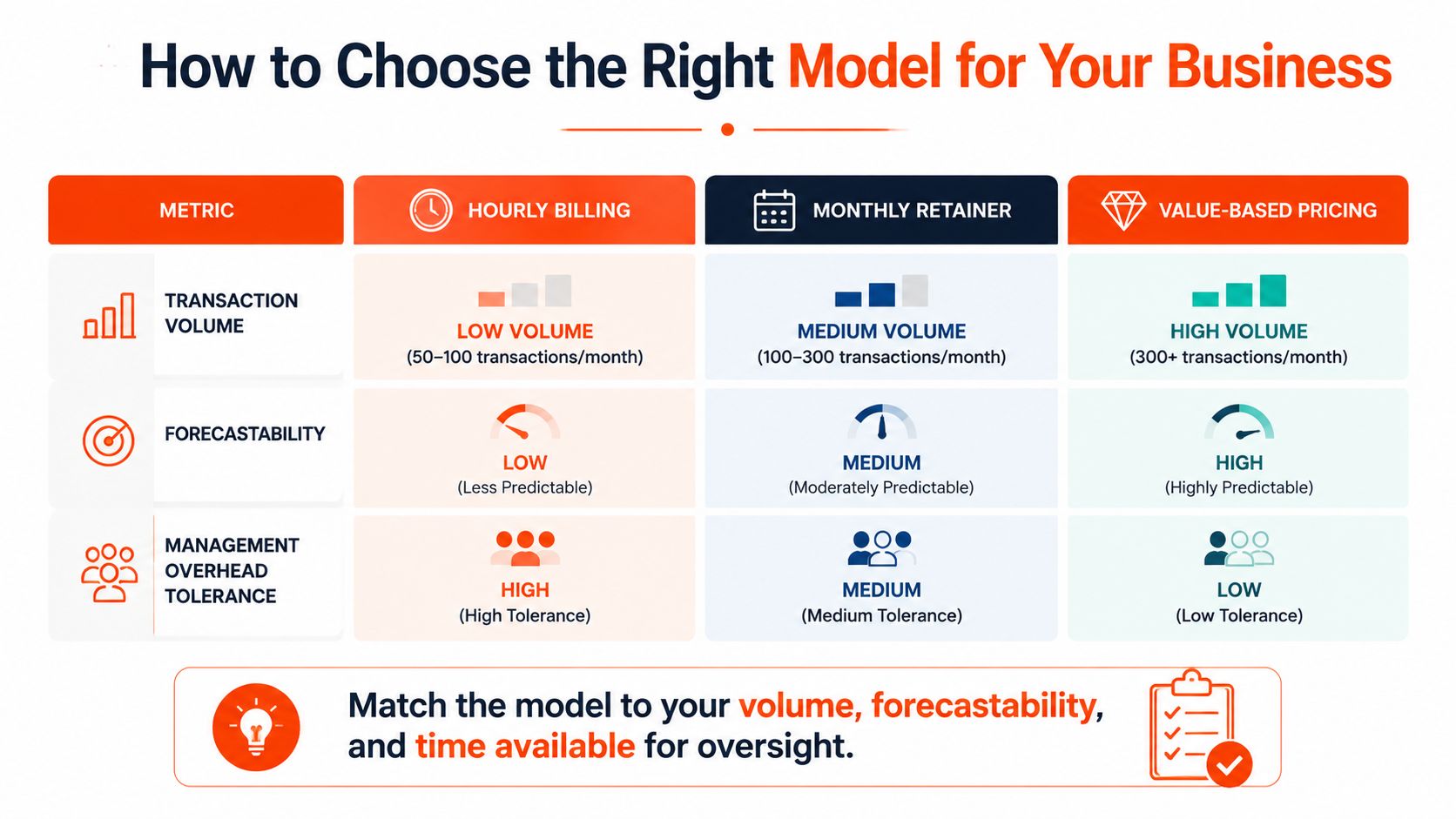
For low volume or uncertain scope, hourly billing is practical. It works especially well below 100 monthly transactions and for one-off cleanup, where a fixed retainer forces the buyer to pay for capacity that will not recur. Require a cap and a defined review point.
A monthly retainer fits steady activity between 100 and 1,000 transactions, provided the books follow a repeatable close calendar. The buyer pays for a defined operating result each month, not an unlimited list of requests. Per-project pricing belongs on top of that arrangement when the company needs a migration, an implementation or a year-end catch-up.
There is a second axis. A US in-house hire maximises direct control, proximity and organisational integration, and carries the highest cost and internal management burden. A US freelancer offers flexibility without a full-time commitment, though continuity and coverage depend heavily on one person.
Nearshore staffing sits in the cost-optimised quadrant when the buyer wants dedicated capacity, English-language collaboration and overlapping working hours without building local employment infrastructure. A US firm sits between those options when the buyer values packaged delivery and does not need a dedicated professional.
Before signing, answer three questions:
If the answers point to stable recurring work with limited internal oversight, choose a defined retainer or dedicated nearshore capacity. If they point to uncertain records and a temporary need, start with a capped project.
These figures are frequently quoted as bookkeeping costs. They are not. They are what the bookkeeper is paid, and the gap between the two is the entire point of this page.
| Source | Published wage | Basis | As of |
|---|---|---|---|
| US Bureau of Labor Statistics | $24.36/hr, about $50,670/yr | Median, bookkeeping, accounting and auditing clerks | May 2025 |
| Indeed | $23.26/hr | 14,500 reported salaries | Oct 2025 |
| ZipRecruiter | $24.31/hr, about $50,573/yr | Average | Aug 2026 |
| Payscale | $20.94/hr | Average | Jul 2026 |
| Salary.com | About $43,830/yr, roughly $21/hr | Estimate | Aug 2026 |
The employer carries a different number. Payroll taxes, benefits, software licences, recruiting, onboarding, management time, equipment and workplace overhead take a $50,670 wage to roughly $90,000 to $105,000 a year, or $7,500 to $8,800 a month. That multiplier of about 1.8 to 2.1 times wage is an estimate built from those components, not a published figure, and it moves with benefits design and how much supervision the role needs.
The employee receives the wage. The company carries the loaded cost. Any comparison that puts a $24.36 wage against a $300 package is comparing an input to a price.
Outsourced bookkeeping runs $250 to $2,500 a month across seven published 2026 sources, and Relay reports the most common fee falling between $250 and $499. A dedicated full-time bookkeeper is a different purchase: about $7,500 to $8,800 a month fully loaded for a US in-house hire, or from $1,120 a month for nearshore capacity at 160 hours, with $1,500 to $5,000 the typical full-time band.
Freelance and outsourced bookkeeping is commonly quoted at $30 to $90 an hour, per Relay's August 2026 figures, with specialised and controller-level work above that. Managed nearshore staffing starts at $7.00 an hour all-in. A US in-house bookkeeper's wage is $20.94 to $24.36 an hour depending on the source, but the wage is not the cost of the role.
Match the price to the work, not the title. Clean books with fewer than 100 monthly transactions and no payroll rarely justify more than a $250 to $500 package. Multiple accounts, payroll, multi-entity activity, or a hard close date move the engagement toward $1,000 to $2,500, or toward dedicated capacity if the work is daily.
Yes, and the gap is about judgment rather than skill. Bookkeeping records and reconciles what happened. Accounting, controller and advisory work interprets it, carries reporting responsibility and supports decisions, which is why it prices higher. Assign each task to the lowest-cost role that can perform it accurately and own the outcome, and do not pay an advisory rate for transaction entry. When the work crosses into month-end close, reporting and advisory, the remote accountant role is the better match.
The test is what the alternative costs you. If a founder is spending six hours a month on categorisation, the question is whether those six hours are worth more than a $300 package. The stronger argument is usually accuracy rather than time: unreconciled accounts and a late close make tax filing more expensive and financing harder, and cleanup is billed at a premium precisely because it is harder than doing it right the first time.
Inside the published band that volume typically lands at $250 to $700 a month, but transaction count alone does not set value. Account count, payroll, reporting depth, cleanup and the required close date change the workload substantially. Ask the provider to state exactly what happens each month, who owns reconciliations, which reports are included and how exceptions are billed, then compare scope and response time at each price rather than just the total.
When the work has a defined endpoint: catch-up bookkeeping, a system migration or a QuickBooks setup. It also gives the buyer a clean way to approve one-time work without committing to a recurring service. Set the periods, accounts, deliverables, client dependencies, error treatment and acceptance conditions before agreeing the fee, and put newly discovered issues through a documented change order rather than an open-ended invoice.
Six places to look: setup or onboarding, historical cleanup, software licences, payroll administration, sales tax and 1099 filings, and overage charges. A package can look inexpensive when these sit outside the recurring scope. Request an itemised fee schedule and a sample invoice for both a normal month and an exception month.
Annual increases are common in service businesses, but the agreement should state the notice period and your options. A rate change may reflect added scope, a different professional assigned to the account, or a repricing of unchanged work, and those three cases deserve different responses. Negotiate notice, renewal timing and the ability to reduce scope before the new rate begins.
Some providers include it; others bill separately for setup, cleanup, software configuration or historical reconciliation. Treat onboarding as a defined project with its own deliverables, timeline and approval point. Confirm how many prior periods are covered and when recurring monthly pricing starts.
If the work is a monthly package, price it against the $250 to $2,500 band above and interrogate the exclusions. If the work is a person, the fastest way to replace a range with a number is a scoping call: you leave with a rate for your specific role, a timeline and example profiles, whether or not you hire. Virtustant sends a first shortlist of 3 to 5 vetted bilingual candidates within 48 hours, can have your hire start in 72 hours, charges zero recruitment fees, and runs month to month with a lifetime replacement guarantee and no time cap. Book a discovery call, or check what your role costs first. External market references used above: QuickBooks bookkeeping cost guidance and outsourced bookkeeping cost benchmarks.