Virtual Assistant Duties: What to Delegate and What to Keep
September 22, 2026


Virtual assistant duties now span inbox triage, calendar orchestration, CRM hygiene, documentation, travel coordination, customer follow-up and light bookkeeping. The mistake most companies make is hiring the title instead of the scope. Start with one or two high-volume, low-complexity workflows, write down who approves what, and expand only after the handoffs stabilize.
The role carries a modern label, but the work sits on a familiar operating pattern: route requests quickly, apply approved templates, update the system of record, escalate anything that needs judgment. For a U.S. founder or operations leader hiring in Latin America, the question is not "What can a VA do?" It is "Which workflow can this person own without creating more coordination work than they remove?"
This guide treats virtual assistant work as an operating system with defined ownership boundaries, service levels, clean records and controlled delegation. It also opens our own hiring data: what 79 U.S. companies actually wrote down when they came to us to fill an assistant role. Use the duty categories to identify the work, the role matrix to pick the right level of autonomy, and the templates and onboarding sequence to turn a vague request into a hire-ready scope. If you are evaluating a provider rather than a process, compare the virtual assistant services on offer against the workflows you actually need covered.
A virtual assistant should be assigned a workflow, not a loose list of chores. The workflow begins when information arrives, continues through prioritization and execution, and ends when the right system is updated and the next owner knows what happens next. That model holds whether the assistant is running a founder's inbox, maintaining a sales pipeline, or coordinating customer follow-up.
The practical framework is four steps:
An assistant who completes the task but leaves the CRM stale has not completed the workflow. One who schedules a meeting without protecting a focus block has created a downstream problem. The standard is not visible busyness. It is predictable throughput with accurate handoffs.
The underlying occupation is large and stable enough to hire against. The U.S. Bureau of Labor Statistics counts 3,515,600 secretaries and administrative assistants in the United States, with median pay of $48,310 a year or $23.23 an hour as of May 2025. BLS projects a 2% decline through 2035 alongside roughly 314,400 openings a year, which is the signature of a role that is being redesigned rather than eliminated.
Scan by the business problem first. If the founder is losing control of the calendar, start with calendar orchestration. If salespeople distrust pipeline reports, start with CRM hygiene. If customer inquiries sit across three channels, start with customer follow-up and escalation rules.
Then define the first assignment narrowly. Convert each duty into four lines: input, action, output and SLA. "Manage my inbox" becomes "Review new messages during agreed working windows, apply the routing taxonomy, draft replies from the approved library, flag decisions, and update the task tracker." That version is specific enough to screen for and to inspect after placement.
Operator rule: if you cannot state the trigger, the required action, the system update and the escalation path, you have not defined a duty yet. You have described a hope.
Published duty lists tell you what is possible. Below is what buyers actually wrote down. This is our own intake data, not a survey and not an estimate, and it contradicts the standard advice in three specific ways.
| Measure | Value |
|---|---|
| Assistant searches reviewed | 79 |
| Titles naming a second function | 11 of 79 (14%) |
| Searches with a stated schedule | 75 |
| Naming a specific U.S. time zone | 68 of 75 (91%) |
| Searches stating weekly hours | 26 |
| Part-time (under 40 h/week) | 15 of 26 (58%), range 10 to 30 h |
| Median stated schedule | 26.25 hours per week |
| Titles requiring bilingual English and Spanish | 4 of 79 (5%) |
| Median full-time monthly budget | $1,818 |
| Median part-time rate | $11.50 per hour |
Method: all virtual assistant, executive assistant and administrative assistant searches in Virtustant's recruitment system as of 22 September 2026, including open, hired, declined, ghosted and on-hold roles. Deduplicated by company; our own internal roles and roles without a stated budget are excluded. Where a schedule gave a range ("5 to 10 hours per week"), the upper bound is used. Part-time rates are computed per role from its own stated weekly hours. Small sample, reported in full rather than extrapolated.
We also put the cost side of this on video:
1. Nobody hires "a virtual assistant." They hire a VA plus something. One in seven searches names the second function in the title itself: Virtual Assistant / Receptionist, Virtual Assistant / Channel Manager, Executive Assistant / HR Administrative Support, Administrative Assistant / Social Media Manager, Medical Interpreter / Admin Assistant. And that only counts the ones honest enough to put it in the title. If your job post says "virtual assistant" but the work is 60% front-desk phone coverage, you will screen for the wrong person and then wonder why the hire underperformed at a job you never described.
2. Part-time is the majority case, not the exception. Of the searches that stated weekly hours, 58% were under 40, running from 10 to 30 hours. Every duty list written for a 40-hour seat quietly misleads the majority of buyers. A 10-hour-a-week assistant cannot own a workflow end to end; they can own a defined slice of it with an unambiguous handoff. Scope to the hours you are actually buying.
3. Overlap is not a preference. It is in 91% of the briefs. Sixty-eight of the 75 searches with a stated schedule named a specific U.S. time zone: Eastern, Central, Mountain or Pacific, usually with exact hours. Buyers are not asking for coverage in the abstract. They are asking someone to be reachable between 9 and 5 in a named zone, because that is when approvals happen. Any duty that depends on a same-day answer inherits that constraint.
The test: read your draft job post and circle every duty that requires a decision from someone else within the hour. Those duties, and only those, set your overlap requirement. Everything else can run asynchronously and should.
The most common scoping mistake is treating all virtual assistant duties as equivalent. They are not. Admin support executes a defined process. Operations ownership maintains the process, improves its reliability, and coordinates the people and systems around it.
An assistant can triage an inbox by labels and response templates without owning the company's communication policy. A more senior operations-oriented professional can maintain the label taxonomy, spot recurring misroutes, update the SOP and report where requests are getting stuck. The difference is not the software. It is the level of judgment and accountability.
This matters more each year because 2026 role guidance increasingly folds CRM updates, SOP creation and maintenance, and light project coordination into the VA role rather than capping it at inbox and calendar. One 2026 role guide lists data entry and CRM updates alongside SOP creation and maintenance, and notes that senior assistants also run SOPs and manage vendors. That expansion is real, and it is exactly why the boundary has to be written down.
| Duty cluster | Admin support scope | Operations ownership scope | Handoff standard |
|---|---|---|---|
| Inbox management | Apply labels, draft approved replies, forward messages | Maintain routing rules, review misroutes, redesign escalation paths | Priority, owner, due date and status recorded |
| Calendar management | Book meetings, send confirmations, resolve routine conflicts | Protect focus blocks, manage recurring meeting logic, coordinate stakeholders | Calendar reflects decision, attendees, location and follow-up |
| CRM updates | Enter contact details and activity notes | Define required fields, audit records, maintain pipeline rules | Record is complete, timestamped and assigned |
| Documentation | Format documents and follow an existing checklist | Create or revise SOPs, templates and knowledge-base structure | Version, owner, approval status and next review identified |
| Project coordination | Update task status and send reminders | Track dependencies, surface blockers, coordinate handoffs | Blocker has an owner, an action and an escalation deadline |
Run a three-way test before assigning any new duty:
Then make the boundary enforceable with service levels. Start with response time, scheduling error rate, CRM update completeness and escalation compliance. Do not measure activity for its own sake. Measure whether the workflow reached the correct owner with the correct information.
Practical boundary: an assistant owns execution until an exception appears. An operations owner owns the rule that decides what counts as an exception.
A reliable scope usually draws from seven clusters. Each has a different risk profile, output format and review method. Assign the cluster first, then define the exact systems and approval limits.
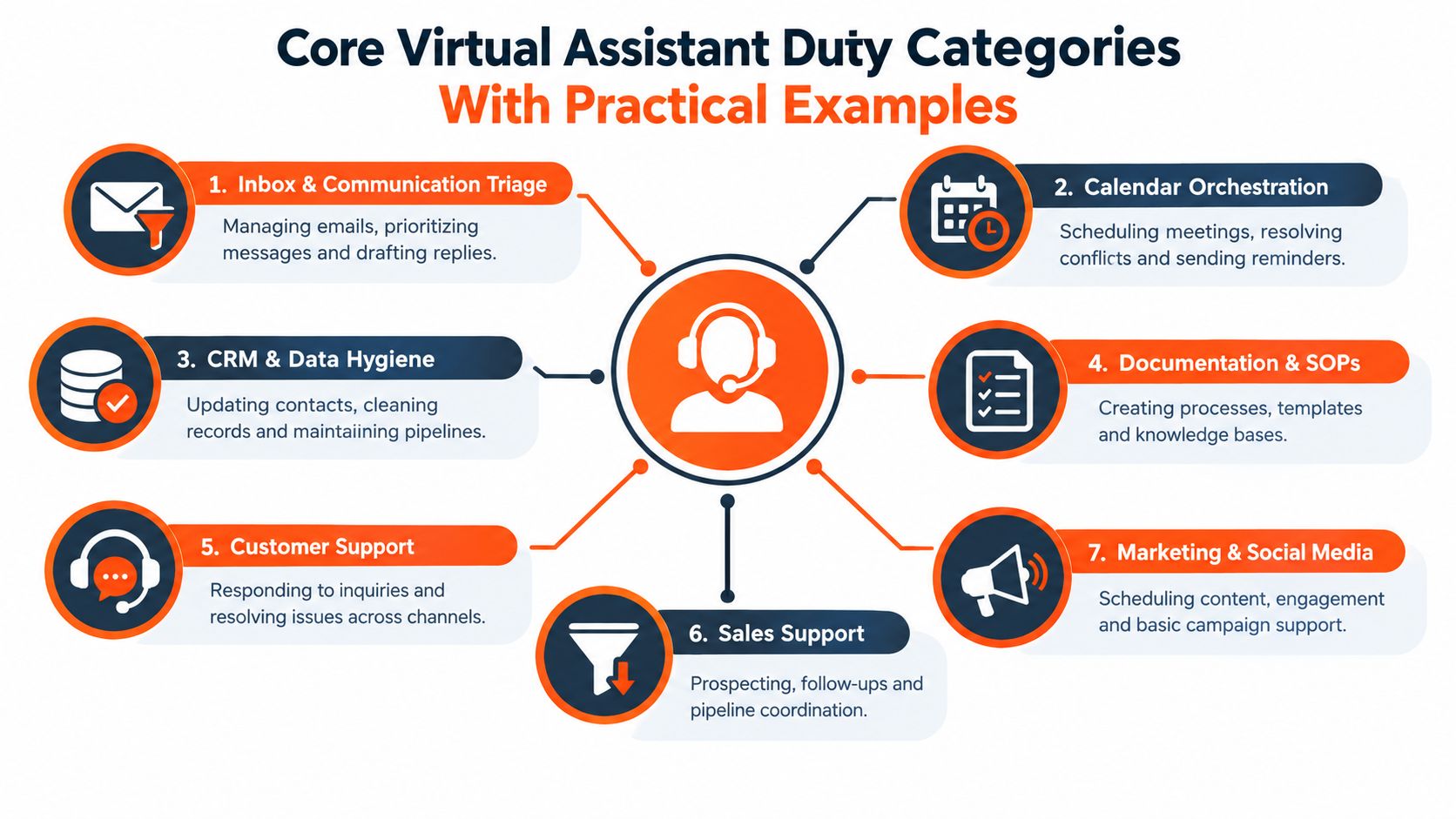
The assistant reviews incoming messages, applies labels, identifies urgent requests, drafts responses and routes work to the correct owner. In Gmail the operating asset is not a clean inbox. It is a routing taxonomy: urgent decision, customer issue, sales follow-up, internal task, reference.
A useful output is a daily exception list with sender, issue, recommended action, owner and due date. The assistant should not make commercial commitments unless the approval rule explicitly says so.
Scheduling, rescheduling, confirmations, recurring meetings, agenda distribution and conflict resolution. A competent assistant checks time zones, meeting duration, travel buffers and protected focus blocks before offering a slot.
If a recurring meeting collides with a protected work window, the assistant applies the documented priority rule, proposes alternatives and records the final decision. Booking the first available opening is not calendar management. It is calendar damage.
Creating contacts, updating lifecycle stages, logging activity, assigning owners, removing duplicates and completing required fields. In HubSpot or Salesforce the assistant should work from a field dictionary and a written definition of each pipeline status.
The output is a trustworthy record, not a completed form. Require a review queue for ambiguous company matches, missing contact data and opportunities that need sales judgment.
Preparing presentations, maintaining folders, formatting proposals, updating knowledge bases and running structured online research. Research requests should specify the question, acceptable sources, fields to capture and the format of the synthesis.
Research becomes valuable when the assistant separates facts, interpretation and unresolved questions. That format lets a founder review quickly without mistaking data gathering for strategic analysis.
Itinerary research, booking requests, confirmations, vendor communication and disruption follow-up. Vendor work can include requesting quotes, collecting documents, scheduling service and maintaining a comparison sheet.
Set approval thresholds and preference rules before granting access. The assistant coordinates the process; unusual purchases, contract changes and nonstandard commitments escalate.
Ticket triage, appointment reminders, FAQ responses, status updates and post-service follow-up, typically in Zendesk, Intercom, Gmail or a shared help desk.
Build a response library with explicit escalation triggers. Billing disputes, threats to cancel, security concerns and product defects need a clear handoff to a manager or specialist.
Receipt collection, invoice preparation, payment-status follow-up, spreadsheet updates and entry of approved information into a bookkeeping platform. It does not automatically include accounting judgment, tax work or financial sign-off.
The safest design separates preparation from approval. The assistant gathers and organizes; an authorized owner reviews exceptions and approves transactions. If the finance workload is the actual bottleneck, scope a virtual accounting assistant instead of stretching a generalist.
A controlled workflow connects all seven. Indeed's current virtual assistant job description reflects that breadth, listing answering emails and phone calls, making travel arrangements, scheduling appointments, cold calls from a provided spreadsheet, creating social media content, online research and preparing presentations, and it benchmarks average U.S. virtual assistant pay at $15.84 an hour against a $7.25 to $49.45 range. Treat that list as a menu you choose from, never as a single job description.
Titles are only useful when they communicate decision rights. A general VA absorbs repeatable administrative volume. An executive assistant protects an executive's time and communication channels. A customer support VA owns queue discipline. A sales development VA maintains prospecting workflows. A marketing VA runs content operations inside approved brand rules.
Seniority determines how much ambiguity the professional can absorb before escalating. Junior follows a documented process. Mid-level handles exceptions inside a defined boundary. Senior improves the process, coordinates stakeholders and protects business priorities.
| Role | Junior scope | Mid-level scope | Senior scope |
|---|---|---|---|
| General VA | Inbox labels, data entry, routine scheduling | Calendar coordination, research, task tracking | Cross-functional workflow ownership and SOP improvement |
| Executive Assistant | Meeting booking and confirmations | Complex calendar, travel, stakeholder communication | Gatekeeping, priorities, executive operating cadence |
| Customer Support VA | FAQ replies and ticket tagging | Multi-channel triage and escalation | Queue standards, knowledge base, quality reviews |
| Sales Development VA | Lead research and list preparation | Outreach support, follow-up, appointment setting | Qualification rules, pipeline hygiene, reporting |
| Marketing and Social Media VA | Content scheduling and asset organization | Community responses and campaign support | Content operations, calendar governance, analytics coordination |
| Bookkeeping VA | Receipt and invoice organization | Routine entries and reconciliation support | Close preparation, exception tracking, process controls |
Fit follows the bottleneck. Hire a general VA when administrative work is scattered. Hire an EA when the founder's calendar, stakeholder access and priorities are the constraint. Choose customer support when queues are growing, sales development when prospect research is eating selling time.
Senior professionals should not process more tickets. They should make better decisions inside the approved boundary. Role-specific operating guidance points at calendar conflicts, recurring meetings, agenda distribution, follow-up task lists, cross-time-zone coordination and protected focus blocks as the mid-level competencies, and at research synthesis, lead qualification, content operations and CRM hygiene as the higher-value ones.
Hiring test: ask candidates how they would handle a calendar conflict, a missing CRM field and a customer escalation. Their answer reveals judgment faster than any software checklist.
Choose from the remote roles we staff based on the autonomy the workflow requires, not the title that sounds most impressive.
A job description should tell a candidate what enters the workflow, what they must produce, which tools they will use, and how the manager will inspect quality. Avoid "help with administrative tasks." That phrase creates unlimited scope and gives nobody a fair performance standard.
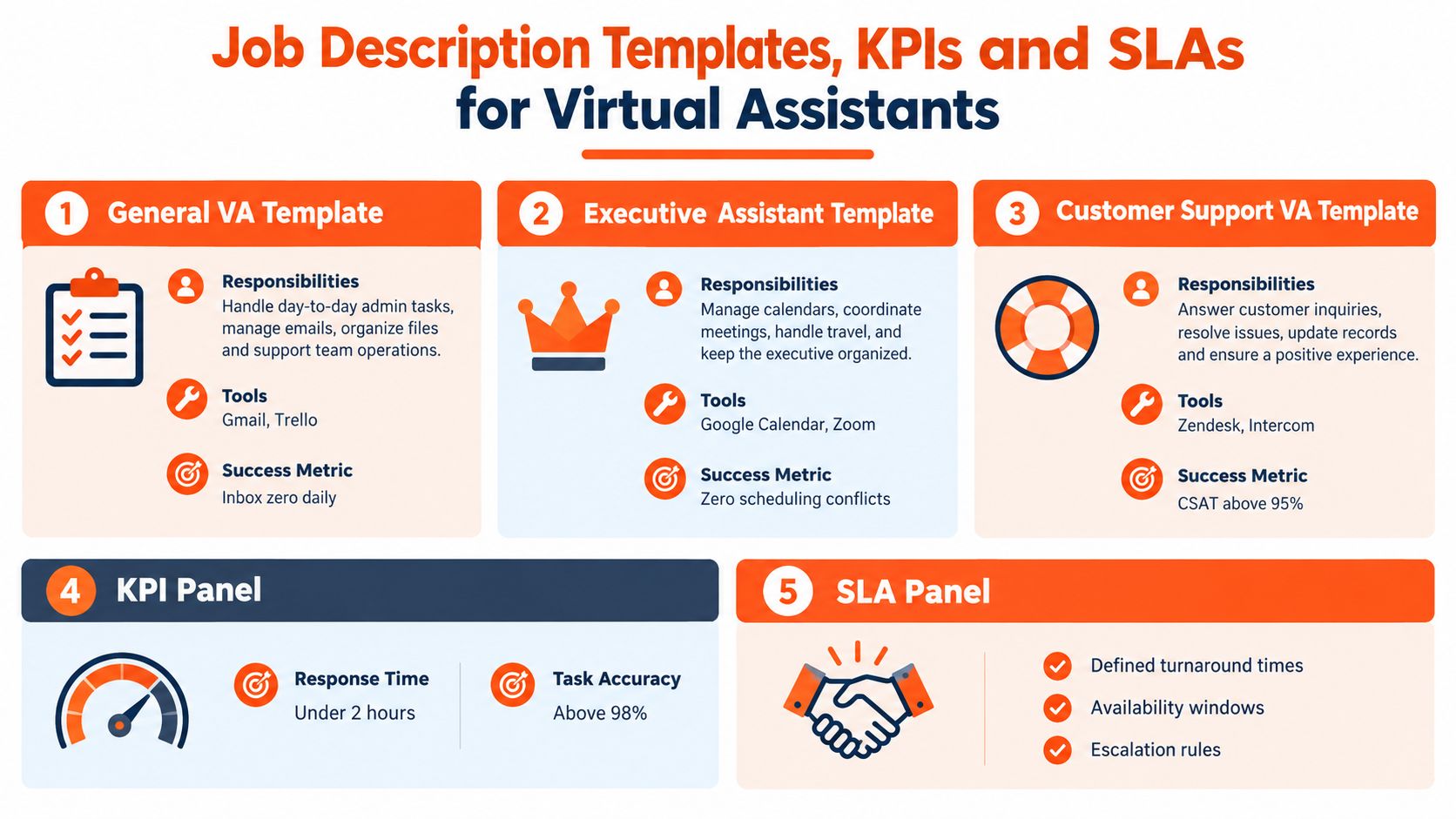
General VA
Responsibilities: triage inbox messages, maintain calendar records, update spreadsheets, organize documents, prepare a daily exception list.
Tools: Gmail, Google Calendar, Google Drive, Trello and the company CRM.
Success standard: every assigned request has an owner, a status, a due date and a documented handoff inside the agreed service window.
Executive Assistant
Responsibilities: manage complex calendars, coordinate travel, distribute agendas, track follow-up tasks, protect focus blocks, draft stakeholder communication.
Tools: Google Calendar, Zoom, Gmail, Slack, travel platforms and a task-management system.
Success standard: conflicts are resolved before they reach attendees, recurring meetings stay current, and executive decisions arrive with the right context.
Customer Support VA
Responsibilities: tag and route tickets, answer approved FAQ questions, send status updates, maintain macros, escalate sensitive or unresolved issues.
Tools: Zendesk or Intercom, Gmail, Slack and the knowledge base.
Success standard: tickets move through the correct status, responses follow approved guidance, and escalations carry the full customer history.
Add one line the templates above deliberately leave blank: the second function. Given that 14% of real searches name one in the title, write yours in explicitly or accept that you are screening for a job you have not described.
Keep the measurement set small. Response time shows whether the queue is moving. Scheduling error rate shows calendar reliability. CRM update completeness shows whether reports can be trusted. Task accuracy shows whether outputs meet the SOP. Escalation compliance shows whether the assistant recognizes boundaries.
Write every SLA with four components:
Do not promise a metric you will not review. A dashboard without a weekly operating conversation becomes decoration. Use performance tracking for nearshore teams to structure that review around outcomes, exceptions and process improvements.
The first month should build controlled access and repeatable judgment, not test how much work you can push onto a new remote professional. Give a narrow queue, a clear owner and examples of acceptable output. Review the process before increasing complexity.
Start with calendar, inbox and travel coordination. Provide approved inbox labels with escalation examples; calendar priorities, durations, buffers and protected focus blocks; travel preferences, approval rules and disruption procedures; a daily checklist and an exception log; and read-only access first, followed by task-specific permissions.
The assistant shadows the process, executes routine items and submits uncertain cases for review. Do not ask for brand-voice drafting or sensitive personal work before the communication rules are documented.
Add CRM hygiene and structured data entry. Supply a field dictionary, a duplicate-handling rule, lifecycle definitions and examples of complete records. Review a sample of updates at the end of each working day, then reduce review intensity only once the pattern is stable.
Keep blockers in a shared channel but keep final status in the tracker or CRM, not buried in chat.
Introduce research, invoicing preparation and vendor coordination in week three. Add brand-voice drafting, personal calendar work and other sensitive tasks only once the assistant reliably distinguishes routine execution from escalation.
By the end of the sequence the assistant should hold a current SOP library, a template folder, an access map, an escalation matrix and a recurring review schedule. A human-first remote onboarding playbook is useful for pairing that documentation with the relationship-building that distributed teams otherwise skip, and the staffing agency onboarding checklist lets you audit whether the practical setup matches the role you scoped.
Handoff standard: every delegated task needs an example, a system of record, an escalation trigger and a definition of done.
Hiring in Latin America changes the operating calendar, not the ownership rules. Most LATAM countries overlap 6 to 8 hours with the standard U.S. business day; Colombia, Peru and Ecuador sit at UTC-5 and match U.S. Eastern exactly, while Mexico and the Central American countries align with U.S. Central at UTC-6, according to this LATAM to U.S. time-zone guide. Colombia and Peru also hold UTC-5 year-round with no daylight-saving shift, which removes two schedule renegotiations a year from a role that runs on same-day approvals.
Our own intake data says buyers already know this: 91% of the briefs with a stated schedule named a specific U.S. time zone rather than asking for generic coverage.
| Pairing | Overlap | Use for | Compliance check |
|---|---|---|---|
| Colombia, Peru or Ecuador with U.S. Eastern | Full alignment, no DST shift | Daily collaboration, customer follow-up, executive support | Contractor agreement, invoice, tax ID and payment proof on file |
| Mexico or Central America with U.S. Central | Full alignment | Central-time coverage, support queues, sales coordination | Country documentation and currency rule confirmed before payout |
| Broader LATAM with the U.S. workday | Roughly 6 to 8 hours | Standups, reviews, handoffs, same-day issue resolution | Working window, payment records and local requirements confirmed |
| Any pairing, async-first scope | Whatever the approval chain needs | Research, documentation, data entry, reporting | Availability, escalation owner and payment controls documented |
On language, we screen client-facing assistants for written clarity, live comprehension and judgment in context rather than for a certificate. A test score tells you someone can pass a test. It does not tell you whether they will handle an irritated customer or a half-explained instruction well. Candidates move through a four-stage vetting funnel, and the top 1% figure we publish refers to the share of applicants who clear that funnel, not to a market estimate.
On AI: automation should redesign the scope, not erase the operator. Calendar management, inbox filtering, meeting transcription, document generation and data entry are all partially automatable today. Prioritization, customer tone, exception handling, qualification and cross-system accountability are not. Automate the deterministic sorting. Keep human ownership of everything that requires deciding what matters.
On payment: contractor-style engagements commonly require an invoice, a written agreement, a tax ID and proof of payment, with the currency rule confirmed before approval, as set out in this LATAM payroll and cross-border payments guide. Have qualified legal and finance professionals validate the arrangement for each country and engagement. We are not lawyers, and neither is a blog post.
If your workflow needs same-day collaboration and structured support, compare how providers source, assess, place and administer candidates before you hire nearshore professionals.
Seven clusters cover most scopes: inbox and communication triage, calendar orchestration, CRM and data hygiene, documentation and research, travel and vendor coordination, customer follow-up, and light bookkeeping. Each duty should be written as four lines — input, action, output and service level — rather than as a title. An assistant owns execution until an exception appears; the exception rule stays with an internal owner.
Usually two, and most companies already know it. In Virtustant's intake data, 11 of 79 assistant searches (14%) named a second function in the job title itself, such as Virtual Assistant / Receptionist or Executive Assistant / HR Administrative Support. If the work is half front-desk phone coverage or half social media, write that into the post. Screening for a job you did not describe is the most common reason an assistant hire underperforms.
Part-time is the majority case. Of the searches in our system that stated weekly hours, 58% were under 40 hours, ranging from 10 to 30 hours a week, with a median stated schedule of 26.25 hours. Duty lists written for a 40-hour seat therefore mislead most buyers. Scope the workflow to the hours you are actually buying, and give a part-time assistant a defined slice with an unambiguous handoff rather than end-to-end ownership.
A general virtual assistant absorbs repeatable administrative volume across the business. An executive assistant protects one executive's time, communication channels and priorities, which means gatekeeping, complex calendar logic, travel and stakeholder communication. The practical difference is decision rights, not software. Ask which bottleneck you are solving: scattered admin work points to a VA, a founder's calendar points to an EA.
Anything that sets a rule rather than follows one. Pricing decisions, hiring decisions, legal interpretation, tax positions, financial sign-off, sensitive customer recovery and nonstandard exceptions stay internal. An assistant can prepare, organize and route all of those; approval authority does not move. The safest design separates preparation from approval in every cluster, especially bookkeeping.
It depends on how many duties need a same-day answer, not on a general preference. Read the job post and circle every duty requiring a decision from someone else within the hour — those set the overlap requirement, and everything else can run asynchronously. In practice 91% of the briefs we receive with a stated schedule name a specific U.S. time zone. Most LATAM countries overlap 6 to 8 hours with the U.S. workday, and Colombia, Peru and Ecuador match U.S. Eastern exactly at UTC-5.
In Virtustant's intake data as of September 2026, the median full-time monthly budget across assistant searches was $1,818 and the median part-time rate was $11.50 an hour, computed per role from its own stated weekly hours. For comparison, Indeed benchmarks average U.S. virtual assistant pay at $15.84 an hour against a $7.25 to $49.45 range, and BLS puts median pay for secretaries and administrative assistants at $23.23 an hour as of May 2025.
Five are enough: response time, scheduling error rate, CRM update completeness, task accuracy against the SOP, and escalation compliance. Write each service level with a turnaround, an availability window in a named time zone, a quality rule and an escalation rule. Do not promise a metric you will not review weekly — a dashboard without an operating conversation is decoration.
Plan four weeks. Week one covers calendar, inbox and travel with read-only access first. Week two adds CRM hygiene and structured data entry with daily sampled review. Weeks three and four add research, invoicing preparation and vendor coordination, and only then brand-voice or sensitive work. By the end the assistant should hold an SOP library, a template folder, an access map, an escalation matrix and a recurring review schedule.
It redesigns the scope rather than removing the operator. Calendar management, inbox filtering, meeting transcription, document generation and data entry are partially automatable now. Prioritization, customer tone, exception handling, qualification and cross-system accountability are not, because each requires deciding what matters in a specific business context. Automate the deterministic sorting; keep human ownership of judgment.
If you can name the first one or two workflows you want to hand over, we can turn them into a scoped role with a written service level, an overlap window and an approval matrix, and source vetted remote professionals from Latin America against it. Review transparent pricing, browse everything we staff, or start from the virtual assistant services page.
Virtustant is a remote staffing agency placing vetted, bilingual remote professionals from Latin America with U.S. companies, from $7 an hour all-in, with zero placement fees and a lifetime replacement guarantee. Companies typically save up to 70% against a comparable U.S. seat.