Freelance vs Agency vs Managed VA: How to Choose in 2026
August 20, 2026


There are four ways to buy remote assistant support, and they are not variations of the same thing: freelance platform, staffing agency, fully managed provider, or direct hire. Market rates across those models run roughly $7 to $50 per hour, but the rate is the least interesting number. What separates the models is who owns vetting, payroll, compliance, and replacement when a placement fails.
Most founders get this decision wrong because they shop for tasks and compare hourly rates, then discover the cheapest invoice carried the most management overhead. This guide compares the four models on total cost of ownership, speed, and replacement risk, so you pick the operating model before you shortlist anyone.
If you already know you want a managed nearshore engagement and just need scope and rates, that lives on the virtual assistant services page. Virtustant's all-in pricing starts at $7 per hour with zero recruitment, setup, or placement fees.
Remote assistant support is administrative, operational, and specialized work delivered remotely and sold on a per-hour, retainer, or managed basis. This category is no longer experimental. Market research firm Fact.MR sizes the virtual assistant services market at USD 5.3 billion in 2025, projected to reach USD 43.4 billion by 2035 — a 23.4% CAGR (Fact.MR, Virtual Assistant Services Market, 2025 to 2035). The same Fact.MR figures are summarized for a general audience in a Wishup industry report if you want the roundup view.
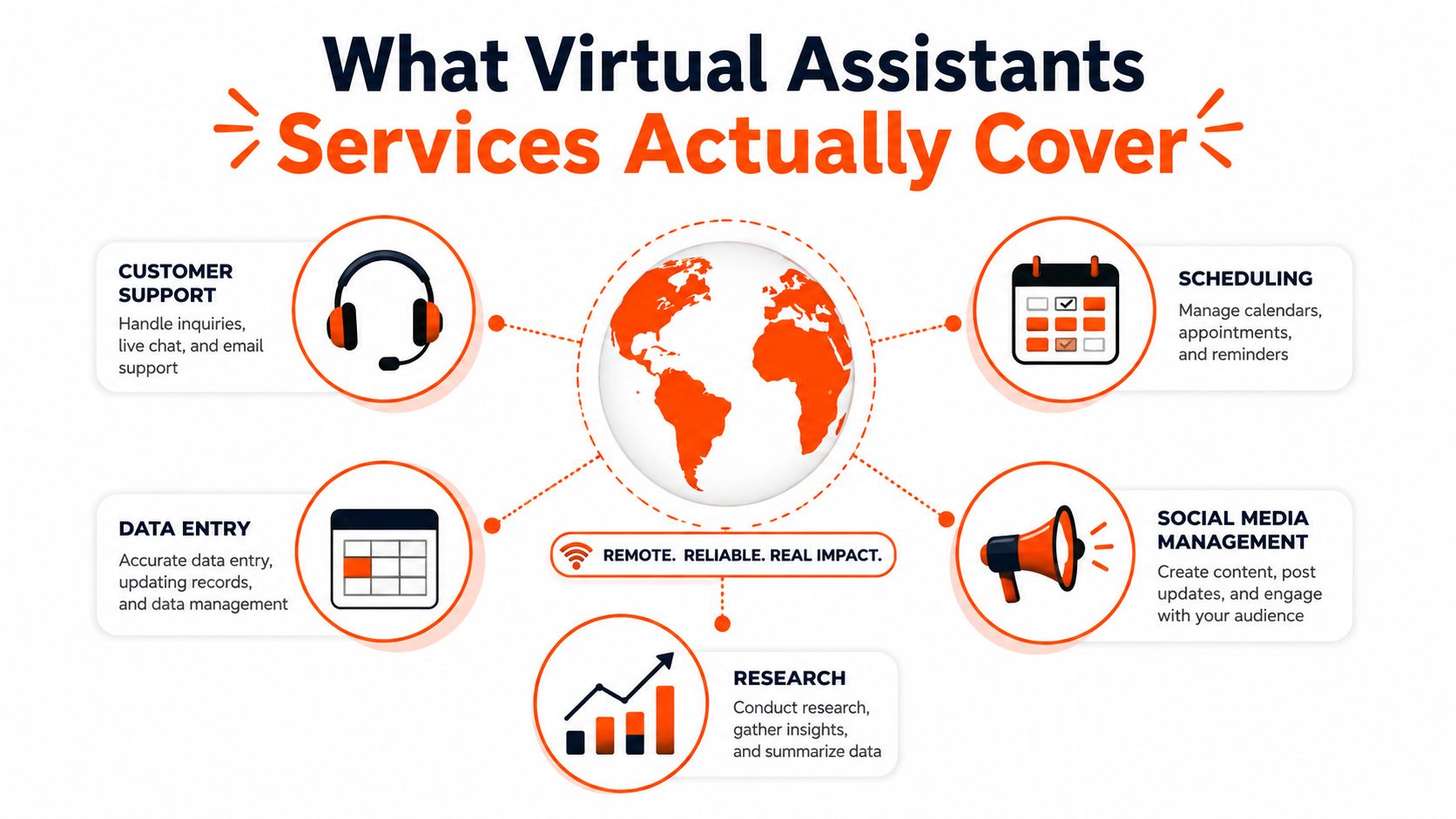
Buyers still reduce the category to “someone who answers email.” That misses the point. The market now includes administrative support, executive assistance, customer support, sales development, bookkeeping, marketing, design, development, and other remote roles. The growth profile shows virtual assistance has become an operating layer, not a side task.
Practical rule: buy a VA service for repeatable work, not for vague “help.” If you cannot define the workflow, the service will drift into low-value busywork.
The difference between bare freelance labor and a true service is the wrapper around the labor. A real VA service usually includes talent sourcing, vetting, payroll, time-zone coverage, compliance, and replacement handling. A bare-bones freelancer sells hours and whatever discipline they bring to the job. That trade-off matters because outcome-based and project-based pricing is spreading — you can see it in the retainer row of the rate table further down — which makes hourly-only comparisons less useful. For a roundup of where the category is heading, see this Wishup trends view.
For U.S. founders, the decision should center on speed-to-hire, cost of ownership, and replacement risk. Compare those three, and the answer gets clear fast. Cheap labor looks good on paper, but it usually hides management time and churn. A managed engagement costs more up front, but it reduces oversight burden and keeps the work moving.
The category only makes sense when you separate general admin from higher-trust support. Administrative help can keep routine coordination moving. Executive-level support sits closer to founder judgment, confidential scheduling, and cross-team follow-up. Specialists, technical VAs, and revenue-focused VAs are better choices when the work depends on process discipline, tool fluency, or sales cadence. For a clean breakdown of skill expectations, see Virtustant on hiring VAs.
The broader market also reflects that shift. Analysts at Grand View Research estimated the wider market at USD 2.48 billion in 2022 and projected it to reach USD 14.10 billion by 2030, a 24.3% CAGR. That points to virtual assistance moving into mainstream operations across devices and business systems, not just basic admin work.
The practical takeaway is simple. If your business runs on recurring coordination, you do not need “help.” You need a defined support layer with clear handoffs, measurable output, and a replacement plan.
The cleanest way to sort remote assistant roles is by role depth, not by buzzwords. Administrative VAs keep the calendar, inbox, and files moving. Executive VAs sit closer to founder judgment and confidential coordination. Specialists, technical VAs, and revenue VAs handle narrower work that demands stronger process discipline or tool fluency.
Administrative VAs usually own email triage, calendar management, travel booking, and data entry. A solid one also handles reminders, document cleanup, and basic follow-up, so the founder stops acting like a human router. Executive VAs go further. They can manage board prep, investor communications, and sensitive operational work where discretion matters more than speed.
Specialized VAs are where the category starts to beat generic help. Bookkeeping support in QuickBooks, CRM hygiene in HubSpot, social scheduling, and content moderation all require tighter process discipline than a broad admin role. Technical VAs often work on Shopify uploads, Zapier or Make automations, light QA, and spreadsheet modeling. Revenue VAs work like light SDRs, handling outbound, lead research, and pipeline updates in Salesforce.
A VA becomes valuable when the task is repetitive, documented, and exception-light. Once the work depends on judgment across too many edge cases, you're buying confusion instead of control.
| Role Type | Example Daily Tasks | Typical Experience | Share of Market |
|---|---|---|---|
| Administrative VA | Inbox triage, calendar scheduling, travel arrangements | Junior to mid-level | Mid-level generalists dominate |
| Executive VA | Board prep, investor follow-up, confidential coordination | Mid-level to senior | Senior and executive-tier roles are a smaller slice |
| Specialized VA | Bookkeeping, CRM cleanup, social scheduling | Mid-level with tool depth | Strong specialist segment |
| Technical VA | Shopify uploads, no-code automation, QA, spreadsheet models | Mid-level to senior | Smaller but growing slice |
| Revenue VA | Lead research, outbound support, pipeline updates | Mid-level with sales systems fluency | Smaller but high-impact slice |
The broad seniority mix still tilts toward mid-level generalists, with a smaller specialist tier and an even smaller executive tier. That matters because the buyer usually does not need a fancy title. They need the right role shape for the amount of ambiguity in the work.
If you want a role inventory built for actual hiring, see the remote roles we staff.
Pricing across the four models looks simple until you compare what is included. A headline hourly rate only matters if you know whether you are paying for labor, management, compliance, or replacement coverage. Skip that check and you will repeat the same mistake, treating the lowest rate as the lowest cost.
Hourly freelance on platforms like Upwork often starts around $7 to $25 per hour for generalists from the Philippines, Latin America, and South Asia. Agency pricing usually lands around $18 to $40 per hour, because sourcing, vetting, and a backup layer are bundled into the rate. Fully managed providers in the U.S. and Asia-Pacific market commonly sit around $25 to $50 per hour, with payroll, taxes, local compliance, equipment, and replacement handling included. Managed nearshore pricing sits well below that band: Virtustant's all-in rate starts at $7 per hour with the same wrapper, payroll in the professional's country, compliance, one consolidated USD invoice, and replacement, and with zero recruitment, setup, or placement fees. Outcome-based retainers can run $3,000 to $12,000 monthly when the provider owns the result, such as booked meetings or closed tickets.
A lower hourly rate can still be the wrong choice. A $15 freelance hour often ends up costing $22 to $25 once you add management time, churn, and tool overhead. The cheapest invoice is often not the cheapest labor.
| Pricing Model | U.S. Rate | Philippines Rate | Latin America Rate | What's Included |
|---|---|---|---|---|
| Hourly freelance | Higher than nearshore rates | $7 to $25 per hour | $7 to $25 per hour | Labor only, buyer manages everything |
| Agency-billed rate | $18 to $40 per hour | $18 to $40 per hour | $18 to $40 per hour | Sourcing, vetting, backup layer |
| Fully managed VA | $25 to $50 per hour | $25 to $50 per hour | From $7 per hour all-in (Virtustant) | Payroll, taxes, compliance, equipment, replacement |
| Outcome-based retainer | $3,000 to $12,000 monthly | Usually not used for simple freelancing | Usually not used for simple freelancing | Provider owns output, not just hours |
The decision is about total cost of ownership. A freelancer may be fine for a narrow, well-documented task list. An agency makes sense if you want sourcing and backup without building an internal recruiting function. A managed provider is the cleanest choice if you want one owner for hiring, payroll, replacement, and day-to-day support.
For a founder, the question is not “What's the hourly rate?” It is “What am I buying with that rate?” The nearshore row is the one most buyers price wrong: a managed LATAM engagement can carry the full wrapper and still land far under a U.S. managed provider, which is how a save up to 70% comparison against a comparable U.S. hire actually works. Check it against the published virtual assistant cost before you lock into a model that looks cheap only on paper.
The right engagement model depends on the burden you are prepared to own. Some founders want direct control and will carry recruiting, payroll, compliance, and replacement themselves. Others want speed and are willing to pay more for a provider that absorbs the messy parts. If you are still deciding, our virtual staffing solutions comparison sets five models side by side on cost and on who carries each job.
Direct hire through W-2 or local contractor onboarding is the most operationally demanding path. It can run $4,000 to $8,000 in recruiting costs and take 30 to 60 days to productivity, while leaving full employer liability on your team. Freelance platforms move faster, often within 48 hours, and can run $8 to $25 per hour, but you inherit vetting, contracts, IP, and tax compliance.
Agency models sit in the middle, and the difference that matters is structural rather than a percentage. An agency bills one rate that already covers sourcing, vetting and a backup layer on top of the work itself, instead of passing through a labor cost you then administer yourself, and it typically carries a 30 to 90 day replacement guarantee. We do not publish mark-up ranges, ours or the category's; at the decision point what matters is what the rate covers, not how any provider splits it internally. Fully managed providers charge $1,800 to $4,500 per full-time VA per month all-in, absorb payroll across 50 states or nearshore jurisdictions, and bundle replacement, HR, and security. That is the cleanest model if you want one point of accountability.
Choose the model based on the risk you are comfortable owning. If you do not want to manage HR, compliance, and replacement, do not pretend a freelancer is simple.
| Model | Cost Range | Time to Start | Compliance Burden | Replacement Risk |
|---|---|---|---|---|
| Direct hire | Recruiting costs of $4,000 to $8,000 | 30 to 60 days to productivity | Full employer liability | Highest if hire fails |
| Freelance platform | $8 to $25 per hour | Often 48 hours | Buyer owns most of it | High, buyer manages backup |
| Staffing agency | One billed rate covering sourcing, vetting and backup | Moderate | Shared, but still real | Lower, with 30 to 90 day replacement terms |
| Fully managed provider | $1,800 to $4,500 per full-time VA per month | Fast once scoping is done | Lowest for buyer | Lowest, because replacement is bundled |
For founders comparing operating models, the question is total cost of ownership. A low hourly rate can still become expensive once you add management time, churn, missed work, and tool overhead. Human VAs beat AI automation when the work needs judgment, context, or back-and-forth with customers and internal teams. That is where managed remote staffing gives you a cleaner setup than piecing together hiring, payroll, and backup on your own.
A real top 1% shortlist doesn't happen because someone claims to “pre-vet talent.” It happens because a provider keeps removing weak candidates at each stage for a different reason. The funnel matters more than the marketing.
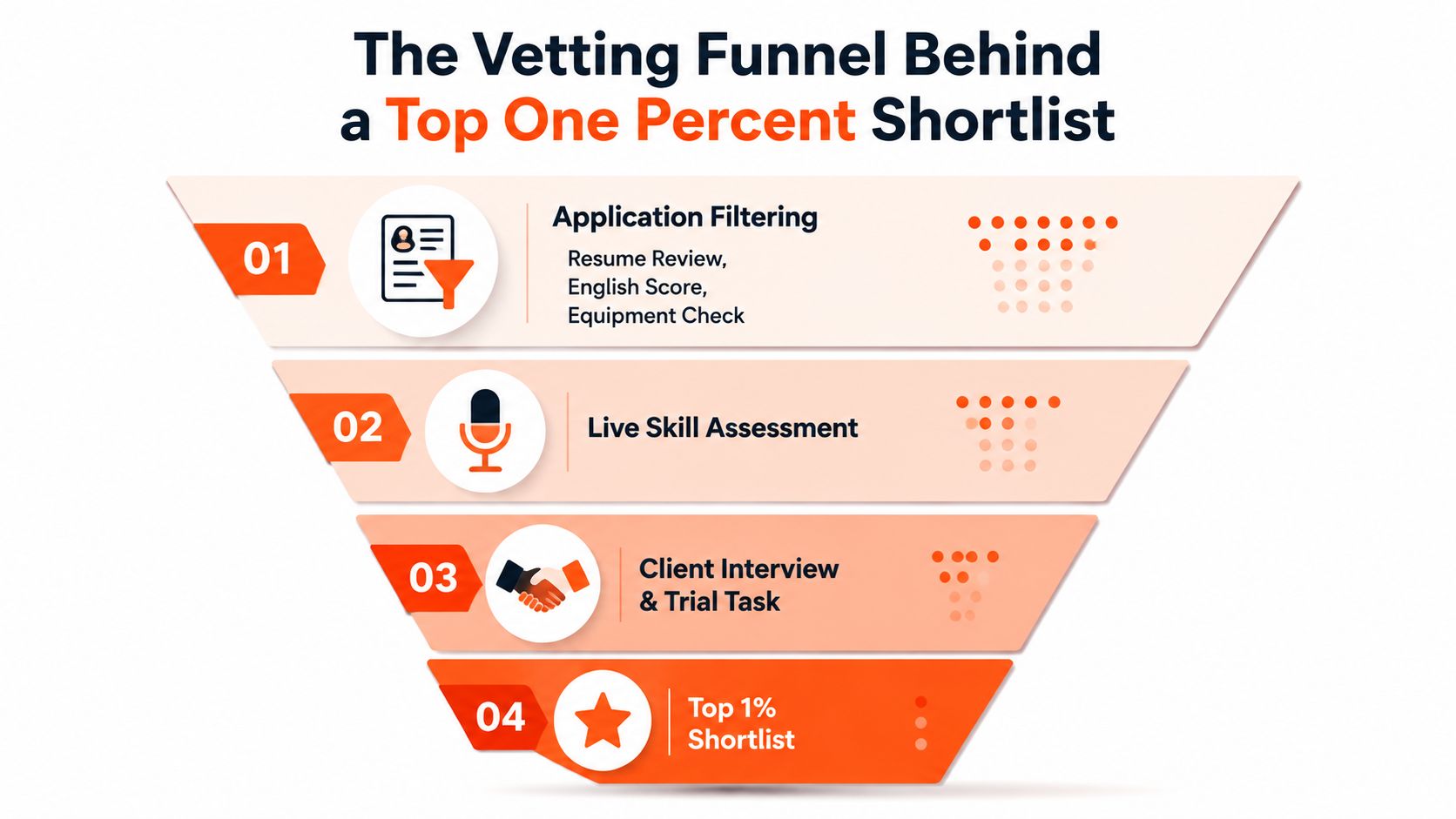
Virtustant runs four stages, and each one removes a different kind of risk:
The top 1% figure is what survives that funnel. It is an acceptance rate produced by a process, not a description of a talent pool, and any provider quoting a similar number should be able to tell you what each stage removes.
What comes out of it: a shortlist of 3 to 5 pre-vetted bilingual candidates within 48 hours, with CVs, skills results, and video introductions. Your hire can start in 72 hours.
Rule of thumb: if the provider shows you everyone and calls it transparency, they're probably skipping the hard filters.
The biggest mistake buyers make is treating a shortlist like a resume stack. A good shortlist is the output of a controlled process, not a pile of names. If you're comparing providers, ask what gets removed at each step, and who carries the cost when a placement fails.
Delegate the work that is repeatable, visible, and easy to verify. That protects your time and keeps a new VA from getting buried in tasks that depend on founder judgment.
Begin with email triage, calendar management, follow-up, file organization, and one revenue-adjacent task. Those jobs show whether the VA can follow SOPs, keep pace, and handle handoffs without constant rescue. Hold back strategic decisions, customer escalations, and confidential calls that need owner-level context.
A clean handoff starts with a checklist for onboarding remote staff. It gives the founder a fixed process instead of improvising each transfer, and it gives the VA the operating context needed to work well.
Week one is documentation. Record 3 to 5 Loom walkthroughs of recurring workflows, share logins through a password manager, and confirm at least three hours of time-zone overlap. Week two is supervised execution, where the VA shadows you on email triage, calendar work, and one revenue-adjacent task while writing an SOP after each session.
Week three is supervised independence. The VA runs the same tasks with a daily fifteen-minute check-in and flags judgment calls in writing. Week four is autonomous execution, with weekly reviews, a defined escalation path, and a scorecard covering accuracy, turnaround, and proactivity. At that point, you are managing outcomes instead of babysitting activity.
The trade-off is simple. A human VA should own tasks with context, exceptions, or coordination across people. AI works for structured, low-variation work. Use both, but do not put the wrong work on either one.
Firing a VA in week one is cheap. Firing one in month six is expensive, because by then you have already built habits around a bad operating model.
Buyers usually ask these four questions right before they sign. The answers are less about theory and more about what kind of operating risk you're willing to tolerate.
The market range is $7 to $50 per hour, but the number only matters if you know what sits behind it. A low hourly freelancer can be fine for narrow, low-risk work, while a managed engagement makes sense when the task set includes payroll, compliance, HR, or replacement handling. The two are not always far apart on price: a managed nearshore engagement starts at $7 per hour all-in with zero placement fees, which is why total cost of ownership beats comparing sticker prices.
For collaborative roles, a defined overlap window is more useful than all-day concurrency. In our own onboardings we ask clients to plan for at least three hours of daily overlap, and LATAM makes that easy rather than hard: the region runs from UTC−3 (Argentina, Brazil, Uruguay, Chile) to UTC−6 (Mexico City, Costa Rica, Guatemala), so a standard local workday already sits inside U.S. business hours — most of the continental U.S. spread is 0 to 3 hours. In Virtustant's own candidate base, 42,716 candidates have confirmed they can work U.S. business hours. If you want a wider view of remote hiring benchmarks, this remote team benchmark is worth a read.
Use AI for predictable, structured, low-exception work. Use a human VA when the task depends on context, judgment, or exception handling. The dividing line is variability. If the work changes every day, AI helps but won't own it. If the work is repetitive and rules-based, a human VA can still be the better control layer, especially when someone has to notice what the automation missed.
Freelance arrangements can leave replacement entirely on you. Agencies usually offer a defined replacement window, often 30 to 90 days. Fully managed models can absorb replacement as part of the service. Read the window carefully, because that is where the models really differ: Virtustant's replacement guarantee has no time cap, so a placement that fails in month nine is still ours to fix rather than yours to re-hire. The more the provider owns onboarding, compliance, and continuity, the less time you spend restarting the search.
| Engagement Model | Cost Range per Hour | Typical Time-Zone Overlap with U.S. Business Hours | AI vs Human Fit | Replacement Guarantee |
|---|---|---|---|---|
| Freelance platform | $7 to $25 | Depends on individual availability | Best for narrow, repeatable tasks | Usually none or buyer-managed |
| Agency-supported VA | $18 to $40 | Often workable, especially in LATAM | Good for human-led operations | Often 30 to 90 days |
| Fully managed VA | $25 to $50, or from $7 nearshore | Strong for nearshore coordination | Best when quality control matters | Bundled continuity support |
If your answer is the managed model, that is what Virtustant does: vetted remote professionals across LATAM, with contracts, payroll, HR, and compliance handled, built for U.S. time-zone overlap, from $7 per hour all-in with zero placement fees and a lifetime replacement guarantee. See scope and rates on the virtual assistant services page, or book a discovery call from Virtustant and get a shortlist inside 48 hours.