Virtual Assistant Latin America: How to Hire One in 2026
October 2, 2026


A Latin American virtual assistant is a remote professional based in Latin America who handles admin, inbox, CRM and customer work during your U.S. business hours. Virtustant virtual assistant rates start at $7/hr all-in, and in Virtustant's H1 2026 placement data (441 starts, January to June 2026) the median client-side rate for a virtual assistant was $10.10/hr (n=24), or $1,616 a month at 160 hours. Which country fits depends on two things: your live hours and your languages.
You're probably not looking for “a cheap assistant.” You're looking for someone who can manage an inbox, update a CRM, join a client call, and keep moving during your U.S. workday without creating another management problem. A virtual assistant in Latin America can deliver that combination, but the result depends less on geography than on role scoping, communication testing, time-zone fit, and who handles the cross-border paperwork.
Before picking a country, look at what buyers specify. We pulled the most recent virtual assistant searches from Virtustant's recruiting system and read each job posting for time zone, English level, Spanish and hours.
Virtustant first-party data: the 25 most recent virtual assistant searches opened between September 9 and September 30, 2026 (n=25, records read October 2, 2026; job title contains “virtual assistant”; no client names).
| What the search specified | Searches | Detail |
|---|---|---|
| Working hours stated in a U.S. time zone | 23 of 25 | 16 Eastern, 4 Pacific, 3 Central; the other 2 gave flexible or day-of-week schedules only |
| C1 or C2 English required | 23 of 25 | 7 accepted only C2; the remaining 2 also accepted B2 |
| Spanish requested | 6 of 25 | 5 as a requirement, 1 as a preference; 3 of the 5 requirements came with a Pacific Time schedule |
| Posted as part-time | 12 of 25 | 13 were posted as full-time |
| Named a specific Latin American country | 1 of 25 | It named Mexico as an example of a nearby time zone, not as a requirement |
The pattern is clear. Buyers describe hours and languages, almost never countries. Nearly every search pinned the work to a U.S. clock, most demanded advanced English, and roughly one in four wanted Spanish too, often for customer calls or field crews. That is why the country decision should start from the schedule and the language mix, not from a ranking of “best countries.”
The major hubs sit between UTC-6 and UTC-3, and none of the seven in the table below changes clocks. U.S. Eastern Time is UTC-5 in standard time and UTC-4 in daylight time; Central is UTC-6 and UTC-5; Pacific is UTC-8 and UTC-7, according to timeanddate's U.S. time zone reference. Because the U.S. shifts and most Latin American countries don't, the gap between you and your assistant moves by one hour twice a year.
| Country (city) | UTC offset | Daylight saving time? | Source |
|---|---|---|---|
| Mexico (Mexico City) | UTC-6 | No; abolished in most of the country on October 30, 2022 (northern border municipalities still follow the U.S. schedule) | timeanddate |
| Honduras (Tegucigalpa) | UTC-6 | No | timeanddate |
| Colombia (Bogotá) | UTC-5 | No | timeanddate |
| Peru (Lima) | UTC-5 | No | timeanddate |
| Argentina (Buenos Aires) | UTC-3 | No | timeanddate |
| Uruguay (Montevideo) | UTC-3 | No | timeanddate |
| Brazil (São Paulo) | UTC-3 | No | timeanddate |
Colombia and Peru are the cleanest match for Eastern Time teams. Both stay on UTC-5 all year, which this guide to remote-work time zones also notes, so a Bogotá or Lima assistant works exactly your hours in the winter and starts one hour earlier on their clock in the summer. Mexico's change matters too: Mexico abolished daylight saving time in most of the country in 2022, so Mexico City is now one hour behind Eastern Time in the winter and two hours behind in the summer. Some older guides still describe Mexico as changing clocks, so check the current rule before you build a schedule.
Here is what a standard 9:00 to 17:00 workday looks like on your assistant's clock. The arithmetic is simple: local start = your start + (their UTC offset − your UTC offset).
| Your 9:00–17:00 window | Mexico City / Tegucigalpa (UTC-6) | Bogotá / Lima (UTC-5) | Buenos Aires / Montevideo / São Paulo (UTC-3) |
|---|---|---|---|
| Eastern, standard time (UTC-5) | 8:00–16:00 | 9:00–17:00 | 11:00–19:00 |
| Eastern, daylight time (UTC-4) | 7:00–15:00 | 8:00–16:00 | 10:00–18:00 |
| Central, standard time (UTC-6) | 9:00–17:00 | 10:00–18:00 | 12:00–20:00 |
| Central, daylight time (UTC-5) | 8:00–16:00 | 9:00–17:00 | 11:00–19:00 |
| Pacific, standard time (UTC-8) | 11:00–19:00 | 12:00–20:00 | 14:00–22:00 |
| Pacific, daylight time (UTC-7) | 10:00–18:00 | 11:00–19:00 | 13:00–21:00 |
Two things stand out. For Eastern and Central teams, every major hub keeps a full workday inside normal local hours, so language and skills should decide. For Pacific teams, the Southern Cone pushes the shift into the evening, and Mexico and Honduras, both on UTC-6, become the natural first look. Use nearshore talent with U.S. time-zone overlap when the work is live; async work like research, documentation and data cleanup can run on a wider window.
Overlap still needs structure: decide which tasks need live coverage (approvals, escalations, customer calls) and write it into the role before hiring.
The EF English Proficiency Index 2025 is built from the test results of 2.2 million adults in 123 countries and regions. Argentina ranks 26th globally with a score of 575, against a global average of 488, and EF places it first of 20 Latin American countries and in its “High proficiency” band. Here is how the countries most often considered for U.S. support roles compare on EF's Latin America country profiles, read October 2, 2026:
| Country | EF EPI 2025 global rank (of 123) | Score | EF band | Rank in Latin America (of 20) |
|---|---|---|---|---|
| Argentina | 26 | 575 | High | 1 |
| Honduras | 32 | 553 | High | 2 |
| Uruguay | 34 | 542 | Moderate | 3 |
| Paraguay | 43 | 531 | Moderate | 4 |
| Peru | 52 | 519 | Moderate | 8 |
| Chile | 54 | 517 | Moderate | 9 |
| Costa Rica | 55 | 516 | Moderate | 10 |
| Guatemala | 61 | 510 | Moderate | 13 |
| Brazil | 75 | 482 | Low | 16 |
| Colombia | 76 | 480 | Low | 17 |
| Mexico | 103 | 440 | Very low | 20 |
Read the table as a sourcing signal, not a hiring filter. A country score is an average of people who took EF's test. Your candidate is one person, and in a country with a lower average you can still find assistants with excellent English; the pool is simply thinner, so you screen more people to find them. Colombia and Mexico sit low on the index yet line up best with Eastern and Pacific hours. That trade-off is exactly what the fit test below resolves.
English level also depends on the work. A candidate may write effective emails yet struggle to summarize a live call or calm an upset customer, so test written and spoken English separately.
Spanish is the other half of the language question. Six of the 25 recent searches above asked for it, usually because the assistant would talk to Spanish-speaking customers, patients or crews. Spanish is an official language of every country in the EF table except Brazil, where Portuguese is the official language, so a Spanish requirement removes Brazil from the shortlist and leaves the rest open. For rate differences across countries, see our bilingual virtual assistant rates by country.
The Overlap-and-Language Fit Test is the method we use to turn a job description into a country shortlist. It takes three inputs from the role and produces a ranked list of time zones. No country statistics are invented; the only math is clock arithmetic.
| Step | Question | How to compute it | Output |
|---|---|---|---|
| 1. Live window | Which hours must the assistant be reachable in real time? | Write the window in your time zone, for example 9:00–17:00 PT | Start and end time |
| 2. Local shift | What does that window look like on their clock in both seasons? | Local time = your time + (their UTC offset − your UTC offset), once for U.S. standard time and once for daylight time | The latest local end time across both seasons |
| 3. Overlap grade | Is that a sustainable shift? | Green if the latest local end is 19:00 or earlier; Amber if 19:01–21:00; Red if after 21:00 | Green, Amber or Red per time zone |
| 4. Language gate | Which languages does the work need? | Spanish required removes Portuguese-speaking Brazil; C2 English means you plan to screen more candidates in countries with a lower EF average | Countries that pass |
| 5. Shortlist | Where do you source first? | Green countries that pass the gate first, then Amber | Ordered country list |
The 19:00 and 21:00 cut-offs are our rule of thumb, not a statistic: a shift that ends in the evening is workable for many people but narrows the pool, and one that ends late at night tends to show up later as turnover or missed handoffs. Adjust the cut-offs if your role is genuinely async.
Three of the five Spanish-required searches above ran on Pacific Time, so this case is common. The live window is 9:00–17:00 PT, full-time.
Shortlist: Mexico and Honduras first, Colombia and Peru second. Because Mexico sits last on the EF index, plan to screen more candidates for English and run the live English test early.
The live window is 9:00–17:00 ET, the most common pattern in the searches above.
Shortlist: Argentina and Uruguay first for the deepest English pool, then Colombia and Peru for exact clock alignment. Every option is Green, so the decision moves to skills testing.
Twelve of the 25 recent searches were part-time, several with a four-hour block such as 10:00–14:00 ET. In Buenos Aires that is 12:00–16:00 (standard time) or 11:00–15:00 (daylight time); in Mexico City, 9:00–13:00 or 8:00–12:00. All Green, so part-time roles can be sourced on skills and language alone.
Virtustant virtual assistant rates start at $7/hr all-in, as listed on our pricing page. The final quote is scoped to the role, the schedule and the skills. As evidence of where real placements land, the median client-side rate for a virtual assistant in Virtustant's H1 2026 cohort (441 placement starts, January to June 2026, records read September 30, 2026) was $10.10/hr (n=24). That is a client-side rate benchmark (expected weekly client revenue divided by expected weekly hours), not a verified invoice total.
| Rate | Hourly | Part-time (80 h/month) | Full-time (160 h/month) | Source |
|---|---|---|---|---|
| Virtustant VA starting rate (all-in) | $7.00 | $560 | $1,120 | Virtustant /pricing |
| Virtustant VA median, H1 2026 (n=24) | $10.10 | $808 | $1,616 | Virtustant 2026 Nearshore Rate Report |
| U.S. secretaries and administrative assistants, median wage (May 2025) | $23.23 | $1,858.40 | $3,716.80 | BLS Occupational Outlook Handbook (wage only, before benefits) |
The monthly figures are hourly rate × hours: $7 × 160 = $1,120 and $10.10 × 160 = $1,616; part-time uses 80 hours (20 hours a week on the same basis). The U.S. benchmark is the BLS median pay for secretaries and administrative assistants, $23.23 per hour or $48,310 per year in May 2025. Against that wage, the $7 starting rate is $16.23 an hour lower, which is how clients save up to 70% versus a comparable U.S. hire (($23.23 − $7) ÷ $23.23 = 69.9%). The BLS figure is wages alone; in the BLS employer compensation cost release for June 2026, benefits made up 30.0% of private-industry compensation costs, so a U.S. hire's full cost is higher than the wage line suggests.
What the all-in rate covers matters as much as the number. At Virtustant there are zero placement fees, engagements are month-to-month, and you get one weekly invoice per placement. How we make money is simple: if you pay your agent $10/hr, we give them $9 and keep the dollar in the middle.
For more on rates, see our LATAM virtual assistant rates guide and the broader virtual assistant cost breakdown.
Operator rule: Calculate the cost of the workflow, not just the cost of the person. A lower quote that creates review work, slower output or a replacement search is not cheaper.
A hiring funnel fails when each stage measures a different thing: a résumé claims “fluent English,” an informal interview rewards confidence, and a generic test checks typing instead of the work.
For reference, this is Virtustant's own funnel: 100% apply, 22% pass the recruiter screen, 9% pass skills and English testing, 3% reach a live interview, and 1% are hired. That is what “top 1%” means in our case: the share of applicants who clear every stage, not a claim about a talent market.
Define the operating profile. List recurring tasks, tools, working hours and escalation rules before sourcing. “Administrative support” gives a recruiter little to test; “manage calendar changes, prepare a daily agenda and escalate conflicts the same day” does.
Screen written communication. Use a short email exercise based on a real customer or executive situation, and score accuracy, tone and prioritization.
Run a live English screen. Ask the candidate to explain a process, summarize a hypothetical call and respond when priorities change. If the role needs Spanish, repeat it in Spanish.
Use a role-specific skills test. A calendar assistant should resolve a scheduling conflict; a CRM assistant should find duplicate records and document the fix. Generic typing or personality tests don't show either.
Verify experience, references and schedule. Ask what the candidate personally owned and how a previous manager measured quality, then confirm in writing that they can work the exact live window from the fit test.
Self-reported language ability and availability help with initial screening, but they are not proof. The vetting process for remote LATAM candidates can serve as a checklist, as long as each exercise maps to a responsibility the person will actually perform.
A defined funnel can move fast without skipping diligence. With Virtustant, you get a shortlist of 3 to 5 vetted candidates within 48 hours of your first call, and your hire can start in 72 hours. That speed only helps if the scorecard and exercises are ready before you review profiles:
Speed depends on scope: one vague position that mixes support, bookkeeping and executive scheduling creates mismatches no matter how fast candidates arrive. Our step-by-step guide to hiring a virtual assistant from Latin America walks through each stage in more detail.
A remote professional becomes useful when you transfer context, demonstrate the workflow and hand over ownership in steps, not when credentials are issued.
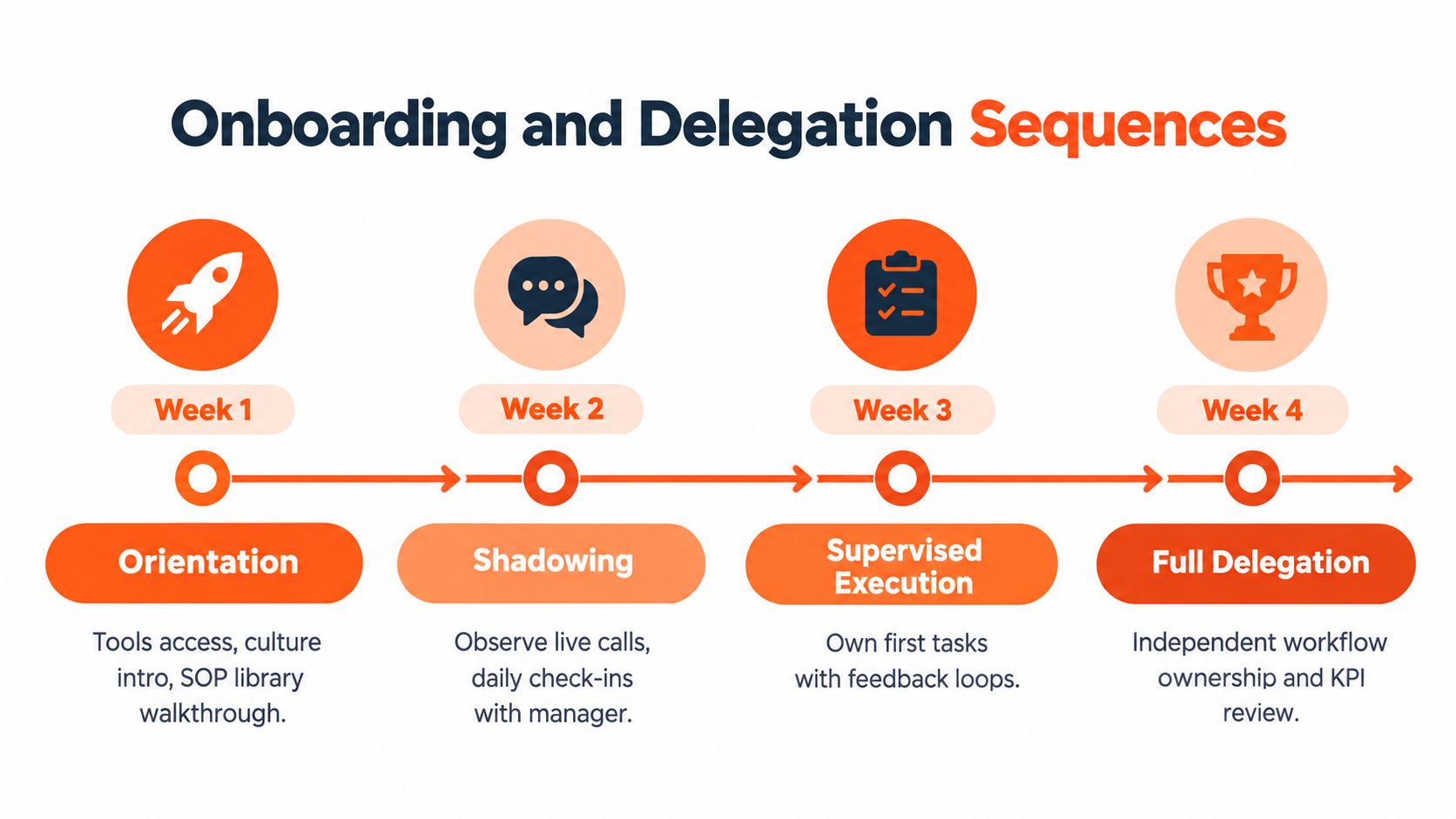
Walk through your tools, communication norms, access controls and SOPs. Calendar and inbox work are good first responsibilities because they reveal priorities while keeping decision boundaries visible. Define what the assistant can do alone, what needs approval and what must be escalated.
Use live shadowing for calls, inbox triage and recurring workflows, scheduled inside the overlap window you calculated. A daily check-in should focus on open questions and blocked tasks. A useful handoff includes four elements:
By week three, assign supervised research, scheduling decisions, report preparation or brand-voice drafts, and update the SOP whenever the same question comes up twice. By week four, the assistant should own a defined workflow while the manager reviews agreed KPIs: task throughput, response times, completion accuracy and exception handling, rather than hours alone. Our remote onboarding guide covers this sequence in more detail.
The largest hidden risk in direct international hiring is treating a cross-border worker as if the legal and payroll rules were the same as in your home state.
A U.S. company hiring directly may need to evaluate worker classification, country-specific contracts, tax handling, payroll administration, local benefits, data access and termination requirements. The details differ by country, so a contract that works in one market may not carry the same obligations in another. Direct hiring makes sense when you already have local counsel and payroll capability in that country.
A remote staffing agency takes the contracts, payroll and paperwork on the professional's side, and you pay one rate. That doesn't remove your own responsibilities for data security, confidentiality and access permissions. Whichever model you choose, ask concrete questions:
Read about remote hiring compliance risks before choosing a direct or managed model. The cheapest arrangement on paper becomes expensive when finance, legal and operations have to coordinate country-specific administration without a repeatable process.
A marketplace gives you access to candidates; a staffing agency should give you a controlled process and a remedy if the placement fails. Evaluate any partner against the work your team would otherwise do:
| Decision criterion | What to ask |
|---|---|
| Candidate quality | How are written English, spoken English, Spanish (if needed), judgment and role skills tested, and what share of applicants clears every stage? |
| Time-zone fit | Will the candidate confirm in writing the exact live window you need, in both U.S. seasons? |
| Speed | How fast does a shortlist arrive, and how soon can the hire start? |
| Operating support | Who handles contracts, payroll and paperwork, and who handles performance concerns? |
| Accountability | Is there a dedicated account manager, and how often are check-ins held? |
| Continuity | What replacement terms apply if the professional leaves or the fit fails, and is there a time cap? |
| Commercial terms | Are there placement fees, minimum terms or long contracts, and how often are you invoiced? |
A replacement guarantee is a meaningful signal because it puts long-term responsibility on the partner instead of ending support after a short trial. Read the terms: confirm whether it covers voluntary departures, performance mismatches and role changes. Virtustant's lifetime replacement guarantee has no time cap.
Ask for evidence instead of adjectives: screening stages, a sample candidate profile, shortlist timing and who owns the relationship after placement. Then judge the model, not just the advertised rate.
Virtustant virtual assistant rates start at $7/hr all-in, which is $1,120 a month at 160 hours. In Virtustant's H1 2026 placement data (441 starts, January to June 2026), the median client-side rate for a virtual assistant was $10.10/hr (n=24), or $1,616 a month at 160 hours. The final quote depends on the role, the schedule and the skills.
It depends on your live hours and your languages. Colombia and Peru stay on UTC-5 all year and match Eastern Time teams closely. Mexico and Honduras, both on UTC-6, fit Pacific Time teams best. Argentina ranks first of 20 Latin American countries on the EF English Proficiency Index 2025, which makes it a strong place to source roles that need advanced English.
Colombia and Peru are on UTC-5 with no daylight saving time, so a 9:00 to 17:00 Eastern workday is 9:00 to 17:00 locally in U.S. standard time and 8:00 to 16:00 in U.S. daylight time. Mexico, Argentina, Uruguay and Brazil also keep an Eastern workday inside normal local hours.
Many do, but country averages vary widely. On the EF English Proficiency Index 2025, Argentina ranks 26th of 123 countries with a score of 575, while Colombia ranks 76th and Mexico 103rd. A country average is not a candidate score, so test each candidate's written and spoken English live.
Yes. Spanish is an official language in every Latin American country in the EF table above except Brazil, where Portuguese is the official language. In Virtustant's 25 most recent virtual assistant searches (September 9 to 30, 2026), 6 asked for Spanish, 5 of them as a requirement.
You get a shortlist of 3 to 5 vetted candidates within 48 hours of your first call, and your hire can start in 72 hours.
Hire directly if you already have local counsel and payroll capability in the professional's country. Otherwise a remote staffing agency takes the contracts, payroll and paperwork on the professional's side for one rate. Virtustant charges zero placement fees and works month-to-month.
Start with documented, repeatable work such as calendar coordination, inbox triage, CRM updates, data entry and recurring follow-up. Add research, reporting and brand-voice tasks after the person understands your tools, standards and escalation rules.
Virtustant is a remote staffing agency that connects U.S. companies with vetted remote professionals across Latin America, with 2,000+ placements and 1,000+ U.S. companies served. If you're weighing a virtual assistant Latin America hire, hire a virtual assistant in Latin America through Virtustant and we'll scope the role around your live hours, languages and workflows.