Global Payroll Compliance: The Founder's Operating Guide
August 21, 2026


You've hired a remote professional in Colombia, paid a contractor invoice from the U.S., and moved on to product and sales. Then someone asks who verified the worker's classification, which country receives the withholding, whether local contributions apply, and where the payroll records live. If those answers aren't documented, the hire isn't cheap. You've just moved the cost into compliance exposure.
Global payroll compliance is the system that makes international pay legally defensible, from classification and registration through withholding, contributions, reporting, and payment. For a U.S. founder hiring in LATAM, the decision isn't whether to comply. It's whether your team should operate that system internally or delegate it to a provider that already manages the local obligations.
This guide is operational, not legal or tax advice. Classification and payroll rules change by country and by the facts of each engagement, so confirm your specific situation with qualified local counsel or a tax adviser before you sign or pay.
Global payroll compliance starts the moment your company pays someone who works outside the United States. It covers income tax withholding, social contributions, statutory reporting, local pay rules, and worker classification. Classification matters first because it determines whether a contractor invoice is legally appropriate or whether the relationship should run through payroll.
The mistake founders make is treating the contract as the answer. A contractor agreement can describe an independent relationship, but authorities may examine how the work operates. In Latin America, substance-over-form tests commonly consider control, exclusivity, business integration, and engagement duration. Fixed hours, company-issued tools, and manager oversight can indicate employment rather than genuine contracting, according to this Latin America classification guide.
Consider a Series A SaaS company that hires three engineers in Colombia under contractor agreements. If the engineers set their own methods, serve multiple clients, control their schedules, and deliver defined project outcomes, the arrangement may support contractor treatment. If they work fixed hours, use company equipment, report to managers, and function inside the product team indefinitely, the practical relationship may look like employment regardless of the paperwork.
Practical rule: Classify the relationship based on the worker's day-to-day reality, not the label on the agreement.
That leaves two operating choices. You can absorb the work by creating a local entity, registering as an employer, maintaining statutory calendars, and managing local payroll. Or you can delegate the employment and payroll infrastructure to an employer of record, staffing agency, or regional payroll specialist.
The second option doesn't make responsibility disappear. You still need accurate worker data, clear job duties, documented approvals, and a process for reviewing travel or location changes. But it can remove the need to build country-specific administration before you know whether the market or role will become permanent. For contractors, founders should understand the available ways to pay LATAM contractors before selecting a structure.
The founder's real question is simple: Where should complexity live? If you have one or two international workers, internal ownership often creates fragile spreadsheets and informal decisions. A managed structure may cost more per worker but reduce the number of legal and operational tasks your team must perform without local expertise.
Payroll compliance has four connected obligations. Miss one, and the others can become inaccurate. A correct gross-to-net calculation is useless if the company classified the worker incorrectly or remitted the deductions to the wrong authority.
Income tax withholding usually requires the payer to calculate deductions before paying net compensation. The calculation can depend on residence, physical work location, payment type, tax status, allowances, and local tables.
U.S. withholding-agent rules carry a direct liability risk on cross-border payments: where a withholding agent fails to withhold and the foreign payee doesn't satisfy the U.S. tax liability, both the payer and the foreign person can be liable for tax, interest, and applicable penalties. That summary comes from this cross-border worker compliance guidance rather than from the IRS directly, so verify the current rule against the primary source before relying on it. That's why withholding needs a pre-payment control, not a correction after funds leave the account.
Payroll taxes aren't limited to employee deductions. Employer contributions can alter the true cost of a hire and may fund pensions, healthcare, unemployment protection, housing, or other statutory programs. The OECD's payroll-tax indicator treats payroll taxes as taxes assessed on enterprises for wages or salaries and reports them as a share of GDP, which is a reminder that the burden is set country by country. Treat that as directional context, not as a rate you can budget from.
Your payroll model should show gross compensation, employee deductions, employer contributions, taxable benefits, and net pay separately. Don't use a single “salary plus buffer” figure when deciding whether a hire fits the budget.
Reporting includes payroll filings, withholding summaries, social contribution submissions, employee certificates, and local payslips. The cadence varies by jurisdiction, and some countries require electronic reporting or specific local formats.
A good control framework maintains a country-by-country statutory calendar with the filing owner, approval owner, payment date, evidence location, and escalation path. “Payroll processed” isn't a sufficient audit record. You need proof that each filing and remittance occurred.
Worker classification is the obligation founders underestimate. If a contractor functions as an employee, authorities may require retroactive benefits, back wages, social contributions, tax withholding, and penalties. In Latin America, the cost of noncompliance when hiring can extend beyond the individual invoice because the relationship may be reassessed over its actual duration.
| Obligation | What It Requires | Common Founder Mistake | Typical Penalty |
|---|---|---|---|
| Income tax withholding | Calculate and remit the correct deductions before payment | Wiring the full invoice and asking the worker to handle local obligations | Tax, interest, and applicable penalties |
| Social contributions | Register, calculate, fund, and report employer and worker contributions | Budgeting only for gross pay | Arrears, interest, penalties, and corrective filings |
| Statutory reporting | Submit local forms and provide compliant payslips or certificates | Using one U.S. payroll calendar everywhere | Late-filing exposure and audit issues |
| Worker classification | Match the legal category to the facts of the engagement | Relying on a contractor label despite employee-like control | Retroactive benefits, back wages, taxes, and penalties |
The operating principle is straightforward: classify first, calculate second, remit third, and retain evidence throughout. Reversing that order creates expensive cleanup.
A U.S. founder generally has three workable models for international payroll. The right choice depends on how many workers you have, how permanent the market is, and how much local administration your team can handle without weakening controls.
| Model | Control | Cost per worker | Liability for Compliance | Best For |
|---|---|---|---|---|
| In-house through a foreign entity | Highest control over process and employment administration | Entity, payroll, accounting, legal, and local staffing costs | Company retains primary responsibility | Established teams with durable local headcount |
| Employer of record | Less direct employment administration, clear operating workflow | Provider fee plus employment and statutory costs | EOR takes on defined employer and filing duties, while the client retains data and business-conduct responsibilities | Early international hiring and market testing |
| Managed agency or regional accounting firm | Shared control with local specialists | Service fee plus payroll and statutory costs | Liability depends on the contract, registrations, and tasks delegated | Companies with entities that need payroll execution |
An in-house entity offers control and can become efficient at scale, but it also requires employer registration, local payroll administration, statutory knowledge, banking, record retention, and ongoing legal review. It's a poor first move when you're testing a market with a small team.
An EOR can employ the worker locally on your behalf, process payroll, and manage withholding and filings through its local infrastructure. The contract should spell out who owns classification decisions, tax data, filing evidence, corrections, benefits, and employee communications. Don't assume “compliant” means the provider accepts every liability.
A managed agency or regional accounting firm sits between those approaches. It's useful when your company already has a foreign entity but doesn't want to build a full payroll function. It's less useful if you still lack the legal presence required to employ workers. If the question is narrower and you only want the payroll execution off your plate, the trade-offs of outsourcing payroll are worth reading before you choose a structure.
For a pre-Series A company with one to three international hires, I'd usually start with an EOR or a managed staffing arrangement. Once the team becomes substantial in one jurisdiction and the country is a durable operating center, compare incorporation and insourcing against the continuing provider cost. Don't incorporate because a contractor invoice feels uncomfortable. Incorporate when the headcount, permanence, and operating requirements justify owning the infrastructure.
If your hiring decision depends on U.S. time-zone overlap, evaluate a nearshore staffing company alongside a standalone EOR. The important comparison is not just hourly price. It's the combined cost of sourcing, vetting, contracts, payroll administration, compliance ownership, replacements, and management time.
International payroll works when the cycle is treated as a controlled operating process, not a monthly payment task. Every country needs its own cutoff dates, pay calendar, statutory rules, approval chain, and evidence folder.
Start by collecting approved time, variable compensation, leave, expenses, and changes in status by each worker's local cutoff. Then validate the local pay calendar and the FX method. If a worker's contract is denominated in U.S. dollars but local payment rules or worker expectations require local currency, document the conversion rule before the pay run.
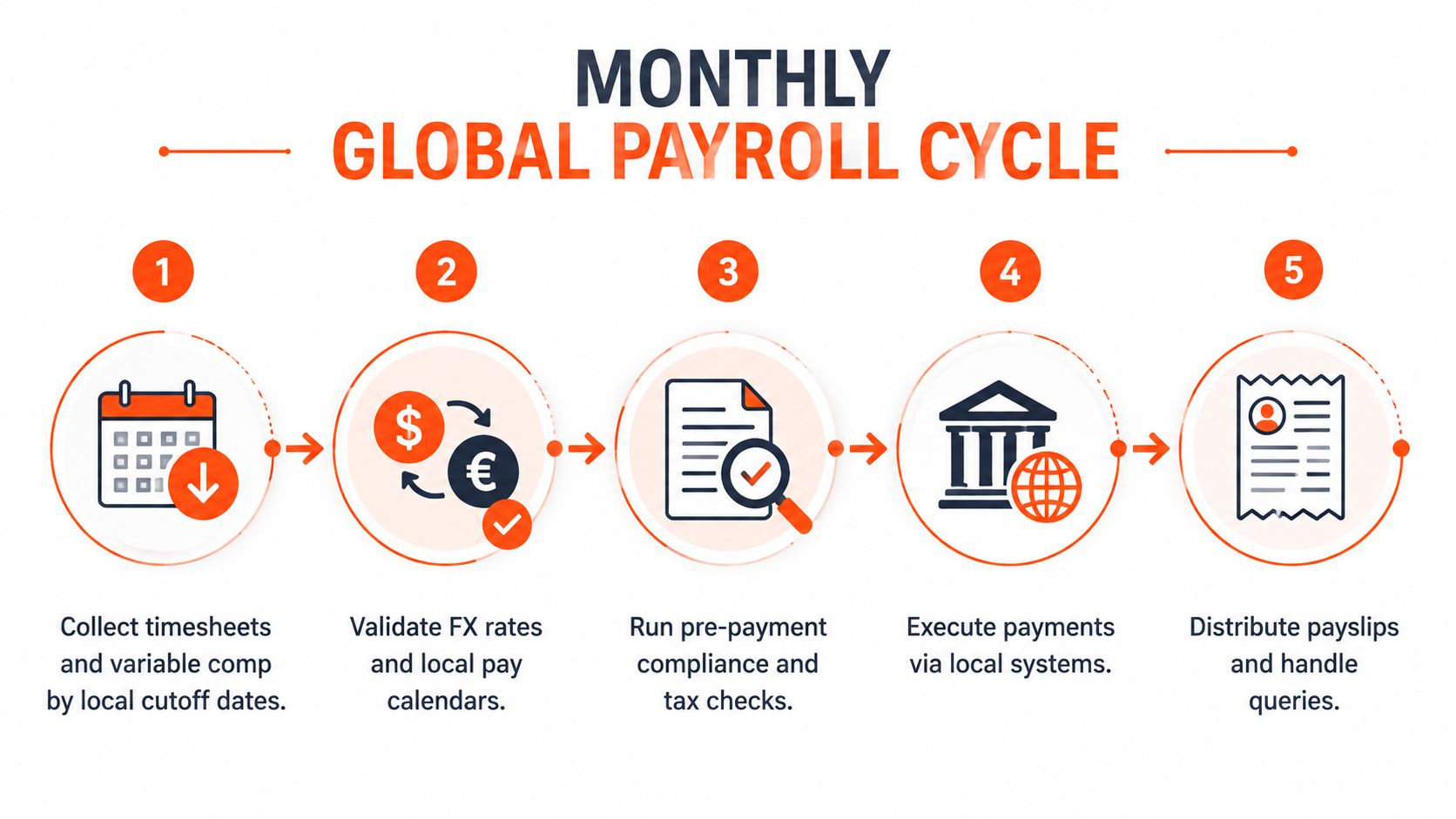
The pre-payment review should verify tax identifiers, social security enrollment, bank details, garnishments, classification, compensation changes, and unusual variances. A payroll register that suddenly shows a new worker, bank account, or compensation amount needs a human review before approval.
Use segregation of duties. The person who requests a new payment or compensation change shouldn't be the only person who approves the payroll register. For larger payments, require dual approval above a defined internal threshold.
Before funds leave the payroll account, reconcile the payroll register to the general ledger. Investigate differences in gross pay, employer contributions, withholding, FX, and settlement amounts. Complete the reconciliation early in the new month, while the source data and approvers are still available.
After payment, issue local-format payslips in the required language and retain payment confirmations, filing receipts, approval records, and exception notes. A worker query often exposes a process weakness before a tax authority does. Your team should be able to trace a net payment back to the approved input and forward to the remittance evidence.
Year-end creates another layer of work. Depending on the country and worker category, you may need annual tax summaries, contractor reporting equivalents, social security reconciliation, benefit reporting, and employee certificates. The operational details behind how nearshore payroll and compliance actually work should be tested before the first payroll, not discovered after an exception.
The usual advice says to avoid misclassification by treating every international worker as an employee. That's too blunt. Conservative treatment can reduce one category of risk while creating a recurring cost structure that doesn't match the work.
A genuine independent contractor shouldn't automatically receive an employment package because the company lacks confidence in its classification process. Over-compliance can mean paying employer contributions on top of a contractor fee, funding statutory benefits that don't apply, limiting the engagement to an EOR structure, or rejecting a compliant specialist because the paperwork feels difficult.
Use a calibrated test for every worker:
Document the answer by jurisdiction and revisit it when the role changes. A contractor who starts with a defined deliverable can become functionally integrated after months of recurring work, daily management, and fixed availability.
| Posture | Annual Loaded Cost | Audit Risk | Speed to Hire |
|---|---|---|---|
| Blanket contractor treatment | Lower visible cost, but potentially significant retroactive exposure | High when facts indicate employment | Fast |
| Blanket EOR employment | Higher fully loaded cost from statutory employment obligations and provider administration | Lower for employer administration, but facts and data still matter | Fast |
| Calibrated classification | Cost aligned to the work and applicable obligations | Managed through documentation and review | Moderate |
The table is a decision framework, not a promise of a particular cost outcome. There are no safe labels, only defensible facts and controls. Most classification exposure comes from choices founders make about supervision, exclusivity, scheduling, tools, and integration. An EOR can administer employment, but it can't make an employee-like relationship look independent.
For U.S. founders dealing with unusual contractor tax situations, a practical resource on what is Form 8919 and who files can clarify when a worker may need to report uncollected Social Security and Medicare taxes. It's not a substitute for jurisdiction-specific advice, but it's useful context when reviewing payment arrangements.
Use original nearshore rate research when comparing a direct contractor, EOR, entity, or managed staffing model. Compare the full operating cost, including management time, compliance administration, replacement risk, and payment friction, not just the quoted rate.
LATAM isn't one payroll jurisdiction. Brazil, Mexico, Colombia, Argentina, and Chile each bring different registration requirements, benefits, reporting practices, termination rules, contribution structures, and currency realities. A U.S. payroll template copied into the region is a control failure disguised as standardization.
Local substance matters. Authorities may examine where the worker physically performs the work, who sets hours, whether the company supplies tools, how benefits are handled, whether the worker is integrated into the business, and whether the contract term matches the actual engagement. A worker based in Mexico who follows a U.S. schedule, reports to a U.S. manager, uses company systems, and works continuously may require a different structure from a specialist delivering a defined project independently.
Founders need to model statutory benefits before approving compensation. Depending on the country and worker status, the cost may include a 13th-month salary, mandated profit-sharing, local social contributions, leave obligations, severance, or termination notice requirements. Brazil's 13th salary, Mexico's PTU, and country-specific payroll reporting aren't optional line items.
Currency adds another risk. A U.S. dollar contract can create a different local-currency outcome each pay cycle, while a local-currency obligation can change the company's dollar cost. Set the FX policy in writing, identify who absorbs movement, and use a conservative planning assumption. Don't let a favorable spot rate become the budget baseline.
The 18 to 25 percent planning range often used for statutory employer costs in LATAM should be treated as an illustrative budgeting assumption, not a universal rule. Actual costs depend on country, worker classification, salary structure, benefits, risk category, and applicable caps. Validate each country before presenting an offer.
| Country | Employer Social Cost | 13th/14th Month | Other Key Obligation |
|---|---|---|---|
| Brazil | Varies by company type and worker circumstances | 13th salary is mandatory | eSocial reporting, INSS, IRRF, and FGTS obligations |
| Mexico | Multirate and dependent on salary and risk category | 13th-month treatment depends on the arrangement and applicable rules | IMSS, INFONAVIT, PTU, state payroll tax, and electronic payslips |
| Colombia | Depends on statutory payroll treatment | Local statutory benefits must be modeled | Classification, registration, withholding, and contribution controls |
| Argentina | Employer burden varies by applicable payroll rules | Local statutory benefits must be modeled | Employer registration, contributions, and local reporting |
| Chile | Depends on worker status and applicable benefits | Local statutory benefits must be modeled | Local payroll, withholding, and employment-law compliance |
For a founder evaluating Argentina staffing, ask for a country-specific cost sheet that separates gross pay, employer costs, worker deductions, provider fees, FX assumptions, and termination exposure. A single all-in number is convenient for purchasing, but it's inadequate for financial planning.
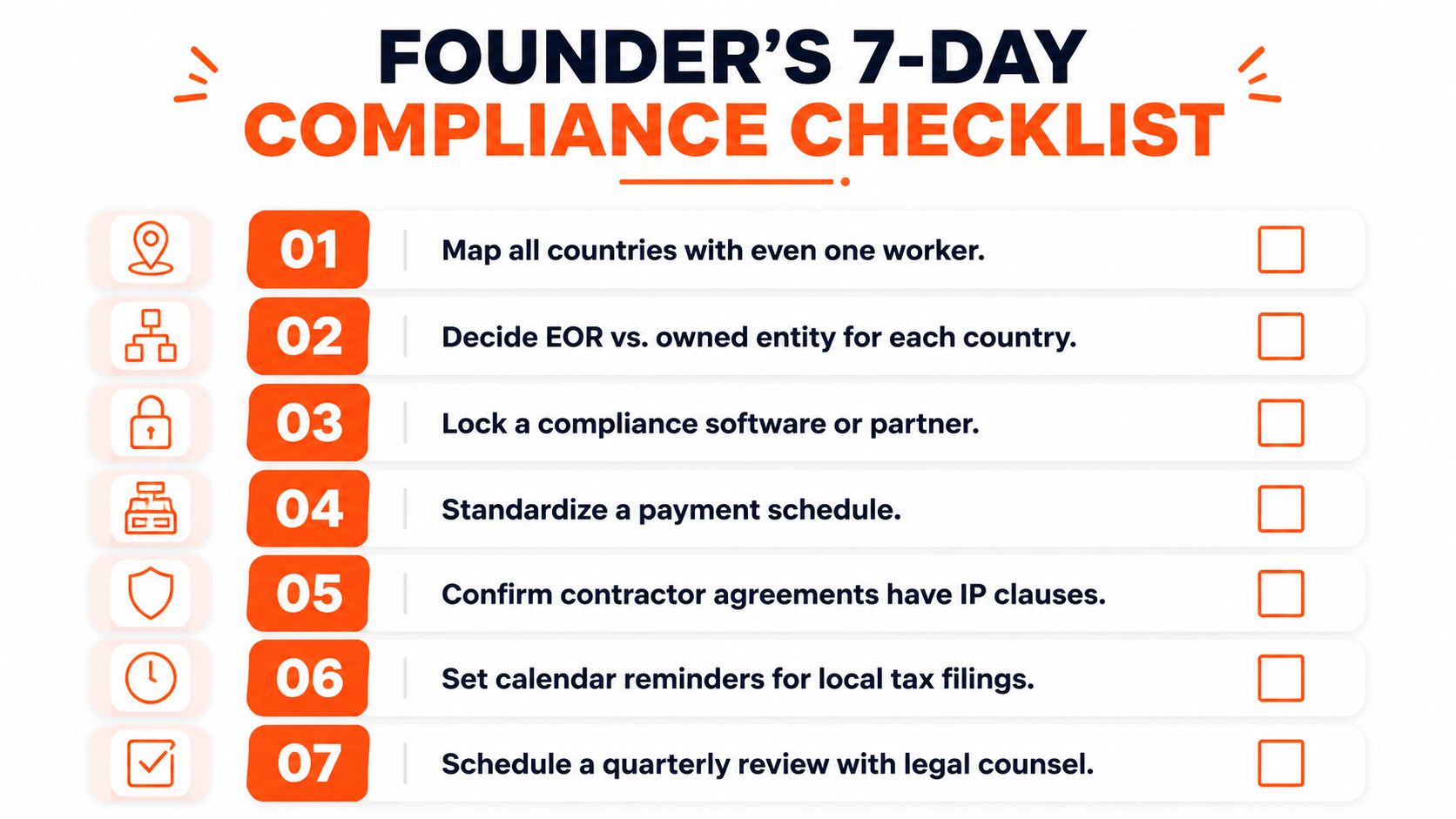
You can reduce the largest gaps in one week if you assign owners and define what “done” means. Don't create a generic compliance policy. Create a tracker that forces a decision for every country and worker.
Map every work location.
Owner: Operations. Trigger: Day one. Exit criterion: Every worker and contractor has a physical work country, engagement type, manager, and payment method recorded.
Choose the operating model.
Owner: Founder and finance. Trigger: Before the next offer or contract renewal. Exit criterion: Each country has a documented EOR, entity, managed agency, or contractor rationale.
Lock the classification test.
Owner: Legal or qualified local counsel. Trigger: Before signing. Exit criterion: The file contains the worker's duties, control factors, integration assessment, contract term, and review date.
Standardize payroll inputs and payslips.
Owner: Finance or payroll operator. Trigger: Before the first payroll. Exit criterion: Gross pay, deductions, employer contributions, FX, payment date, and local payslip requirements are mapped.
Assign every statutory deadline.
Owner: Payroll provider or finance. Trigger: Before onboarding. Exit criterion: Each filing has a due date, responsible person, backup owner, approval step, and evidence location.
Control payment and FX execution.
Owner: Finance. Trigger: Each pay cycle. Exit criterion: The team has documented FX rules, bank verification, dual approval where appropriate, and register-to-ledger reconciliation.
Run a quarterly review.
Owner: Founder, finance, and legal adviser. Trigger: Every quarter and after a location or role change. Exit criterion: Classification, registration, benefits, filings, payment evidence, and provider performance receive a signed review.
Document control deserves its own owner. Signed contracts, tax forms, classification notes, payroll registers, payslips, remittance receipts, approval trails, and worker-location records should live in a controlled workspace with restricted access and a clear retention policy. Tools that streamline legal document processing can help reduce missing signatures and scattered records, but they don't replace legal review.
The broader operating benchmark is visibility. ADP survey findings summarized in this global payroll compliance report say 75 percent of organizations surveyed, across more than 1,800 employers, consider keeping up with local payroll regulations a major challenge, while 57 percent of global payroll professionals identified local compliance as their single biggest challenge in 2025. The same research stream reports that 42 percent of organizations had no formalized global payroll strategy. One caveat on that last figure set: it is drawn from global multi-country employers, so read it as evidence that the problem is common, not as a benchmark for a company hiring in two LATAM countries. And if your team also employs inside the EU, note that the EU Pay Transparency Directive's transposition deadline of 7 June 2026 has already passed, and most member states did not meet it, so the applicable national rule now varies by country rather than arriving on a single date.
Sometimes, but the contract label does not decide it. Authorities in the region commonly apply substance-over-form tests that look at control, exclusivity, business integration and how long the engagement has run. Fixed hours, company-issued equipment, manager oversight and indefinite work inside a core team point toward employment no matter what the agreement says. Classify on the day-to-day reality, then document the reasoning by jurisdiction and revisit it when the role changes.
Not to start. There are three workable models: your own foreign entity, an employer of record, or a managed staffing or regional payroll arrangement. For one to three hires in a market you are still testing, incorporating is usually the wrong first move because it adds employer registration, local payroll administration, banking, record retention and ongoing legal review. Incorporate when headcount, permanence and operating requirements justify owning that infrastructure, not because a contractor invoice feels uncomfortable.
An employer of record employs the worker locally on your behalf and takes on defined employer and filing duties through its own local infrastructure. A managed staffing agency sources, vets and places the professional and administers contracts and local payroll, with liability depending on what the contract and the registrations actually delegate. In both cases you keep responsibility for accurate worker data, clear job duties, documented approvals and how you supervise the work in practice.
Authorities may require retroactive benefits, back wages, social contributions and tax withholding, plus penalties. The exposure is not limited to the most recent invoice, because the relationship can be reassessed over its actual duration. That is why the classification file should hold the worker's duties, control factors, integration assessment, contract term and a review date.
The 18 to 25 percent range often quoted for statutory employer costs is an illustrative planning assumption, not a universal rule. Actual cost depends on the country, the worker's classification, salary structure, benefits, risk category and applicable caps, and some countries add mandatory items such as a 13th-month salary or profit-sharing. Model each country separately and ask any provider for a cost sheet that separates gross pay, employer costs, worker deductions, provider fees, FX assumptions and termination exposure.
It depends on the contract, the registrations and which tasks were delegated. Compliant does not mean the provider accepts every liability. The agreement should name who owns classification decisions, tax data, filing evidence, corrections, benefits and worker communications, and you should be able to trace any net payment back to the approved input and forward to the remittance evidence.
Virtustant places vetted remote professionals across LATAM and handles contracts, local payroll in the professional's country, HR and compliance, billing the client through one consolidated U.S. dollar invoice. The client keeps direct day-to-day management of the professional. It is a remote staffing arrangement rather than an employer-of-record product, so compare it against an EOR, a local entity and a direct contractor model on total operating cost, not just the quoted rate.
If you're hiring remote professionals across LATAM, Virtustant handles sourcing, assessment, contracts, local payroll, HR, and compliance in the professional's country through one consolidated U.S. dollar invoice. Review Virtustant to discuss a compliant staffing structure for your next remote hire, then compare its managed approach against an EOR, local entity, or direct contractor model.