Recruitment Process Outsourcing (RPO): A 2026 Guide for US Employers
October 5, 2026


Recruitment process outsourcing (RPO) is, in the RPO Association's definition, a model where an employer transfers all or part of its recruitment process to an external provider. It is a large category: Grand View Research valued the global RPO market at USD 12.8 billion in 2025. RPO is built for sustained hiring volume. If you need one to ten remote roles filled, a remote staffing agency usually fits better.
A note on who is writing this. Virtustant is a remote staffing agency, not an RPO provider. We place dedicated remote professionals from Latin America with US companies, and the client directs their work day to day. That gives us a clear view of where RPO is the right call and where it is more machinery than a small team needs. This guide describes the models, not vendors, and shows the math so you can decide with your own numbers.
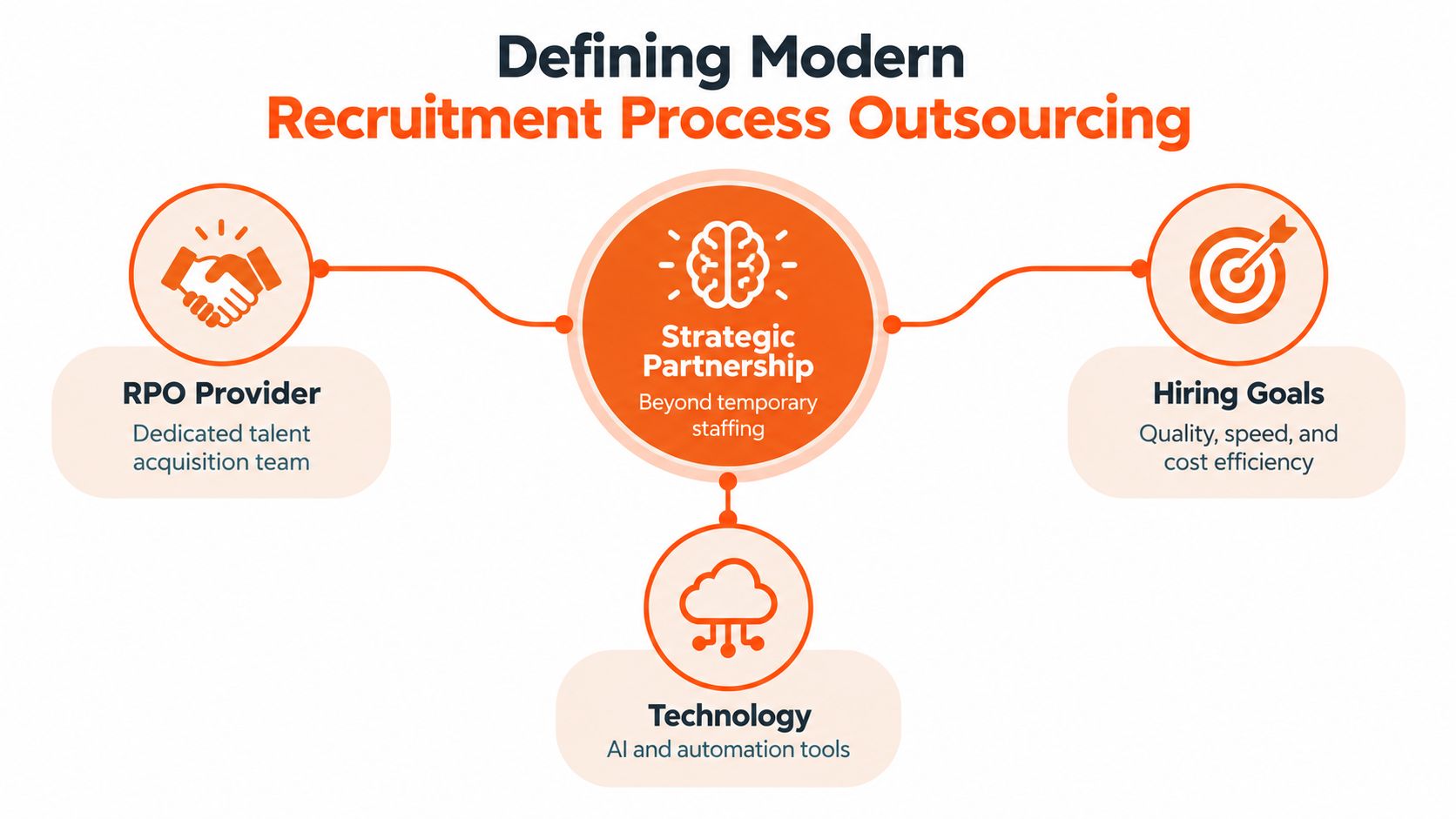
The RPO Association describes RPO as "a form of business process outsourcing (BPO) where an employer transfers all or part of its recruitment processes to an external service provider." ADP's RPO guide puts it as "the long-term transfer of ownership of all or part of an employer's recruitment process to a third-party specialist."
Two words in those definitions matter most: process and ownership. An RPO provider does not just send you resumes. It can run intake with hiring managers, choose sourcing channels, set screening rules, schedule interviews, chase feedback, manage offers and report on the funnel. The RPO Association says RPO differs from staffing companies and contingent or retained search firms because it "assumes ownership of the design and management of the recruitment process and the responsibility for results."
The other point buyers miss: an RPO provider recruits on your behalf. ADP describes the provider as acting as "an in-house recruiter for a business." The people it hires join your company, on your payroll, under your employment terms. You still own onboarding, management, payroll and everything that comes after the offer is signed.
The defining issue is control. A contingency recruiter receives a vacancy, searches and submits candidates. An RPO provider can own the system around the vacancy across a group of roles. Before you sign, get clear answers to three questions:
If your real need is a person doing the work rather than a recruiting function, read how Virtustant explains remote staffing and what a staffing agency does before you compare RPO quotes.
RPO models differ by scope, duration and ownership. The label matters less than where your hiring process is breaking.
| Model | What the provider owns | Best fit | Main trade-off |
|---|---|---|---|
| End-to-end RPO | Most or all recruiting stages, across many roles | Ongoing, multi-function hiring | Needs deep integration, governance and a long contract |
| Selective or modular RPO | Specific stages (sourcing, screening, scheduling) or one role family | One clear bottleneck in a process that otherwise works | Your team must manage the handoffs well |
| Project or on-demand RPO | A defined hiring campaign with a start and an end | Launches, new locations, seasonal surges | The capability leaves when the project ends |
The RPO Association uses its own labels for the same idea (Enterprise Full Talent Lifecycle, Hybrid-Select and On-Demand/Project RPO) and adds a fourth, a contingent RPO model for sourcing temporary and contract labor.
The provider sits at the center of talent acquisition. It may handle workforce planning, employer-brand messaging, sourcing, assessment, interview logistics, offers, onboarding coordination and reporting. This fits a company whose hiring is inconsistent across departments and large enough that leaders want one accountable operator instead of several agencies working in parallel. The cost is governance: decision rights, escalation paths, data access and success metrics must be agreed before launch, or you transfer activity without transferring accountability.
Here you keep final interviews and offers, and the provider owns one piece, such as sourcing and first-round screening for support or sales roles. It is the sensible entry point when your process works but one stage is slow. The risk is a bad handoff: if the provider is judged on candidate volume while your managers take a week to review profiles, you get activity without hires. The same question comes up in managed staffing vs traditional recruiting: who owns the workflow once a candidate is in the pipeline?
Project RPO is built around a finite requirement: a new office, a product launch, a funded growth plan or a seasonal program. Before signing, define the roles in scope, the target profile, the approval process, the reporting format and the exit plan. It works poorly when the brief is a general wish to "hire faster."
A simple decision rule:
ADP lists four common pricing approaches for RPO:
ADP notes that most employers prefer the cost-per-hire model because costs move with hiring volume. In practice, many proposals combine a fixed element (a management or resource fee) with a variable one (a fee per hire). That fixed element is why volume decides whether RPO pays off. A fixed fee spread over 40 hires is cheap per hire. The same fee spread over four hires is not.
Also check what the quote leaves out. Job-board spend, assessment tools, background checks and your managers' interview hours may sit outside the RPO fee. Compare like with like before you compare totals.
You will see confident percentages in RPO marketing. Here is what the most-quoted sources say, checked on October 5, 2026, and how much weight each deserves.
Speed and cost claims. The benchmark summary from Hyring, an HR glossary entry, cites a 2023 Everest Group study for two claims: RPO engagements reach 30–40% faster time-to-fill, and companies using RPO cut cost-per-hire by 40–50% compared with in-house recruiting. Hyring applies the speed range to a 44-day average time-to-fill, which it attributes to SHRM (2024), and gets 26 to 31 days. We have not seen the underlying Everest Group study, so treat these as reported ranges for companies that already use RPO, not a forecast for yours.
Cost per hire by route. Serendi's RPO benchmark page comes from an RPO provider and says so. Serendi's own comparison puts cost per hire at €4,500 for end-to-end RPO, €5,900 for traditional in-house recruiting and €8,000 for contingency agencies, with 37, 63 and 42 days to hire. Serendi calls these figures illustrative, built from its own cost model, not a universal benchmark. Its practical guidance is that RPO makes sense from about 30 hires a year. Useful as a sense of scale, not as a quote.
Market size. Estimates differ by firm. Grand View Research puts the market at USD 12.8 billion in 2025, growing at 12.1% a year from 2026 to USD 31.5 billion by 2033, with North America holding over 41.0% of revenue in 2025. Global Market Insights values it at USD 11.11 billion in 2025, reaching USD 27.16 billion by 2035 at a 9.44% CAGR. The takeaway is not the exact number. It is that RPO is a mature category built mostly around large employers.
Risk. Global Growth Insights' market coverage flags candidate data privacy and information governance as a concern for companies that hand recruiting to third-party providers. If an RPO provider will run AI screening on your applicants, ask who can see that data, where it is stored and how a wrongly rejected candidate gets a human review.
Benchmarks from other companies cannot tell you whether RPO pays off for yours. The RPO Volume Threshold Test uses your own numbers and takes about ten minutes with a provider's quote in hand.
The table below runs the test with example inputs only: C = $5,000, F = $96,000 a year ($8,000 a month) and P = $1,500. These are not market figures. Replace them with your own cost data and the provider's written quote.
| Hires per year (H) | In-house: H × $5,000 | RPO: $96,000 + H × $1,500 | Result |
|---|---|---|---|
| 40 | $200,000 | $156,000 | RPO passes by $44,000 |
| 28 | $140,000 | $138,000 | RPO passes by $2,000 (break-even zone) |
| 20 | $100,000 | $126,000 | RPO fails by $26,000 |
| 4 | $20,000 | $102,000 | RPO fails by $82,000 |
With these example inputs, break-even is $96,000 ÷ ($5,000 − $1,500) = 27.4, so about 28 hires a year. That lands close to Serendi's practical guidance of 30 or more hires. Notice the stability check too: a company planning 40 hires that ends up making 20 goes from saving $44,000 to losing $26,000, because the fixed fee does not shrink with the hiring plan.
The test assumes you are buying a recruiting function. A remote staffing agency works on a different model. Virtustant charges zero placement fees, so on the recruiting side F = $0 and P = $0. You pay the professional's hourly rate for the hours worked, on one weekly invoice per placement, month to month. The question stops being "how do I spread a recruiting fee across enough hires?" and becomes "what does this role cost per hour, all in?"
For a virtual assistant, Virtustant's rate starts from $7/hr all-in. A full-time month of 160 hours at $7 is 160 × $7 = $1,120. The Bureau of Labor Statistics reports a May 2025 median wage of $23.23 an hour for US secretaries and administrative assistants, or 160 × $23.23 = $3,716.80 for the same hours. That is a wage-only figure, before US benefits and payroll costs. Against it, the $7 floor is $16.23 an hour lower (1 − 7 ÷ 23.23 = 0.699), which is why we say you can save up to 70%.
RPO is designed around volume. Small-business demand looks very different, and our own recruiting data shows it.
Virtustant data: of the 25 most recent virtual assistant searches opened in our recruiting system between September 9 and September 30, 2026, 13 were part-time (from 4 to 6 hours a week up to 30 hours a week) and 12 were full-time. Each search is one opening for one person.
How we counted: we read the 25 newest virtual assistant positions on October 5, 2026, and classified each one by the weekly hours in its schedule or, where the schedule only gave a time window, by the job type on the posting. No client or candidate data is shown.
Put that next to the threshold test. A business that needs one part-time assistant is making one hire, not 28, and the work starts at 4 to 30 hours a week. No fixed recruiting fee spreads well over that. What that business needs is a vetted person who can start soon and an arrangement that can change as the workload does. That is the problem a remote staffing agency is built to solve.
"RPO vs staffing agency" is the comparison most buyers are really making. Here are the five models side by side. This compares how each model works, not any specific vendor.
| Model | Who runs recruiting | Where the hire sits | How you pay | Built for |
|---|---|---|---|---|
| RPO provider | The provider runs all or part of your recruiting process | Joins your company and your payroll | Per-hire, per-resource, hybrid or per-transaction fees | Sustained volume across many roles |
| Remote staffing agency | The agency sources, vets and shortlists; you pick | You direct the daily work; the agency handles payroll and admin on the professional's side | An hourly rate; at Virtustant, zero placement fees and one weekly invoice per placement | One to ten remote roles, filled fast |
| In-house recruiting | Your recruiters and hiring managers | Joins your company and your payroll | Recruiter salaries, job ads, tools and manager time | Steady hiring with a mature process |
| Contingency recruiter | The recruiter searches for one vacancy at a time | Joins your company and your payroll | A placement fee, paid only on a successful hire | Hard-to-fill individual roles |
| Freelance marketplace | You search, screen and interview yourself | An independent freelancer you manage directly | The freelancer's rate plus platform fees | Short, well-scoped projects |
The line that matters most is the third column. With RPO, in-house recruiting and contingency search, you end up with a new person on your own payroll and every obligation that comes with it. With a remote staffing agency, you get the person and the work, and the agency carries the payroll and paperwork on the professional's side. For a breakdown of how agency fees are structured, see how much staffing agencies charge.
RPO is the better tool when your own threshold test passes (Serendi's guidance is about 30 or more hires a year), you need a recruiting function you do not have, and you want every hire on your own payroll. A remote staffing agency is usually the better fit when most of these are true:
Virtustant is a remote staffing agency. We hire the top 1% of applicants, and that number comes from a funnel: of every 100 people who apply, 22 pass the recruiter screen, 9 pass skills and English testing, 3 reach a live interview and 1 is hired. You can see each step in our candidate vetting process.
Shortlist in 48 hours. Start in 72 hours. You get a shortlist of 3 to 5 vetted candidates within 48 hours of your first call, and your hire can start in 72 hours. For context on why speed matters, read our guide to time to hire.
After the hire, an account manager is your main point of contact and coordinates onboarding, the start date, tools access and the first-week plan. Virtustant follows up during the first weeks. You direct the day-to-day work. Virtustant handles payroll, paperwork and everything administrative on the professional's side. Every placement includes a lifetime replacement guarantee with no time cap, month-to-month terms, zero placement fees and one weekly invoice per placement. No single item on that list is unusual. The combination is what makes the model work for a small team.
Starting prices are published by role: virtual assistants and customer service reps from $7/hr all-in, SDRs, appointment setters and social media managers from $8/hr, and executive assistants and bookkeepers from $8.50/hr. See what remote staffing costs for every role.
Rates above the floor depend on the role and experience. In Virtustant's H1 2026 placement data (441 starts, January to June 2026), the median client-side rate for a virtual assistant was $10.10/hr (n=24) and for an executive assistant $12.00/hr (n=24). The full method is in the 2026 Nearshore Rate Report.
Most of our professionals are in Latin America, so they work during US business hours. That time-zone overlap is the practical reason to pick a nearshore staffing partner for roles that need same-day answers from you, your customers or your team.

In this video from Virtustant's YouTube channel, a client walks through how they hired remote talent in Latin America:
If the threshold test says RPO, start vendor selection with the work you need controlled, not a feature list. Four checks catch most problems.
Write down every stage and who owns it: demand planning, intake, sourcing, assessment, interview coordination, offer and handoff, and reporting. If the provider cannot state its ownership at each stage, the contract will leave gaps between teams.
Ask to see the real funnel, not just a polished shortlist. How many applicants reach each stage? What does the skills test look like? Who makes the final call, and how do you challenge an automated rejection? Ask for anonymized assessment outputs from a recent search.
With RPO, the new hire joins your company, so onboarding, payroll and day-one setup are yours. Ask where the provider's scope ends. Some teams add onboarding tools at this stage; the rollout playbook by Supercenter describes one approach that uses an AI assistant in Slack to track first-month onboarding tasks. Whatever you use, decide who owns the first 30 days before the first hire lands.
Replacement terms should state eligibility, timing, exclusions and whether a replacement search costs another fee. Do not accept a vague promise to "help" if a hire leaves. Get the process in writing.
Finally, compare reporting depth, account management, escalation paths and integration with your applicant tracking system. If you are weighing remote staffing agencies instead, our guide to choosing a remote staffing agency covers the questions that separate real vetting from resume forwarding.
Recruitment process outsourcing is a model where an employer transfers all or part of its recruitment process to an external provider, which then runs those stages on the employer's behalf. The people it hires join the employer's own company and payroll.
An RPO provider takes ownership of your recruiting process and fills roles that join your payroll. A remote staffing agency finds, vets and places a professional who works for you day to day while the agency handles payroll and admin on the professional's side.
ADP lists four RPO pricing models: cost-per-hire, cost-per-resource (a monthly fee for assigned recruiters), hybrid, and transaction-based. Many quotes combine a fixed fee with a per-hire fee, so the cost per hire falls as your hiring volume rises.
It depends on your own costs. Use the RPO Volume Threshold Test: break-even hires = fixed annual RPO fees ÷ (your internal cost per hire − the RPO per-hire fee). Serendi, an RPO provider, gives about 30 hires a year as practical guidance.
Usually not for one to ten roles. A fixed recruiting fee does not spread well over a few hires. Of Virtustant's 25 most recent virtual assistant searches (September 9 to 30, 2026), 13 were part-time and each was one opening.
No. Virtustant is a remote staffing agency. It places vetted remote professionals, mostly from Latin America, with US companies. The client directs the work, and Virtustant handles payroll, paperwork and everything administrative on the professional's side.
With Virtustant, you get a shortlist of 3 to 5 vetted candidates within 48 hours of your first call, and your hire can start in 72 hours.
Virtustant's virtual assistants start from $7/hr all-in. The BLS reports a May 2025 median wage of $23.23 an hour for US secretaries and administrative assistants, so the $7 floor lets you save up to 70% on the hourly wage alone.
Need one to ten remote roles filled without building a recruiting function? Browse the roles Virtustant staffs, review starting prices and book a discovery call to get your shortlist.