What Is Remote Staffing? How It Works and Who It Actually Works For
September 30, 2026


Remote staffing is a hiring model in which a company directs the daily work of a remote professional while a staffing partner handles sourcing, vetting, contracts, and payroll, usually for one all-in hourly rate. It rests on how Americans already work: among U.S. employees with remote-capable jobs, Gallup finds 26% fully remote and 52% hybrid, as summarized in FMC Group's global remote work data overview (updated March 2026).
In practice, you choose from a vetted shortlist, set the priorities, and manage the work. The staffing partner runs recruiting and everything administrative on the professional's side. At Virtustant, a remote staffing agency, the median all-in rate across 462 placements that started between 22 Sep 2025 and 22 Sep 2026 was $12.75 an hour, with the middle half of placements between $10.67 and $14.50.
This guide covers what remote staffing is, how an engagement runs, how it differs from direct hire, marketplaces, an employer of record (EOR), and outsourcing, what it costs, and a four-check test for deciding whether it fits your role. If you already know you want a provider and need a list to compare, start with our roundup of remote staffing agencies.
Remote staffing splits one job into two kinds of ownership. Your company owns the work: the priorities, the tools, the feedback, and the definition of done. The staffing partner owns the hiring and the administration: sourcing, screening, the contract with the professional, payroll, and replacement if the match fails.
That split is the whole definition. A remote professional placed through a staffing agency works on your team, in your Slack or Teams, on your schedule, and takes direction from your manager. They are not a vendor's crew delivering a finished service, and they are not a freelancer you found and manage alone.
Three features separate remote staffing from the models it gets confused with:
For how agencies work in general, see what a staffing agency does.
Every provider runs its own version. Here is Virtustant's actual sequence with real timings, so you know what to ask any provider to put in writing. For how this compares with other remote options, see our virtual staffing solutions overview.
Scope the role on a discovery call. Outcomes, recurring tasks, tools, weekly hours, time zone, and budget. The rate is scoped here, based on the role and the experience it needs. A brief like "maintain the CRM, prepare the weekly pipeline report, and route inbound requests" gives the recruiter something testable. "Operations assistant" does not.
Get a shortlist within 48 hours. Once the job description is approved, you receive a tracker with 3 to 5 vetted candidates within 48 hours. Each profile includes a video introduction, résumé, English level, assessment results, and the recruiter's notes. Here is what a shortlisted candidate should come with.
Choose who to meet. You mark the candidates you want to interview. If none fit, the search is adjusted the same day rather than restarted from zero.
Interview and select. You interview your picks and choose. Across 468 placements in the 12 months to 23 Sep 2026, Virtustant averaged 11.2 days from opening a search to the professional's start date. Our breakdown of time to hire explains how that clock is measured.
Start with an account manager. After the hire, an account manager becomes your main point of contact and reaches out the same day to coordinate onboarding, start date, tools access, and the first-week plan. Virtustant follows up with you and with the professional during the first weeks to catch issues early.
Run the work while the provider runs the rest. You direct the day-to-day work. Virtustant handles payroll, paperwork, and everything administrative on the professional's side. If the match isn't working at any point, the lifetime replacement guarantee applies, with no time cap.
Behind the shortlist sits the vetting funnel. Of every 100 people who apply to Virtustant, 22 pass the recruiter screen, 9 pass skills and English testing, 3 reach a live interview, and 1 is hired. That is what "top 1%" means here: a pass rate through defined stages, not a label. When any provider quotes a percentage, ask for the stages behind it.
Five different arrangements get blurred into the phrase "remote staffing." What separates them is who owns each piece of the job. This is the typical split; confirm any provider's in its contract.
| Model | Who finds and vets the person | Who directs daily work | Who handles contracts and payroll | If the hire fails |
|---|---|---|---|---|
| Remote staffing agency | The agency, from its vetted pool | You | The agency | Replacement under the written guarantee |
| Direct hire | You | You | You, including local rules where the person lives | You restart the search |
| Talent marketplace | You, from platform profiles | You | Mostly you, under the platform's terms | You restart the search |
| Employer of record (EOR) | Usually you, before engaging the EOR | You | The EOR, as the legal employer | You find a new person, then onboard them to the EOR |
| Outsourcing / BPO | The vendor | The vendor | The vendor | The vendor reassigns its own staff |
Outsourcing buys an outcome. You hand a function, such as a support queue or back-office processing, to a vendor that hires, schedules, and supervises its own team, and you manage a service contract and its metrics. Remote staffing buys a person. The professional is dedicated to your company and takes direction from your manager. Choose outsourcing when you want to hand off a function you don't want to manage. Choose remote staffing when you want the work done your way, inside your team.
An EOR is the legal-employment layer without the search. It fits when you have already found the person and need someone to employ them formally in their country. A remote staffing agency includes the search: sourcing, testing, and a shortlist, and then carries the contract and payroll for whoever you choose.
A marketplace gives you breadth and fast access to profiles. Screening, contracting, payment disputes, and replacement stay closer to you. It works well for a defined project with an end date, or for a founder who can assess candidates alone. Our comparison of freelance vs. agency vs. managed assistants walks through the trade-offs role by role.
Direct hire gives you full control and the full administrative load. It makes sense when you already have an entity or a compliant contracting setup where the person lives, a recruiter with time, and enough hiring volume to justify the process. Some providers go a step further than staffing and manage the work too; managed staffing services explains where that line sits.
A U.S. manager can approve a remote hire in one afternoon and still inherit weeks of operational work. The provider's value is not the introduction. It is the system that keeps the engagement running after the candidate accepts.
A provider should define the role with you, find relevant candidates, test job-specific skills and English, and interview them before you do. The useful output is a short, tested shortlist, not a database. An executive assistant needs calendar judgment and clean written updates. A bookkeeper needs software fluency and accurate reconciliations. Match the test to the work, and check the remote roles we staff to see how requirements differ by function.
A professional in another country needs a contract that fits where they live, plus payroll and tax handling there, all rolled into one invoice to you at the agreed rate. CrewBloom, itself a remote staffing agency, writes that agencies with EOR services "handle tax filings, labor law compliance, and benefits administration in each talent geography." Cross-border remote hiring responsibilities like these should be spelled out in your service agreement, not assumed.
This part stays with you. Your company owns system access, confidentiality terms, and data handling. Set permissions before day one, and put account ownership and offboarding steps in writing.
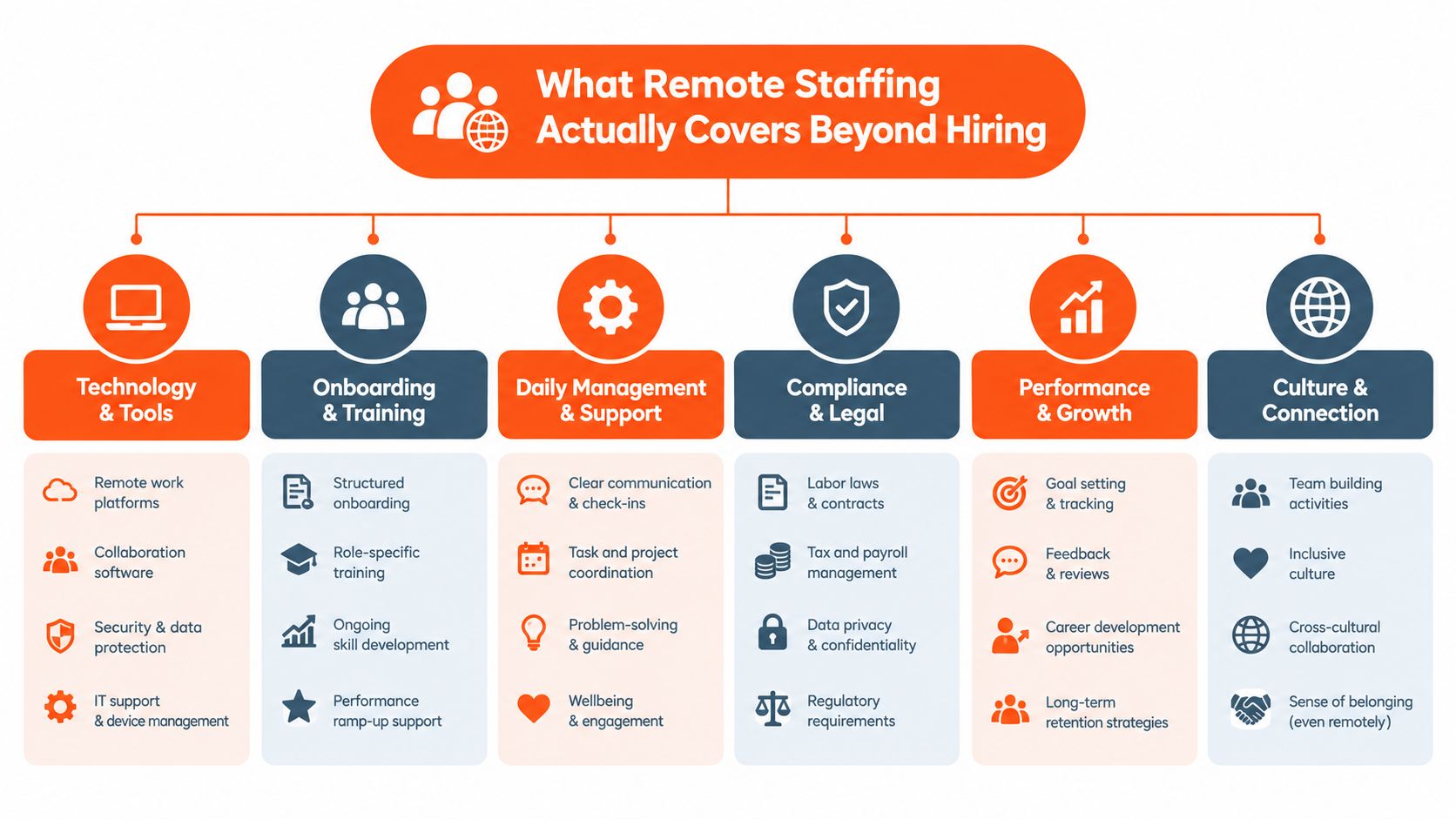
Not every item in that picture is the provider's job. Daily management, goals, and feedback remain yours, which is exactly what makes it staffing rather than outsourcing. If you want a checklist for choosing the provider itself, our video covers eight questions to ask first.
Most articles on this topic give ranges without saying where they come from. Here is ours, with the sample and window attached.
Virtustant first-party placement data, n=462 placements with a derivable rate, placements started 22 Sep 2025 to 22 Sep 2026. Rates are the client's all-in hourly rate.
| Metric | Value | Sample and window |
|---|---|---|
| Median all-in hourly rate | $12.75 | n=462, starts 22 Sep 2025 to 22 Sep 2026 |
| Middle 50% of rates | $10.67 to $14.50 | n=462, same window |
| Rate floor | From $7.00/hr | Current published floor |
| Share of placements that are part-time | 46% | n=462, same window |
| Part-time vs. full-time median | $12.41 vs. $12.93 | n=462, same window |
| Weekly hours | 49% at 40 h, 26% at 20 h, 8% at 10 h, 7% at 15 h | n=462, same window |
| Booked exactly 20 or exactly 40 h/week | 74.1% (7.2% strictly between; median 35 h) | 332 most recent placements, start dates 29 Jun to 19 Oct 2026 |
| Average time to fill | 11.2 days, search opened to start date | 468 placements, 12 months to 23 Sep 2026 |
| Assistant searches naming a U.S. time zone | 68 of 75 with a stated schedule (91%) | Virtustant assistant searches |
Rates move with the role. These are the medians for the roles with the most placements in the same window:
| Role | Median all-in rate | Middle 50% | Placements (n) |
|---|---|---|---|
| Virtual assistant | $10.73 | $9.23 to $12.00 | 42 |
| Executive assistant | $11.94 | $9.88 to $13.68 | 16 |
| Appointment setter | $12.00 | $10.46 to $13.50 | 68 |
| Social media manager | $12.00 | $10.66 to $12.89 | 46 |
| Sales development rep | $13.00 | $12.00 to $13.00 | 41 |
| Customer service | $14.00 | $9.00 to $16.00 | 33 |
| Bookkeeper | $15.00 | $12.64 to $16.38 | 12 |
To turn an hourly rate into a monthly figure, multiply by weekly hours and by 4.33 (52 weeks ÷ 12 months). A 20-hour role at the part-time median costs $12.41 × 20 × 4.33 = $1,075 a month. A 40-hour role at the full-time median costs $12.93 × 40 × 4.33 = $2,239 a month. Part-time does not cost more per hour: the part-time median sits below the full-time one.
There are zero recruitment or placement fees, and engagements run month to month. How Virtustant earns, in one line: "If you pay your agent $10/hr, we give them $9 and keep the dollar in the middle." For current rates by role and schedule, see what remote staffing costs.
Use this test to choose between remote staffing, direct hire, a marketplace, and an EOR for one specific role. Run the four checks in order; the first one that gives a clear answer usually decides. The thresholds below are suggested rules drawn from Virtustant's own placement and intake data, not market benchmarks.
Question: Have you already found the person? If yes, and you only need someone to employ and pay them in their country, an EOR is the cleaner fit. If yes, and you already have an entity or a compliant contracting setup there, direct hire works. If no, keep going: finding and testing the person is the part remote staffing is built for.
Question: Is this a recurring weekly block of hours, or a project with an end date? In Virtustant's 332 most recent placements, 74.1% booked exactly 20 or exactly 40 hours a week. That is 0.741 × 332 = about 246 placements. Smaller blocks exist too: 8% of the 462 placements in the full window were 10 hours a week and 7% were 15.
Suggested rule: if you can write the role as a steady 10, 20, or 40-hour week that will still exist in six months, it is a staffing role. If it is a deliverable with an end date, such as a logo or a one-time data cleanup, a marketplace fits better.
Question: How many hours a day must this person be live with your team or customers? Of 75 Virtustant assistant searches with a stated schedule, 68 named a specific U.S. time zone: 68 ÷ 75 = 91%. Buyers almost always want the work to happen during their own day.
Suggested rule: if the role needs four or more hours a day of live overlap, such as calls, chat support, or same-day approvals, limit the search to time zones close to yours. That is where nearshore Latin America comes in (see the next section). If the work is fully asynchronous, geography matters less than skill.
Formula: maximum affordable hourly rate = monthly budget ÷ (weekly hours × 4.33). A 40-hour week is 173.2 hours a month; a 20-hour week is 86.6.
Here is the formula applied to the intake budgets companies stated when they opened a search with Virtustant (midpoint of the stated monthly budget, searches opened through 23 Sep 2026, deduplicated by company), next to the median placed rate for a comparable role:
| Search type (n companies) | Monthly budget | Max rate at 40 h | Max rate at 20 h | Comparable placed median |
|---|---|---|---|---|
| Bookkeeping (n=25) | $2,072 | $11.96 | $23.93 | Bookkeeper $15.00 |
| Admin / assistant (n=79, 58% part-time) | $1,818 | $10.50 | $20.99 | VA $10.73 · EA $11.94 |
| Sales development (n=20, 35% part-time) | $1,732 | $10.00 | $20.00 | SDR $13.00 |
| Customer service (n=22, 21% part-time) | $1,648 | $9.52 | $19.03 | Customer service $14.00 |
| Marketing and social media (n=23, 61% part-time) | $1,212 | $7.00 | $14.00 | Social media manager $12.00 |
Worked example: an $1,818 admin budget ÷ 173.2 hours = $10.50 an hour at 40 hours a week. A full-time virtual assistant at the $10.73 median costs $10.73 × 173.2 = $1,858, which is $40 over. The same budget at 20 hours allows $1,818 ÷ 86.6 = $20.99 an hour, and a 20-hour executive assistant at the $11.94 median costs $11.94 × 86.6 = $1,034.
In all five groups, the budget covers a 20-hour week above the comparable median and a 40-hour week below it, partly because many of those budgets were set for part-time roles. Run the formula on your own number before the first call. Suggested rule: if your maximum rate at the hours you want falls below the bottom of the role's middle-50% range, either start at 20 hours or narrow the role.
If you are weighing a direct U.S. hire instead, compare total cost, not wage. The U.S. Bureau of Labor Statistics' Employer Costs for Employee Compensation release puts benefits at 30.0% of private-industry compensation costs in June 2026, so total cost is roughly wage ÷ (1 − 0.30), or about 1.43 × the wage, before recruiting time.
| Result | Model that usually fits |
|---|---|
| Person already found, no entity in their country | Employer of record |
| Person already found, entity or compliant setup in place | Direct hire |
| Project with an end date, you can vet candidates yourself | Talent marketplace |
| Not found yet, recurring 10 to 40 h/week, overlap needed, budget clears the role's range | Remote staffing agency |
| You want to hand off a whole function and not manage people | Outsourcing / BPO |
A support manager hiring across a twelve-hour gap may save on the rate and lose it again in delayed escalations and missed handoffs. For roles built on live collaboration or same-day turnaround, time-zone overlap is the operating advantage.
Crossbridge, a nearshore staffing firm, describes Latin America as offering "Full overlap (1–3 hr diff)" with U.S. working hours in its time-zone guide to Latin American staffing. The exact gap depends on the country and the U.S. zone you work in, so check the professional's local hours against your own schedule rather than a region label.
That fit is why Virtustant recruits across Latin America for U.S. companies, and why 68 of 75 assistant searches with a stated schedule named a U.S. time zone. A support agent can escalate during the manager's day. A sales development rep can work alongside account executives in real time. An operations assistant can close a handoff before the U.S. day ends. See nearshore staffing options for how this works by role.
English still needs direct testing: "bilingual" on a profile proves little. At Virtustant, English is tested alongside skills, and each shortlisted profile shows the candidate's English level. In the interview, ask candidates to explain a problem and respond to an ambiguous request.

Nearshore staffing suits customer support, administrative work, sales development, bookkeeping, marketing production, and other digitally delivered work. It is a poor fit when the job requires physical equipment, local licensing, or daily in-person contact.
Remote staffing suits companies that can separate who owns the work from where the person sits. The buyers who do best start with one repeatable workflow, name one manager, and write down what done looks like.
| Buyer profile | Usual best model | First role to staff | Placed median (Virtustant) |
|---|---|---|---|
| Founder at a 5 to 25-person company buried in admin | Remote staffing agency | Executive or virtual assistant | EA $11.94 · VA $10.73 |
| Support leader who needs same-day coverage | Remote staffing agency | Customer service agent | $14.00 |
| Sales leader whose reps spend hours prospecting | Remote staffing agency | SDR or appointment setter | SDR $13.00 · setter $12.00 |
| Finance lead with a growing close backlog | Remote staffing agency, with U.S. review of entries | Bookkeeper | $15.00 |
| Founder who already found a specific person abroad | Employer of record | That person | Not applicable |
| Team needing a one-off deliverable | Talent marketplace | Project freelancer | Not applicable |
If your HR team is still deciding how location fits into policy at all, this overview of UK workplace models for HR teams lays out fully onsite, hybrid, and fully remote models and notes that around 28% of workers in Great Britain were hybrid working by the first quarter of 2025. The terminology differs by market, but the question is the same: who is accountable for the work, and who owns the employment framework?
The weak case for remote staffing is "it's cheaper." The stronger case is a wider labor market and capacity when local recruiting stalls, and it only holds when you can describe the output clearly enough for someone else to own it.
Distributed work doesn't produce results by itself. A September 2026 IntechOpen review of research on distributed team performance and dynamics (Cavudissa and Tam) finds that unresolved conflict in remote teams can increase burnout and weaken trust and communication, and that supportive leadership can buffer those effects. Three risks deserve a written plan:
Coordination risk shows up when nobody knows which channel to use, where decisions are recorded, or who owns the next step. Set a meeting rhythm, define response expectations, and measure finished output, not online status.
Security risk shows up when a new professional gets broad access before the role's needs are clear. Use role-based permissions, a password manager, confidentiality terms, and a documented offboarding process.
Retention risk shows up when the professional feels cut off from the team or unclear on what good looks like. Give them one manager, regular one-to-ones, written goals, and a clear escalation route. At Virtustant, the early follow-ups with both you and the professional exist to catch these issues in the first weeks, and the lifetime replacement guarantee covers the case where the fit is simply wrong.
If you can't describe the first month's outputs, the access required, and who gives feedback, don't hire remotely yet. Write those three things down first.
Run this with every provider. Vague answers tell you more than the pitch does.
Compare answers across providers using remote staffing services, the remote roles you can hire for, and what remote staffing costs. Ten written answers beat ten sales calls.
Virtustant is a remote staffing agency that connects U.S. companies with vetted remote professionals across Latin America, with a 48-hour shortlist, zero placement fees, month-to-month terms, and a lifetime replacement guarantee. Review Virtustant's staffing options if you have a defined role and want U.S. time-zone overlap.
Remote staffing is hiring a remote professional through a staffing partner. You pick the person from a vetted shortlist and direct their daily work, while the partner handles sourcing, screening, the contract, payroll, and replacement if the match fails.
Outsourcing buys an outcome: a vendor hires, schedules, and supervises its own team to deliver a function, and you manage a service contract. Remote staffing buys a dedicated person who works inside your team and takes direction from your manager.
No. An employer of record is the legal-employment layer for a person you have already found, and it usually does not recruit. A remote staffing agency runs the search, vets candidates, and then handles contracts and payroll for the person you choose.
It depends on the role and hours. Across 462 Virtustant placements that started between 22 Sep 2025 and 22 Sep 2026, the median all-in hourly rate was $12.75, with the middle half between $10.67 and $14.50. Rates start at $7 an hour, with zero recruitment or placement fees.
At Virtustant, the first shortlist of 3 to 5 vetted candidates arrives within 48 hours of an approved job description. Across 468 placements in the 12 months to 23 Sep 2026, the average was 11.2 days from opening a search to the professional's start date.
Not in Virtustant's data. 46% of 462 placements were part-time, and the part-time median rate was $12.41 an hour against $12.93 for full-time. Most clients book exactly 20 or 40 hours a week.
You do. Your manager sets priorities, reviews work, and gives feedback. At Virtustant, an account manager is your main point of contact after the hire, and Virtustant handles payroll, paperwork, and the administrative side for the professional.
Read the replacement terms before you sign, because they vary by provider. Virtustant offers a lifetime replacement guarantee with no time cap, and engagements run month to month.