What Is a Shortlisted Candidate? How to Shortlist Candidates Who Get Hired
September 29, 2026


A shortlisted candidate is an applicant who has passed the first review and is still being evaluated. Salary.com's explanation of shortlisted candidates (June 2025) puts it as someone who has "met the minimum requirements set as the baseline for shortlisting, and is being considered for further evaluation." Being shortlisted is not an offer. For a hiring manager, the shortlist is where screening ends and your own interview time begins, so it should be small, evidenced, and built against criteria you set before reading any résumé.
If you searched "what does shortlisted mean" because you just got the email: you are still in the running, and the paragraph above is the whole definition. The rest of this guide is written for the other side of the table, the founder or hiring manager who decides who makes the list, how many names it should hold, and what each profile has to prove before it earns an interview slot.
Two more public references frame the method: Indeed's shortlisting guidance and the LSE shortlisting guide published by the London School of Economics HR division. Everything else comes from how Virtustant, a remote staffing agency, builds shortlists for U.S. companies, with the sample size and window stated wherever a first-party number appears.
Indeed defines shortlisting as "a screening process that identifies which candidates in an application pool have the best qualifications and should progress to the interview stage." Salary.com adds the other half: a shortlisted candidate is still "being considered for further evaluation." Put together, the status means two things at once. The person has cleared a baseline, and nothing has been decided.
That makes the shortlist a control point, not a courtesy label. Every name on it will cost the hiring team a screening call, an interview slot, scorecard time, a debrief, and possibly a reference check. A weak name does not just waste its own interview. It pushes a stronger candidate further down the calendar while they keep talking to other companies.
The LSE guide is blunt about the entry rule: "Only shortlist those who meet all the essential criteria. If there are a large number that are suitable, use the desirable criteria to help narrow down the number to a final shortlist." Read that twice. Essentials decide who is eligible. Desirables only decide the order among the eligible. A candidate who misses one essential but dazzles on three desirables is not a shortlisted candidate; they are a screening mistake that will surface in round two.
Operator rule: treat the shortlist as a decision record. For each name it should say why the person passed and what is still unverified.
The record matters for more than speed. LSE requires that "the reasons for not shortlisting candidates must be recorded on the eRecruitment system for statutory monitoring and legal purposes." A U.S. small business is not bound by LSE policy, but the habit of writing down why someone did or did not advance is what keeps a shortlist defensible and consistent. If you are deciding whether to build that process yourself or hand the first stages to a partner, start with what a staffing agency actually does.
These three words get used interchangeably, and that is where a lot of wasted interview time comes from. They are different stages with different owners and different evidence.
| Stage | Question it answers | Typical evidence | Who usually owns it |
|---|---|---|---|
| Screening | Does this applicant meet the minimum requirements? | Résumé, application answers, a short recruiter call | Recruiter or agency |
| Shortlisting | Which of the qualified applicants deserve the manager's time, and in what order? | Scorecard against essential and desirable criteria, test results, recruiter notes | Recruiter proposes, hiring manager approves |
| Interviewing | Which finalist will do this job best, here? | Structured interview, work sample, references | Hiring manager and panel |
The practical takeaway: if you are reading full résumés during interview week, the shortlist did not do its job. Screening should have removed the mismatches, and the shortlist should have handed you comparable profiles with the evidence already attached. For a detailed look at what happens before the shortlist, see the candidate vetting process for remote hires.
None of the three public sources sets a fixed number. Indeed advises you to "agree on the ideal length of the candidate shortlist" before reviewing applications, and to "consider the total number of applicants and the time and resources available for interviews," whether you decide to "advance five or ten candidates." LSE says the number depends on applicant quality and the number of posts. Salary.com only asks for "a manageable number."
Virtustant's first shortlist is 3 to 5 vetted candidates. Behind every one of those candidates sits the vetting funnel Virtustant runs on every search:
| Funnel stage (Virtustant) | Share of applicants | Per 100 applicants |
|---|---|---|
| Apply | 100% | 100 |
| Pass recruiter screen | 22% | 22 |
| Pass skills and English testing | 9% | 9 |
| Reach a live interview | 3% | 3 |
| Hired (the top 1%) | 1% | 1 |
Two pieces of arithmetic come out of that table. First, 3% ÷ 1% = 3: in the vetting funnel, three candidates reach a live interview for every one who is hired. Applied to your own interviews as a rule of thumb, a shortlist of 3 covers that ratio with no slack; a shortlist of 5 covers it with two spares for a withdrawal or a candidate who looks different on camera than on paper.
Second, the shortlist is the visible tip of a lot of hidden work. If you treat the shortlist as the live-interview tier, a 3-person list implies about 3 ÷ 0.03 = 100 applicants reviewed, and a 5-person list about 5 ÷ 0.03 ≈ 167. At the funnel's ratios, those 167 applicants mean roughly 167 × 0.22 ≈ 37 recruiter screens and 167 × 0.09 ≈ 15 skills and English tests before anyone reaches your calendar. That is the screening work an in-house team absorbs, and it is the part of cost per hire that never shows up on an invoice.
What this means for you: a longer list is not a safer list. Past five, you are usually doing screening work in interview slots. If a specialist search genuinely needs more comparison, raise the essential bar rather than the headcount on the list.
A usable shortlist lets a manager compare candidates without reopening every résumé. Each profile should appear in the same format, with the same evidence, so that presentation polish does not outweigh job-related proof. Indeed's version of this is a scorecard used to "assess each applicant consistently and objectively"; LSE's version is a grid where every cell is either 1.00 (meets the criterion) or 0.00 (does not).
Virtustant's client template carries five evidence items on every shortlisted profile. They are a good default for any team:
| Evidence item | What it shows | What to check before you interview |
|---|---|---|
| Video introduction | How the candidate explains their work, spoken English, how they come across on a call | Would a client or teammate understand them on the first try? |
| Résumé | The two or three roles most relevant to this one | Is the relevant experience recent and at the scope you need? |
| English level | A tested level, not a self-rating | Does it match what the role requires in writing and on calls? |
| Assessment results | Role-specific skills, measured the same way for every candidate | Which essential criteria are proven, and which are only claimed? |
| Recruiter's notes | Why this person made the list, and what is still uncertain | What should your interview probe first? |
Add logistics to the top of each profile: availability, weekly hours, and working time zone. Late discoveries here are the most expensive kind. In Virtustant's intake data, 68 of 75 assistant searches with a stated schedule (91%) named a specific U.S. time zone, searches opened through 23 Sep 2026. If your hiring managers work Eastern hours, the time zone belongs in the shortlist, not in the offer conversation.
The recruiter's note is the item teams most often skip, and it is the one that saves the most interview time. "Strong in Salesforce, untested on calendar management for three executives" tells you exactly where to spend the first ten minutes.
The six steps below follow the order in which evidence gets more expensive. Cheap checks first, manager time last. They line up with the steps Salary.com, Indeed and LSE describe, adapted for a small team hiring remote professionals.
Write the criteria before you read applications. Split them into essential (the person cannot do the job on day one without it) and desirable (helps, can be learned). Indeed's first step is to "determine the shortlist criteria" from the job description, which "may include technical skills, certifications, level of experience and essential soft skills."
Score essentials as pass or fail. Use LSE's binary approach: 1.00 or 0.00 per essential criterion. Anyone with a 0.00 on an essential is out, whatever their total. Desirables can carry weighted scores, as Indeed suggests, but only to rank candidates who already passed every essential.
Test core skills the same way for everyone. A short, role-specific assessment beats a résumé claim. Keep it close to the real work and brief enough that strong candidates will actually complete it.
Score independently, then compare. LSE recommends that "all panel members consider the applications and come up with their own shortlist before discussing them with others." This stops the first confident voice from anchoring the room.
Separate fit from interest. SignalSpot's lead scoring approach makes a point that transfers directly to hiring: it keeps a fit score and an intent score as two dimensions instead of blending them into one number, and it treats every score as a hypothesis to test against downstream outcomes. For a shortlist, "fit" is can-they-do-the-job and "intent" is are-they-available-and-still-interested. A brilliant candidate who has gone quiet for a week is not the same as a responsive one.
Record the reason for every decision. One line per candidate, in and out. It is what lets you explain a decision later and calibrate the next search.
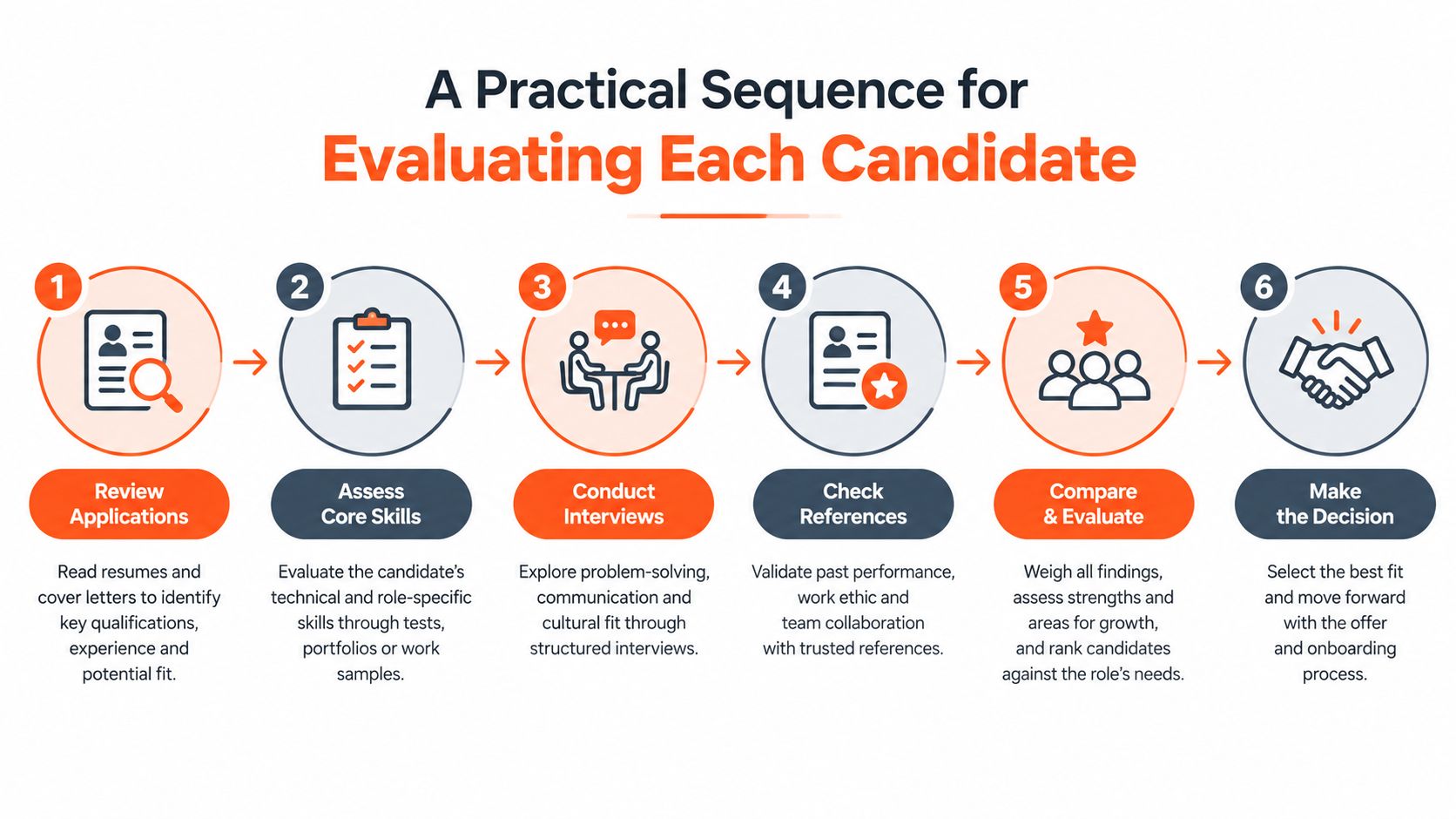
After the shortlist, the sequence continues into structured interviews, a work sample where it makes sense, and references for the finalists. Salary.com's sixth step is further background checks, which it says "might include reference checks, verification of qualifications, and, in some cases, criminal record checks." Before you call anyone, review the legal guardrails for reference checks, and if the role is an executive assistant, use a prepared set of executive assistant interview questions so every finalist is asked the same things.
Before you book a single interview, run the list you received (or built) through three checks. The name comes from the funnel arithmetic above: 3 live interviews per 1 hire in Virtustant's vetting funnel. The thresholds are a suggested decision rule, not a market benchmark.
| Check | How to calculate it | Pass rule (suggested) | If it fails |
|---|---|---|---|
| 1. Essentials coverage | Profiles meeting every essential ÷ profiles on the list | 100% | Remove the profile; it should never have been shortlisted |
| 2. Evidence completeness | Evidence items present ÷ (5 items × profiles on the list) | 100% before interviews | Ask for the missing items first; do not interview around a gap |
| 3. Meet count | Profiles you actively want to meet | 3 or more | 1–2: meet them and request a top-up in parallel. 0: send the list back with what is missing |
Worked example. You receive a shortlist of 5 for a part-time operations assistant.
The test does two useful things. It moves the argument about quality from gut feel to three countable facts, and it tells you when the problem is upstream. If Check 1 keeps failing, the criteria were not clear in the brief. If Check 3 keeps coming back at 0 or 1, the job description, the rate, or the schedule is off, and more interviews will not fix it. Revisit the brief; Virtustant's pricing page and the discovery call are where rate and hours get scoped.
Internal and agency shortlists solve different problems. An internal recruiter knows the team, the manager's preferences and the unwritten expectations. A staffing partner brings a wider candidate pool and a screening workflow that already exists. The honest trade-off is context versus capacity.
| Factor | In-house shortlist | Agency shortlist (Virtustant model) |
|---|---|---|
| Role context | Deep knowledge of team and priorities | Depends on the intake call and the job description |
| Who does the screening work | Your team: sourcing, screens, tests (about 37 screens and 15 tests for a 5-person list at the funnel's ratios) | The agency's recruiters, before anything reaches you |
| Time to first shortlist | Depends on your team's capacity | First shortlisted candidates within 48 hours of an approved job description |
| Shortlist size | Whatever you decide | 3 to 5 vetted candidates |
| Evidence per profile | Whatever your process captures | Video introduction, résumé, English level, assessment results, recruiter's notes |
| Fees | No invoice, but the hours are real | Zero recruitment or placement fees; you pay the hourly rate |
The in-house route wins when the role depends on knowledge an outsider cannot assess without heavy calibration. The agency route wins when managers keep getting pulled into résumé review, or when there is no reliable skills test in place. Either way, count manager hours as a cost. If you are comparing providers, how staffing agencies charge explains the fee models, and the remote staffing agency comparison lays out delivery models and how much work each leaves with the client.
This is the process in Virtustant's client templates, described as it runs today.
Virtustant first-party data. Vetting funnel: 100% apply, 22% pass the recruiter screen, 9% pass skills and English testing, 3% reach a live interview, 1% are hired, which is what "top 1%" refers to. Time to fill: across 468 placements in the 12 months to 23 Sep 2026, the average was 11.2 days from opening a search to the professional's start date. How that compares with market benchmarks is covered in the time-to-hire guide.
The commercial terms are simple: zero recruitment or placement fees, month-to-month, and a lifetime replacement guarantee with no time cap. None of those terms is unusual on its own; the combination of a 48-hour evidenced shortlist, no placement fee and lifetime replacement is what the model is built around. After the hire, an account manager becomes your main point of contact and coordinates onboarding, start date, tools access and the first-week plan; the remote onboarding guide covers what that first week should look like on your side. The full list of roles is on the services page.
Salary.com's first step for shortlisted candidates is to communicate on time: "Notify candidates whether they've advanced to the next stage of the hiring process or if they've been eliminated." A shortlisted candidate has cleared a gate and is more invested, which also makes them more visible to competing employers. The period between shortlist and decision needs an owner.
Once someone is hired, tracking skills and performance becomes a separate job with its own tools. In Italy, for example, la piattaforma Spark per HR is a Milan-based HR software platform for OKRs, 360° reviews and AI skills mapping. The point for a small team is the same with or without software: the evidence you gathered at shortlist stage is the baseline you will measure the first months against.
A small team does not need an applicant tracking system to run a disciplined shortlist. A shared sheet with the criteria, the five evidence items and a one-line reason per candidate is enough. The requirement is consistency, not software.
If you would rather receive the shortlist than build it, Virtustant sends 3 to 5 vetted candidates, each with a video introduction, résumé, English level, assessment results and recruiter's notes, within 48 hours of an approved job description, with zero recruitment or placement fees. See rates on the pricing page or start from the Virtustant homepage.
It means you passed the first review and met the employer's minimum requirements, so you are still being considered. Salary.com describes a shortlisted candidate as someone who has met the baseline for shortlisting and is being considered for further evaluation. It is not an offer; you still need to do well in the interviews or assessments that follow.
There is no fixed rule. Indeed suggests deciding the length before you review applications, weighing applicant volume and interview capacity when choosing between five or ten. Virtustant sends a first shortlist of 3 to 5 vetted candidates; for reference, its vetting funnel moves three candidates to a live interview for every one it hires.
Each profile should carry the same evidence so candidates can be compared fairly: a video introduction, the résumé, a tested English level, assessment results, and a recruiter's note on why the candidate made the list and what is still unverified. Put availability, weekly hours and time zone at the top.
Set essential and desirable criteria before reading applications, score essentials as pass or fail, and have each reviewer score independently before discussing. The LSE guide says to shortlist only those who meet all essential criteria and to use desirable criteria to narrow a large group. Record the reason for every decision.
Screening checks whether an applicant meets the minimum requirements. Shortlisting ranks the qualified applicants and decides which of them earn the hiring manager's interview time. Screening removes mismatches; the shortlist hands the manager comparable, evidenced profiles.
The first shortlisted candidates land in your candidate tracker within 48 hours of an approved job description. Across 468 placements in the 12 months to 23 Sep 2026, the average from opening a search to the professional's start date was 11.2 days.
You tell Virtustant what is missing and the search is adjusted the same day. If the same gap keeps appearing, the brief itself usually needs work: the criteria, the rate or the schedule.
No. Virtustant charges zero recruitment or placement fees. You pay the hourly rate for the remote professional you hire, month-to-month, with a lifetime replacement guarantee and no time cap.