How to Reference Check Remote LATAM Hires
September 14, 2026


Six out of ten employers rejected a candidate or failed to confirm an appointment in the prior year because of an unfavourable reference, according to research summarised by Personnel Today. A reference check is not a polite final formality: it is the last point at which new evidence can still change the decision, and that matters most when you are hiring a remote professional in Latin America and cannot rely on a shared network to fill the gaps.
How to reference check remote LATAM hires: obtain written permission, test one or two role-specific risks with structured behavioral questions, speak with relevant managers or peers in the right language, document exact answers, and score the evidence against the job's risk profile. Don't ask whether someone is “good.” Ask what they did, under what conditions, and what happened next.
Reference checks remain a meaningful hiring filter because they can change the decision at the point where a manager is closest to making an offer. Research summarized by Personnel Today found that six out of 10 employers had rejected a candidate or failed to confirm an appointment because of an unfavorable reference in the prior year. The same summary reported that 15% had changed employment decisions three or four times because of references, while 10% had changed decisions five or more times (Personnel Today reference-check research).
That evidence should change how U.S. founders think about remote LATAM hiring. A candidate may have passed a staffing agency's screening, performed well in interviews, and completed a work sample. None of those steps tells you how they handled a missed deadline with a U.S. manager, whether they accepted difficult coaching, or whether their remote discipline held up when priorities changed.
Reference checking is also not an unusual practice reserved for cautious corporations. A 2015 SkillSurvey poll reported that about 70% of respondents reference checked every job candidate, rising to 84% for executive-management hires. The poll placed reference checking just behind background screening as a source of candidate insight, ahead of skills, behavioral, and personality assessments (HR Dive coverage of the SkillSurvey poll). That poll is a decade old, which is worth saying plainly: treat it as evidence that the practice is normal, not as a current adoption rate.
For a remote LATAM hire, a strong check is a targeted risk probe, not background verification. I usually define the highest-risk unknowns before contacting anyone:
My preferred evidence set is two direct-manager references from the last five years and one peer reference, where the role justifies that depth. I want a real video conversation, usually in English, Spanish, or Portuguese, with translated confirmation when needed. A short “yes, they were great” email is weak evidence.
Operator rule: If the question could be answered from the résumé, it usually doesn't belong in the reference call.
Use consistent questions, record the reference's relationship to the candidate, and write down examples instead of collecting approval statements. That keeps the evaluation tied to observable job behaviour rather than personal impressions, which is also what makes the process defensible if a rejected candidate ever asks how the decision was made.
For U.S. teams considering nearshore staffing, the practical framework is simple: identify the risk, secure permission, ask the same core questions, probe specific examples, and score the evidence before extending an offer.
Start with written consent, not a call. Send the candidate a bilingual authorization that names the references you may contact, the purpose of the check, the languages that may be used, whether a translator may participate, and how the notes will be stored. Keep the signed authorization with the candidate record before anyone dials.
The candidate should control the first reference list. Don't contact a current employer, a person the candidate has expressly excluded, or an undisclosed back-channel contact without explicit permission. The U.S. Office of Personnel Management guidance summarized by SHRM recommends informing the candidate, obtaining permission, describing the position to the reference, asking consistent questions, and clarifying conflicts with the candidate afterward (compliant reference-check practices).
Candidate-supplied references are cleaner because the candidate can confirm the relationship, language, availability, and consent. They're also more likely to answer a scheduled call. Ask for direct managers, close peers, and, for people-leadership roles, former direct reports where appropriate.
If the list is thin, use blind LinkedIn mapping only as a fallback. Map the candidate's reported employer, team, title, and reporting line, then ask the candidate to approve any contact before outreach. Blind outreach can create privacy problems and can damage trust before the candidate joins your team.
For U.S. companies hiring nearshore, time-zone planning matters. Offer windows that work across CST, COT, ART, BRT, and UTC-3 to UTC-6, and make 20 minutes the default appointment. A reference who can't make a long meeting may still provide excellent evidence in a focused call.
Before scheduling, fill in this short brief:
If the call is bilingual, decide who translates before the meeting. A bilingual interviewer is preferable, but a qualified translator can work if the translator stays neutral and preserves the reference's wording. Don't record by default. Recording rules vary, so disclose the recording, obtain the required agreement, and store it only when your privacy process permits it.
The same OPM framework recommends deciding in advance who conducts the check, preparing role-specific questions, contacting multiple reference types when relevant, clarifying contradictions, and storing results under policy. That preparation is what turns a conversation into usable hiring evidence.
Generic reference questions invite socially desirable answers. Behaviorally anchored questions force the reference to recall a situation, the candidate's action, and the result. That structure mirrors a STAR-shaped probe without turning the call into an interrogation.
Use the matrix below as a working script. Keep the wording consistent across finalists, then add role-specific follow-ups only where the answer creates uncertainty.
| Generic Question (Avoid) | Why It Fails | Behaviorally Anchored Replacement |
|---|---|---|
| “Was the candidate reliable?” | “Reliable” means different things to different people. | “Tell me about a deadline the candidate owned that was at risk. When did they alert you, what did they do, and what was delivered?” |
| “Did they manage operations well?” | It invites broad praise without evidence. | “Describe a process the candidate improved. What problem existed, what action did they take, and what changed afterward?” |
| “How did they handle pressure?” | Pressure isn't defined, and the answer is easy to polish. | “Tell me about a period when priorities changed quickly. How did the candidate communicate tradeoffs and protect the most important work?” |
| “Were they good at handoffs?” | The reference may not remember specific cross-functional work. | “Walk me through one handoff between the candidate's team and another function that went wrong. What did the candidate do next?” |
| “Did they hit quota?” | A single result hides trajectory, territory, and context. | “How did the candidate's quota performance develop during your time together? Give an example of a strong or weak period and the behavior behind it.” |
| “Were they organized in the CRM?” | The reference may not use the same definition of hygiene. | “When did outdated CRM information create a sales problem, and how did the candidate correct or prevent it?” |
| “Was the candidate a strong salesperson?” | It produces a personal opinion, not observable evidence. | “Describe a deal the candidate lost or rescued. What did they control, what did they miss, and what did they learn?” |
| “Was their financial work accurate?” | Accuracy needs a concrete control or error. | “Tell me about a reconciliation or reporting error involving the candidate. How was it found, corrected, and prevented from recurring?” |
| “Did they do well in audits?” | “Do well” doesn't reveal findings or ownership. | “What audit finding touched the candidate's work, and how did they respond to the finding?” |
| “Could you trust them with confidential data?” | The answer may reflect trust, not actual behavior. | “Describe a situation where the candidate handled sensitive financial or customer information. What controls did they follow?” |
| “Did they work well remotely?” | It doesn't test communication under real conditions. | “Tell me about a remote project where the candidate had to work across time zones. How did they manage updates, delays, and availability?” |
| “Would you rehire them?” | Useful only when followed by reasons. | “Would you rehire the candidate for this role? What specific behavior supports your answer, and what role would you not place them in?” |
For operations hires, prioritize deadline slippage, process ownership, and cross-functional handoffs. For sales roles, investigate quota trajectory, pipeline discipline, and CRM hygiene. For finance roles, test reconciliations, audit findings, approval controls, and confidential-data handling.
Ask how the reference knows the candidate and how closely they worked together before accepting any evaluation. Then probe three cross-cutting areas:
Don't lead the witness with “I heard there was a conflict” or “The candidate said they left for growth.” Ask open questions first, then reconcile the accounts afterward. A structured reference check adds the most signal when it tests job competencies rather than merely confirming résumé facts, and the long-standing Schmidt and Hunter meta-analysis of selection methods places reference checks at a validity coefficient of about .26, against roughly .51 for structured interviews and .54 for work-sample tests. Read that as a ranking, not a verdict: a reference check is a weaker predictor on its own, which is exactly why it belongs after a skills test rather than instead of one.
Teams adding structured evaluation to nearshore hiring with Virtustant assessments should use the call to investigate what interviews and work samples can't reveal, not duplicate them.
“Can you describe the analyst's responsibilities?”
“He supported operations. I can confirm his dates.”
“Did he manage deadlines and communicate issues early?”
“I'd rather not comment on performance.”
That exchange with a Colombian operations lead isn't automatically disqualifying, but it gives you a clear next move. The reference may face legal or company-policy limits, or may not have worked closely enough with the candidate. Don't fill the silence with assumptions. Ask what the reference is authorized to confirm, then contact another approved reference.
Some signals justify pausing the offer immediately:
A timing discrepancy matters more for a finance hire claiming ownership of a reporting cycle than for a junior administrative role with limited scope. A vague role description is particularly serious when the candidate is being hired as an operations lead, because the reference should be able to explain what the person owned.
Hesitation can mean caution, not misconduct. Probe it. Ask, “What makes that question difficult to answer?” and “Who else worked closely enough with the candidate to speak to that behavior?”
Watch for deflection around termination context, especially when the reference repeatedly changes the subject. Also notice managers who redirect praise to team output instead of describing the candidate's personal contribution. That doesn't prove poor performance, but it does mean you need individual examples.
| Signal Type | Example on the Call | Recommended Action |
|---|---|---|
| Hard stop | “I can't confirm this person held that title.” | Pause and reconcile with the candidate before proceeding. |
| Hard stop | The reference gives dates that don't match the résumé. | Request documentation or a second direct-manager reference. |
| Hard stop | The reference only confirms dates and refuses role questions. | Treat the check as incomplete, not positive. |
| Soft signal | Long hesitation before answering about teamwork. | Ask for a specific collaboration example. |
| Soft signal | The manager praises the team but not the candidate. | Ask what the candidate personally delivered. |
| Soft signal | The reference redirects questions about departure. | Ask neutrally for the documented reason and seek another perspective. |
My heuristic is blunt: if two references produce the same red flag, treat it as confirmed. One ambiguous answer deserves investigation. Repeated ambiguity is a decision signal.
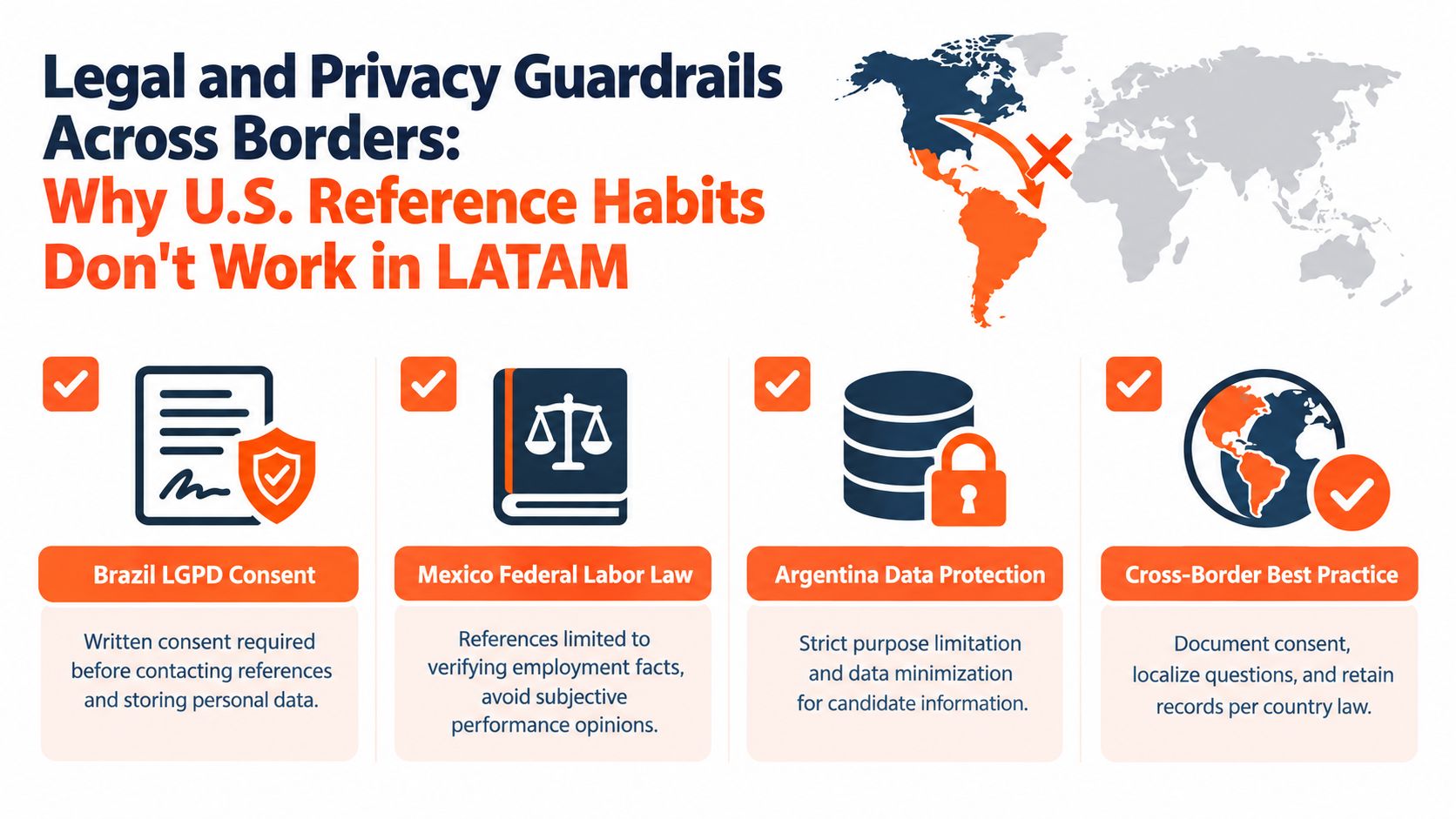
U.S. reference habits don't automatically travel into Latin America. The legal question isn't only whether a reference is willing to talk. It's whether you had the right consent, collected information for a legitimate purpose, limited the questions to the role, and stored the answers responsibly.
For Brazil, build the process around LGPD consent and data handling. Written permission should cover contacting the reference and retaining personal information from the conversation. In Mexico, keep the script narrow and factual, particularly around employment dates, title, and duties. Avoid pushing a manager to provide subjective performance opinions when local rules or employer policy restrict that disclosure.
Argentina requires careful attention to purpose limitation and data minimization. If the role only requires evidence of financial-control experience, don't collect unrelated personal information. Quebec adds another important constraint. Its privacy regulator says reference checks should generally occur only after a conditional offer, require explicit consent, and be limited to information necessary for the role (Quebec hiring privacy guidance).
Your consent template should be one page, bilingual where required, and signed by the candidate before outreach. Include:
Colombia, Chile, and Costa Rica increasingly use consent norms that resemble GDPR-style expectations in practical hiring operations. Treat that as a reason to standardize permission and minimum-necessary collection, not as permission to use one generic script everywhere.
Compliance rule: Employment verification and performance opinion are different activities. Get explicit authorization before moving from facts to evaluation.
Treat the written note, not the phone call, as the moment the obligation attaches: once an oral answer is recorded in a hiring file it becomes personal data in a record, with the retention, access and minimisation duties that follow. That is the operational point for cross-border teams, whatever the local regime is called.
For teams managing cross-border employment administration, compare the reference process with broader nearshore payroll with Virtustant compliance workflows before assigning responsibility to a hiring manager who isn't familiar with local requirements.
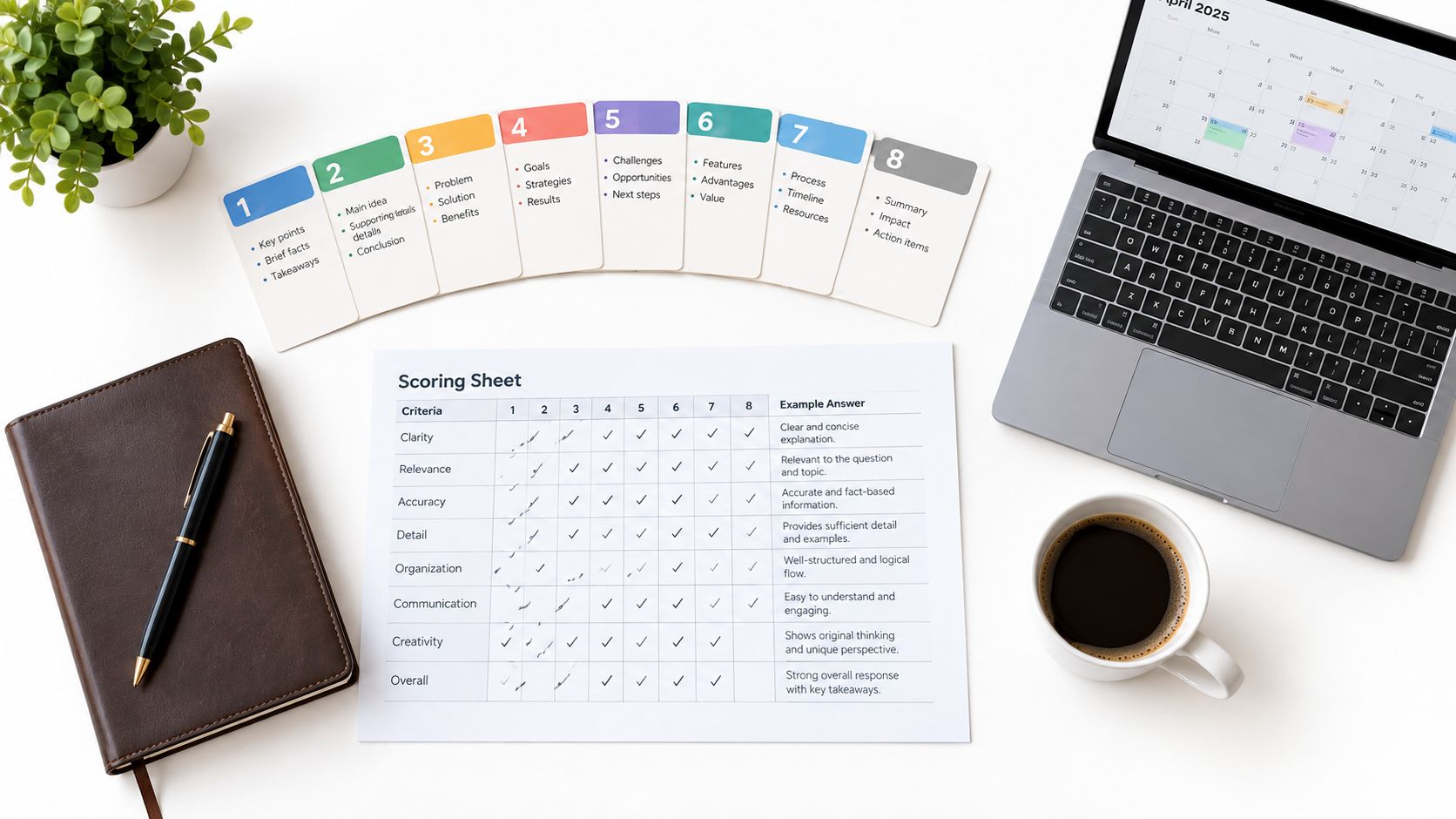
A reference call shouldn't end with “seems good.” Convert the conversation into structured evidence while the details are fresh. Use a four-axis score, with each axis rated from 1 to 5 and supported by a written explanation and one verbatim line.
The four axes are:
A score without evidence is worthless in a hiring dispute. Require one exact line from the call for every axis, with a timestamp if you recorded the conversation lawfully. If you didn't record, note the time of the statement in your call notes and preserve the wording as accurately as possible.
| Axis | Score (1-5) | Required Quote | Weight (0.5x-2x) |
|---|---|---|---|
| Role-relevant competence | |||
| Integrity markers | |||
| Collaboration fit | |||
| Rehire probability |
Store the sheet in the ATS, a controlled Notion page, or a restricted Google Doc. Record the reference's name, title, relationship, organization, call date, language, translator if used, consent status, and any unresolved contradiction. Don't put sensitive personal information in a general hiring channel.
A generic average hides risk. If the candidate is joining finance, assign the highest weight to integrity markers or confidential-data handling. If the candidate will manage a distributed support team, weight collaboration fit and coachability. If the role is deadline-heavy operations, weight competence around prioritization and remote discipline.
Use the score as decision support, not as an automatic rejection engine. A low score on the highest-risk axis should trigger a second reference, a candidate clarification, or a pause. It shouldn't be buried under strong scores on less important traits.
The scoring sheet should sit beside your other evidence, including pre-employment skills assessment samples. Reference calls explain behavior in context. Work samples show capability in a controlled task. Neither replaces the other.
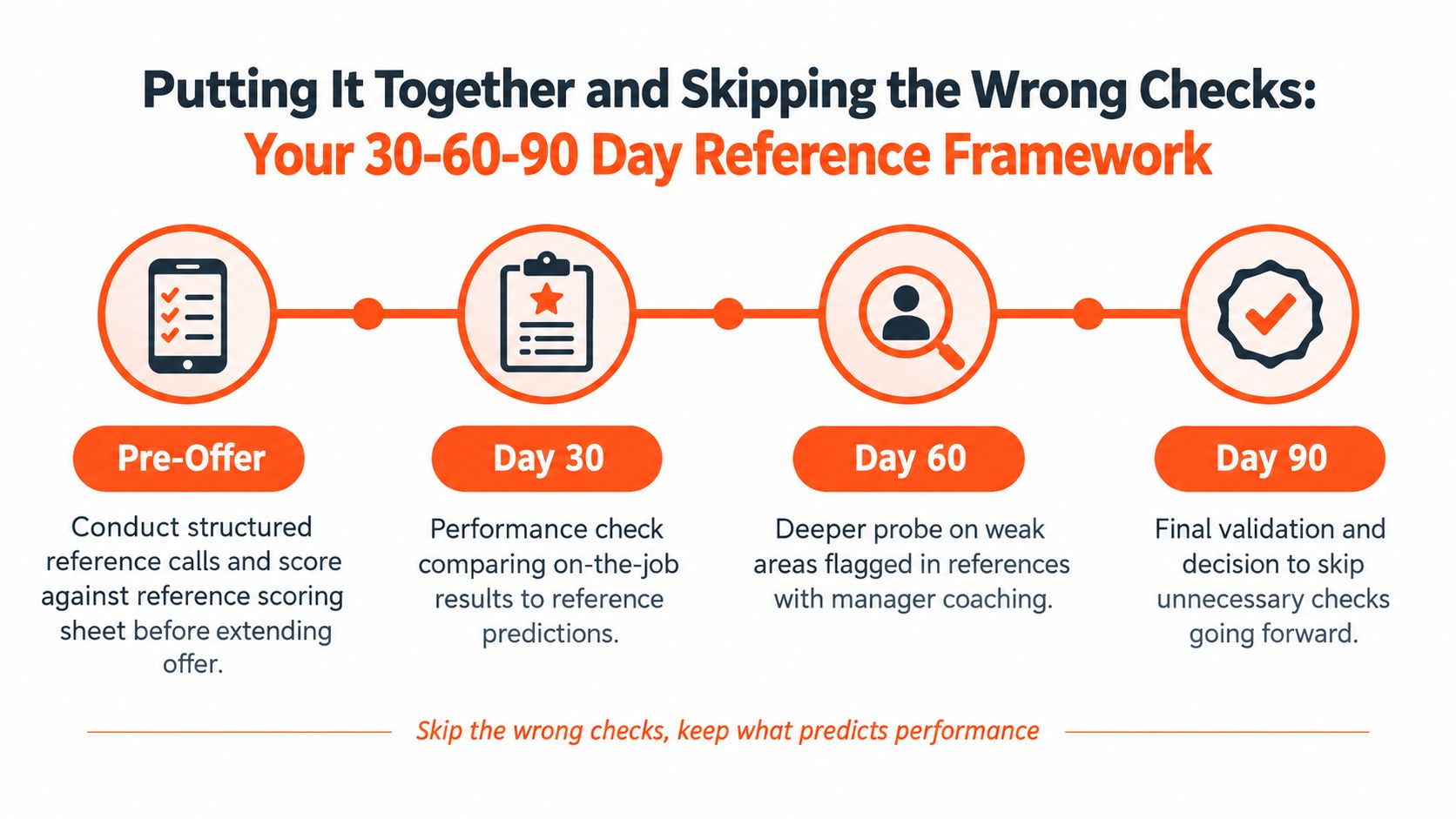
Reference checking works best as the last targeted filter in a larger chain, not as a substitute for sourcing discipline, résumé verification, language screening, cognitive assessment, or role-specific work. For a remote LATAM hire, use the evidence on a 30-60-90 day cadence.
Before the offer, conduct the structured calls and score them against the risk hypotheses. At day 30, compare actual work behavior with the reference predictions. At day 60, revisit any weak signal, such as delayed escalation or poor handoffs, and pair the finding with direct manager coaching. At day 90, validate the pattern and decide which checks should remain part of future hiring for that role.
Don't repeat checks that add no new signal:
The point isn't to add more process. It's to spend time on the uncertainty most likely to produce a bad hire. If source vetting and résumé verification are weak, fix those upstream. If the candidate's skills are already tested, use the reference call for coachability, reliability, and collaboration instead of repeating the test.
Yes. Obtain written authorisation before outreach, name the references and the purpose, and follow local privacy and recording requirements. Do not contact a current employer or an excluded reference without express permission. Quebec's privacy regulator goes further and says reference checks should generally happen only after a conditional offer.
Use the same core questions for every finalist, then add role-specific probes tied to the same scorecard. Consistency protects fairness and makes answers comparable, and it is what makes the decision defensible if a rejected candidate asks how it was made.
Skip it when an equivalent, reliable record already answers the question, such as an employer-of-record verification letter for employment dates or documented performance evidence from a known internal manager. Do not skip it merely because the candidate already passed a general vetting process.
Less than most hiring teams assume. The long-standing Schmidt and Hunter meta-analysis of selection methods puts reference checks at a validity coefficient of about .26, against roughly .51 for structured interviews and .54 for work-sample tests. Treat the reference call as confirmation after a skills test, not as a substitute for one.
A reference who cannot confirm the working relationship the candidate described, a refusal to say whether they would work with the person again, contradictions on dates or scope that the candidate cannot reconcile, evidence of dishonesty rather than underperformance, and any account of a confidentiality or security breach. One of those outweighs a strong average across the rest of the call.
The mechanics are the same, the guardrails are not. Get bilingual written consent, keep the questions tied to the role, apply data minimisation so you collect only what the role requires, and confirm the reference's own working relationship with the candidate before you weigh anything they say. Virtustant runs experience and reference verification as the fourth stage of its vetting funnel, before a client ever sees a profile.
Virtustant offers sourcing, structured vetting, reference verification, contracts, payroll, HR, and compliance for remote professionals across Latin America, with a replacement guarantee for hires who leave. Compare that workflow with your current reference-check process on the remote staffing services page, or see the candidate vetting process in full.