What Is a Cognitive Assessment for Hiring
September 8, 2026


Search for what is a cognitive assessment and almost everything you find describes a medical procedure: a short screen a doctor administers to check for memory loss or dementia. Search for a cognitive test to use in hiring and you get aptitude batteries sold to recruiters. The two share a name, a handful of domain labels, and essentially nothing else.
Confusing them is the most common and most expensive mistake in this area. A clinical screen is built to detect impairment against an expected baseline. An employment test is built to spread normal-range adults by how quickly they absorb unfamiliar material. Using one where the other belongs produces a score that looks authoritative and predicts nothing, and in the United States it can also create legal exposure.
This article covers what each instrument actually measures, what the validity evidence says after a significant 2022 correction, how to read a score without overreading it, and where cognitive testing belongs in a remote hiring funnel for teams building in Latin America.
A cognitive assessment, in the clinical sense, is a structured evaluation used to identify cognitive impairment. That is the definition used in the NCBI review of neuropsychological assessment, and it is the sense that dominates almost every general search result on the topic. The Cleveland Clinic describes the same category of instrument: a short set of questions and tasks covering attention, decision-making, judgment, language, learning, reasoning, memory and understanding, with examples such as recalling three unrelated objects or solving simple arithmetic.
Read those examples as a hiring manager and the problem becomes obvious. Recalling three words and drawing a clock face will not separate a strong project manager from a weak one. It was never meant to.
| Clinical cognitive assessment | Employment cognitive ability test | |
|---|---|---|
| Question it answers | Is this person's cognition impaired relative to expected function? | How quickly will this person learn an unfamiliar role? |
| Typical instruments | MoCA, MMSE, Mini-Cog, SAGE | General mental ability and aptitude batteries |
| Norm group | Matched on age and education, sometimes against a clinical population | Working-age applicant pools |
| What a low score suggests | Possible impairment warranting medical follow-up | A slower ramp on novel, complex material |
| Score distribution | Built to detect a floor. Most healthy adults cluster near the maximum | Built to spread normal-range adults across a range |
| Who administers it | A clinician | An employer or an assessment vendor |
| U.S. hiring status | Generally treated as a medical examination, which is restricted before an offer | A selection procedure that must be job-related and consistent with business necessity |
The row that matters most is the score distribution. A clinical screen is designed so that cognitively healthy adults nearly all score at or near the ceiling. That is a feature: it makes the instrument sensitive to impairment. It also makes it useless for ranking healthy applicants, because almost everyone gets the same result. An employment battery is built the opposite way, with enough difficulty and range that scores spread across the applicant pool.
The rule: if a test is designed to find a floor, it cannot be used to find a ceiling. A clinical screen answers "is something wrong?" An employment test answers "how fast will this person get up to speed?" Neither answers the other question, no matter how similar the domain labels look.
The legal point is worth stating plainly. In the United States, a cognitive instrument designed to detect impairment is generally treated as a medical examination, and medical examinations are restricted before a conditional offer. An employment aptitude test is treated as a selection procedure and must be job-related. This is a general description of the distinction rather than legal advice, and any assessment program should be reviewed with employment counsel before it goes live.

An employment battery earns its place only when each task maps to a domain and each domain maps to a real requirement of the job. Otherwise the composite score is a number without a referent.
| Cognitive domain | What the task looks like | Where it shows up in the job |
|---|---|---|
| Verbal reasoning | Drawing a conclusion from a short written passage | Reading a client brief correctly the first time |
| Numerical reasoning | Interpreting a table or computing a rate | Reconciling accounts, checking a discount, catching a bad figure |
| Working memory | Holding and manipulating several items at once | Managing an interruption without losing the thread of a task |
| Processing speed | Simple decisions made quickly and accurately | High-volume queues: inbox triage, chat support, data entry |
| Attention and inhibition | Sustained focus while suppressing an obvious wrong answer | Catching the exception in routine work instead of pattern-matching past it |
| Planning and shifting | Sequencing steps, then adapting when a rule changes | Reprioritizing when a client moves a deadline |
| Spatial and visual perception | Manipulating shapes or spotting visual differences | Design QA, layout work, reviewing a mockup against a spec |
Granularity helps here, but only if someone interprets the sub-scores against the job. One published cognitive test inventory is made up of 17 tasks measuring 22 cognitive skills, including working memory, short-term memory, divided attention, inhibition, visual perception, planning, shifting and processing speed. That level of detail lets a team investigate a specific concern rather than react to one composite figure.
A customer support agent needs sustained attention, verbal reasoning and judgment more than visuospatial manipulation. A data analyst needs numerical reasoning and problem-solving weighted heavily. An executive assistant needs memory, planning, language and the ability to shift between priorities, which will predict more than raw speed. A single abstract puzzle cannot stand in for any of these.
Write the weighting down before you look at a single score, based on the job analysis. Deciding which domains matter after seeing the results is how a test becomes a rationalization for a decision already made. For a practical view of how different jobs are evaluated, review the remote roles we staff, and compare formats against these pre-employment test samples.
Almost every vendor page and hiring article still quotes the same figure: general cognitive ability predicts job performance at a corrected validity of around 0.51, second only to work samples. That number comes from Schmidt and Hunter's 1998 meta-analysis and it was the standard answer for twenty-four years.
It was revised downward. In 2022, Sackett, Zhang, Berry and Lievens published a re-analysis in the Journal of Applied Psychology showing the 1998 estimates had been systematically overcorrected for range restriction. In the corrected figures, cognitive ability comes in at 0.31 and ranks fifth, not first or second.
| Selection method | Schmidt & Hunter (1998) | Sackett et al. (2022) | Rank in the revised estimates |
|---|---|---|---|
| Structured interview | r = 0.51 | r = 0.42 | 1st |
| Job knowledge test | r = 0.48 | r = 0.40 | 2nd |
| Empirically keyed biodata | Not in the tier cited here | r = 0.38 | 3rd |
| Work sample test | r = 0.54 | r = 0.33 | 4th |
| Cognitive ability (GMA) | r = 0.51 | r = 0.31 | 5th |
The 1998 coefficients are as cited in the Cogn-IQ 2025 research review; the revised coefficients are from the 2022 re-analysis as summarized by the Society for Industrial and Organizational Psychology. Our companion guide to pre-employment test samples walks through the full comparison across all eight assessment types.
Two things follow, and they point in opposite directions from the usual advice.
These are also average validities across many jobs. A coefficient of 0.31 does not mean cognitive ability is unimportant for a specific analytical role where it may matter considerably more. Use the number to size your confidence, not to settle the question.
Short screens are attractive because they are easy to administer. They produce a fast filter, hand recruiters a clean number, and appear to cut review time. The cost is hidden in the psychometrics.
There is a hard ceiling here that no vendor can market around: a test cannot correlate with job performance more strongly than the square root of its own reliability. Reliability rises with the number of items. A fifteen-to-twenty item, ten-minute screen is therefore capped at a lower validity than a full-length battery measuring the same construct, before anything else is considered. That is a property of measurement, not a criticism of any particular product.
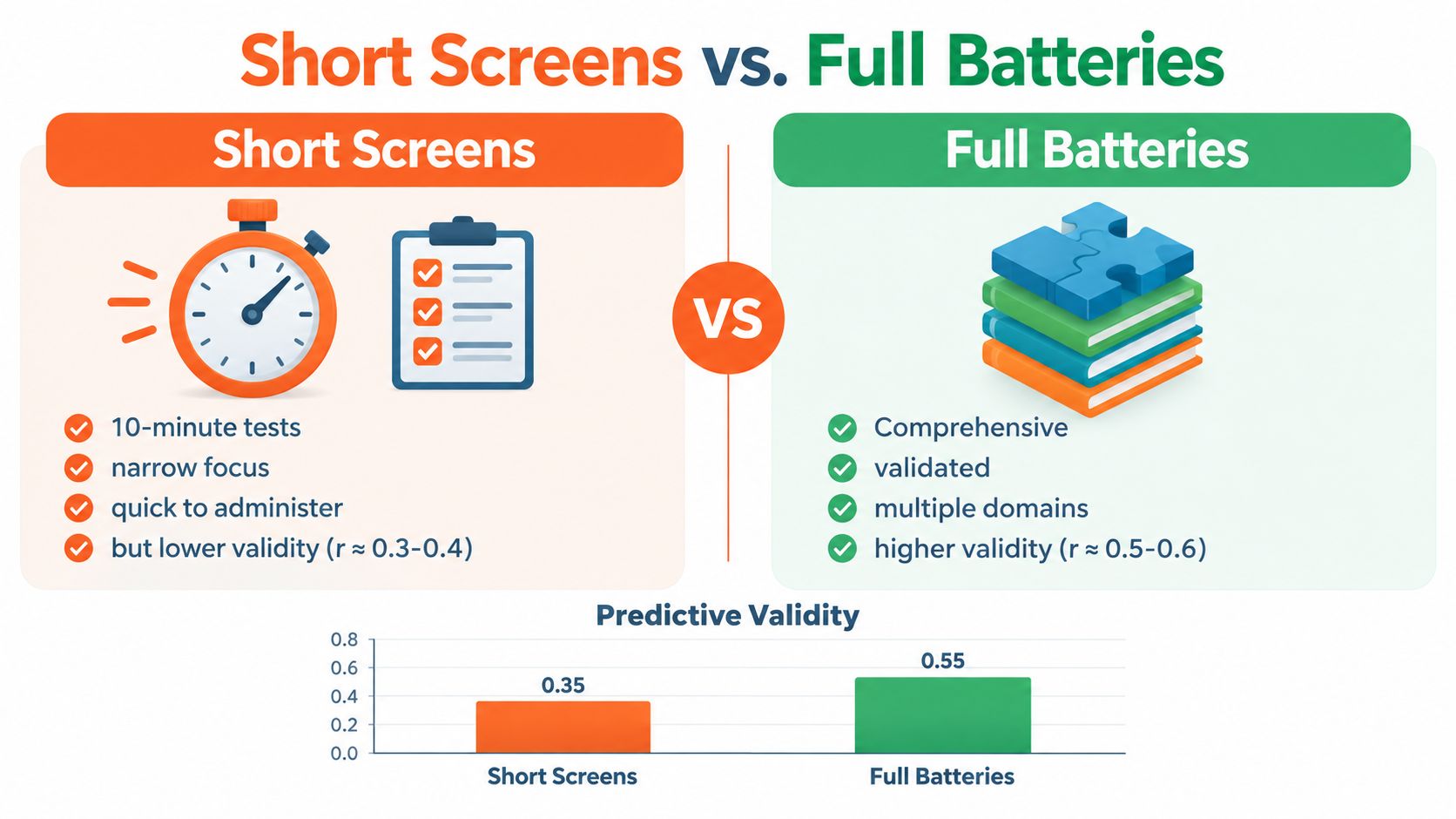
The practical failure modes follow from the same narrowness. A short screen may overweight one skill, usually rapid pattern recognition, while missing language comprehension, working memory, judgment and sustained attention. And because each item carries more weight when there are fewer of them, a short test magnifies the effect of test familiarity, device conditions, anxiety and an unstable connection. A candidate who loses ninety seconds to a dropped connection loses a far larger share of a ten-minute test than of a forty-minute one.
Use a short screen where a short screen belongs: as a very early, high-volume filter with a low cutoff, set to remove the clearly unsuitable rather than to rank the promising. Rank with something longer, or do not rank on cognitive data at all.
Cognitive results arrive as percentiles against a norm group, which means the first question is always: which norm group? A 70th percentile against a general adult population and a 70th percentile against a screened applicant pool for the same role are different results. Ask the vendor before you interpret anything.
A candidate scores around the 70th percentile on reasoning and around the 40th percentile on processing speed. The wrong reading is "mixed result, probably a no." The right reading depends entirely on the job.
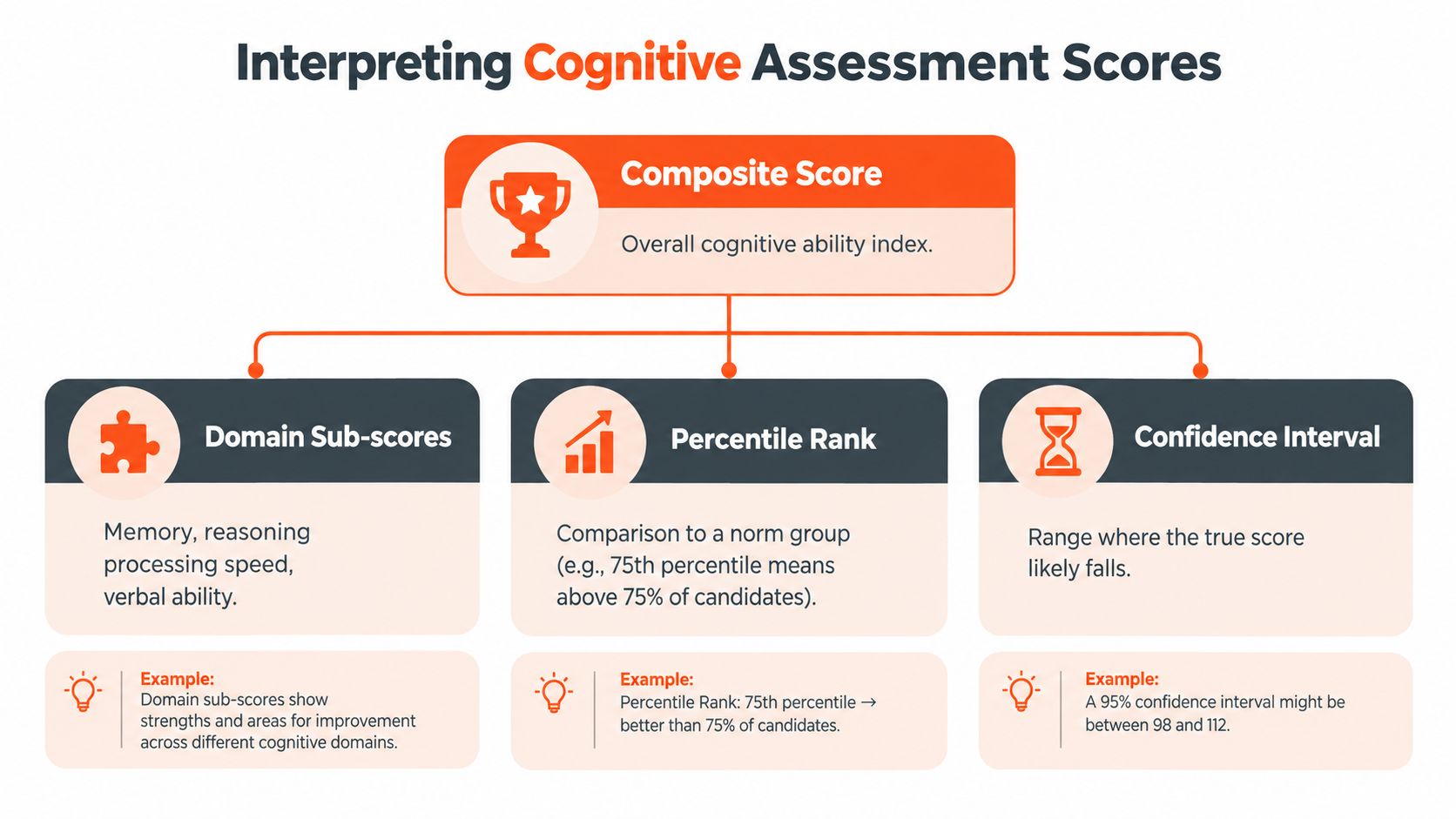
Three rules keep this honest. Do not set one universal cutoff across every role, because different jobs need different combinations. Use bands rather than point scores, since the difference between the 68th and 72nd percentile is measurement noise, not a finding. And treat a surprising result as a question, not a verdict: a strong candidate with one weak domain deserves a role-specific task before anyone concludes the weakness is real rather than a testing artifact.
Then corroborate. A cognitive score that is not confirmed by a work sample or a structured interview is a hypothesis. The structured interview is the higher-validity instrument, so let it carry more weight, and use unique questions for LATAM hires to make it specific rather than generic.
Cognitive tests carry real adverse-impact risk, and remote administration adds a second layer of noise that has nothing to do with ability. Both are manageable, but only deliberately.
Candidate experience is not a soft concern here. A long, technically demanding test that feels unrelated to the job drives strong candidates out of the funnel before you ever see them, and the strongest candidates have the most alternatives. Teams that want to reduce interview note-taking and keep hiring signals organized sometimes add tooling at the interview layer, such as ParakeetAI hiring assistant. No tool substitutes for validated assessment design, accommodation procedures or human review of the decision.
For teams weighing these tradeoffs while building a first distributed team, we cover the wider set of concerns in Virtustant remote hiring in LATAM.
Cognitive assessment is a filter, not a decision. It belongs early, where it is cheap and applies to everyone, and it should be overruled by later, more direct evidence whenever the two disagree.
Each stage answers a different question, and none of them answers another stage's question. Language screening asks whether the candidate can be understood. Cognitive testing asks how fast they will learn. Skills testing asks whether they can do the work now. Verification asks whether the history is accurate.
Virtustant applies this as a four-stage model combining live spoken-English screening, cognitive assessment, role-specific skills testing and experience or reference verification, which narrows an applicant pool of 100% to roughly 22%, then 9%, then 3%, then the top 1% presented to clients. You can review how Virtustant staffs remote roles to see how the sequence runs in a managed context.
The operator-level principle: cognitive data narrows the search, skills evidence earns the interview, and verification protects the decision. If a cognitive score is doing more work than that in your process, it is doing too much.
In clinical use, a cognitive assessment is a structured evaluation used to identify cognitive impairment, covering domains such as memory, attention, language, reasoning and processing speed. In hiring, a cognitive ability test is a different instrument built for a different purpose: it measures how quickly someone reasons through and learns unfamiliar material, and is designed to spread normal-range adults rather than to detect impairment.
No. Those instruments are built to detect impairment against an expected baseline, so cognitively healthy adults cluster at or near the maximum score and the test cannot separate them. In the United States such a test is also generally treated as a medical examination, which is restricted before a conditional offer. Use an employment aptitude battery validated for selection, and confirm your program with employment counsel.
The widely quoted figure of around 0.51 comes from Schmidt and Hunter's 1998 meta-analysis. The 2022 re-analysis by Sackett, Zhang, Berry and Lievens corrected an overcorrection for range restriction and put general cognitive ability at about 0.31, fifth behind structured interviews at 0.42, job knowledge tests at 0.40, biodata at 0.38 and work samples at 0.33. It remains a genuine signal, but a weaker one than most vendor material suggests.
For an early high-volume filter with a low cutoff, yes. For ranking candidates, no. A test cannot correlate with job performance more strongly than the square root of its own reliability, and reliability rises with item count, so a 15 to 20 item screen is capped at a lower validity than a full battery measuring the same thing. Short tests also amplify the effect of anxiety, test familiarity and connection problems.
Set the policy in advance and apply it to everyone. A common approach allows one retake after a defined waiting period, with the second result used. Expect a modest practice effect on a repeat attempt, which is a further reason to treat scores as bands rather than exact values. An unplanned retake granted to one candidate and not another is a fairness problem.
General cognitive ability is stable in adults, so a result does not expire quickly the way a skills test on a specific software version does. Many teams treat results as current for about a year for internal reuse. The greater risk is not staleness but drift in the norm group and the job itself, so revalidate the cutoff against your own hiring outcomes rather than trusting an old score indefinitely.
No, and the evidence points the other way. In the revised 2022 estimates the structured interview is the stronger predictor, at 0.42 against 0.31 for cognitive ability. A cognitive test is cheap, automated and scalable, which makes it a good early filter. The interview, run with the same questions and a written rubric for every candidate, is what should carry the decision.
First check whether that domain is central to the job, because a low processing-speed score matters for a support queue and very little for a reconciliation role. Then test the concern directly with a role-specific task, a structured interview and references, rather than inferring a limitation from a sub-score. A single weak domain in an otherwise strong profile is more often a testing artifact than a finding.
Clinical definitions from the StatPearls cognitive assessment review on NCBI Bookshelf and Cleveland Clinic. Task and domain inventory from CogniFit. Validity coefficients from Schmidt and Hunter (1998) as compiled in the Cogn-IQ 2025 research review, and from Sackett, Zhang, Berry and Lievens (2022), Journal of Applied Psychology, as summarized by the Society for Industrial and Organizational Psychology. Last reviewed September 2026.
Virtustant helps U.S. companies evaluate and place vetted remote professionals across Latin America through a structured process that includes live English screening, cognitive assessment, role-specific skills testing and experience verification. Visit Virtustant to discuss a nearshore hiring workflow built around evidence rather than a single test score.