The best unique interview questions for employers are the ones a candidate cannot rehearse: questions about a belief they changed, a project that failed, and what their last manager would say they need to improve. A resume shows the professional background; the right mix of unique, casual and creative questions reveals how a candidate actually thinks, solves problems and handles pressure.
This guide gives you 51 questions across six banks, starting with the top 20 in a single list, plus a scoring rubric so the answers are comparable, the questions you must never ask, and a dedicated section on what to ask instead when you are interviewing remote and LATAM candidates, where the standard playbook breaks down.
The top 20 interview questions to ask candidates
If you only have time for one list, this is it. These 20 are a subset of the 51 below, not an extra set: the 12 judgment questions that do the heaviest lifting, the 5 warm-ups candidates expect, and the 3 remote-specific prompts that matter most when you will never share an office with this person. Each one is expanded, with the trait it surfaces and how to score it, in the sections that follow.
- What's a belief you held strongly five years ago that you've since changed your mind about?
- Tell me about a project that failed. What did you learn?
- If you joined and could fix only one thing in your first 90 days, what would it be?
- What would your last manager say you need to improve?
- Describe a time you disagreed with a decision. How did you handle it?
- Walk me through how you'd spend your first week in this role.
- What's something you taught yourself in the last year, and how?
- When you're stuck and no one's around to help, what do you do?
- What part of your last job would you be happy never to do again?
- How do you decide what to work on when everything feels urgent?
- Tell me about feedback that stung but turned out to be right.
- What questions do you have about how we actually work day-to-day?
- Can you tell me about yourself?
- Why are you interested in this position?
- What are your greatest strengths and weaknesses?
- Describe a challenging situation at work and how you handled it.
- Where do you see yourself in five years?
- Walk me through how you'd handle a day with zero meetings and an unclear priority list.
- Tell me about a time you flagged a problem to a manager you'd never met in person.
- Show me how you document a task so someone else can run it.
Ask 3 to 5 of them in a 45-60 minute interview, not all 20. The scoring rubric two sections down is what turns them into a comparable signal.
Which 12 unique interview questions reveal the most?
Standard questions get rehearsed answers. These twelve are built to get past the script: each one maps to a trait that predicts on-the-job success:
- "What's a belief you held strongly five years ago that you've since changed your mind about?". Intellectual honesty and a growth mindset.
- "Tell me about a project that failed. What did you learn?". Accountability and resilience versus blame-shifting.
- "If you joined and could fix only one thing in your first 90 days, what would it be?". How they prioritize and diagnose problems.
- "What would your last manager say you need to improve?". Self-awareness and candor.
- "Describe a time you disagreed with a decision. How did you handle it?". Communication style and conflict navigation.
- "Walk me through how you'd spend your first week in this role.". Initiative and planning.
- "What's something you taught yourself in the last year, and how?". Curiosity and self-direction (critical for remote roles).
- "When you're stuck and no one's around to help, what do you do?". Resourcefulness and async working style.
- "What part of your last job would you be happy never to do again?". Honest self-knowledge and motivation.
- "How do you decide what to work on when everything feels urgent?". Judgment under pressure.
- "Tell me about feedback that stung but turned out to be right.". Coachability and ego maturity.
- "What questions do you have about how we actually work day-to-day?". Whether they have seriously thought about the role.
How do you score the answers? A 4-point rubric
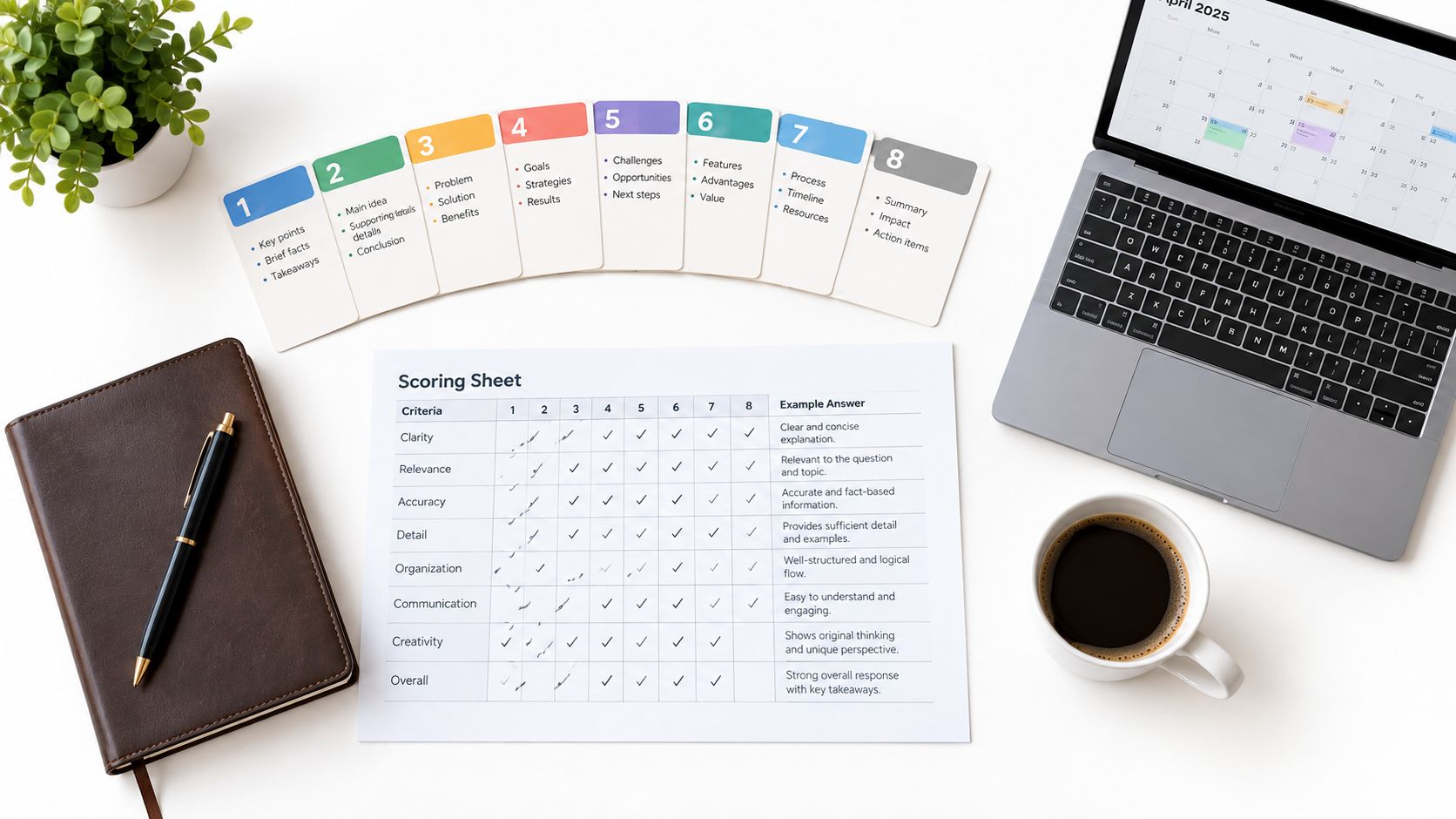
Unique questions are worthless if two interviewers walk out with two different impressions. Score every answer on the same four axes, 1 to 4, and write the number down before you move to the next question:
- Specificity (1-4). Did they name a real situation, a date, a number, a person's reaction? A 1 is "I always try to communicate well." A 4 is "In March we missed the launch by nine days because I underestimated QA, so I now build a two-week buffer."
- Ownership (1-4). Where does the responsibility land in their story? A 1 blames the manager, the tooling or the client. A 4 names their own contribution to the failure before naming anyone else's.
- Judgment (1-4). Did they weigh a trade-off, or just describe activity? A 4 explains what they chose not to do and why.
- Self-awareness (1-4). Can they describe a real weakness without either performing humility or getting defensive? "I'm a perfectionist" is a 1.
Twelve to sixteen points is a strong signal, eight to eleven is coachable, below eight is a pass regardless of the resume. The scoring matters more than the question list: consistent scoring is what makes candidates comparable weeks apart.
What are the red flags to listen for?
- Every failure story ends with someone else's mistake.
- Answers stay abstract no matter how many times you ask for a specific example.
- They cannot name a single thing they would do differently in their last role.
- The "weakness" is a disguised strength.
- They have no questions about how the work actually gets done day to day.
What are the 5 most common interview questions?
Keep one or two of these as warm-ups, just expect polished answers and follow up with a specific example request:
- Can you tell me about yourself?
- Why are you interested in this position?
- What are your greatest strengths and weaknesses?
- Describe a challenging situation at work and how you handled it.
- Where do you see yourself in five years?
Which casual interview questions to ask candidates break the ice?
Use two or three of these ten casual questions to lower the temperature and see the person behind the resume. Keep them to the first five minutes, and never let a casual question drift into protected territory such as family, religion or age:
- What's your go-to way to unwind after a busy workday?
- If you could live anywhere in the world for a year, where would it be?
- What's something you're passionate about outside of work?
- If you could have any superpower, what would it be?
- What's your favorite book or movie?
- If you could invite three people, dead or alive, to a dinner party, who would they be?
- What would your ideal weekend look like?
- Tell me about a hobby you've picked up recently.
- If you could switch lives with anyone for a day, who would it be?
- What's on your bucket list?
Which creative questions test original thinking?
- If you were a brand, what would your tagline be?
- How would you explain your job to a five-year-old?
- If you had unlimited resources to start a business, what would it be?
- If you had to teach a course on anything, what would it be?
- What skill have you always wanted to learn?
- If you could invent a new app, what problem would it solve?
- How would you pitch yourself in a 30-second TV commercial?
- If you could redesign one aspect of our company, what would it be?
Which unique interview questions fit each role?
Generic questions produce generic signal. These ten are calibrated to the roles US companies hire remotely most often:
- Virtual assistant: "Show me how you would triage an inbox with 200 unread messages and no instructions."
- Executive assistant: "Tell me about a time you protected an executive's calendar from a request you knew they would say yes to and regret."
- Bookkeeper: "Walk me through the last time your reconciliation did not balance. How did you find it?"
- Customer support: "Describe the angriest customer you handled. What did you say in the first thirty seconds?"
- Sales development rep: "What did you change about your outreach after a month of poor reply rates, and what happened?"
- Social media manager: "Tell me about a post that underperformed. What did the data say and what did you do next?"
- Marketing specialist: "Which channel did you kill, and how did you defend that decision internally?"
- Designer: "Tell me about feedback you disagreed with. Did you implement it? Why?"
- Developer: "Describe a bug that took you more than a day. What did the process of finding it look like?"
- Project or operations manager: "Tell me about a deadline you knew you would miss. When and how did you tell people?"
Browse the full list of remote roles you can hire for role-specific vetting criteria.
Which interview questions should you never ask?
In the United States, questions that touch protected characteristics are unlawful regardless of intent, including when asked as friendly small talk before the interview formally starts. The U.S. Equal Employment Opportunity Commission prohibits discrimination based on race, color, religion, sex (including pregnancy), national origin, age (40 or older), disability and genetic information, and is explicit that employers may not make pre-offer inquiries about disability. Its general rule for pre-employment questions is that they be limited to what is essential for determining whether a person is qualified for the job. Avoid anything that probes:
- Age or date of birth, including "what year did you graduate?"
- Race, ethnicity or national origin, including "where are you originally from?"
- Religion, including questions about weekend or holiday availability framed around observance.
- Disability or medical history, including "how many sick days did you take last year?"
- Marital status, pregnancy or family plans, including "do you have kids?" and "are you planning to?"
- Citizenship, beyond the permitted "are you legally authorized to work in this position?"
- Arrest record, as distinct from conviction record, which is restricted in many states.
The EEOC extends the same caution to questions about clubs, societies and organizations, which can reveal a protected characteristic indirectly. The safe rewrite is always the job-condition version: instead of "do you have young children?", ask "this role requires availability between 9am and 2pm Eastern. Can you commit to that?"
Interviewing remote and LATAM candidates: what should you ask instead?
Clever questions matter less in remote hiring than practical ones. You are hiring for async judgment, written communication, and reliability across a distance, so swap the brain teasers for prompts that test the actual job conditions. Six swaps that work:
- Instead of "Where do you see yourself in five years?" ask: "Walk me through how you'd handle a day with zero meetings and an unclear priority list." Remote work is mostly unsupervised days.
- Instead of quizzing English grammar, have the candidate explain a past project in writing first, then live on the call. You will see workplace English in both modes, the way you will actually experience it.
- Ask: "Which hours overlap with our team, and how do you protect them?" Most of LATAM sits within 0-2 hours of US time zones, so full-overlap collaboration is realistic, but confirm the candidate's actual schedule.
- Ask: "Tell me about a time you flagged a problem to a manager you'd never met in person." Tests proactive communication, the #1 remote-work skill.
- Ask: "What's your home office and backup internet setup?" Mundane, and more predictive of missed deadlines than any riddle.
- Ask: "Show me how you document a task so someone else can run it." A work sample beats a hypothetical every time.
The honest catch: screening for these traits at scale is a volume game. Virtustant runs this process daily and has been placing vetted remote professionals with US client companies since 2021 through nearshore staffing, so clients interview a pre-vetted shortlist within 48 hours instead of screening hundreds of resumes. Virtustant hires the top 1% of applicants: 100% apply, 22% clear the recruiter screen, 9% pass skills and English testing, 3% reach a live interview, and 1% are hired. Applicants and candidates pay Virtustant nothing: no fees to apply, to be placed, or to stay placed. If you are weighing doing this yourself versus using an agency, start with the Virtustant guide on questions to ask before hiring a staffing agency.
Already running interviews this week? The expensive part is rarely the questions, it is the twenty calls you sit through to find three people worth asking them. Virtustant sends a first shortlist of 3–5 pre-vetted bilingual candidates within 48 hours and averages 3 days to hire, so the questions above go to finalists only. One all-in rate from $7.00/hr, zero recruitment fees, and a lifetime replacement guarantee with no time cap.
Pick the role you are hiring for →
FAQ: unique interview questions
What are the top 20 interview questions to ask candidates?
The top 20 are the 12 judgment questions, the 5 standard warm-ups, and 3 remote-specific prompts, listed in full at the top of this guide. The judgment half is where the signal is: a belief they changed their mind about, a project that failed, the one thing they would fix in their first 90 days, what their last manager would say they need to improve, and a disagreement they had with a decision. Ask 3 to 5 of the 20 in a single interview, not all of them, and score each answer before moving on.
What are the best unique interview questions to ask candidates?
The most effective ones reveal judgment and character, not rehearsed answers. Top five: a belief you changed your mind about; a project that failed and what you learned; the one problem you would fix in your first 90 days; what your last manager would say you need to improve; and a time you disagreed with a decision and how you handled it.
What are good casual interview questions to ask candidates?
Use two or three light questions in the first five minutes: how they unwind after a busy day, a hobby they picked up recently, what an ideal weekend looks like, a book or film they love, or where they would live for a year. Keep casual questions away from family, religion, age and health, which are protected categories even in small talk.
How many unique interview questions should I ask in one interview?
Ask 3-5 unique questions in a 45-60 minute interview. A workable mix: about half role-specific technical questions, a third behavioral (STAR-format) questions, and the remainder unique judgment and character questions.
How do you evaluate the answers to unique interview questions?
Score each answer 1-4 on four axes: specificity (did they name a real situation with details), ownership (where the responsibility lands in their story), judgment (did they weigh a trade-off), and self-awareness (can they name a real weakness). Twelve to sixteen points is a strong signal; below eight is a pass. Write the score before moving to the next question so answers stay comparable across candidates.
Are unique interview questions legal?
Yes, as long as they do not probe protected categories such as age, race, religion, national origin, disability, marital status, pregnancy or family plans. Keep every question tied to job-relevant judgment, problem-solving, and behavior, and rewrite anything personal as a job-condition question instead.
What questions should you never ask in an interview?
Never ask about age or graduation year, race or national origin ("where are you originally from?"), religion or observance-based availability, disability or sick-day history, marital status, pregnancy or family plans, citizenship beyond work authorization, or arrest records. The EEOC prohibits discrimination on these grounds and bars pre-offer inquiries about disability outright, so they are unlawful in the US regardless of intent, including as pre-interview small talk.
What should I ask remote or LATAM candidates?
Prioritize practical prompts over clever ones: a written project explanation, time-zone overlap and how they protect it, their home office and backup internet, how they escalate problems async, and a sample of their task documentation.
Skip the stress with Virtustant
Great interviews still start with a great candidate pool. Virtustant handles sourcing, vetting, and shortlisting: a first shortlist in 48 hours and zero placement fees, so your interview time goes to finalists only. See how Virtustant's remote staffing service works end to end, from vetting to placement. Book a discovery call.
Compare what a vetted candidate costs at Virtustant's pricing: from $7/hr all-in with zero recruitment fees.