Staff Augmentation Companies: 6 Types Compared for Business Roles (2026)
October 29, 2026


Staff augmentation companies come in six types, and the right one depends on the seat you need to fill, not on a brand list. US staffing companies hired 12.7 million temporary and contract workers during 2023, according to the American Staffing Association. Most published lists cover only developer seats. For business seats such as assistants, customer service, SDRs and bookkeepers, compare who contracts the professional, what the rate includes, and the cost per hour you actually use.
Written by Virtustant, a remote staffing agency that places business-operations professionals with US companies, so we say where we fit.
A staff augmentation company adds a person to your team for a seat you direct. You direct the work; the provider finds the person and handles the contract and payment side. For the full definition, read our staff augmentation guide. For developer, QA and DevOps seats, our IT staff augmentation guide covers dev shops and engineering rates.
The classic US model is large and built for short assignments. In the fourth quarter of 2023, US staffing companies employed an average of 2.4 million temporary and contract workers per week. Temporary and contract staffing sales totaled $142.4 billion for 2023, and average tenure was 10.1 weeks, per the same ASA release. HR teams track the same shift in HR.com's State of Contingent Work 2024 survey.
That 10.1-week tenure is the point. An executive assistant who learns your calendar or an SDR who learns your market is a seat you want to keep for years, not ten weeks.
"Top staff augmentation companies" lists rank brands. Compare by provider type instead: the type decides who finds the person, who pays them, and which risks stay with you.
Staff augmentation provider types compared
| Provider type | Who finds the person | Who contracts and pays the person | Price shape | Best fit | Watch for |
|---|---|---|---|---|---|
| Domestic staffing firm | The firm's recruiters | Usually the firm, on its own US payroll, for the assignment | Hourly bill rate set above the worker's pay rate | Short US-based surges and on-site work | Average tenure of 10.1 weeks in 2023 (ASA); rates carry US wages |
| IT / dev staff augmentation shop | Technical recruiters or the shop's own bench | The shop | Rate per engineer, tiered by seniority | Developer, QA and DevOps seats | Screens engineers, rarely business roles |
| Freelance marketplace | You: search, interview and test | You contract the freelancer; the platform processes payment | Freelancer's rate plus platform fees | One-off projects with a clear deliverable | Screening and replacement are on you |
| EOR platform | You bring the person | The platform, as legal employer in the worker's country | Monthly fee on top of pay and local costs | Someone you already found, abroad, for the long term | No sourcing or vetting |
| Remote staffing agency for business roles | Agency recruiters, from a vetted pool | The agency handles contracts, payroll and the paperwork on the professional's side | One all-in hourly rate | Ongoing admin, support, sales, finance and marketing seats | Minimum hours, replacement terms and time-zone coverage |
| Direct hire (your own payroll) | You, or a contingency recruiter | You | Salary plus payroll taxes and benefits; recruiter fee if used | Core roles you want inside the company for years | Full loaded cost; slowest to fill |
Virtustant sits in row five. If two quotes come from different rows, the Usable-Hour Test below puts them on one scale.
Match the seat before the vendor: how long it lasts, whether the work is live during your hours, and who should own the search.
Business seats and the provider types that usually fit
| Seat | Usually fits | Why | Virtustant starting rate (all-in) |
|---|---|---|---|
| Virtual assistant or admin assistant | Remote staffing agency; direct hire for an on-site role | Ongoing; your tools and hours | From $7/hr |
| Executive assistant | Remote staffing agency or direct hire | Continuity matters most | From $8.50/hr |
| Customer service rep | Remote staffing agency; domestic firm for an on-site surge | A live queue needs coverage in your hours | From $7/hr |
| SDR / BDR or appointment setter | Remote staffing agency | Ramp time makes turnover costly | From $8/hr |
| Bookkeeper | Remote staffing agency for the monthly close; freelancer for a one-time cleanup | Monthly close vs one project | From $8.50/hr |
| Social media manager or marketer | Remote staffing agency; freelancer for a single campaign | Ongoing vs one deliverable | From $8/hr (social media manager); marketing from $7/hr |
| Developer | IT staff augmentation shop or remote staffing agency | See the IT guide linked above | From $8/hr, scoped on the discovery call |
Starting rates are floors, not quotes. The pricing page lists current starting offers, and the final rate depends on role, experience and schedule.
Our H1 2026 rate report covers 441 Virtustant placement starts from January 1 to June 30, 2026. Ten named business-operations roles account for 193 of those starts, or 43.8%. The other 248 starts (56.2%) are specialized and hybrid titles the report does not pool by role, so 43.8% is a floor for the business-role share, not a ceiling.
Business-operations roles in Virtustant's H1 2026 cohort
| Role | H1 2026 placement starts | Median client-side rate | Valid rate n |
|---|---|---|---|
| SDR / BDR | 32 | $12.41/hr | 32 |
| Social media manager | 31 | $12.00/hr | 31 |
| Executive assistant | 25 | $12.00/hr | 24 |
| Virtual assistant | 25 | $10.10/hr | 24 |
| Appointment setter | 22 | $10.73/hr | 22 |
| Administrative assistant | 18 | $9.50/hr | 17 |
| Customer service | 12 | $10.83/hr | 12 |
| Customer service representative | 10 | $9.65/hr | 9 |
| Dispatcher | 10 | $9.00/hr | 10 |
| Bookkeeper | 8 | $12.85/hr (small sample) | 7 |
| Total, ten named roles | 193 of 441 (43.8%) | Not pooled |
Role medians range from $9.00/hr (dispatcher) to $12.41/hr (SDR/BDR). They are client-side benchmarks from placement records retrieved on September 30, 2026, not what talent is paid and not a current quote. Rate n can be lower than the placement count because records without a valid rate are excluded.
Our placement records log 351 placement starts from July 1 to September 30, 2026: 94 in July, 125 in August and 132 in September (read on October 29, 2026). Its January to June monthly counts add up to 441, the same cohort as the rate report. These are placement starts, not job postings, so our evergreen recruiting posts are excluded. Counts only.
A cheaper rate is not a cheaper seat if half the hours land when nobody needs the work. The Usable-Hour Test is the method we use with buyers to turn any quote into one number: what you pay per hour of work you can actually use.
For the benchmark multiplier, use the occupation group, not the all-industry average. In June 2026, private-industry office and administrative support occupations cost employers $36.73 per hour in total compensation, of which $25.22 was wages and $11.51 benefits, per the BLS employer cost table by occupational group. That gives a multiplier of $36.73 ÷ $25.22 = 1.4564. The BLS median wage for customer service representatives was $21.53 in May 2025, so a US customer service rep costs about $21.53 × 1.4564 = $31.36 per hour worked before recruiting, equipment, software or manager time.
Worked example: one customer service seat on a live queue during US business hours, 160 billed hours a month. Inputs labeled "example" are illustrations; use your own quotes.
The Usable-Hour Test, worked example
| Line | Quote A: all-in rate, shift set to your hours | Quote B: lower rate, distant time zone | US hire benchmark |
|---|---|---|---|
| Hourly rate | $7.00 (Virtustant customer service starting rate) | $6.00 (example) | $31.36 loaded ($21.53 × 1.4564) |
| Billed hours per month | 160 | 160 | 160 |
| Monthly fees | $0 | $150 platform fee (example) | Not included |
| Monthly cost | $1,120 | $1,110 | $5,017.60 |
| Overlap share | 100% (example) | 50% (example) | 100% (example) |
| Productive share | 90% (example) | 90% (example) | 90% (example) |
| Used hours | 144 | 72 | 144 |
| Cost per used hour | $7.78 | $15.42 | $34.84 |
The arithmetic: Quote A is $7 × 160 = $1,120, and 160 × 100% × 90% = 144 used hours, so $1,120 ÷ 144 = $7.78. Quote B is $6 × 160 + $150 = $1,110, and 160 × 50% × 90% = 72 used hours, so $1,110 ÷ 72 = $15.42. The US benchmark is 160 × $31.36 = $5,017.60, divided by 144 used hours = $34.84.
Quote B looks a dollar an hour cheaper on paper and costs about twice as much per used hour as Quote A. Against the US benchmark, Quote A comes to about 22.3% of the loaded cost per used hour ($7.78 ÷ $34.84). The multiplier is a group average, and the benchmark leaves out recruiting, equipment and supervision, so treat it as a floor.
Use one basis for every quote. 160 hours is a four-week month; a calendar month at 40 hours a week averages 173.33 hours (40 × 52 ÷ 12). Annualized, $7 × 2,080 hours = $14,560, an illustrative figure at the starting rate.
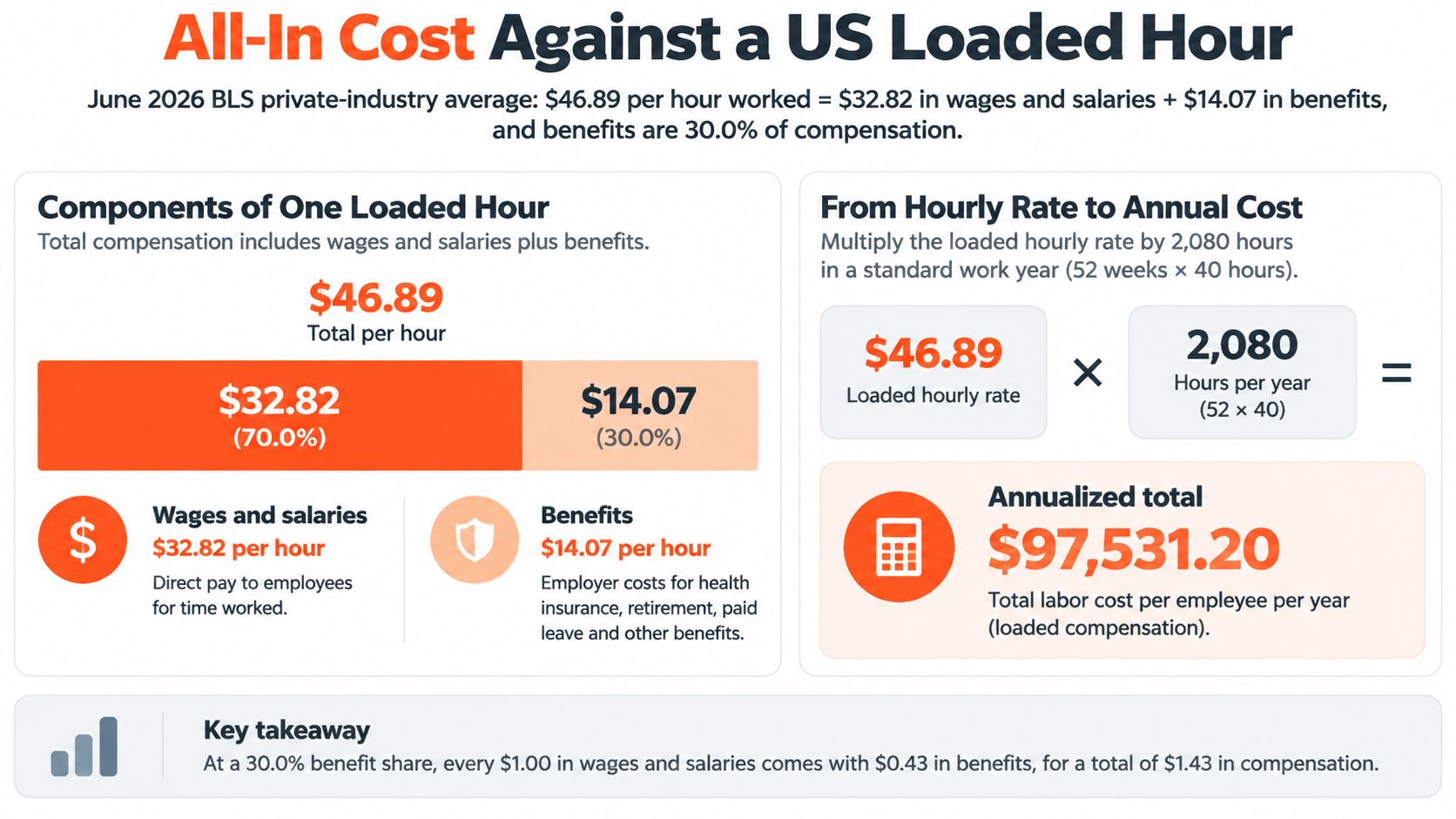
For context, the headline figure in the Bureau of Labor Statistics employer compensation release averages every private-industry occupation: $46.89 per hour worked in June 2026, with $32.82 in wages and $14.07 in benefits, so benefits were 30.0% of compensation. Fine for budgeting, wrong for pricing an assistant. Our guide to the fully loaded labor rate builds the US side rung by rung, with payroll taxes and overhead. If you are weighing a direct-hire offer package instead, assess your total compensation the way a candidate would: base pay and benefits side by side.
Virtustant says clients save up to 70%. That claim only holds where the $7/hr floor is compared with a named BLS wage for a comparable US role. At $7/hr, a remote marketing specialist costs about 18.5% of the $37.87 median hourly wage for US market research analysts and marketing specialists (May 2025), so the up-to figure is conservative there. It does not hold for every seat, as the table shows.
Starting rates against BLS wages for comparable US roles
| Seat | Virtustant starting rate | Comparable BLS occupation and median hourly wage, May 2025 | Starting rate as a share of the US wage |
|---|---|---|---|
| Marketing specialist | $7.00 | Market research analysts and marketing specialists: $37.87 | 18.5% |
| Executive assistant | $8.50 | Executive secretaries and executive administrative assistants: $36.82 ($76,590 ÷ 2,080) | 23.1% |
| Virtual assistant | $7.00 | Secretaries and administrative assistants, except legal, medical and executive: $22.86 ($47,540 ÷ 2,080) | 30.6% |
| Customer service rep | $7.00 | Customer service representatives: $21.53 | 32.5% |
| Bookkeeper | $8.50 | Bookkeeping, accounting and auditing clerks: $24.36 | 34.9% |
Sources: BLS Occupational Outlook Handbook pages for secretaries and administrative assistants and bookkeeping, accounting and auditing clerks, plus the pages linked above. Two subcategories are published as annual medians; we divide by 2,080 hours.
So for a virtual assistant the honest phrase is "under a third of the US wage," and for customer service "about a third." These use the wage alone; the Usable-Hour Test is the better way to compare two real quotes.
Define the coverage window before you choose a region. Escalations, appointment changes and same-day sales follow-up need someone online while your customers are.
Virtustant recruits from Latin America first, where most time zones overlap US business hours. For some roles we also place vetted professionals from the Philippines and South Africa, with the schedule agreed before the search. See nearshore staffing with US time-zone overlap for how we set shifts. Whatever region you compare, run the Usable-Hour Test with the overlap share you will really get: in the example above, a 50% overlap doubled the cost per used hour.
Cross-border remote work is common and still complex. KPMG's 2025 Global Mobility Benchmarking Report had more than 400 respondents, and almost 40% expected their cross-border remote-work arrangements to increase while about 40% expected them to stay the same, according to KPMG's global mobility submission.
On the US side, the Department of Labor's classification guidance explains that the economic reality test looks at the totality of the circumstances, with no single factor deciding, and asks whether a worker is economically dependent on an employer for work. The Department announced a proposed rule to change it on February 26, 2026, so check its current status. None of this replaces country-specific advice.
Responsibilities by provider type
| Provider type | What moves to the provider | What stays with your company |
|---|---|---|
| Domestic staffing firm | Payroll and the employment paperwork for the assignment | Supervision, workplace safety, system access, any shared obligations |
| Freelance marketplace | Payment processing | Search, vetting, classification review, continuity, replacement |
| EOR platform | The local contract and payroll in the worker's country | Finding and vetting the person, daily management, replacement |
| Remote staffing agency for business roles | Sourcing, vetting, contracts, payroll and the paperwork on the professional's side, replacement | Daily direction, tool access and security, performance feedback, your company's own legal and tax questions |
| Direct hire | Nothing, unless you add a payroll provider | Everything: classification, payroll, leave, termination, supervision, replacement |
At Virtustant, the client directs the day-to-day work and we handle contracts, payroll and the paperwork on the professional's side. Our lifetime replacement guarantee has no conditions and covers any role and any hours while you are an active client. It covers replacement. It does not move your security, data access or company-level legal and tax questions to us.
Give access only to the systems the role needs, name an approver for refunds or payments, and revoke credentials the day an engagement ends.
This guide is general information, not legal, tax or insurance advice. Get qualified advice for your situation.
Bullhorn surveyed more than 2,400 contingent workers for its 2024 Talent Trends Report. It found that 75% would work with their staffing firm again, up from 68% the year before. It also found that 81% of candidates are comfortable with AI in recruiting if it speeds up the process, and 79% if it doesn't mean giving up personalization. Those are worker attitudes, not a measure of hiring quality.
Speed on the provider side often comes from tooling. Staffing firms run prospecting on dedicated software; dreach's staffing agency sales software options page groups those tools by job. That stack decides how fast a firm finds you, not how well it vets. Ask about the vetting.
Virtustant's speed is stated as capacity: you get a shortlist of 3 to 5 vetted candidates within 48 hours of the call, and your hire can start within 72 hours of that same call. The bar behind it is a measured funnel we call the top 1%: 100% apply, 22% clear the recruiter screen, 9% pass cognitive (IQ), skills and English testing, 3% reach a live interview, 1% are hired. Our candidate vetting process explains each step. You interview the shortlist and make the final call.
Write the brief around skills, not credentials, and ask for work samples. Job seekers see the same shift: HiredBySkill's directory lets job seekers find employers offering no-degree roles.
After the hire, your Virtustant account manager is the main point of contact. They coordinate onboarding, the start date, tools access and the first-week plan, and follow up during the first weeks. Set 30-, 60- and 90-day checkpoints for quality, errors and independent work.
Ask every provider the same questions, in writing. The right column shows our answers as a reference point.
Questions to ask any staff augmentation company
| Question | Why it matters | Virtustant's answer |
|---|---|---|
| Who contracts and pays the professional? | Decides who carries payroll and the paperwork | We handle contracts, payroll and the paperwork on the professional's side. |
| What does the hourly rate include? | Extra fees change the cost per used hour | One all-in hourly rate and zero placement fees. If you pay your agent $10/hr, we give them $9 and keep the dollar in the middle. |
| Is there a minimum number of hours? | Sets the smallest seat you can test | 10 hours a week minimum, part time or full time, month-to-month. |
| What are the replacement terms? | Tells you who pays for a miss | Lifetime replacement guarantee, no conditions, any role and any hours while you are an active client. |
| How fast is the shortlist, and how many candidates? | Speed only counts if the bar holds | A shortlist of 3 to 5 vetted candidates within 48 hours of the call; your hire can start within 72 hours of that same call. |
| How are candidates vetted? | Shows what the shortlist is filtered for | About 3 in 100 applicants reach a live interview, and about 1 in 100 is hired. |
| Who directs the day-to-day work? | Control and accountability | You do. Your account manager coordinates onboarding and follows up during the first weeks. |
| How are you invoiced? | Keeps billing auditable | One weekly invoice per placement. |
A staff augmentation company adds a professional to your team for a seat you direct, while the provider finds the person and handles the contract and payment side. The main types are domestic staffing firms, IT and dev shops, freelance marketplaces, platforms that employ someone you already found abroad, and remote staffing agencies for business roles.
We don't publish a brand ranking. For non-engineering seats the provider type matters more than the name: a remote staffing agency for business roles usually fits ongoing assistant, customer service, sales and bookkeeping seats, while IT shops fit developers. Shortlist two or three providers of the right type and ask each the same written questions.
It depends on the type. Domestic staffing firms bill US wages plus their fee, freelance marketplaces add platform fees to the freelancer's rate, and remote staffing agencies usually quote one hourly rate. Virtustant starts at $7/hr all-in for virtual assistants and customer service reps, $8/hr for SDRs and appointment setters, and $8.50/hr for executive assistants and bookkeepers, with zero placement fees.
Ask for the time to a shortlist and the time to start, and treat both as capacity rather than a promise for every role. Virtustant delivers a shortlist of 3 to 5 vetted candidates within 48 hours of the call, and your hire can start within 72 hours of that same call.
For some seats. At Virtustant's $7/hr floor, a remote marketing specialist costs about 18.5% of the $37.87 BLS median hourly wage for US marketing specialists (May 2025), so clients can save up to 70%. A virtual assistant at $7/hr is about 30.6% of the $22.86 BLS median for secretaries and administrative assistants, so the honest figure there is under a third of the US wage.
You do. The client directs the daily work, priorities and reviews. At Virtustant, an account manager is your main point of contact, coordinates onboarding, the start date, tools access and the first-week plan, and follows up during the first weeks, while we handle contracts, payroll and the paperwork on the professional's side.
No. Most published lists focus on developers, but the same model works for virtual assistants, executive assistants, customer service, SDRs, appointment setters, bookkeepers and marketers. In Virtustant's H1 2026 rate report, ten named business roles made up 193 of 441 placement starts (43.8%).
Bring one seat: the role, the hours it must cover and how you will judge the first 30 days. Then compare your quotes with ours on the Usable-Hour Test.
Developer seat instead? Watch our video on IT staff augmentation costs.
Virtustant has made 2,000+ placements for 1,000+ US companies and is rated 4.9/5 on G2 and 4.5/5 on Trustpilot. Book a discovery call and get a shortlist within 48 hours of the call.