
8 Skills Assessment Test Examples for Remote Roles
September 7, 2026


Why do hiring processes keep advancing candidates whose resumes look strong but whose work does not hold up once the job starts? The most useful skills assessment test examples close that gap by making a candidate demonstrate job-relevant capability before the offer, rather than describe it. Work samples, cognitive tests, technical builds, communication screens, situational judgment, tool tasks and structured references each buy down a different hiring risk.
For U.S. founders and small-business hiring leaders evaluating remote professionals in Latin America, the useful question is not which test is best in the abstract. It is which test predicts performance, what each one costs to run, and in what order to run them. Below are eight practical examples with sample prompts and scoring guidance, ranked against the published validity evidence, including the 2022 re-analysis that reordered the whole list.
A skills assessment test is a structured, scored exercise that requires a candidate to produce evidence of a job-relevant capability under controlled conditions. Three properties separate an assessment from an interview question: the task is the same for every candidate, the scoring criteria are written before anyone is evaluated, and the output can be reviewed by someone who was not in the room.
That definition rules out a great deal of what gets called assessment. An unscripted conversation is not an assessment. A take-home project with no rubric is not an assessment. A certificate on a resume is a claim, not an assessment, until someone verifies it. The distinction matters because the predictive power of a hiring method comes almost entirely from its structure, not from its subject matter, which is the single clearest finding in the selection research.
Each test in this article answers a different question:
A funnel that runs five tests against the same question is expensive and redundant. A funnel that runs one test against each question is cheap and complete.
Most articles about assessment testing quote the same hierarchy: work samples predict job performance best, cognitive ability is close behind, unstructured interviews are near-worthless. That hierarchy comes from Schmidt and Hunter's 1998 meta-analysis, and for twenty-four years it was the default answer.
It was corrected. In 2022, Sackett, Zhang, Berry and Lievens published a re-analysis in the Journal of Applied Psychology showing that the 1998 estimates had been systematically overcorrected for range restriction, inflating the coefficients. Their revised figures do not merely shrink the numbers. They change the order.
| Selection method | Schmidt & Hunter (1998) | Sackett et al. (2022) | What changed |
|---|---|---|---|
| Structured interview | r = 0.51 | r = 0.42 | Moves to first. The strongest predictor in the revised estimates. |
| Job knowledge test | r = 0.48 | r = 0.40 | Moves up to second. |
| Empirically keyed biodata | Not in the 1998 top tier cited here | r = 0.38 | Enters the top five. |
| Work sample test | r = 0.54 | r = 0.33 | Falls from first to fourth. The largest single reordering. |
| General mental ability / cognitive | r = 0.51 | r = 0.31 | Falls to fifth. No longer the default best predictor. |
| Unstructured interview | r = 0.38 | Not among the revised top five | Still the weakest common interview format. |
| Reference check | r = 0.26 | Not among the revised top five | Corroboration tool, not a primary predictor. |
The 1998 coefficients above are as cited in the Cogn-IQ 2025 structured-interview research review. The revised coefficients come from the 2022 re-analysis as summarized by the Society for Industrial and Organizational Psychology.
The practical consequence: the highest-validity instrument available to a small hiring team is a structured interview, which costs nothing but discipline. Most teams already run the interview. They just run it unstructured, at r = 0.38 instead of r = 0.42, and then buy an assessment tool to compensate.
That is the first recommendation in this article, and it is free: before adding any test below, write down the questions, ask every candidate the same ones in the same order, and score each answer against a rubric written in advance. Then add tests to cover the risks a structured interview cannot see, which is what the remaining eight examples do.
Two caveats keep this honest. These are average validities across many jobs, so a coefficient of 0.33 for work samples does not mean a work sample is unhelpful for a specific bookkeeping role. And validity is measured against supervisor performance ratings, which carry their own noise. Use the ranking to allocate effort, not to eliminate a method your own hiring data supports.
A work sample asks the candidate to complete a bounded task that resembles the job. The candidate must produce an output rather than describe past experience. A resume can claim proficiency; a deliverable can be inspected.
A sales development candidate might receive a prospect list and record five cold-call openings for review of tone, structure and objection handling. A designer could rebuild a supplied homepage mockup against brand guidelines. A bookkeeper could reconcile a month of transactions and produce a trial balance. These are especially useful for remote roles because they test independent execution and written handoff quality at the same time.
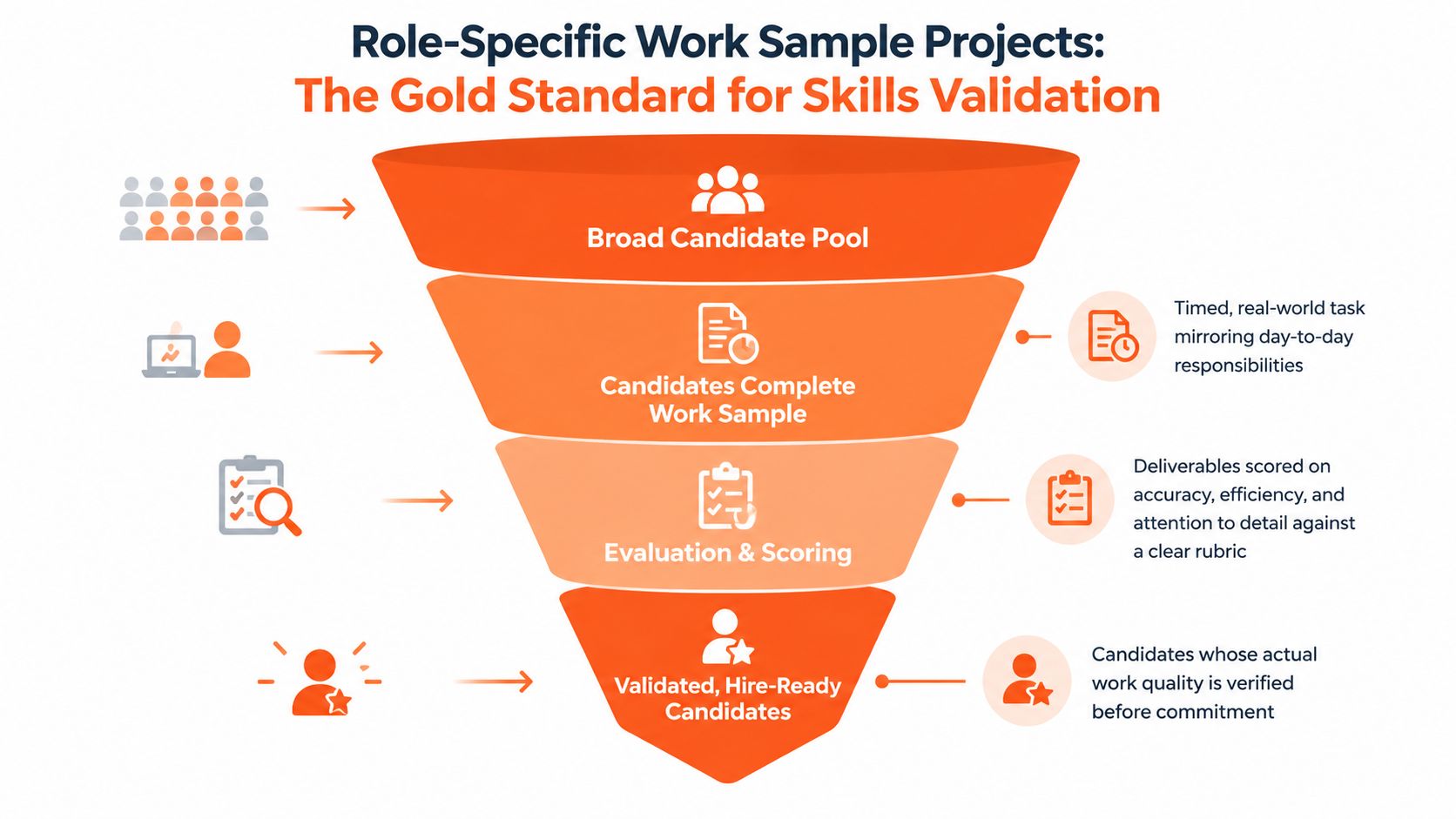
Score the output against criteria the role actually requires:
Keep the task bounded. Share the rubric before the timer starts, supply the tools and data, and score the outcome rather than one preferred method. Two different routes to the same correct answer should score the same. A work sample should reveal whether the candidate can do the work, not produce a free version of work your business needs done.
Run this late in the funnel, after language and cognitive screening, because it is the most expensive test on the list for both sides. For realistic task-design patterns, see these e-commerce usability task examples. Teams hiring administrative support can score the deliverable against the top 10 executive assistant skills.
Cognitive ability tests measure reasoning, pattern recognition, verbal logic and numerical logic without depending heavily on role-specific knowledge. They are useful early because a new hire will have to learn an unfamiliar CRM, troubleshoot a broken process, and interpret incomplete information before anyone is available to answer.
Note the ranking above before you weight them heavily. Cognitive ability sat at or near the top of the old hierarchy and lands fifth in the revised estimates. It remains a genuine predictor and it is cheap and fast to administer, which is exactly what an early-stage filter should be. It is no longer a reason to override the rest of the evidence. Our deep dive on what a cognitive assessment measures for hiring covers score interpretation, short screens versus full batteries, and why the clinical instrument of the same name cannot be used for selection.
Do not adopt a generic cutoff because a test vendor recommends one. Set thresholds by role and compare them against the performance of past hires. A support role may need strong verbal reasoning and prioritization; a data analyst may need more numerical logic. A senior hire should also be able to explain assumptions and trade-offs, not merely answer quickly.
Give candidates practice questions before the timed assessment. That reduces avoidable anxiety and makes the score more representative of reasoning than of test familiarity. Review score distributions once enough hires have accumulated to see whether the cutoff is excluding capable people or letting weak ones through.
Adoption is broad but not uniform, and the reported numbers depend on what is being counted. SHRM's 2024 Talent Trends research put organizational use of pre-employment assessments at 54%, and 36% of those organizations said assessments had increased their time-to-fill. TestGorilla research cited in a 2025 skills-based hiring report put employer use of pre-hire skills tests specifically at 76%. Both figures, and the sources behind them, are compiled in this overview of candidate assessment methods and statistics. The gap between the two is the trade-off in one line: more organizations are testing skills than are running formal assessment programs, and the ones running formal programs are paying for it in time-to-fill.
Technical candidates should solve a technical problem that resembles the environment they are joining. A live or time-boxed build reveals more than syntax: it shows how a developer clarifies requirements, decomposes a problem, tests edge cases, communicates uncertainty and recovers when the first approach fails.
A full-stack candidate might build a small CRUD API and a React interface that reads from it. A backend engineer could debug a payment function that fails only under specific conditions. A data analyst might write SQL against sample tables, explain the resulting insight, and improve an inefficient query.
Use tiered difficulty. Easy work verifies basic syntax and environment familiarity. Medium work tests logic and implementation judgment. Hard algorithmic puzzles belong only in roles where that level of abstraction reflects the actual job.
Give candidates the requirements, expected inputs and outputs, constraints and definition of done before they start. Allow documentation and search when that reflects real working conditions. Memorization is not the objective: a candidate who can locate, evaluate and apply reliable documentation is usually more useful than one who recalls an isolated method but cannot explain a trade-off.

If scheduling across time zones makes a live session difficult, record it or accept an asynchronous submission followed by a short debrief. Ask why the candidate chose that architecture, what they would change with more time, and which tests they would add before release. The debrief is where a build challenge turns into a structured interview, which is the higher-validity instrument.
For U.S. teams comparing recruiting models, this guide for U.S. teams on offshore hiring covers a different terminology and operating model than nearshore staffing. The assessment principle is unchanged: test the capability the role requires, under conditions the team will recognize.
Language testing should measure whether a remote professional can communicate clearly in the situations the job creates. Accent is not the standard. The relevant questions are whether the candidate understands the request, answers precisely, writes a usable update, and adjusts tone for a customer, a colleague or an executive.
A live English screen can use five to seven open-ended prompts, such as "walk me through a project you led," scored for fluency, vocabulary, clarity, specificity and listening. A recorded response to "describe a time you handled a difficult customer" tests pronunciation and coherence. A written exercise can ask the candidate to email a client about a project delay with an explanation and a next step.
A strong answer has a sequence: it identifies the situation, explains the action taken, states the result, and acknowledges the constraint. A weak answer can use polished vocabulary and still leave the listener unsure what happened, who decided, or what happens next.
Use live conversation rather than automated-only testing for client-facing roles. Automated tools help with consistency, but real-time interaction exposes whether a candidate can follow an unexpected question and recover when the conversation changes direction. Pair the language result with cognitive and work-sample scores so communication does not quietly outweigh technical fit.

Set the threshold from the role, not from a general standard. Client-facing work needs a higher communication bar than an internal production role, but every candidate should be judged on clarity and specificity rather than on sounding like a native speaker. Vendors increasingly package this as a per-skill test library, defining each competency as a separate scored component, which makes it possible to score communication on its own rather than folding it into a general aptitude number.
Certifications validate structured knowledge of a specific platform or discipline: AWS Certified Solutions Architect, Azure Administrator, Google Analytics, HubSpot, QuickBooks ProAdvisor, Salesforce Administrator. They are most useful when the role depends on a tool the credential directly covers.
Note where this sits in the evidence. The revised hierarchy ranks job knowledge tests second at r = 0.40. A certificate is not a job knowledge test. It is a record that someone passed one, on an unknown date, possibly on an earlier version of the product. The validity belongs to the test, not to the certificate.
A credential on a resume is a claim until the issuing organization confirms it. Check the status through the official registry. A certificate that has expired, belongs to someone else, or covers an adjacent product should not carry the same weight as an active credential tied to the job.
Do not make certification a blanket requirement. Exam fees and access exclude capable candidates, particularly for junior roles. Treat the credential as supporting evidence unless the role carries a compliance, platform-access or client requirement that makes an active certification necessary.
Then ask a question that forces application: "which part of the certification have you used to solve a real workflow problem?" A usable answer contains a decision, a constraint and an outcome. Pair verification with a short build, such as configuring a simple Salesforce automation or classifying sample transactions in QuickBooks and explaining the exceptions. The credential establishes structured learning; the task establishes usable performance.
A situational judgment test presents a realistic workplace problem and asks the candidate to choose or rank responses. It measures judgment, prioritization, conflict handling, ethics and emotional regulation. Those matter more in remote teams than in co-located ones, because a remote worker routinely has to make a defensible decision before a manager is available.
Consider a support scenario: a customer demands a refund for a product they appear to have misused. The options might be to approve immediately, investigate with the customer, or decline while explaining the policy. There is no universally correct answer. The rubric has to encode your retention policy, authority limits and communication standards, which is why a purchased SJT with a vendor-supplied answer key is usually the wrong instrument.
Run these after language and cognitive screening, then use the results to shape interview follow-ups. Ask "what would you want to know before choosing that response?" The explanation usually reveals whether the selected answer came from a working principle or a guess.
For legal-support hiring, pair the scenario with the top legal assistant interview questions. A structured form tool such as Kiwiform as a Typeform option can capture the responses consistently, though the quality of the scenario and the rubric matters far more than the form.
A tool mastery test answers one narrow question: can this candidate use the software the role requires without turning basic execution into a training project? Test the actual stack, not adjacent products the person will never open.
A virtual assistant might receive a disorganized Google Sheet and be asked to structure a schedule with filters and conditional formatting. A bookkeeper could reconcile sample transactions, produce a trial balance and flag discrepancies. A designer might rebuild a supplied mockup in Figma using specified components and export branded assets. A social media manager could schedule a week of posts, add hashtags and select platform-appropriate formats.
Keep the assignment realistic and bounded. Provide clean instructions, sample data and sandbox access. If a requirement is ambiguous, allow questions; the ambiguity tests communication and judgment, not interface knowledge.
Score accuracy, organization, completion quality and the explanation of exceptions. Do not award points for a particular sequence of clicks. An efficient candidate may use shortcuts or a different workflow and still produce the correct, maintainable output.
Use tool testing as a tie-breaker after broader screens. It has high face validity, which is precisely its risk: it over-rewards familiarity with one interface. A strong professional who has used a comparable tool will usually learn yours in a week, while a candidate who knows every button but misses the business requirement will still fail in practice. For teams defining the role before testing, this guide for U.S. businesses on VA skills connects software expectations to the wider responsibilities of the job.
References should corroborate the assessment results, not simply confirm that someone held a job. Reference checks measured r = 0.26 in the 1998 estimates, which is the honest way to think about them: weak as a predictor, useful as a check on everything else.
Ask open questions tied to observable work. A manager might describe a candidate who led a three-person data migration, missed an intermediate deadline to scope creep, then recovered by reallocating resources and communicating early. A peer might describe exceptional spreadsheet accuracy alongside a slower pace caused by careful verification. Neither is a generic endorsement; each hands the hiring manager a trade-off to weigh.
A discrepancy is more useful than praise. If a candidate claims two years in a role and the reference confirms eight months, pause and verify the timeline. That is not proof of misconduct, but it changes the diligence required before an offer.
Prepare the same core questions for every reference so the answers can be compared:
Compare the answers against the work sample and the interview. A high practical score should broadly match descriptions of strong execution, though a reference may surface context the test could not capture. Contact more than one reference where possible and document the findings for the hiring manager.
Rank the eight by what they cost rather than by what they measure and the sequencing answers itself. Cheap, automated, broadly predictive tests go early. Expensive, narrow, high-signal tests go last, applied to the two or three candidates still standing.
| Assessment | Risk it buys down | Funnel stage | Cost to run | Reviewer time per candidate |
|---|---|---|---|---|
| Structured interview | Everything, weakly but cheaply | Throughout | Low | 30 to 45 min |
| Cognitive ability test | Cannot learn the role fast enough | Early screen | Low | Automated |
| Language and communication | Cannot be understood by clients or teammates | Early screen | Low to medium | 20 to 30 min |
| Situational judgment | Decides badly without supervision | Mid funnel | Medium to design, low to run | 10 to 15 min |
| Software and tool mastery | Needs training on day-one basics | Mid funnel | Low | 15 to 20 min |
| Credential verification | The claim is not true | Mid funnel | Low | 10 min plus registry check |
| Work sample or technical build | Cannot produce the actual output | Finalists only | High for both sides | 45 to 90 min |
| Structured references | The history does not match the story | Pre-offer | Medium, mostly scheduling | 20 to 30 min each |
Reviewer time is the number most teams underestimate. Eight tests across forty applicants is roughly a hundred hours of internal review, which is why assessment programs collapse after the first hire. The table is a budget, not a checklist.
A useful assessment program does not give every candidate every test. It assigns each test to a specific risk and drops it as soon as that risk is retired.
Start with one role and one rubric. Have the hiring manager define what unacceptable, acceptable and strong work looks like before any candidate is reviewed. Score every submission against the same criteria, record the reason for each pass or fail, and compare those decisions against the interview impressions. That comparison is what exposes whether the rubric is measuring the job or rewarding a polished presentation.
Calibration continues after hiring. Track manager rework, missed handoffs, quality escapes, customer escalations and time to independent execution. Feed those observations back into the thresholds. A test that predicts nothing beyond the interview is consuming candidate goodwill without adding decision value, and should be cut.
Two validation studies show what a calibrated test looks like when it is tied to a business outcome. In a clothing retailer study, employees who scored high on the Criteria Basic Skills Test sold on average $98.02 of goods per hour against $81.45 for low scorers, and salespeople who passed the test were on average 20% more productive than those who did not, according to Criteria's guide to the benefits of pre-employment tests. In a market research firm, staff who passed with a raw score of 28 or better averaged productivity ratings of 9.8 against 6.0 for those who failed, making them 63% more productive; 89% of passing staff were rated fair or better against 50% of failing staff, with a validity coefficient of .26 against job performance, per this market-research productivity validation study.
That .26 is the point. A validated, business-linked test still explains a modest share of performance variance. It earns a place in a structured funnel; it does not earn the right to make the decision by itself. For sales-specific exercise design, how to build sales pre-hire assessments is a useful reference.
A skills assessment test is a structured, scored exercise that requires a candidate to demonstrate a job-relevant capability under controlled conditions. Three properties distinguish it from an interview question: every candidate gets the same task, the scoring criteria are written before anyone is evaluated, and the output can be reviewed by someone who was not present.
Eight practical examples are role-specific work sample projects, cognitive ability tests, live coding or technical build challenges, proficiency-based language and communication screens, industry certification and credential verification, situational judgment and behavioral assessments, software proficiency and tool mastery tasks, and structured reference and background verification.
In the 2022 re-analysis by Sackett, Zhang, Berry and Lievens, structured interviews had the highest mean operational validity at r = 0.42, followed by job knowledge tests at 0.40, empirically keyed biodata at 0.38, work sample tests at 0.33 and cognitive ability at 0.31. This reorders the widely quoted 1998 hierarchy, in which work samples ranked first at 0.54.
The 1998 meta-analytic estimates applied a correction for range restriction that later work showed was systematically too large, which inflated the coefficients. The 2022 re-analysis corrected the overcorrection. The revised numbers are lower across the board and the relative order changes, most notably moving work samples from first to fourth and cognitive ability from the top tier to fifth.
Assign one test per hiring risk rather than stacking tests that measure the same thing. A typical remote-role funnel runs a communication screen and a cognitive test early, a structured interview against a written rubric in the middle, a work sample for finalists only, and credential and reference verification before the offer. Reviewer time, not test cost, is usually the binding constraint.
They carry a real cost. SHRM's 2024 Talent Trends research found 54% of organizations use pre-employment assessments, and 36% of those said assessments increased their time-to-fill. The trade-off is worth making when the tests are calibrated against actual post-hire performance and cut when they stop predicting anything the interview did not already reveal.
That depends on what the agency has already tested and whether it will show you the evidence. Virtustant screens candidates through a multi-stage vetting funnel that includes live English screening, cognitive assessment, role-specific skills testing and experience or reference verification, narrowing an applicant pool of 100% to roughly 22%, then 9%, then 3%, then the top 1% who are presented to clients. Clients typically still run a structured interview and, for senior roles, a work sample against their own rubric, because only the hiring team can define what good output looks like in their business.
Weight written and asynchronous communication more heavily, because most handoffs happen in writing. Test independent execution rather than supervised task completion. Where time zones make live sessions difficult, allow an asynchronous submission followed by a short recorded debrief, which preserves the structured-interview component that carries most of the predictive value.
Validity coefficients cited from Schmidt and Hunter (1998) as compiled in the Cogn-IQ 2025 research review, and from Sackett, Zhang, Berry and Lievens (2022), Journal of Applied Psychology, as summarized by the Society for Industrial and Organizational Psychology. Adoption figures from SHRM 2024 Talent Trends and TestGorilla research cited in a 2025 skills-based hiring report. Validation study figures from Criteria Corp. Last reviewed September 2026.
Virtustant connects U.S. companies with vetted remote professionals across Latin America, and includes live English screening, cognitive assessment, role-specific skills testing and experience or reference verification in its vetting process. Review our nearshore staffing services or visit Virtustant to see candidates for virtual assistance, customer support, sales, bookkeeping, design, development and operations roles, with nearshore time-zone overlap.


