Interview Questions for a Legal Assistant: 8 to Ask
September 6, 2026
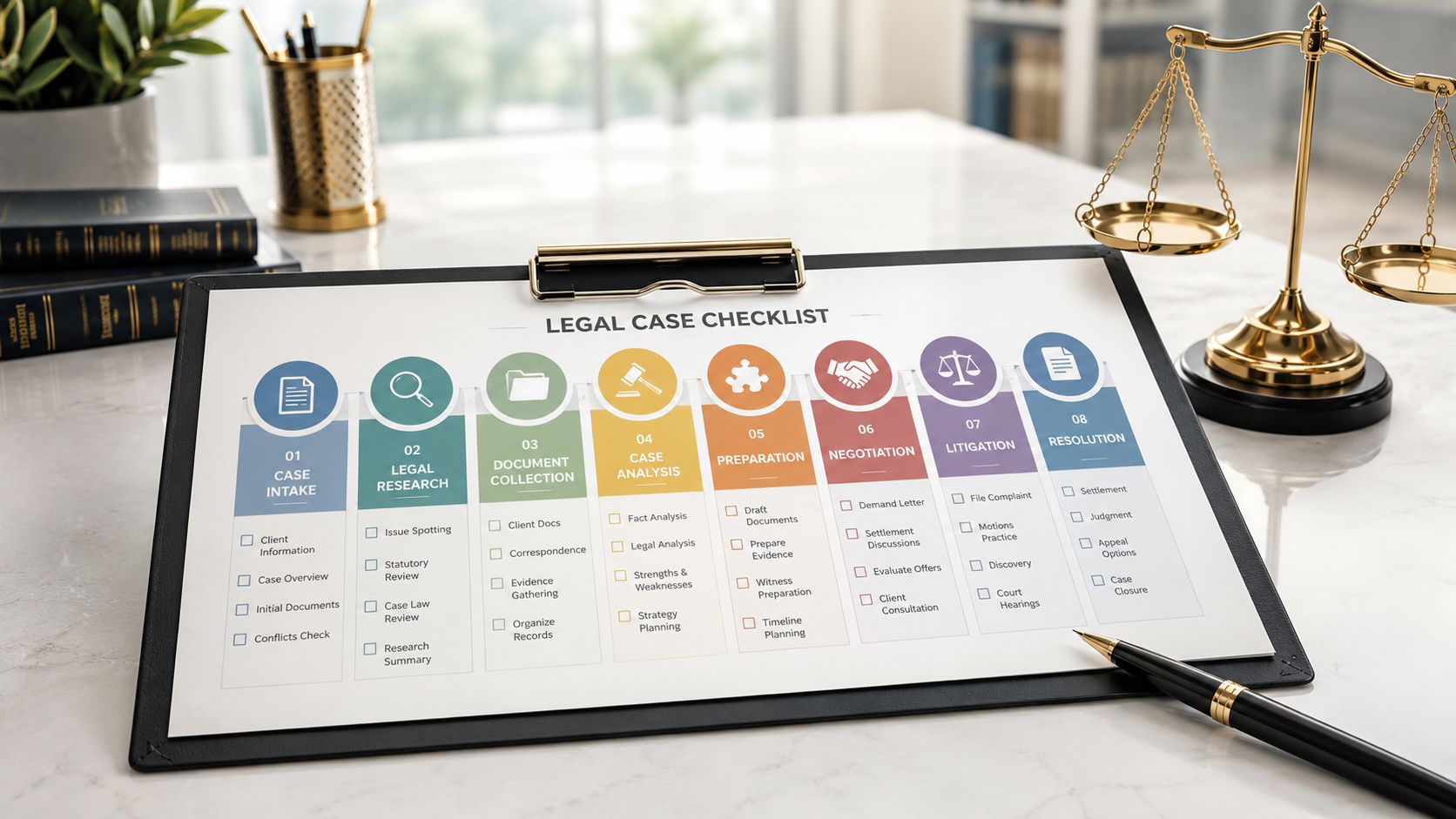

Eight questions, each scored against an observable behavior rather than a good answer. Hiring a legal assistant fails in predictable places: a candidate who lists software they have never operated, one who cannot say what they would do after sending a privileged document to the wrong recipient, and one who is organized in a way only they can follow.
The market context is worth having in front of you. The U.S. Bureau of Labor Statistics counts 404,900 paralegals and legal assistants with median pay of $62,890 a year, or $30.24 an hour, as of May 2025, and projects roughly 40,800 openings a year through 2035 on essentially flat employment. Most of that hiring is replacement demand, which is another way of saying the cost of a bad hire is paid twice.
Below: the eight questions, what a strong answer contains, the follow-up that separates rehearsed from real, and a scoring method that survives comparing five candidates a week later.
Ask: "Walk me through a time you had to explain a filing delay to a client who was already frustrated. What did you say first?"
Legal assistants write more than they speak, and most of what they write goes to someone with less context than they have. You are testing whether the candidate leads with the fact or with the apology, whether they commit to a next step, and whether they know which details are theirs to share.
"What did you check before you contacted them?" A strong candidate confirms the status with the attorney first. A weak one improvises reassurance and creates a second problem.
Then test it in writing rather than taking their word for it. Ask for a short written response to the same scenario during the interview. A résumé claim about communication is unfalsifiable; two paragraphs are not.

For remote or bilingual roles, verify English at the level the work actually requires: correspondence a client will read, not conversational fluency. Our interview questions from Virtustant covers how to structure this without turning it into a language exam.
Ask: "Which case-management system have you used most, and what did you do in it that someone new to the tool could not?"
The question should produce platform names, specific tasks and examples. Legal assistant hiring guides consistently recommend asking about case-management, e-filing and document-production systems because those tools sit inside the daily workflow rather than being generic administrative skills (Indeed's legal assistant hiring questions).
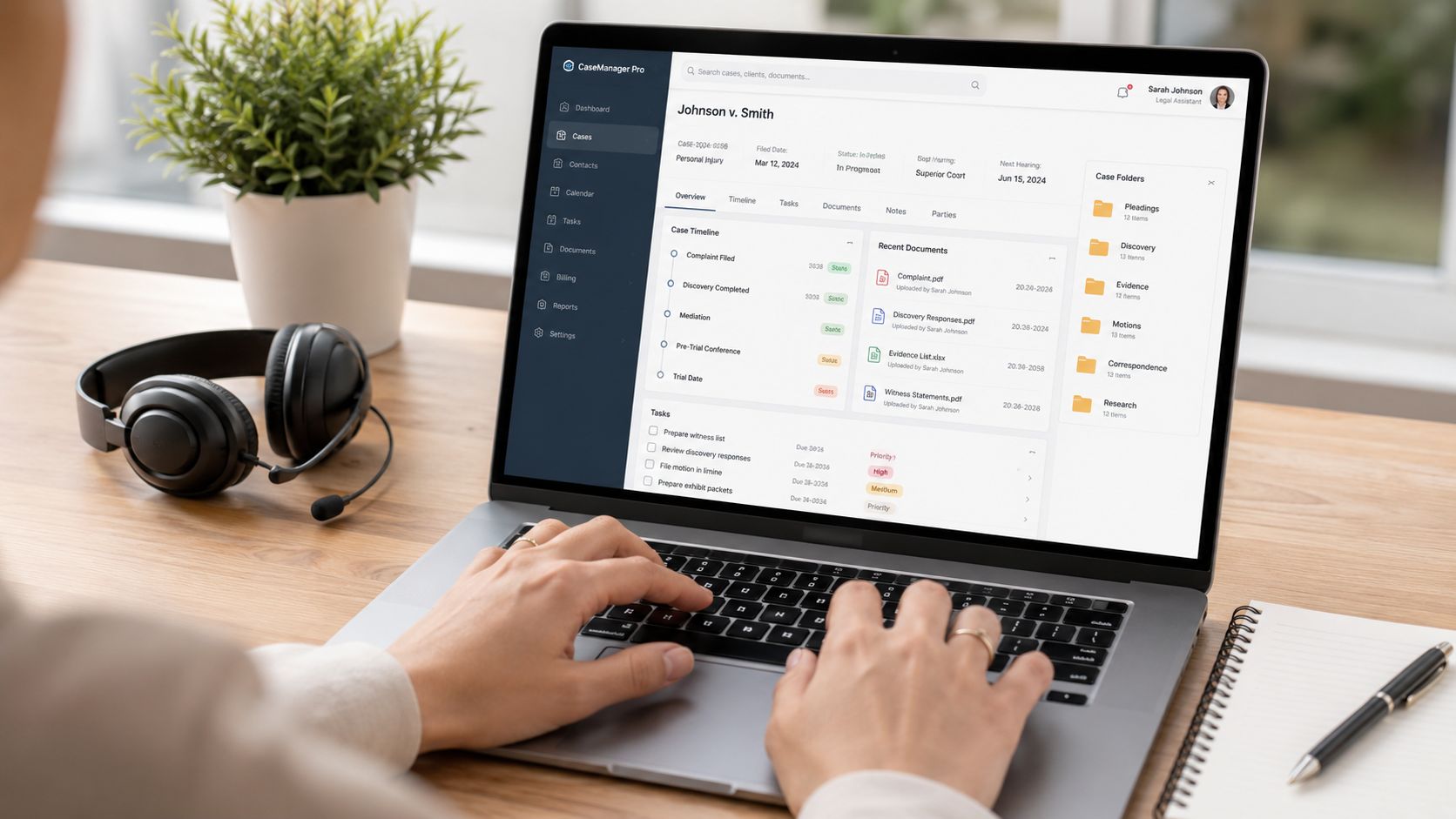
Ask the candidate to describe the exact sequence for an e-filing in the jurisdiction you practice in, including what they do when the portal rejects a submission. Someone who has done it will mention the rejection path unprompted, because it happens.
AI has changed this screening area, but less than the marketing suggests. The Law360 report on law-firm AI adoption reports that 80% of respondents said their firms are using or exploring generative AI, with Microsoft 365 Copilot the most widely adopted tool at 68%. The more useful finding for an interviewer is what sits underneath that: nearly 60% of firms using Microsoft 365 Copilot are still piloting it, and adoption of the public version of ChatGPT is far lower than the headline implies.
So do not ask whether the candidate uses AI. Ask what they do not put into it, and what they verify before a draft goes to an attorney. A candidate who cannot name a confidentiality boundary around a public tool is telling you something important.
Ask: "Tell me about a mistake in a document that reached an attorney or a client. What happened next?"
Every candidate has one. The ones who claim otherwise are either inexperienced or not telling you. What you are scoring is the sequence after the error: did they find it or did someone else, how fast did they escalate, and what did they change so it would not recur.
A rehearsed answer is heavy on the lesson learned and light on the mechanics. Push for mechanics: "What is your actual check before a document goes out?" Look for something specific, a second-pass read on names, dates and dollar figures, a checklist, a colleague review on anything filed. Vague conscientiousness is not a process.
The same principle drives our EA assessment method and our guide for hiring remote bookkeepers: score the control the candidate uses, not the adjective they use to describe themselves.
Ask: "Three attorneys each need something today and two of them say it is urgent. What do you do in the first ten minutes?"
The wrong answer is a scheduling technique. The right answer starts with information: what is actually deadline-driven, what is court-imposed versus preference, and who needs to be told they are waiting.
Every prompt in your interview should connect to an observable work behavior like these. If you are building the full set, this is the principle to design better interview questions around: score what the candidate would do, not how well they narrate.
Ask: "A client asks you whether they should accept a settlement offer. What do you say?"
This is a boundary question wearing a knowledge question's clothing. The only correct answer routes it to an attorney. A candidate who offers an opinion, however hedged, has just shown you how they will handle unauthorized practice of law.
Follow with a research task instead: "How would you find the filing requirements for a motion you have never filed before?" Look for a real method, the court's own rules first, then the firm's precedent files, then a named person to confirm with. Look especially for the last step. Confident wrong answers are more expensive than slow right ones in this role.
Interview guides commonly identify documents, deadlines, client communication, systems and ownership as the core capability areas, while others emphasize document preparation, filing, scheduling, calendaring, legal research and file organization (Yardstick's legal assistant interview questions). Use those lists to make sure your eight questions cover the surface area rather than testing the same trait four times.
Ask: "You sent a privileged document to the wrong recipient and you notice an hour later. Walk me through the next thirty minutes."
"I keep information private" is not an answer. Confidentiality here is an ethical obligation with an operational procedure attached, and the interview should test both. One hiring guide describes client confidentiality as being of the utmost importance in legal work and recommends testing familiarity with the ethical rules and regulations that govern it (the Los Angeles County Bar Association interview resource).

Remote work adds a second layer. Ask how they handle confidential documents on a shared home network or in a public space, and whether a consultant or IT contractor may access a client file and under whose authorization. For the broader framing of the obligation, see Ciphar's guide for lawyers.
This is also where background screening belongs in the process. Run employment-appropriate screening for the role and jurisdiction; a volunteer criminal background check is the equivalent process on the volunteer side and is a useful reference point for what these checks do and do not cover. Screening supplements the interview, it does not replace the confidentiality question.
Ask: "A client calls upset about a bill. You do not handle billing. What do you do?"
You are testing whether they can hold a boundary and still be useful. The strong answer acknowledges the frustration, does not speculate about the invoice, states who will follow up and by when, and then actually makes that happen.
"What do you write down, and who do you tell?" The interaction is not finished when the call ends. A candidate who does not mention logging it or notifying the attorney is describing a dropped ball they have not noticed yet.
Ask: "You are out sick and an attorney needs a document from a matter you own. Describe how they find it without calling you."
This is the question that reveals the most and gets asked the least. A filing system that only works when its author is available is not a system, it is a dependency. Look for naming conventions, a predictable folder logic and a location everyone can reach.
For remote roles, extend it: how do they keep the firm's system as the source of truth rather than working from a local copy? Local working files are how versions diverge and how a privileged document ends up somewhere it should not be.
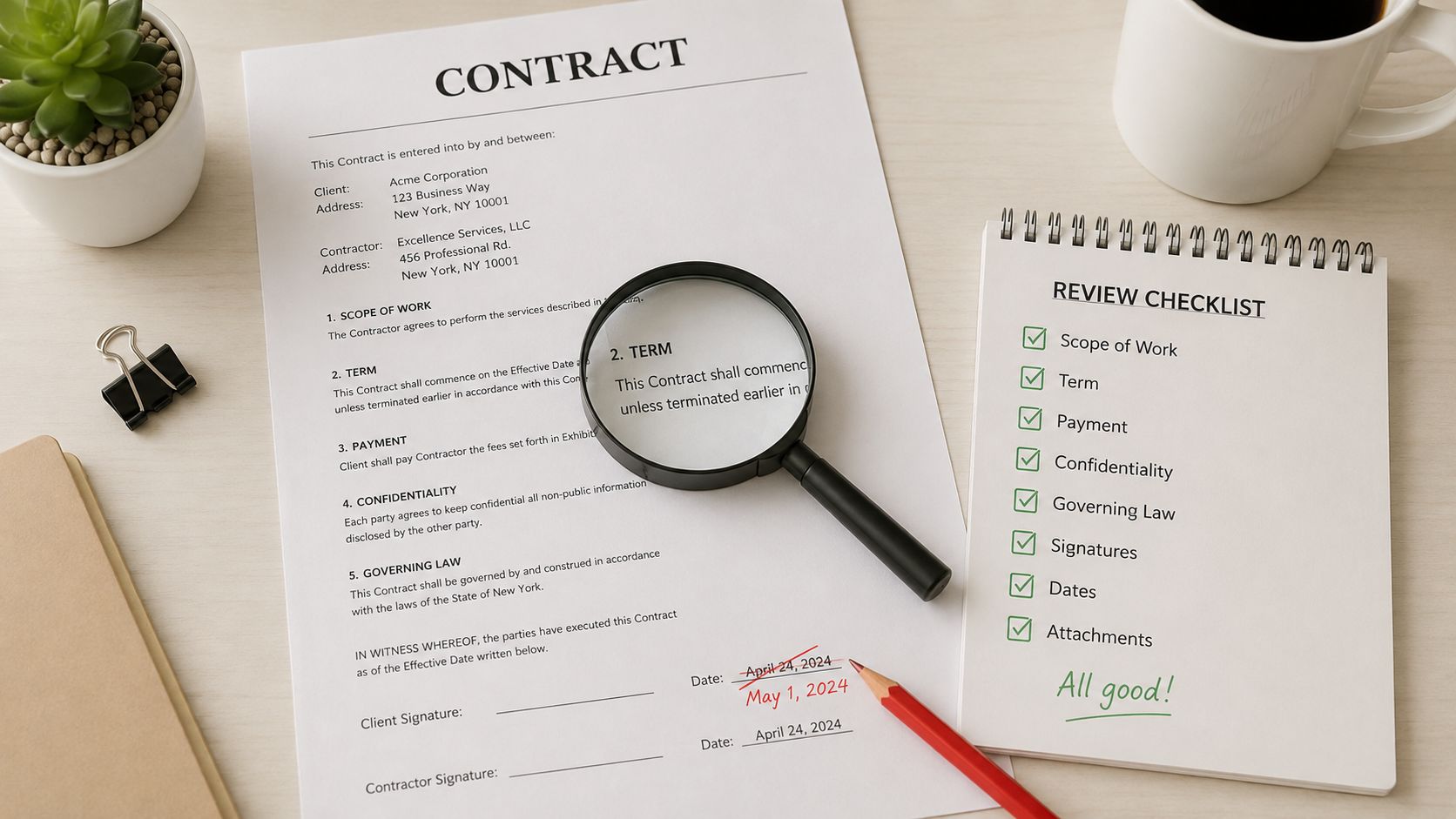
Score during the interview, not afterward. Memory converts into impressions within a day, and impressions are where bias lives.
| # | Question tests | Strong answer contains | Automatic concern |
|---|---|---|---|
| 1 | Communication under pressure | Fact first, confirmed status, committed next step | Improvised reassurance without checking |
| 2 | Software and AI judgment | Named systems, the rejection path, a confidentiality boundary | Logos with no workflow behind them |
| 3 | Error handling | A specific pre-send check and fast escalation | A lesson learned with no mechanics |
| 4 | Prioritization | Deadline hierarchy, proactive notice, escalation trigger | Seniority or volume as the ranking rule |
| 5 | Boundaries and research | Routes to an attorney; rules first, then confirmation | Any legal opinion offered to a client |
| 6 | Confidentiality | Escalate, document, no unilateral fix, prevention change | Concealment, or a generic privacy promise |
| 7 | Client interaction | Boundary held, named owner, committed timeline | Speculating about something they do not own |
| 8 | Organization | Conventions someone else can follow | A system only they can navigate |
Do not average away a serious failure. A candidate can be excellent on software and still be unhirable if they would conceal a wrong-recipient disclosure or give a client unauthorized legal guidance. Questions 5 and 6 are pass-fail, not weighted.
Record red flags in the same format for every candidate so you compare evidence rather than impressions. For preparation-side context on how candidates rehearse for these interviews, the U.S. Bureau of Labor Statistics data cited in this legal assistant interview guide and the Bureau of Labor Statistics information summarized by Indeed are both useful reading before you write your prompts, because knowing the rehearsed answer is how you design the follow-up that gets past it.
Most of the eight questions work unchanged for a remote hire. Three need an extra layer: confidentiality on a home network, filing discipline in a shared system, and time-zone overlap with the attorneys the person supports.
Overlap is the practical constraint. Court deadlines do not move for a handoff, so a legal assistant needs to be reachable during the hours filings actually happen. Our Virtustant South America guide maps which countries hold which working windows against U.S. business hours.
Virtustant places named vetted professionals across Latin America, including bilingual legal assistants, while we carry sourcing, assessment, contracts, payroll, HR and compliance. You run the interview, you score it, you make the call.
| What we publish | Figure |
|---|---|
| All-in hourly rate | Role-specific quote, scoped on the discovery call |
| Placement, setup and recruitment fees | $0 |
| Vetted bilingual candidates presented | 3 to 5 within 48 hours |
| Time to start | Start in 72 hours from your first call |
| Contract terms | Month to month, with a lifetime replacement guarantee and no time limit |
Against a comparable U.S. hire, you can save up to 70% once payroll, benefits and overhead are counted, measured against the $30.24 median hourly wage above. The vetting funnel behind our top 1% claim is published rather than asserted: of everyone who applies, 22% pass the initial screen, 9% pass the cognitive (IQ), skills and English assessment, 3% reach a live interview and 1% are hired. The 1% refers to that full multi-stage funnel. We have worked with more than 1,000 U.S. clients since 2021.
If you are still deciding what the role should be before you interview for it, executive assistant vs administrative assistant maps the authority difference, and the cost to hire a virtual receptionist covers the front-desk side of legal support. When you are ready to see candidates, start from nearshore staffing, the published rate card, virtual assistant services or the remote roles we staff. Our onboarding checklist covers the first 30 days after the offer.
Eight areas cover the role: communication under pressure, case-management software and AI judgment, error handling, prioritization against deadlines, legal boundaries and research method, confidentiality procedure, client interaction, and filing systems someone else can navigate. Ask each as a scenario rather than a trait question, and score the observable behavior in the answer.
The confidentiality scenario: a privileged document went to the wrong recipient and they notice an hour later. It is pass-fail. A strong answer escalates to the supervising attorney immediately, does not attempt a unilateral fix, documents what happened, and proposes a prevention change. Concealment or a generic promise of discretion should end the process.
Ask which case-management system they used most and what they did in it that a newcomer could not. Then ask for the exact sequence of an e-filing in your jurisdiction, including what happens when the portal rejects a submission. Anyone who has actually done it mentions the rejection path without being asked.
Do not ask whether they use it. Ask what they refuse to put into it and what they verify before a draft reaches an attorney. Law360 reports 80% of firms using or exploring generative AI with Microsoft 365 Copilot most adopted at 68%, but nearly 60% of those users are still piloting, so expect exposure rather than mastery.
The U.S. Bureau of Labor Statistics reports median pay of $62,890 a year, or $30.24 an hour, for paralegals and legal assistants as of May 2025, across 404,900 jobs. Employment is projected to be essentially flat through 2035, with about 40,800 openings a year, most of them replacement demand.
Offering a client any legal opinion, however hedged. Concealing or minimizing a confidentiality breach. Listing software with no workflow behind it. Ranking work by who asked loudest rather than by deadline. And a filing system only the candidate can navigate, which becomes an outage the first time they are out sick.
Yes, a short one. Ask for two paragraphs responding to a realistic client scenario during the interview, plus a small task such as prioritizing a deadline list or organizing a sample matter folder. Written claims about communication are unfalsifiable; a writing sample produced under the same conditions as the job is not.
Score during the interview against a written rubric, one row per question, with a note on what the candidate actually said. Treat the boundary and confidentiality questions as pass-fail rather than weighted, so a strong technical score cannot average away a serious failure. Record red flags in the same format for every candidate.
Yes, with three additions to the screen: how they protect confidential documents on a home network or in public, how they keep the firm system as the single source of truth instead of local copies, and whether their working hours overlap the window in which filings and attorney reviews actually happen.
It depends on the model. The U.S. median is $30.24 an hour in wage alone before employer costs. Virtustant quotes legal assistant roles at a role-specific, all-in hourly rate scoped on the discovery call, with no placement or setup fee and with contracts, payroll, HR and compliance included.
Third-party figures are those each source publishes on its own site, checked September 2026. Virtustant figures are first-party placement data.