Accounts Receivable Services: What They Are and How They Work
September 6, 2026


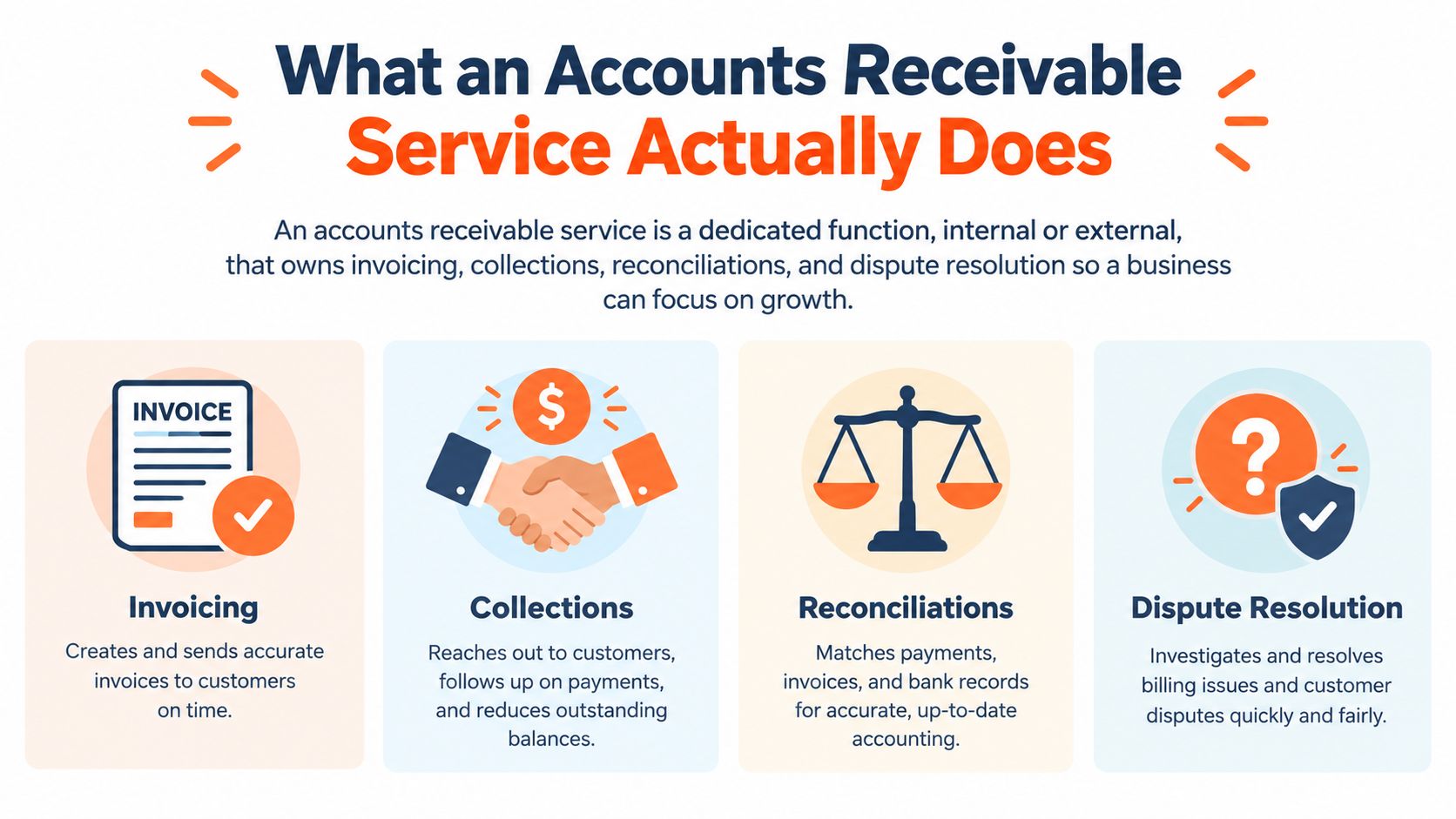
An accounts receivable service owns the work that turns an issued invoice into collected cash: invoicing, cash application, aging management, dunning, dispute resolution and AR reporting. It is a finance-operations function, not a collections agency, and that distinction decides both what you buy and what it is allowed to do.
The reason it matters is timing, not paperwork. Industry payment data shows that 54% of SMEs expect payments to arrive past the due date, invoices are paid an average of 6 days late, and 20% are delayed by more than two weeks. Every one of those days is your working capital financing your customer.
This page covers what the service actually does, the four KPIs that matter, how engagement models are priced, where the authority boundary sits, and a 90-day plan to hand the function over without losing control of the customer relationship.
Four functions, run as one loop. Break any of them and the others stop working.
| Function | What it covers | What "done" looks like |
|---|---|---|
| Invoicing and billing | Issue invoices on terms, apply the right entity, PO and tax treatment, deliver to the right contact | Invoice out within one business day of the trigger event, no rework |
| Cash application | Match incoming payments to invoices across bank, card and processor feeds | Unapplied cash cleared within the same week it lands |
| Aging and dunning | Bucket open balances, run the reminder cadence, escalate on schedule | Every past-due invoice has a next action and a named owner |
| Disputes and reporting | Log the reason code, route to the owner, report DSO, aging and collection effectiveness | Disputes resolved or escalated inside an agreed SLA |
This is the question buyers actually ask, and most vendor pages skip it. The difference is who owns the relationship and when the debt changes hands.
| Accounts receivable service | Collections agency | |
|---|---|---|
| When it engages | From invoice issuance onward, on current and past-due balances | After an account is written off or seriously delinquent |
| Relationship | Works as your finance team, in your name and systems | Works as a third party pursuing a debt |
| Commercial model | Retainer, per-transaction or dedicated headcount | Typically a percentage of what it recovers |
| Goal | Prevent lateness and keep the customer | Recover cash from an account you may lose |
Practical consequence: an AR service should reduce the number of accounts that ever reach a collections agency. If your provider only shows up when an invoice is 90 days old, you bought the wrong thing. For the wider function, see finance and accounting outsourcing and outsource accounting.
AR is one of the few finance functions with genuinely clean metrics. Track four, and make the provider report them in the same format every month.
| KPI | What it measures | What good looks like |
|---|---|---|
| DSO (Days Sales Outstanding) | Average days to collect after a credit sale | The APQC spread is 30 days top quartile, 46 days bottom |
| Aging distribution | Share of the balance in 0 to 30, 31 to 60, 61 to 90 and 90+ | The 90+ bucket shrinking month over month |
| Unapplied cash | Money received but not matched to an invoice | Near zero at each week close |
| Dispute cycle time | Days from reason code logged to resolved or escalated | Inside an agreed SLA, with the reason codes trending |
DSO is the average time to collect after a credit sale. Salesforce's DSO explanation gives the standard calculation: DSO = (accounts receivable ÷ credit sales for the period) × days in the period.
Worked example, because this is where most write-ups go wrong. An AR ledger of $1.2 million against $200,000 in monthly credit sales, over a 30-day month:
($1,200,000 ÷ $200,000) × 30 = 180 days.
Not 18. A company carrying six months of sales in receivables is in a working-capital emergency, and the difference between those two numbers is the difference between a healthy business and one about to miss payroll. Check the arithmetic on any DSO figure a provider quotes you, including the ones in their case studies.
The APQC benchmark summary places top performers at roughly 30 days to collect against 46 days for bottom-quartile performers, a 16-day spread. On $200,000 of monthly credit sales, closing 16 days of that gap frees roughly $107,000 of cash that was sitting in someone else's bank account.

Aging discipline is what moves the number. This guide to lowering Days in AR connects bucket-level tracking to collection execution: prioritize the oldest balances rather than treating every open invoice the same. For reporting cadence, our guide to creating dashboards for nearshore teams covers how to make the numbers visible weekly instead of at month-end.
Before you buy a service, know what you are fixing. The North American payment-practices report finds that U.S. B2B payment delays are primarily due to customer cash flow pressures. That is worth sitting with, because it changes the remedy.
If lateness is mostly your customers' liquidity, then a harder dunning script will not fix it. What works is earlier: credit terms set against actual customer risk, invoices that are correct the first time, and a reminder cadence that starts before the due date rather than after it.
The late-payment analysis puts the average at 6 days late with 20% past two weeks. Combine the two findings and the operating conclusion is specific: most of your late cash is recoverable through process, not pressure. Correct invoices, delivered to the right contact, with a pre-due reminder, remove the excuses that let a stretched customer deprioritize you.
A broader cash flow management guide is useful for connecting AR discipline to the rest of the cash cycle, including payables timing and the buffer you hold. If payables are the other half of the job you are handing over, our guide to accounts payable outsourcing shows the invoice volume at which a dedicated professional pays off, and why most small businesses end up buying AP and AR inside one bookkeeper seat.
AR touches revenue recognition, customer relationships and cash. Hand it over without an approval design and you have created exposure, not leverage. Separate preparation from approval, exactly as you would in bookkeeping.
| Decision | The AR team does this | This stays with you |
|---|---|---|
| Invoice issuance | Prepare and send on agreed terms and templates | Any off-template term, discount or special arrangement |
| Credit memos and write-offs | Prepare with the reason code and evidence | Approval above a written dollar threshold |
| Payment application | Match receipts, clear unapplied cash | Sign-off on any reallocation between customers |
| Dunning | Run the agreed cadence and templates | The escalation point, and any change of tone or terms |
| Customer escalation | Flag with full history within the SLA | Every conversation with a strategic account |
| Sending to collections | Recommend with the file assembled | The decision, always |
Two rules make that table operational. Write the write-off threshold as a dollar figure, so escalation is policy rather than judgment. And keep the decision to send an account to collections internal, without exception, because that decision usually ends the customer relationship and the person making it should be the person who owns the account.
The provider should never be able to forgive a balance, change a term, or escalate a strategic customer on its own initiative.
Three ways to buy this, priced on different logic. Ranges below are planning ranges; validate against quotes for your volume.
| Model | How it is priced | Speed | Best fit | Watch for |
|---|---|---|---|---|
| Managed AR service or BPO | Retainer or per-transaction | Fast once scoped | High invoice volume with standard terms | Less visibility into who does the work day to day |
| Collections agency | Percentage of recovered dollars | Fast on aged accounts | Recovery campaigns on difficult delinquency | It engages after the relationship is already damaged |
| Dedicated nearshore AR professional | All-in hourly rate, from $8.50 per hour | 3 to 5 vetted candidates within 48 hours | Ongoing invoicing, collections and reconciliation inside your systems | You still own approvals and weekly review |
For reference on what the market advertises, providers on this term publish rates from around $15 per hour for AR support. Virtustant publishes an all-in rate from $8.50 per hour for finance-operations roles, with a typical full-time cost of $1,500 to $5,000 per month and $0 in placement, setup or recruitment fees. The all-in rate includes contracts, payroll, HR and compliance. See remote staffing pricing and what a bookkeeper costs for the full picture.
The comparison that matters is not rate against rate. It is cost per collected dollar, including the management hours the arrangement consumes on your side.
Virtustant is a remote staffing agency. We place named vetted professionals across Latin America who run AR inside your systems and your calendar, while we carry sourcing, assessment, contracts, payroll, HR and compliance. Approvals, escalation and the customer relationship stay with you.
| What we publish | Figure |
|---|---|
| All-in hourly rate for finance-operations roles, from | $8.50 per hour |
| All-in hourly rate, floor across all roles | $7.00 per hour |
| Placement, setup and recruitment fees | $0 |
| Typical full-time monthly cost | $1,500 to $5,000 per month |
| Vetted bilingual candidates presented | 3 to 5 within 48 hours |
| Time to start | Start in 72 hours from your first call |
| Contract terms | Month to month, with a lifetime replacement guarantee and no time limit |
The vetting funnel behind our top 1% claim is published rather than asserted: of everyone who applies, 22% pass the initial screen, 9% pass the cognitive (IQ), skills and English assessment, 3% reach a live interview and 1% are hired. The 1% refers to that full multi-stage funnel. We have worked with more than 1,000 U.S. clients since 2021.
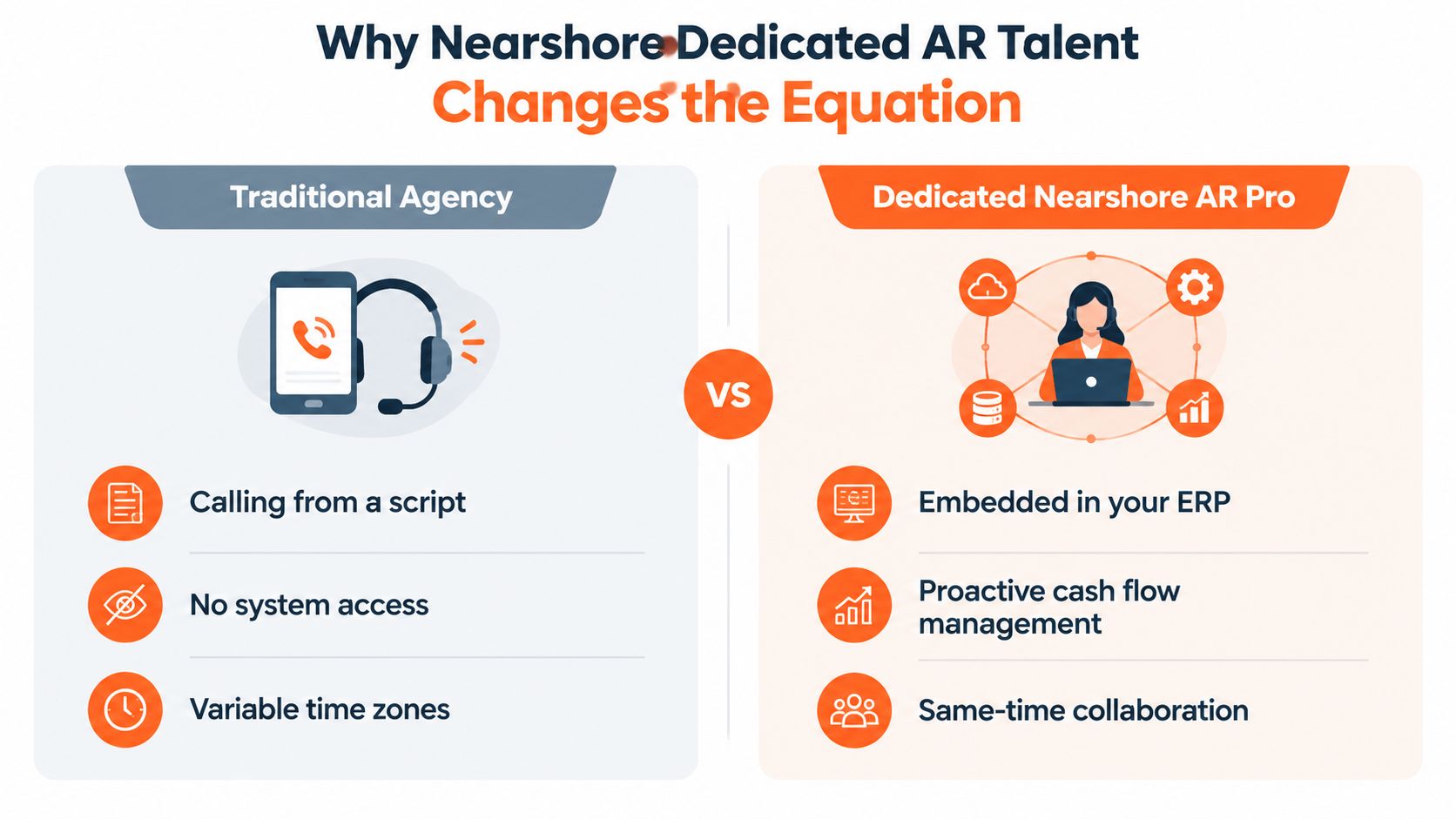
For AR specifically, the operational argument is time-zone overlap: dunning calls, disputed line items and bank exceptions need same-day resolution inside your business day, not a next-morning handoff. Review a nearshore staffing company only after you have defined the systems, the approval rights and the outcomes the role must own. Related: bookkeeper virtual assistant, hire a remote bookkeeper, outsourcing back office operations, remote staffing services and the remote roles we staff.
Do not transfer the function on day one. Transfer visibility first, then execution, then ownership.

An accounts receivable service owns the work that converts an issued invoice into collected cash: invoicing and billing, cash application, aging and dunning management, dispute resolution and AR reporting. It runs as part of your finance operation, in your systems and under your approval rules, rather than as an outside party pursuing a debt.
No. An AR service works from invoice issuance onward on current and past-due balances, acts in your name and in your systems, and is paid by retainer, per transaction or as dedicated headcount. A collections agency engages after an account is seriously delinquent or written off, acts as a third party, and is typically paid a percentage of what it recovers. A good AR service reduces how many accounts ever reach an agency.
Timing. Invoices go out correctly and cash arrives late, so working capital sits on someone else's balance sheet. Atradius finds U.S. B2B payment delays are primarily driven by customer cash flow pressures, which means the fix is usually upstream: accurate invoices, correct delivery, terms matched to the customer's payment cycle, and a reminder before the due date rather than after it.
DSO equals accounts receivable divided by credit sales for the period, multiplied by the number of days in the period. An AR ledger of $1.2 million against $200,000 of monthly credit sales over a 30-day month gives (1,200,000 ÷ 200,000) × 30 = 180 days. Check the arithmetic on any DSO figure a provider quotes, including in case studies.
It depends on your terms and industry, so measure the trend rather than a single target. As a benchmark, APQC data places top performers at roughly 30 days to collect against 46 days for bottom-quartile performers, a 16-day spread. On $200,000 of monthly credit sales, closing that gap frees roughly $107,000 of cash.
It depends on the model. Managed AR services and BPOs price on retainer or per transaction, collections agencies take a percentage of recovered dollars, and dedicated remote AR professionals are priced hourly. Providers advertising on this term publish rates from around $15 an hour. Virtustant publishes an all-in rate from $8.50 per hour with no placement, setup or recruitment fee and typical full-time roles between $1,500 and $5,000 per month.
Approving credit memos and write-offs above a written dollar threshold, changing payment terms or granting discounts, reallocating payments between customers, escalating a strategic account, and the decision to send an account to collections. The provider prepares and recommends; you approve. Keeping the collections decision internal matters most, because it usually ends the customer relationship.
Four: DSO, aging distribution across 0 to 30, 31 to 60, 61 to 90 and 90-plus buckets, unapplied cash, and dispute cycle time. Require the same format every month and baseline all four before the engagement starts, otherwise you cannot prove whether it worked.
Plan 90 days in three stages: discovery and control design in the first 30 days, shadow mode where the provider prepares and you release everything in days 31 to 60, and controlled ownership with escalation thresholds from day 61. Watch whether your weekly review time is falling. If it stays flat, the documentation is the gap.
Yes, and time-zone overlap is the reason it works better than a distant model for this function. Dunning calls, disputed line items and bank exceptions need same-day resolution inside your business day. The requirements are the same as for any AR provider: scoped system access, a written write-off threshold, a named escalation counterpart and weekly review.
Third-party figures are those each source publishes on its own site, checked September 2026. Virtustant figures are first-party placement data.