How to Outsource Back Office Operations the Right Way
August 17, 2026

The popular advice is simple: outsource back office operations to cut labor costs. That advice is incomplete and often expensive. Payroll, bookkeeping, accounts payable, HR administration, and data processing don't fail because an hourly rate was slightly too high. They fail because the buyer outsourced a poorly defined process, ignored exception handling, or discovered too late that setup, integration, compliance, and oversight costs weren't included in the quote.
A better question is: which functions should leave the business, which controls must stay internal, and how will the new operating model perform after the transition team disappears? The market is already large enough that outsourcing is no longer an experiment. One estimate places the back-office support BPO market at US$13.1 billion in 2025, with a projection of US$26.23 billion by 2033, at a 9.1% CAGR. The same estimate identifies North America as the largest revenue-generating region in 2025 and expects India to record the fastest growth from 2026 to 2033. These figures come from back-office outsourcing market research.
Cost matters, but it shouldn't lead the decision. Back-office work is different from customer-facing work because the value sits in consistency, control, documentation, and dependable throughput. A payroll error, missed vendor payment, or incorrect employee record may never appear in a marketing dashboard, but it can disrupt trust, cash flow, compliance, and management attention.
The category has been structurally outsourced for years. A global business survey identified payroll and HR as the most commonly outsourced back-office processes, with 34% of businesses either already outsourcing those functions or planning to do so. The same research found that roughly two out of five businesses used outsourcing as an important way to reduce costs, improve efficiency, and sometimes support compliance, as summarized in the global back-office outsourcing data.
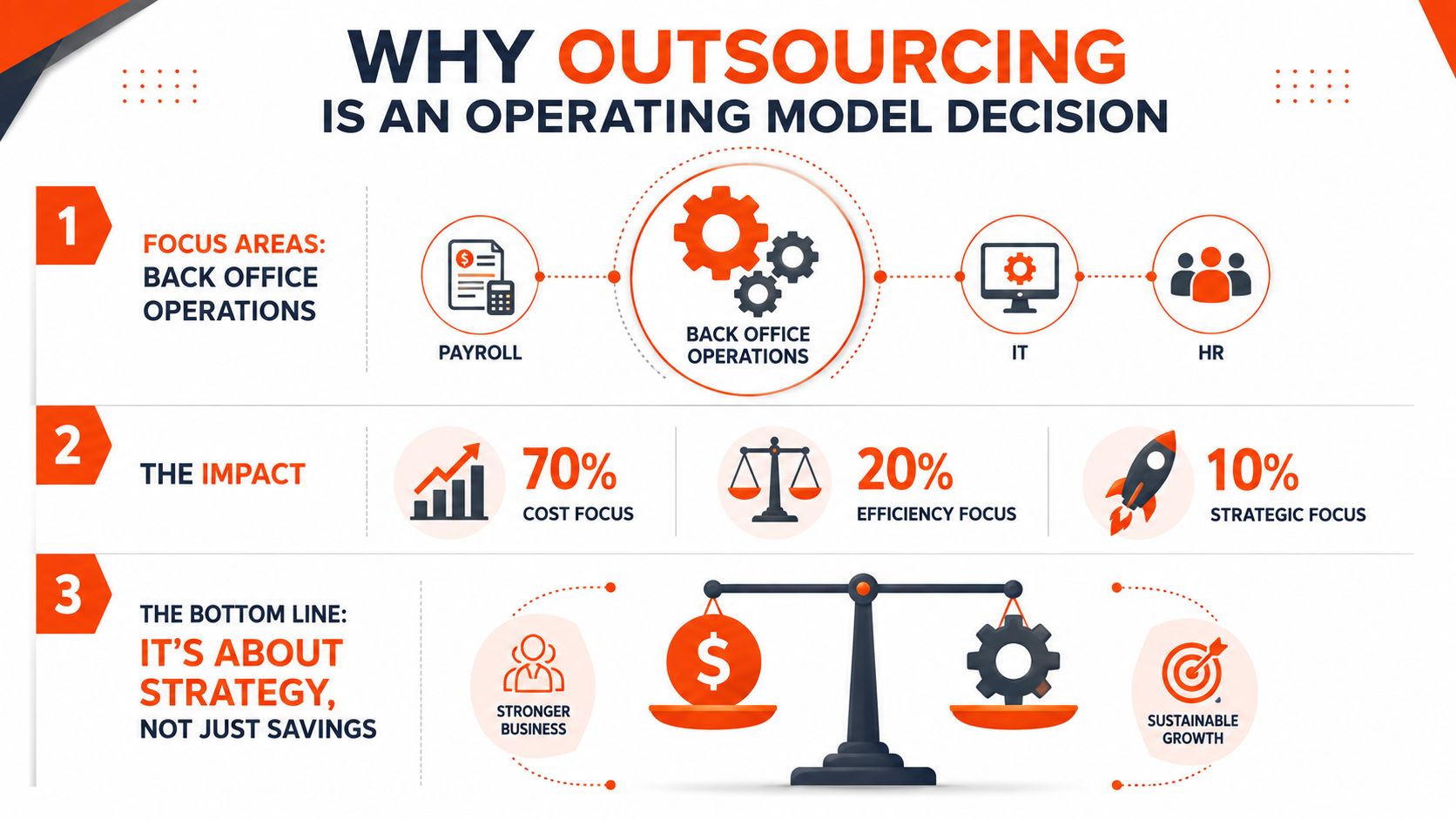
A vendor isn't just supplying labor. It is taking responsibility for queues, handoffs, system access, review procedures, escalation, documentation, and continuity. That changes the buyer's job from supervising individual tasks to designing a service system.
The right comparison is therefore total cost of ownership, not the lowest rate card. A credible business case includes:
Research on the category highlights setup, integration, software, termination, and compliance expenses as common additions that change the economics of outsourcing. Analysis of hidden back-office outsourcing costs makes the important point that the hourly price is only one input.
Operating rule: If the business can't explain who owns each approval, exception, and escalation, it isn't ready to outsource the process.
The mature approach treats outsourcing as a recurring operating expense with ongoing governance. Procurement selects the partner, but operations must make the model work.
Start with the process, not the department. A good candidate has repeatable inputs, clear rules, measurable outputs, manageable data risk, and limited strategic differentiation. A poor candidate depends on undocumented judgment, sensitive relationships, or decisions that the company can't afford to delegate.
Payroll is often a strong candidate when the provider understands the relevant employment rules, maintains access controls, and supports review before submission. It can be a poor choice when the company has unusual compensation structures, frequent one-off adjustments, or weak source data. Keep policy decisions, final approvals, and employee escalation ownership inside the business.
Bookkeeping, reconciliations, invoice coding, payment preparation, and routine reporting also tend to fit well. A 20-person professional services firm may gain flexibility by outsourcing bookkeeping to a managed team. A regulated fintech may outsource transaction preparation while retaining approvals, controls, financial policy, and investigation of unusual items. Businesses evaluating this route can review Wisely's accounting services alongside guidance on outsourcing accounting to compare service scope and control requirements.
HR administration is another candidate, especially for document collection, onboarding coordination, benefits administration, and employee-record maintenance. Keep employee relations, sensitive investigations, compensation philosophy, and final policy interpretation with internal leaders.
Data entry and document processing fit when the source material is stable and the output can be checked. Reporting is more conditional. Routine report production can leave the business, but metric definitions, interpretation, and decisions based on the reports should remain with the people who own the business outcome.
Score each process against these questions:
Select two to four functions for serious evaluation, then pilot one. Don't outsource everything because a vendor offers everything. Outsource the work that benefits from standardization, specialist capacity, and flexible coverage, while keeping accountability for money, access, policy, and judgment close to the business.
The right model depends on how much context the work requires. Offshore BPO is attractive for standardized, high-volume queues. Nearshore staffing is often stronger when managers need daily collaboration, process customization, and shared working hours. Automation can beat both when the task has stable inputs, clear rules, and a safe human fallback.
| Model | Time-Zone Overlap | Control & Customization | Best Fit Functions | Pricing Predictability |
|---|---|---|---|---|
| Nearshore staffing | Usually strong for U.S. teams | High, with dedicated professionals | Bookkeeping, executive administration, reporting, coordination | Predictable when payroll, compliance, and management terms are clear |
| Offshore BPO | Varies by provider and service window | Moderate, process-led | Data processing, invoice queues, standardized HR administration | Predictable at scale, but scope exclusions require close review |
| Software-led automation | Continuous system availability | High rule control, lower judgment | Classification, routing, field extraction, status updates | Depends on licenses, usage, integration, and exception handling |
Nearshore staffing works when the process has exceptions that require conversation. A bookkeeper who can join a same-day call with a finance manager may be more useful than a lower-cost queue operator who works from a rigid script. It also suits firms that want dedicated ownership rather than a pooled service desk.
The tradeoff is management responsibility. The buyer must define the role, provide systems, set priorities, and maintain process documentation. A provider may handle contracts, payroll, HR administration, and compliance, but the client still owns workflow design and performance expectations. Nearshore outsourcing guidance is useful when comparing this model with a process-managed BPO.
Offshore BPO makes sense when volume is steady, work can be measured at queue level, and the vendor has mature quality assurance. It can provide broader coverage and process specialization, but buyers should test escalation quality rather than relying on a polished sales presentation. Ask who handles exceptions, how the vendor documents changes, and whether the proposed team is dedicated or shared.
Automation should enter at the task level, not as a vague promise to replace a department. Software can classify documents, extract candidate fields, route defined work, and flag exceptions. Human reviewers should retain control over payment approvals, conflicting records, access changes, policy exceptions, and legal interpretation. Automation is a poor first move when the underlying process is inconsistent, undocumented, or full of judgment calls.
Most outsourcing failures happen during transition. The vendor may be capable, but the buyer transfers incomplete procedures, misses informal approvals, and assumes the exception rate will resemble the happy-path demonstration.
Start with process scoping and volume mapping. Document every input, system, approval, output, handoff, exception, and deadline. Map normal work separately from unusual work. If payroll includes retroactive changes, manager corrections, commissions, or leave adjustments, each category needs an owner and a treatment rule.
Don't send a generic request for proposal. Give each vendor the same process description, sample records, access assumptions, reporting requirements, and exception scenarios. Compare:
The UK outsourcing market provides a useful signal of buyer intent. Survey data reported that 57% of organizations planned to increase outsourced business processes in 2025, with analysts estimating that incremental demand could add £3 billion to the UK outsourcing market. Those figures from the UK back-office outsourcing report also reinforce the need for disciplined transition planning.
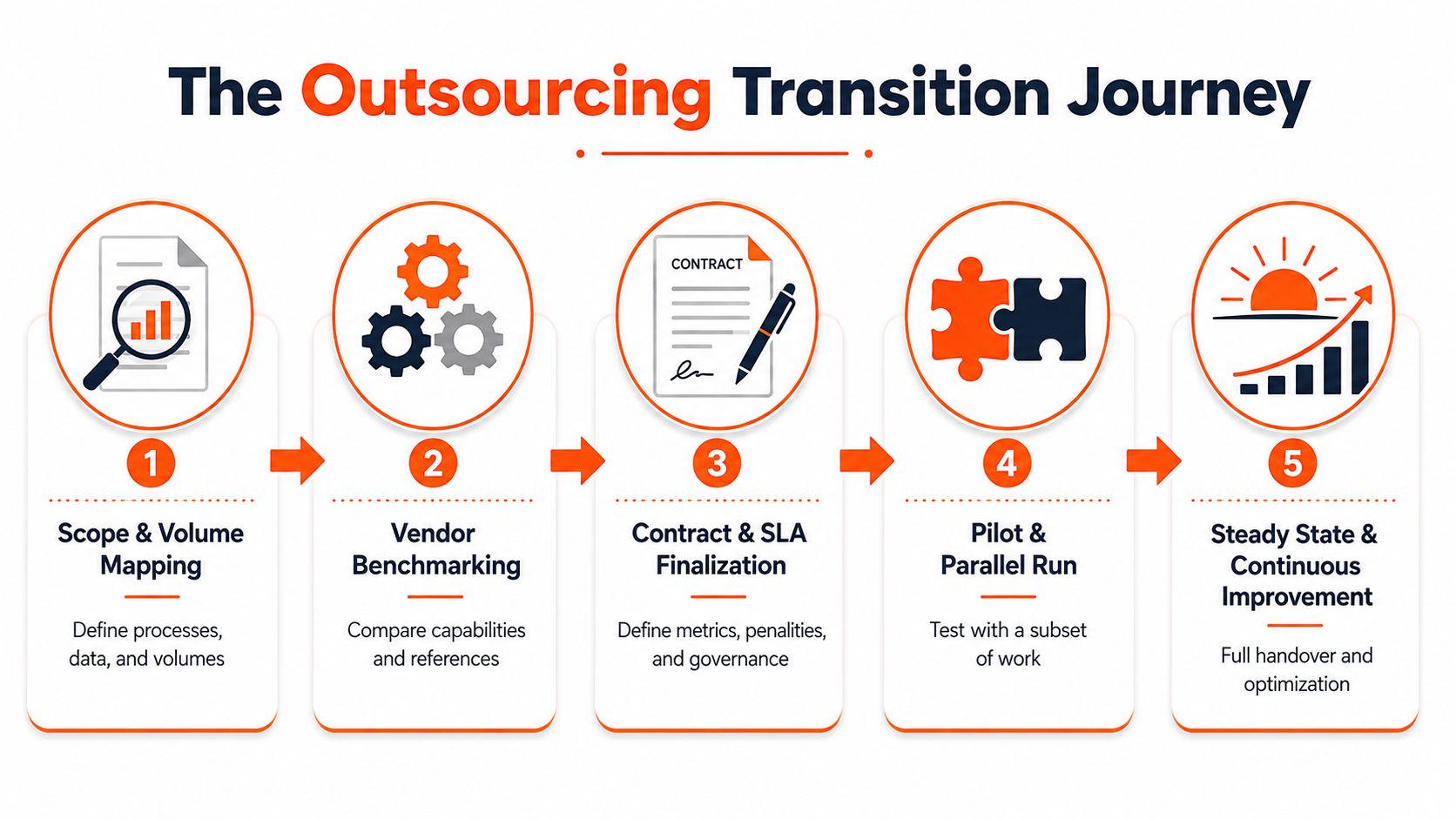
The contract should define service levels, data responsibilities, approval boundaries, escalation routes, reporting, business continuity, and termination assistance. Don't accept a generic promise to deliver “quality service.” Define what accuracy means, how errors are corrected, and which failures trigger remediation.
Knowledge transfer needs more than recorded training. Have the internal team demonstrate the process, observe the vendor performing it, and document every question that arises. The internal subject-matter expert who leaves during week two can take critical context with them, so capture decisions and exceptions before the handoff.
Run a pilot with a contained subset of work. Use a parallel run where the internal team continues checking output before the vendor becomes the production owner. This reveals hidden exception volume, unclear approval rights, missing data, and integration problems while recovery is still manageable.
Automation can support the transition when the process contains stable, repetitive steps, but keep accountability with named operators. Teams exploring a blended human and software model can use a managed AI workforce as a reference point, then define precisely which tasks software performs and which decisions require human review.
Don't measure transition success by whether the vendor can process the happy path. Measure whether the team can recover when the input is incomplete, late, contradictory, or urgent.
A vendor's hourly rate is a starting point, not a business case. A low quote can become expensive after the buyer adds process documentation, internal review, access provisioning, software, integration work, compliance checks, management time, and termination support.
Separate one-time costs from recurring costs. One-time costs include discovery, process mapping, data cleanup, knowledge transfer, workflow configuration, testing, and parallel running. Recurring costs include labor, software, reporting, quality assurance, account management, compliance support, and internal governance.
Ask vendors to price these items explicitly:
The right test is not “which vendor is lowest-cost?” It is “which proposal produces the lowest credible total cost for the required control level?”
Hourly pricing can distort a high-volume process. If automation handles routine invoice classification while people review exceptions, charging only for hours may reward activity rather than completed outcomes. Industry commentary points to a shift toward outcome-based pricing, particularly as automation affects invoice processing, claims validation, KYC, and payroll. Claims that machines can handle up to 90% of routine back-office tasks appear in recent coverage, but buyers should treat that as a scope-dependent industry claim, not a universal planning assumption. The relevant automation pricing discussion is best used to frame questions about task design and accountability.

A $7-per-hour quote isn't automatically a better deal than a $25-per-hour hire, and a higher rate isn't automatically safer. The comparison changes once you include supervision, benefits, recruiting, software, coverage, rework, compliance, and the cost of mistakes. Use a guide to hidden costs in remote hiring to pressure-test labor assumptions, then model the entire workflow rather than multiplying an hourly rate by expected hours.
Outsourcing without governance creates a delayed operational problem. A vendor can process a large volume while accuracy declines, exceptions accumulate, and internal users lose confidence. Volume handled is a useful capacity measure, but it isn't a quality measure.
Set a baseline before the pilot. Then track:
Each KPI needs an owner, reporting frequency, target, and response when performance misses. Don't create a dashboard full of measures nobody uses. Choose a small operating set that helps managers make decisions.
Use weekly operational reviews for queue health, defects, staffing, blockers, and open exceptions. Hold monthly business reviews for trend analysis, root causes, process changes, and commercial issues. Use quarterly strategic reviews to assess whether the model still fits the business, where automation belongs, and which adjacent processes are ready for a controlled pilot.
Create an escalation ladder before the first incident. The service team should know when to resolve an issue, when to involve the account manager, and when the client's process owner or executive sponsor must decide.
An automation CoE framework from Doczen can help organize ownership when workflow automation becomes a broader capability rather than a single vendor project.
Governance test: If a missed SLA produces only a red cell in a report, you don't have governance. You have monitoring.
Watch for recurring late work, rising rework, unexplained staffing changes, unresolved access questions, undocumented process changes, and internal teams creating shadow spreadsheets. These signals mean the operating model is drifting.
A focused launch should create evidence before it creates dependency. Use the first 30 days to choose the work, the next 30 to prepare the handoff, and the final 30 to test controlled production.
Select one or two candidate functions, map the workflow, identify internal owners, document exceptions, and define success criteria. Shortlist vendors using the same scope and request clear pricing for setup, software, transition, ongoing service, and exit.
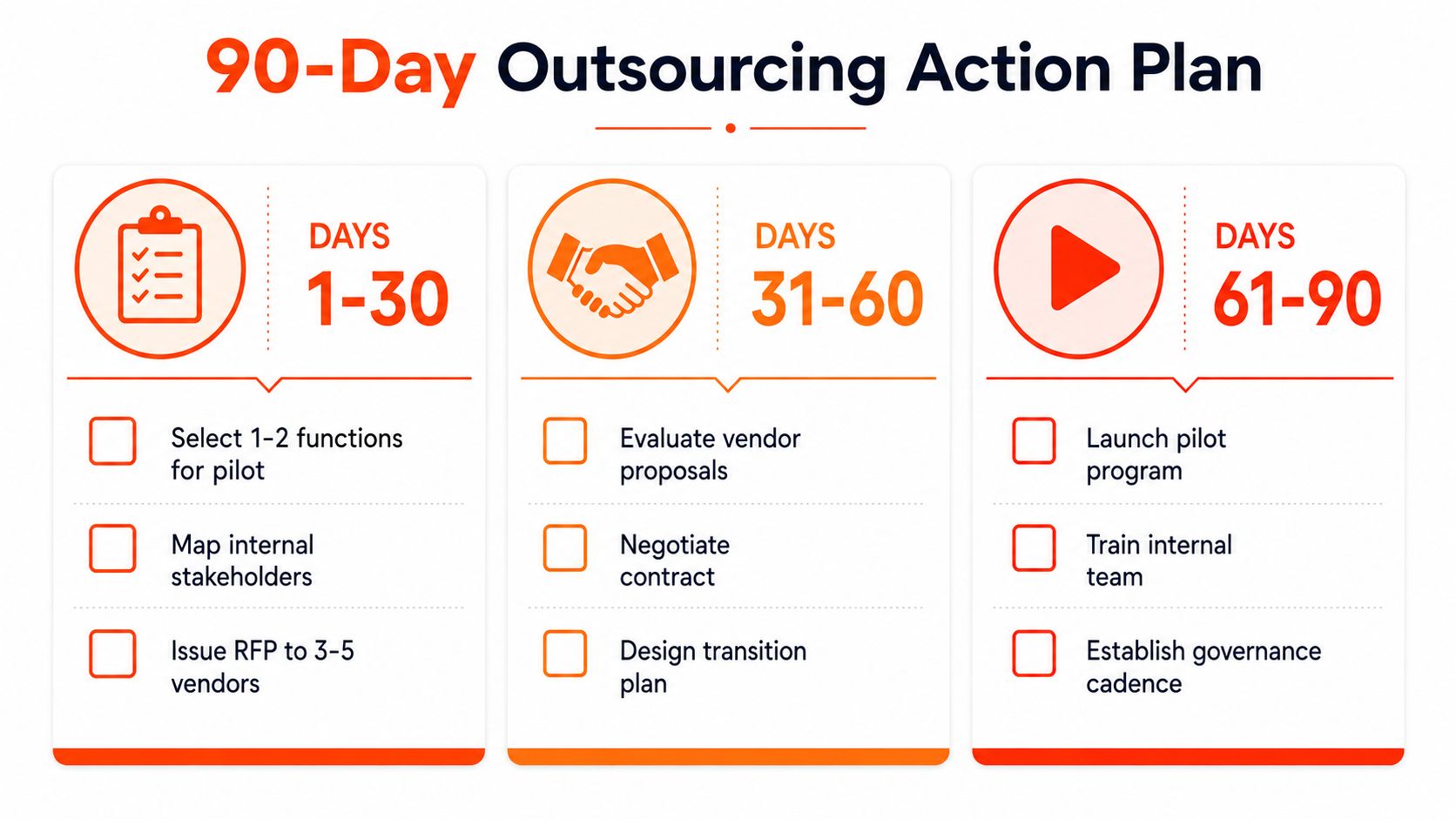
Evaluate proposals through sample work and live process questions. Finalize the contract, access plan, service levels, escalation path, reporting format, and transition schedule. Transfer knowledge through demonstrations, documented procedures, shadowing, and review of edge cases.
Launch a contained pilot, run internal checks in parallel, and record every exception. Set the KPI baseline, hold weekly operating reviews, correct the process, and decide whether to expand, redesign, or stop.
The common momentum trap appears after a technically successful pilot. Teams discover that nobody defined what “ready to scale” means, so expansion becomes an emotional decision. Set the checkpoint in advance: scale only when accuracy, cycle time, exception ownership, access controls, reporting, and internal confidence meet the agreed standard.
If you want to outsource back-office work without losing operational control, Virtustant connects U.S. companies with vetted nearshore professionals for bookkeeping, administration, data, and related support roles. Visit Virtustant to discuss a defined pilot, compare dedicated staffing with other operating models, and build the governance around the work before you hand it over.
Back office outsourcing moves internal support processes, such as payroll, bookkeeping, accounts payable, HR administration, and data processing, to an external team or provider. The value is consistent, documented, dependable throughput, not just a lower hourly rate.
Strong candidates have repeatable inputs, clear rules, measurable outputs, manageable data risk, and limited strategic differentiation, such as bookkeeping, reconciliations, invoice coding, data entry, and onboarding coordination. Keep policy decisions, final approvals, money movement, and employee relations inside the business.
The hourly rate is only one input. A credible cost stack adds transition labor, technology and integration, control and oversight time, compliance, and exit costs. It reduces cost when the process is well defined; a low quote can become expensive once setup, exception handling, and rework are billed separately.
Offshore BPO suits standardized, high-volume queues. Nearshore staffing fits when managers need daily collaboration, customization, and shared hours. Automation wins when inputs are stable and rules are clear, with a human fallback for exceptions. Most teams blend them by task.
The common surprises are setup and transition, integration and software licenses, exception and rework handling, compliance administration, change requests, and exit or continuity costs. Price these explicitly and compare total cost of ownership, not the headline rate.
Scope and map the process, shortlist two to four functions and pilot one, benchmark vendors against the actual work, define the contract and controls, transfer knowledge, then run a parallel pilot before production. Scale only when accuracy, cycle time, exception ownership, and controls meet the agreed standard.