Bookkeeper Virtual Assistant: Role, Costs, and How to Hire
September 3, 2026


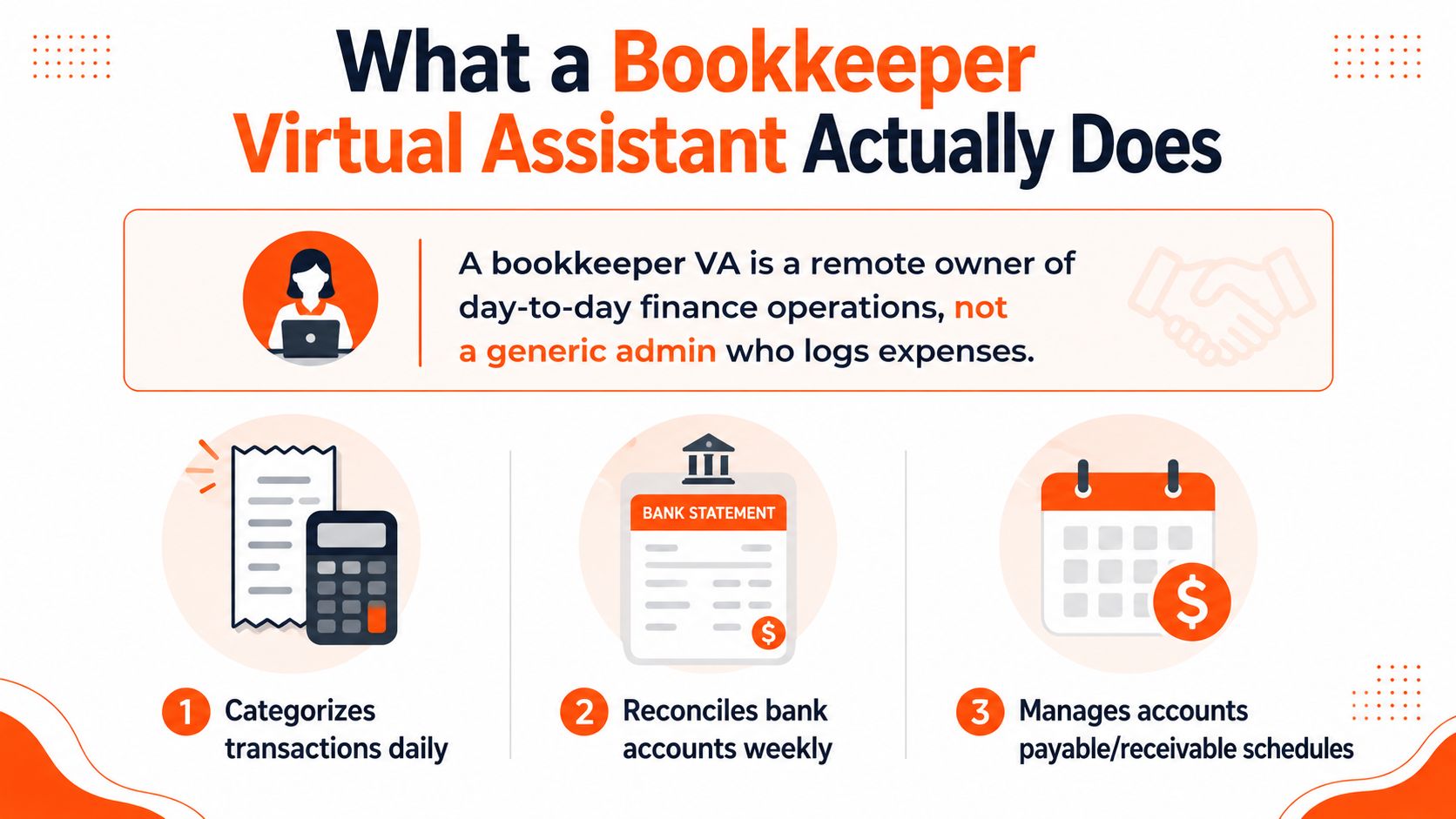
A bookkeeper virtual assistant is a remote finance-operations professional who owns the recurring work in your books: transaction coding, bank and card reconciliations, AP and AR administration, and month-end close preparation. Not a general assistant who happens to log expenses, and not a controller. Many buyers search for the same hire as an accounting virtual assistant.
The rate is the easy part. The decision that actually protects you is the authority boundary: which systems this person gets, what they may approve on their own, and what has to route to someone in the U.S. who can carry the liability. Get that wrong and the cheapest hire becomes the most expensive one.
This page covers what the role owns, what it costs against the U.S. alternative, the access model to set up before day one, and the readiness test that tells you whether to hire at all.
The role covers transaction entry, bank and credit card reconciliations, invoicing, accounts payable and receivable support, month-end close preparation, and financial reporting. That is the scope Virtustant writes into its own bookkeeping placements, and it is how the role is worded in published remote bookkeeping listings generally — this listing is one example of the same wording.
The cleanest way to design the job is to separate work by function and decision authority at the same time. A candidate who codes transactions accurately may still be the wrong person to approve a payment run.
| Function | Typical tasks | Common software | Decision authority |
|---|---|---|---|
| Transactional | Coding bank feeds, receipts, vendor and customer setup | QuickBooks Online, Xero, Sage, Hubdoc, Dext | Apply approved rules, escalate ambiguity |
| Reconciliations | Bank, card, Stripe, PayPal and loan matching | QuickBooks, Xero, Stripe, PayPal | Resolve routine items, flag variances |
| AP and AR | Bills, invoices, aging, first-stage collections | Bill.com, Ramp, Brex, QuickBooks | Prepare payments, never release unilaterally |
| Reporting | Weekly cash snapshot, P&L, balance sheet, KPI pack | QuickBooks, Xero, Excel, Google Sheets | Assemble reports, explain exceptions |
Pre-approve most chart-of-accounts decisions before the first transaction, so the professional is applying your policy rather than inventing one entry at a time. Map candidate experience against your actual stack using Virtustant's software ecosystem. NetSuite administration, intercompany accounting and multi-entity close ownership belong in a more senior role unless a controller has designed and supervises the workflow.
For platform selection, a practical guide to bookkeeping software for tax prep and invoicing helps narrow the tool choice for a small-business workflow. For the underlying role itself, see what a bookkeeper does day to day and bookkeeper vs accountant.
This is the section most guides skip, and it is the one that decides whether the hire is safe. Delegation should follow risk boundaries, not convenience. A remote bookkeeper can run finance operations without owning any decision that creates fraud, tax or strategic exposure.
The single principle: separate preparation from approval. The same person should never be able to initiate, alter and approve the same transaction.
| System or decision | What the bookkeeper gets | What stays with a U.S. officer |
|---|---|---|
| Accounting ledger | Named individual login with standard-user rights | Admin ownership and the audit-log review |
| Bank and merchant accounts | View and export only, or a read-only feed | Master credentials, signing authority, payment release |
| AP and payment tools | Build and stage payment runs | Dual approval on every release |
| Ambiguous coding and write-offs | Apply written rules, escalate above a set threshold | The threshold, and every call above it |
| Sales tax, 1099s, payroll registrations | Collect records, prepare schedules, track deadlines | Review and submission by a qualified professional |
| Board reporting and forecasting | Produce the underlying numbers | The model, the narrative and the commitments |
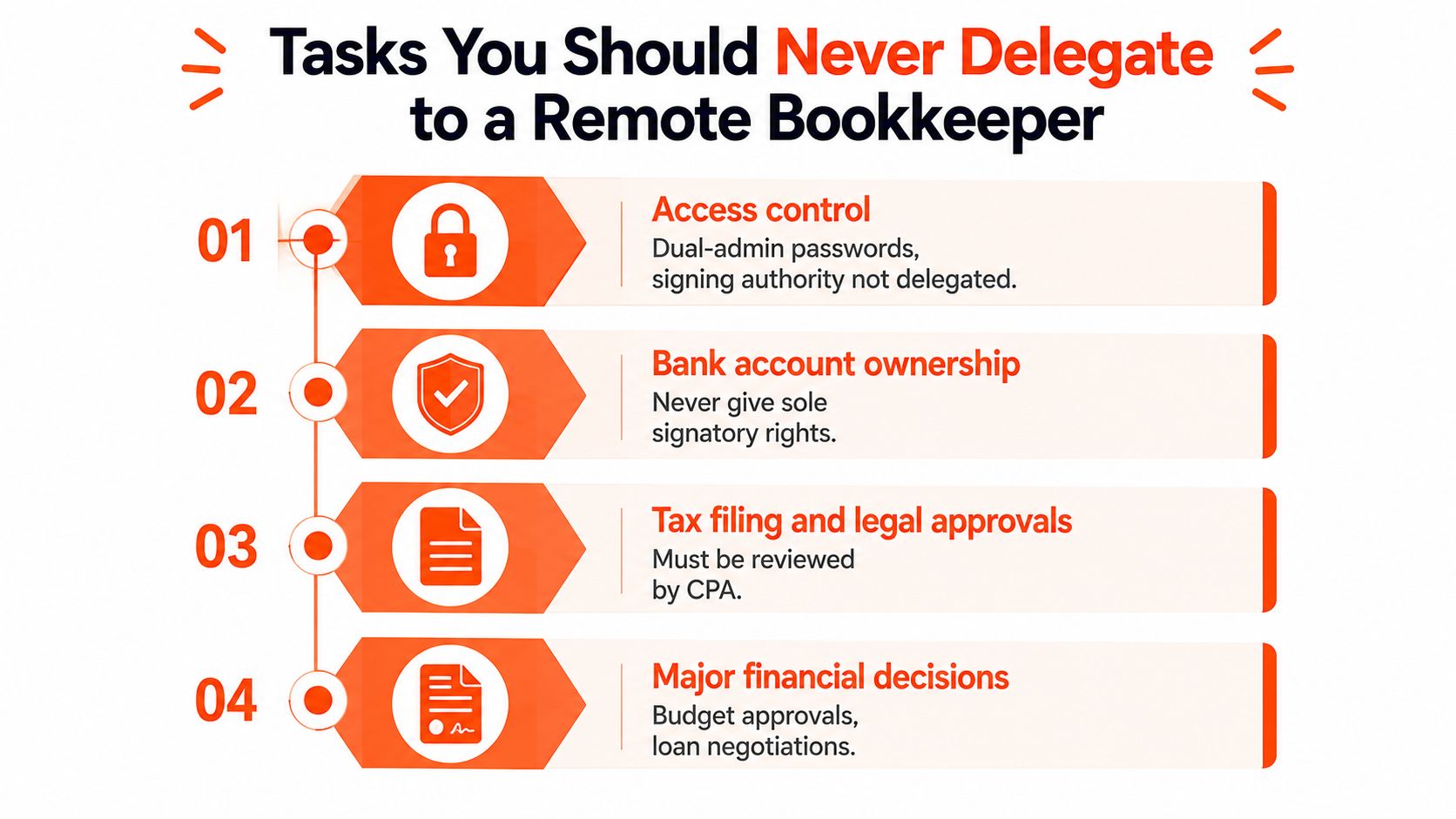
Three practical rules that make the table real. Use individual credentials, never shared ones, so the audit log names a person. Require dual approval on payment release, no exception for small amounts, because the exception is where losses start. Write the escalation threshold as a dollar figure, not as a feeling, so escalating is compliance rather than a judgment call the professional has to defend.
Keep execution with the bookkeeper. Keep every liability-bearing decision with the person who has the authority and the expertise to own it.
None of this is about distrust or about distance. An in-house bookkeeper in your office needs the same separation of duties. Remote delivery does not create the risk, it just makes the absence of a written approval design visible.
Two independent sources land in the same place on U.S. bookkeeping labor, which makes the comparison number unusually solid.
| Benchmark | Figure | Source |
|---|---|---|
| U.S. bookkeeping, accounting and auditing clerks, median pay | $50,670 per year, $24.36 per hour, May 2025 | Bureau of Labor Statistics |
| U.S. bookkeeping virtual assistant, average advertised pay | $24.40 per hour, with most between $20.43 and $27.40 | ZipRecruiter |
| Virtustant all-in rate for bookkeeping support | From $8.50 per hour | Virtustant placement data |
The U.S. Bureau of Labor Statistics puts the median for bookkeeping, accounting and auditing clerks at $50,670 a year, or $24.36 an hour, as of May 2025. Advertised pay for the remote version of the job sits in the same place: ZipRecruiter reports an average of $24.40 an hour for a bookkeeping virtual assistant, with most of the market between $20.43 and $27.40.
Two different measurements, both landing in the mid-$20s. That is your comparison number, and it is a wage figure only, before employer payroll taxes, benefits, equipment, recruiting time and the management hours the role consumes.
Virtustant publishes an all-in rate for bookkeeping support from $8.50 per hour, which includes contracts, payroll, HR and compliance. Against a comparable U.S. in-house hire, clients save up to 70% once payroll, benefits and overhead are counted. For the full model-by-model breakdown see what a bookkeeper costs in 2026 and remote bookkeeper hourly rates.
Price the hire on total operating cost: labor, plus onboarding drag, manager review time, software seats, transition overlap and replacement exposure. The cheapest hourly rate becomes expensive when the owner still trains every task, corrects reconciliations and chases missing records.
Budget for a ramp. Expect one to two weeks before the books run at steady state, depending on how clean your existing records are — a window that this roundup of virtual bookkeeping firms also describes. Our own placement process is faster on the front end, 3 to 5 vetted candidates within 48 hours and a start in 72 hours, but the books still need that cleanup window before steady-state production. If your records carry historical gaps, inconsistent vendor naming or undocumented approval paths, the first period costs more than the ones after it.
Scope and continuity are part of the price too. A 2025 survey of 644 bookkeepers found 58% work solo, 40% charge $300 to $500 per month, 26% manage 20 or more clients and 41% rely on word-of-mouth referrals as their main acquisition channel (Ambitious Bookkeeper). A solo provider carrying 20 clients is a continuity question, not just a rate.
For market context, the global virtual bookkeeping services market was $4.5 billion in 2024 and is projected at $12.5 billion by 2032 on a stated 15% CAGR (Future Data Stats). Worth noting for anyone modelling from it: those two endpoints imply roughly 13.6% compounded, not 15%, so treat the growth figure as directional.
The hourly rate is not the decision. Hours required and integration depth are.
| Model | All-in hourly cost | Weekly hours | Control and integration | Best fit |
|---|---|---|---|---|
| Dedicated remote bookkeeper VA | From $8.50, all-in | Full-time equivalent | High workflow integration, remote delivery | Daily transaction and close operations |
| U.S. in-house bookkeeper | $24.36 median wage before employer costs | Full-time | Highest direct control and internal access | On-site control and constant collaboration |
| Fractional or contracted bookkeeper | Priced per engagement, judgment-heavy | 5 to 10 | Strong judgment, limited daily availability | Light integration and complex review |
Operator rule: under 20 hours a week with light integration, use fractional support. At 20 to 40 hours with daily operational integration, use a dedicated remote professional. Choose in-house when full-time internal control outweighs the cost difference.
Do not compare a transaction processor with a CPA-led fractional engagement as though they are interchangeable. They solve different problems, and the fractional option is usually the right answer when the work is periodic and the difficulty is judgment rather than volume.
Hire on repeatable workload, not on a feeling that the company is growing. Below roughly $500,000 in annual revenue, a founder plus automation is often enough if the books stay current. Between $500,000 and $2 million, recurring operational pain usually justifies the hire.
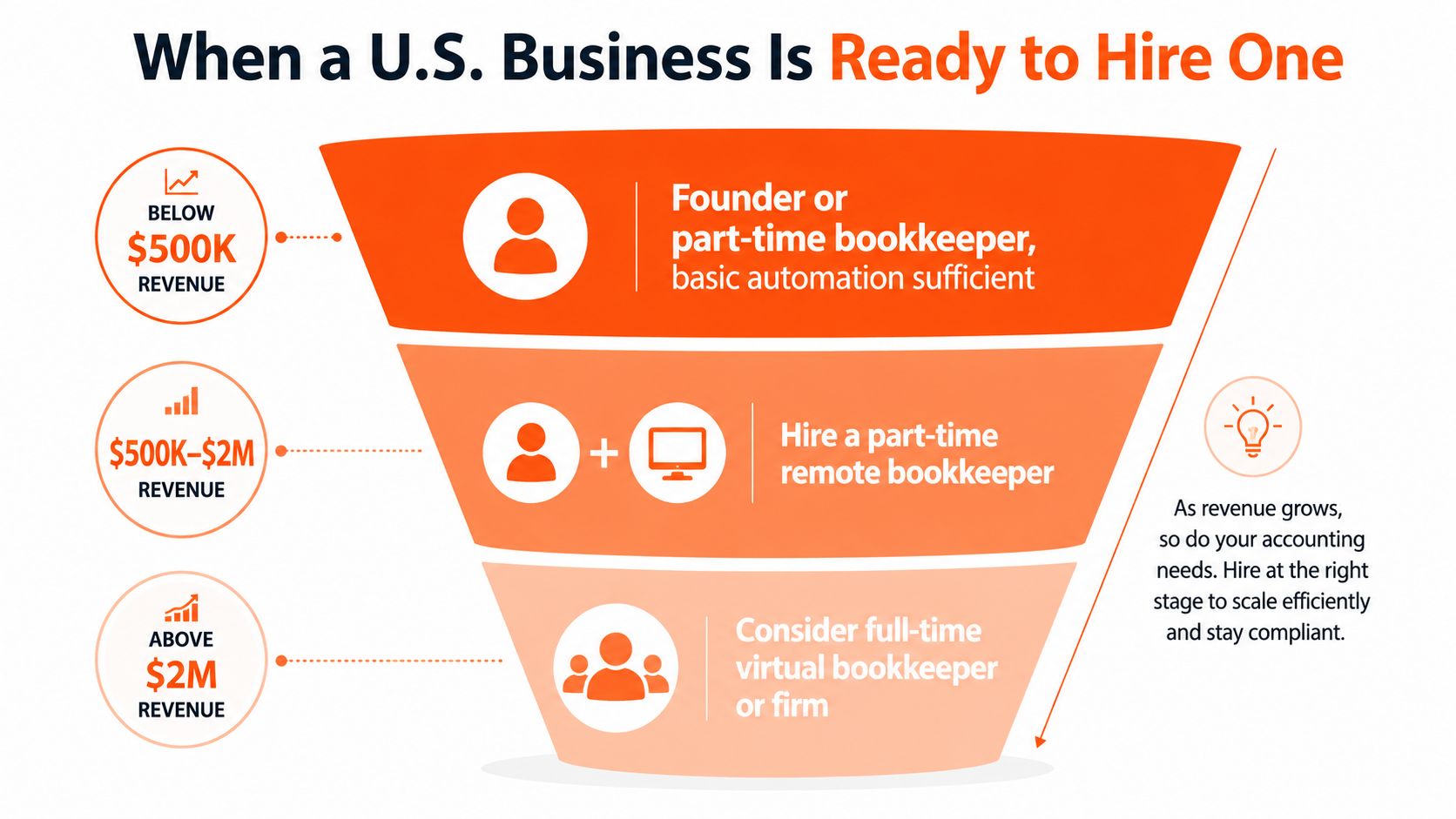
Do not hire yet if volume is under 50 transactions a month, the books are already clean and stable, or nobody can administer the accounting system and review the output. A remote hire cannot compensate for absent ownership, and item five is the one that actually fails in practice.
Founders often benchmark scope before committing, and you can search remote jobs from HiredBySkill to see how bookkeeping responsibilities are written up across the market. Read those postings for scope language, not for pricing: job-board rates describe what a U.S. worker is paid, not what a staffing engagement costs. If the workload is real and recruiting is the bottleneck, you can hire a virtual assistant once the access and review model is defined.
A weak job description attracts general assistants. A useful one names the ledger, the systems, the permissions, the outputs and the manager.
Run a paid 60-minute trial in your own stack. Give a sample bank feed, ask for 30 transactions coded, the account reconciled, an AR aging email drafted and the cash position summarized. Score accuracy, judgment, documentation and speed. A polished resume does not outweigh a failed trial in your accounting environment.
Before the offer, confirm: hands-on proficiency in your exact platform, a written English sample, references on finance-process ownership, working hours that cover your review and payment windows, how they protect access and devices, a connectivity backup plan, a signed NDA, contract terms and notice, the probation window, the KPIs you will track, and the weekly review cadence.
Our 25 bookkeeper interview questions gives the technical and integrity questions to run in the interview, step-by-step hiring guide for a small business covers the process end to end, and remote bookkeeper roles in LATAM shows how the scope is named in live roles.
Virtustant is a remote staffing agency. We place named vetted professionals across Latin America who work inside your systems and your calendar, while we carry sourcing, assessment, contracts, payroll, HR and compliance. You keep the management relationship, the approvals and the daily direction.
| What we publish | Figure |
|---|---|
| All-in hourly rate for bookkeeping support, from | $8.50 per hour |
| All-in hourly rate, floor across all roles | $7.00 per hour |
| Placement, setup and recruitment fees | $0 |
| Typical full-time monthly cost | About $2,056 at the H1 2026 bookkeeper median client-side rate of $12.85 per hour (n=7, small sample), full time; $1,500 to $5,000 is the typical full-time band across roles |
| Vetted bilingual candidates presented | 3 to 5 within 48 hours |
| Time to start | Start in 72 hours from your first call |
| Contract terms | Month to month, with a lifetime replacement guarantee and no time limit |
The vetting funnel behind our top 1% claim is published rather than asserted: of everyone who applies, 22% pass the initial screen, 9% pass the cognitive (IQ), skills and English assessment, 3% reach a live interview and 1% are hired. The 1% refers to that full multi-stage funnel. We have worked with more than 1,000 U.S. clients since 2021.
Time-zone overlap is the operational reason this works for finance. Virtustant's database holds more than 349,000 candidates, 61.5% of them based in Latin America, and 42,716 have confirmed they can work U.S. business hours (Virtustant hiring records, September 2026). The clock backs that up, and it is a matter of public record rather than anyone's proprietary finding: most major Latin American business centers sit within 0 to 3 hours of U.S. Eastern Time — Bogotá and Lima at UTC-5, Mexico City at UTC-6, São Paulo and Buenos Aires at UTC-3 — which on a 9-to-18 local schedule leaves 6 to 8 hours of overlapping work hours with a U.S. business day. For a country-by-country breakdown, see Wow Remote Teams. Bank exceptions, vendor questions and same-day founder review all happen inside the business day rather than in a next-morning handoff.
One question before you sign anything, with any provider: could you replace this person in under two weeks if the engagement failed? If not, document the workflow and protect the access before you hire, not after. When you want a shortlist of vetted, time-zone-aligned candidates instead of another pile of unverified applications, compare nearshore staffing and the cost to hire a virtual assistant, or start from hire a remote bookkeeper. For the wider function, see finance and accounting outsourcing guide and bookkeeping for startups.
A bookkeeper virtual assistant is a remote finance-operations professional who owns recurring bookkeeping work: transaction coding, bank and credit card reconciliations, accounts payable and receivable administration, month-end close preparation and routine financial reporting. It is a finance role delivered remotely, not a general administrative assistant who occasionally logs expenses.
Virtustant publishes an all-in rate for bookkeeping support from $8.50 per hour, which includes contracts, payroll, HR and compliance. For comparison, the U.S. Bureau of Labor Statistics puts median pay for bookkeeping, accounting and auditing clerks at $50,670 a year or $24.36 an hour as of May 2025, and ZipRecruiter reports an average of $24.40 an hour for advertised bookkeeping virtual assistant roles.
Never grant master bank or merchant account credentials, signing authority, or the ability to release a payment alone. Ambiguous coding, sales tax positions and write-offs above a written dollar threshold should escalate. Filings, IRS notice responses and board or fundraising materials need a qualified U.S. reviewer. The rule is to separate preparation from approval so no single person can initiate, alter and approve the same transaction.
Yes, when the access model is designed before the first task. Use individual logins rather than shared credentials so the audit log names a person, give view-and-export access to banking rather than master ownership, require dual approval on every payment release with no small-amount exception, and set a written escalation threshold. An in-house bookkeeper needs the same separation of duties.
When the workload is recurring rather than occasional: roughly 200 to 300 transactions a month or multiple payment channels, month-end close repeatedly taking more than 10 days, a growing AP queue and missed reconciliations, and a manager spending more than 30% of the week on data entry. The last condition is the one that fails most often: someone internal must be able to review weekly and maintain written procedures.
QuickBooks Online or Xero as the ledger, plus the tools around it: Hubdoc or Dext for document capture, Bill.com, Ramp or Brex for accounts payable, Stripe and PayPal for payment reconciliation, and Gusto or ADP for payroll inputs. Ask which workflows the candidate has personally operated rather than which platforms appear on the resume.
A bookkeeper records and reconciles transactions and prepares the reporting package. An accountant or CPA interprets those records, takes tax positions, signs filings and carries professional liability. A bookkeeper virtual assistant can prepare everything an accountant needs, but should not make the decisions that create tax or legal exposure.
Run a paid 60-minute trial in your own accounting stack: 30 transactions coded, one account reconciled, an AR aging email drafted and the cash position summarized. Score accuracy, judgment, documentation and speed. Then confirm platform proficiency, a written English sample, references on finance-process ownership, working-hour overlap with your review windows, access and device security, an NDA, and the KPIs and review cadence you will hold them to.
Budget one to two weeks for the books themselves, depending on the state of your existing records; published roundups of virtual bookkeeping firms describe a similar window. Sourcing is faster: Virtustant presents 3 to 5 vetted candidates within 48 hours, and your hire can start in 72 hours. Cleanup of historical records is what extends the first period, not the hiring.
Most major Latin American business centers operate within 0 to 3 hours of U.S. Eastern Time, which produces 6 to 8 hours of overlapping work hours with a U.S. business day. For bookkeeping that matters more than for most roles, because bank exceptions, vendor questions and payment approvals need same-day resolution rather than a next-morning handoff.
Third-party figures are those each source publishes on its own site, checked September 2026. Virtustant figures are first-party placement data.