Executive Assistant vs Administrative Assistant: Which Role Should You Hire?
August 18, 2026


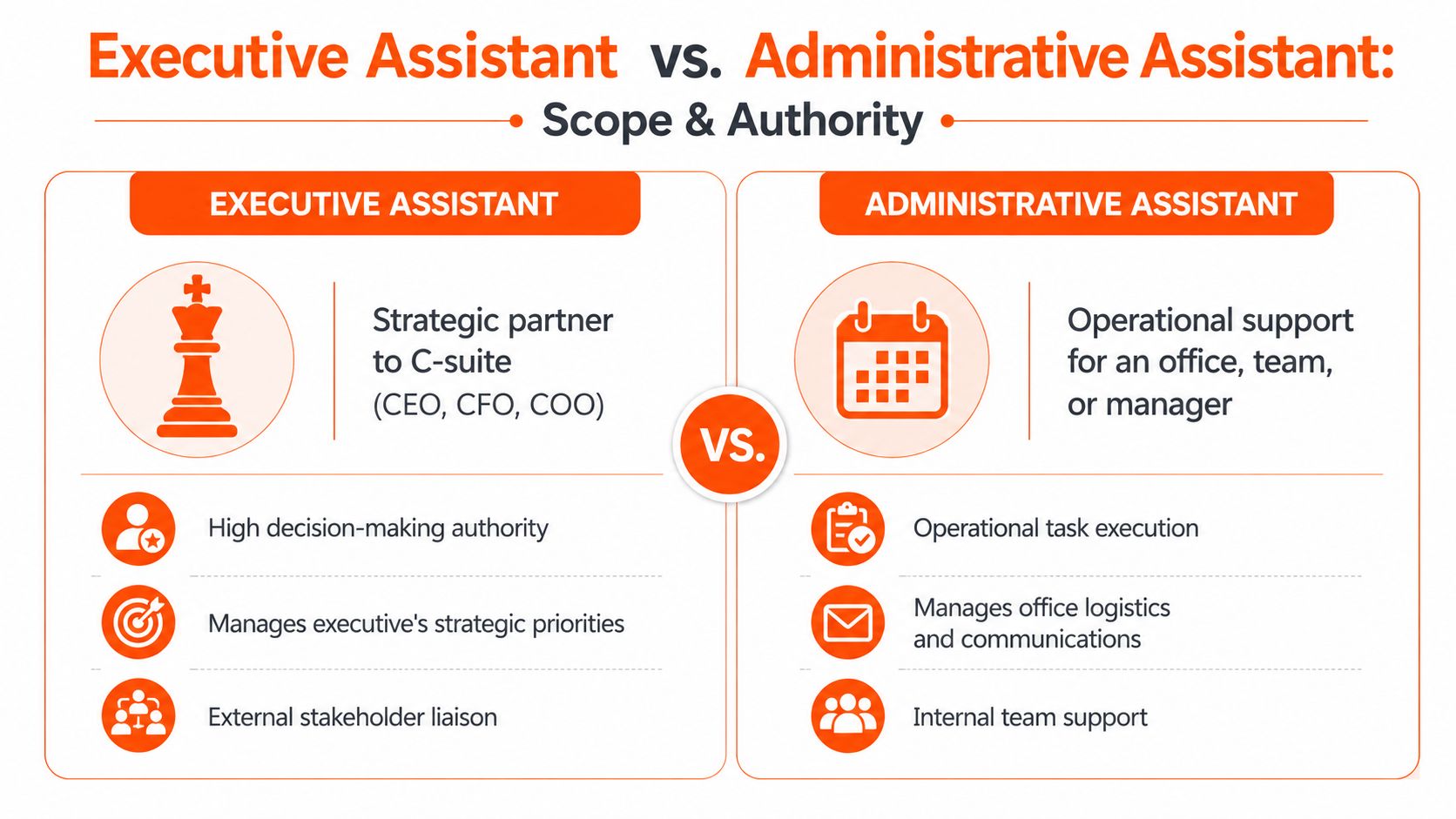
An executive assistant supports a senior leader with judgment-heavy work such as priority management, board preparation, and cross-functional coordination. An administrative assistant supports an office or department through scheduling, documentation, and coordination, so the choice comes down to whether you need a second brain for an executive or a throughput engine for a team.
The popular advice says to compare task lists, calendar management for an executive assistant and office supplies for an administrative assistant. That framing is too shallow for a hiring decision. Both roles can schedule meetings, manage documents, coordinate travel, and handle communications. The meaningful difference is the level of business impact the role must carry.
For a founder, the wrong hire creates a specific failure. An administrative assistant may complete assigned work accurately while leaving the founder responsible for prioritization, escalation, and executive preparation. An executive assistant placed into a broad office-support role may be underused, or may lack the process design needed to keep a department moving.
The rest of this comparison uses six operating criteria: scope, seniority, decision authority, skills, compensation, and business fit. The titles matter because they signal different expectations, but the job description should follow the decisions the remote professional is expected to make.
The hiring decision is not a task-list comparison. Both roles can schedule meetings, manage documents, and coordinate requests. The operating question is whether the position must protect one leader's attention or keep a broader system moving.
An executive assistant carries responsibility for a senior leader's operating capacity. The work can include ranking competing priorities, filtering requests, preparing board or investor materials, drafting briefs, coordinating across functions, and identifying issues before they reach the executive. The assistant does not make strategic decisions for the company, but often determines what reaches the executive, when it arrives, and what preparation is needed.
An administrative assistant carries responsibility for reliable throughput across a team, office, or department. The work includes scheduling, documentation, record maintenance, shared inboxes, vendor contact, supplies, and internal communications. The value comes from keeping defined processes moving across many requests, rather than aligning closely with one leader's priorities and working style.
If the role you are scoping is broader than one leader but lighter than a department, the comparison you actually need is executive assistant vs virtual assistant, where the dividing line is dedicated judgment against task-based coverage.
Recent market commentary describes executive assistants taking on workflow orchestration, governance documentation, cross-functional priority alignment, and risk identification, while administrative assistants remain associated with scheduling, documentation, and coordination. It also identifies growing relevance for AI, automation, data visualization, and project management as job descriptions overlap and expand (Robert Half's administrative and customer support demand analysis).
The title therefore signals an operating expectation, not a rank. You are deciding how much judgment the role must carry and where that judgment should create capacity.
Operator rule: If one executive's attention is the bottleneck, define an EA scope. If recurring work across a team is the bottleneck, define an AA scope.
Test the role against manager absence. An AA should keep documented processes moving without constant supervision. An EA should understand priorities well enough to resolve conflicts, protect time, and prepare decisions without waiting for instructions at every step.
Before you hire a remote executive assistant, define the role's authority, escalation limits, and expected outputs. Tools such as a Voice Control Pro app comparison can help assess productivity workflows, but software cannot compensate for a position designed around the wrong level of authority.
The title decision is an operating decision. An administrative assistant supports an office, department, or function through scheduling, travel arrangements, policy maintenance, purchasing, and front-desk requests. An executive assistant supports a senior executive, founder, or C-suite leader, as outlined in Indeed's comparison of administrative and executive assistants.
The practical dividing line is the cost of a wrong call. An AA keeps defined work moving. An EA protects executive attention when priorities conflict, information is incomplete, or stakeholders require careful handling.
| Criterion | Executive Assistant | Administrative Assistant |
|---|---|---|
| Primary support | One senior executive, founder, or C-suite leader | An office, department, team, or operational function |
| Core output | Protected executive time, prepared decisions, aligned stakeholders, completed strategic support work | Accurate scheduling, records, documents, communications, and coordination |
| Typical scope | Calendar strategy, inbox triage, board preparation, briefing documents, project follow-through, stakeholder liaison | Scheduling, document preparation, data entry, filing, vendor coordination, shared inboxes, office logistics |
| Autonomy | Resolves competing priorities and escalates judgment calls with context | Executes established processes and flags exceptions |
| Stakeholder exposure | Executives, board members, investors, clients, senior leaders, and cross-functional owners | Internal teams, vendors, customers, and department contacts |
| Confidentiality | Frequent access to sensitive executive, financial, personnel, board, or investor information | Access varies by department and usually follows defined permissions |
| Best fit | A leader whose decisions are delayed by fragmented attention | A team whose recurring administrative workload is slowing throughput |
The U.S. Bureau of Labor Statistics places executive secretaries and executive administrative assistants in a published occupation category covering 483,570 jobs, with a mean annual wage of $73,680 in May 2023 (BLS occupational employment data). The category does not imply identical work across every employer. It does show that executive-support titles represent a defined labor-market segment, not merely a more senior-sounding version of general office support.
A requisition should specify the level of ownership required. Coordination covers arranging, recording, routing, and confirming, which describes much of administrative support. Orchestration adds sequencing people, information, and deadlines around a departmental or executive outcome. Ownership adds responsibility for tracking results, identifying blockers, making permitted tradeoffs, and escalating with context. EA work becomes judgment-heavy when the assistant represents an executive with senior stakeholders.
The boundary can shift. An AA may own a complex department process, while an EA may also handle broad office administration. The title should follow the decisions, stakeholders, and outputs the role controls, not the perceived prestige of the label. Define those three elements before hiring, then test whether the candidate has operated at that level without constant instruction.
Compensation data supports the scope distinction, but the pay premium isn't just payment for years in a chair. It pays for judgment under ambiguity, confidentiality, stakeholder handling, and proximity to decisions.
One 2026 market dataset lists the average Executive Assistant at $68,026 annually, compared with $60,550 for an Executive Administrative Assistant, an 11.2% premium for the executive-focused title. The same dataset lists $50,922 in total compensation for early-career Executive Assistants and $59,435 for mid-career workers, which indicates a steeper experience and scope ramp (PayScale Executive Assistant salary data).
A separate Robert Half midpoint comparison places executive assistant pay at $59,000 in the United States and administrative assistant pay at $39,000 (salary midpoint comparison). The datasets use different methodologies and titles, so you shouldn't treat them as one unified salary band. Taken together, they point to a consistent operating pattern, executive support commands more compensation when the role carries greater responsibility.
For an AA, compensation generally buys dependable execution across a defined workload. The assistant may coordinate calendars for a department, prepare documents, maintain records, manage vendors, or keep shared communications moving.
For an EA, the premium buys a tighter working relationship with one leader. The remote professional must learn how that executive evaluates requests, distinguish urgent work from important work, protect preparation time, and communicate with senior stakeholders without creating avoidable friction.
The labor-market outlook also matters. In the United States, the BLS projects little or no change in employment for secretaries and administrative assistants from 2024 to 2034. In Canada, administrative assistants numbered 233,800 employed workers in 2023, with 41% aged 50 or over and 110,200 job openings projected for 2024 through 2033. The Canadian projection lists annual employment growth of 0.8%, below the national average of 1.2% (Employment and Social Development Canada occupation summary).
That makes AA hiring more replacement-driven and suitable for repeatable volume. EA hiring is narrower and more sensitive to fit. Before setting a budget, compare local benchmarks with relevant nearshore salary data, then price the cost of delayed decisions and executive distraction, not just the hourly rate. The 2026 executive assistant cost breakdown shows how the same scope prices out onshore against nearshore.
A strong candidate profile should mirror the scope ladder. Don't interview an EA and an AA with the same scorecard, then assume the higher title will reveal itself through confidence or polished language.
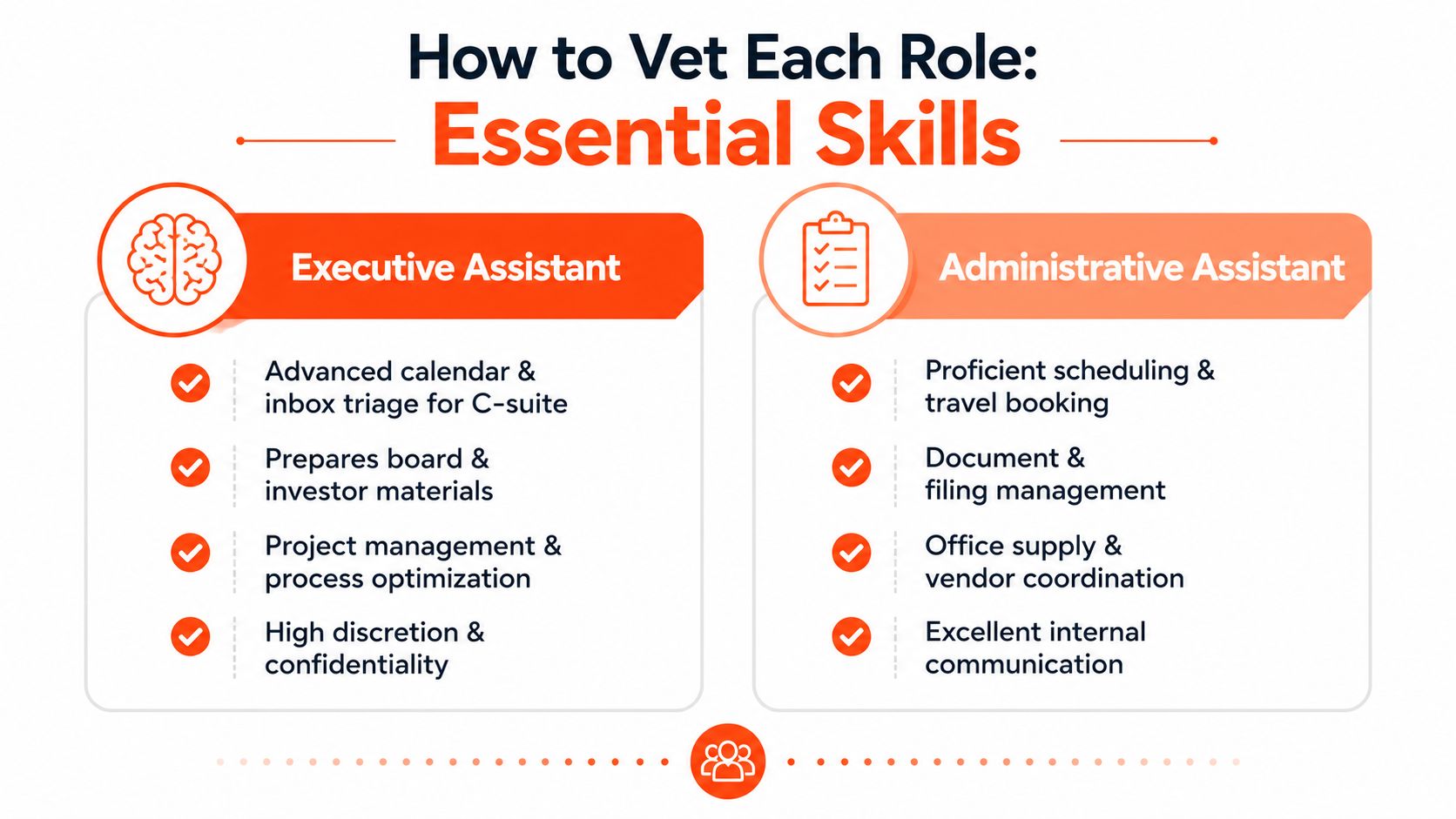
An EA candidate should demonstrate:
The best EA interview questions are situational. Give the candidate conflicting executive asks and ask them to explain the sequence, assumptions, communication, and escalation path. You're testing reasoning, not the ability to recite software names.
An AA candidate should show consistent execution across recurring workflows:
Operational interviews should use volume and accuracy scenarios. Ask the candidate to describe a process for handling a crowded shared inbox, incomplete requests, duplicate records, or a vendor delay. A good answer includes a queue, priority rules, quality checks, and an escalation trigger.
Both roles increasingly need AI, automation, data visualization, and project management skills as employers combine responsibilities in one job description. For candidates who'll maintain technical process documentation, resources covering master API and AI documentation skills can help you define the documentation standard.
Use a compact artifact request:
For broader capability mapping, use the Virtustant virtual assistant guide as a starting reference, then add role-specific tests.
Role fit becomes clearer when you examine the failure you're trying to remove. The same person may perform well in either position if the scope, authority, and manager are explicit.
A U.S. founder or SMB operator usually needs an executive assistant when inbox decisions, scheduling conflicts, travel, board preparation, and investor communication consume attention that should stay on strategy.
During the first 30 days, the EA should learn the founder's priorities, map recurring meetings, establish inbox and calendar rules, build briefing templates, and create an escalation system. The assistant should also identify which requests can be declined, delegated, grouped, or moved. Writing that scope is faster if you start from a documented list of tasks to delegate to an executive assistant and cut what does not apply.
The failure mode is subtle. You may hire an AA who completes every request but leaves the founder as the only person capable of deciding what matters. The calendar looks organized while executive bandwidth remains unprotected.
A sales, marketing, or customer operations leader usually needs an administrative assistant when several people lose time to scheduling, document preparation, records, vendor coordination, and follow-up.
The first 30 days should produce a visible operating queue. The AA can standardize intake, clean shared records, create meeting and documentation routines, define ownership for recurring tasks, and report exceptions to the department head.
The wrong hire is an EA whose strengths are concentrated around one leader's priorities when the department needs broad process coverage. You'll pay for executive-level proximity while routine work continues to spread across managers.
A solo operator or early-stage agency often needs a hybrid. The person may begin with administrative work, then take on founder calendar protection, client coordination, project tracking, and basic executive preparation as the business grows.
Write the first 30-day scope as an AA-led operating role with explicit EA expansion triggers. For example, the candidate might own scheduling, document control, and client follow-up first, then add priority triage and leadership meeting preparation once the underlying records and workflows are reliable.
The hybrid only works when the decision rights grow deliberately. “Do everything” isn't a job description. It's a mis-hire mechanism.
The diagnostic is simple. If the bottleneck is one leader's attention, choose EA scope. If it's team-wide administrative throughput, choose AA scope. If both are material but neither justifies a separate specialist, start with the narrower operating problem and document how the role can expand.
For U.S. companies evaluating remote hires in LATAM, nearshore staffing can address either scope if the hiring process tests the correct operating behaviors. Time-zone overlap matters because an EA may need same-day decisions with a founder, while an AA may need live coordination with a department.
Virtustant's vetting funnel runs 100 applicants → 22 clear the recruiter screen → 9 pass skills and English testing → 3 reach a live interview → 1 is hired. The top 1% acceptance rate is tied to that vetting funnel, not to a single interview or a general talent claim.
The commercial and operating details are direct:
For executive assistant scope, the placement may cover calendar management, inbox triage, travel booking, expense reports, meeting preparation, research, and executive coordination. For administrative assistant scope, the work may include scheduling, communications, records, documentation, vendor coordination, and back-office support. The title should follow the work package you define, not the candidate's preferred label.
The provider handles contracts, local compliance, cross-border payroll in the professional's country, and one weekly USD invoice per placement. That removes country-specific administration from the U.S. hiring leader's workload while preserving direct day-to-day management of the remote professional.
Review the process through the lens of your scope ladder, then evaluate nearshore staffing for U.S. companies against your need for judgment, coverage, and operational ownership. For the sequence itself, see how to hire a virtual executive assistant from scoping to first week.
Answer three questions before approving the role:
Use the recommendation below:
| Business problem | Initial role |
|---|---|
| Founder or senior leader is the bottleneck | Executive Assistant |
| Department workflows are fragmented | Administrative Assistant |
| One operator needs both coordination and growing executive support | Hybrid, starting with the narrower scope |
Nearshore hiring can save up to 70% against comparable U.S. salaries, but the saving only matters if the role definition protects the expected business impact. The differentiator is the combination of multi-stage vetting, nearshore time-zone overlap, and lifetime replacement, not any single feature in isolation.
If your scope points to flexible remote support, hire a virtual assistant after writing the first 30-day outputs and decision rights.
Virtustant connects U.S. companies with vetted remote professionals across LATAM for executive assistant, administrative assistant, and other support roles, with sourcing, assessment, placement, contracts, payroll, and compliance handled through one operating model. Visit Virtustant to define the scope you need and review a qualified shortlist for the role.
In most organizations an executive assistant sits higher in scope and pay, but the real difference is authority, not rank. An executive assistant supports one senior leader and often decides what reaches that leader, when it arrives, and what preparation is needed. An administrative assistant supports a team, office, or department and executes defined processes. A senior administrative assistant who owns a complex department process can carry more ownership than a junior executive assistant.
Hire against the bottleneck. If one leader's attention is the constraint, through priority conflicts, gatekeeping, board or investor preparation, and cross-functional follow-through, define an executive assistant scope. If recurring administrative work across a team is the constraint, through scheduling, records, documentation, vendors, and shared inboxes, define an administrative assistant scope.
The market pays more for executive support. One 2026 dataset lists an average of $68,026 for an Executive Assistant against $60,550 for an Executive Administrative Assistant, an 11.2% premium, and a Robert Half midpoint comparison places executive assistant pay at $59,000 against $39,000 for administrative assistant pay. The premium buys judgment under ambiguity, confidentiality, stakeholder handling, and proximity to decisions, not seniority for its own sake.
An executive assistant protects one senior leader's operating capacity. An administrative assistant keeps an office, team, or department running. A personal assistant supports an individual's personal logistics and can extend into household or family matters. Access to confidential business information and responsibility for decision support are what separate the executive assistant from the other two.
Yes, and for a solo operator or early-stage agency a hybrid is often the right call, but only when decision rights expand deliberately. Start with the narrower operating problem, usually administrative throughput, then add priority triage, leadership meeting preparation, and executive gatekeeping once records and workflows are reliable. Do everything is not a job description, it is a mis-hire mechanism.
Titles vary by employer. Common progressions run from administrative assistant to senior administrative assistant, executive administrative assistant, administrative or office manager, and then operations or chief of staff roles. The U.S. Bureau of Labor Statistics groups executive secretaries and executive administrative assistants in one published occupation covering 483,570 jobs, with a mean annual wage of $73,680 in May 2023.
Virtustant's all-in hourly pricing starts at $8.50 per hour for executive assistants, administrative assistants get a role-specific quote, and there are zero recruitment, setup, or placement fees. In Virtustant's H1 2026 placement data (441 starts, Jan–Jun 2026), the median client-side rate was $12.00/hr for executive assistants (n=24) and $9.50/hr for administrative assistants (n=17). A shortlist of 3 to 5 pre-vetted bilingual candidates arrives within 48 hours, your hire can start in 72 hours, and the replacement guarantee has no time cap. Against comparable U.S. salaries, nearshore hiring can save up to 70%.