Time Zone South America Guide for U.S. Teams (2026)
August 19, 2026
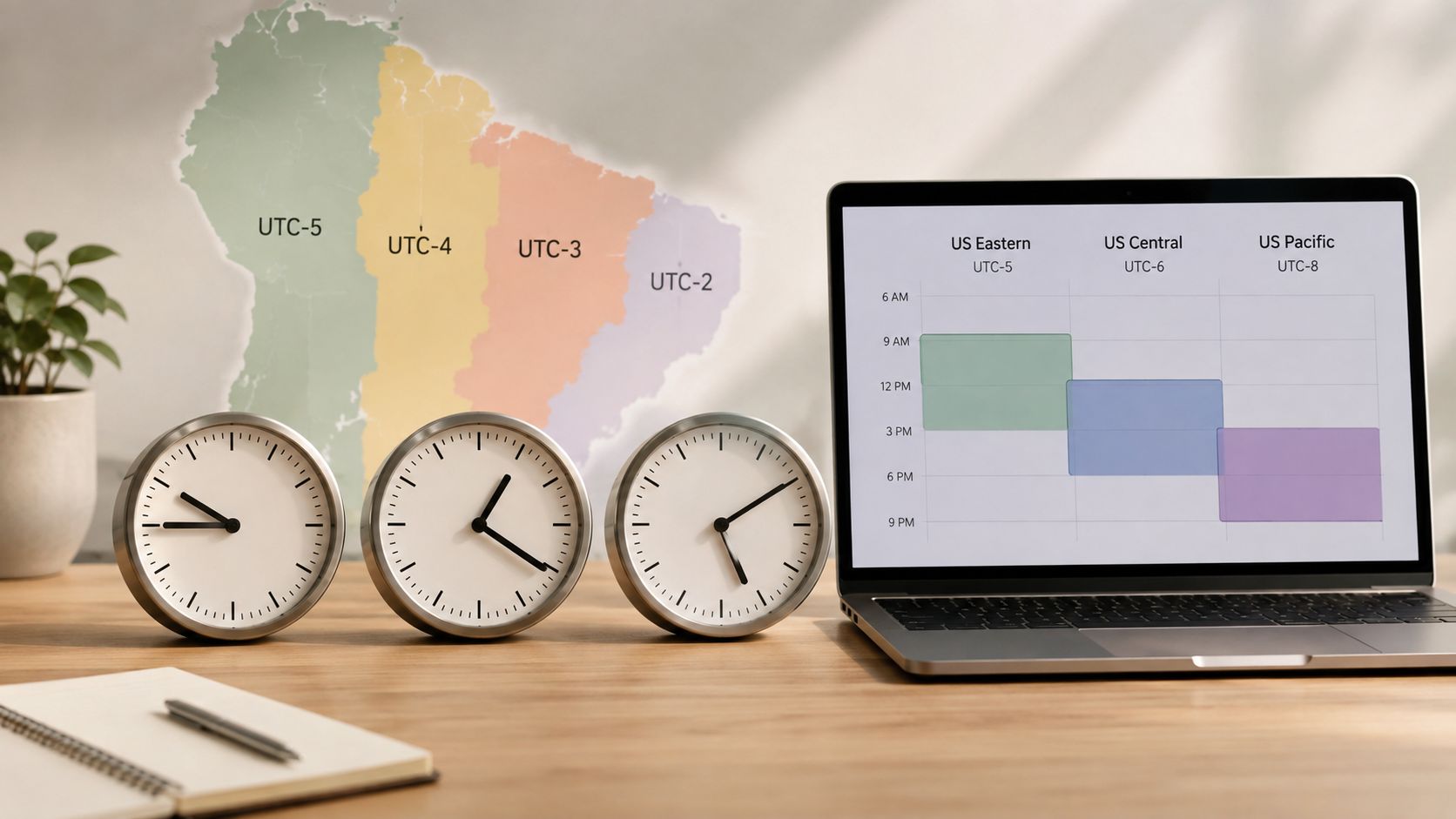

America/Santiago (UTC−4 standard, UTC−3 summer), America/Punta_Arenas and America/Coyhaique (both permanent UTC−3), and Pacific/Easter (UTC−6 standard, UTC−5 summer).−03:00 offset, or U.S. daylight saving transitions will silently move recurring meetings that the LATAM side never changed.South America's mainland spans UTC−5 through UTC−3, while Brazil's Atlantic islands reach UTC−2, and most countries no longer observe daylight saving time except Chile. For U.S. teams, that means the region usually offers more predictable overlap than its continental label suggests, but only when schedules are built around the candidate's actual IANA time zone.
The operational mistake I see most often is treating “South America” as one scheduling block. A call with Bogotá, São Paulo, and Buenos Aires can work smoothly from a U.S. office, while a call involving Chile or one of Brazil's Atlantic islands can shift unexpectedly if the calendar uses a fixed offset. The practical answer isn't to memorize every city. It's to map each role to an offset, calculate the workday intersection, and store every recurring meeting against a location-aware zone.
South America's commonly used mainland offsets span UTC−5 to UTC−3, with Brazil's Atlantic islands reaching UTC−2. Colombia, Peru, and mainland Ecuador use UTC−5; Bolivia and Venezuela are among the UTC−4 locations; Argentina, Uruguay, and most of Brazil use UTC−3. Fernando de Noronha adds an Atlantic-island UTC−2 location, widening the operational range. The Greenwich Mean Time's South America overview maps these offsets and their geographic distribution.
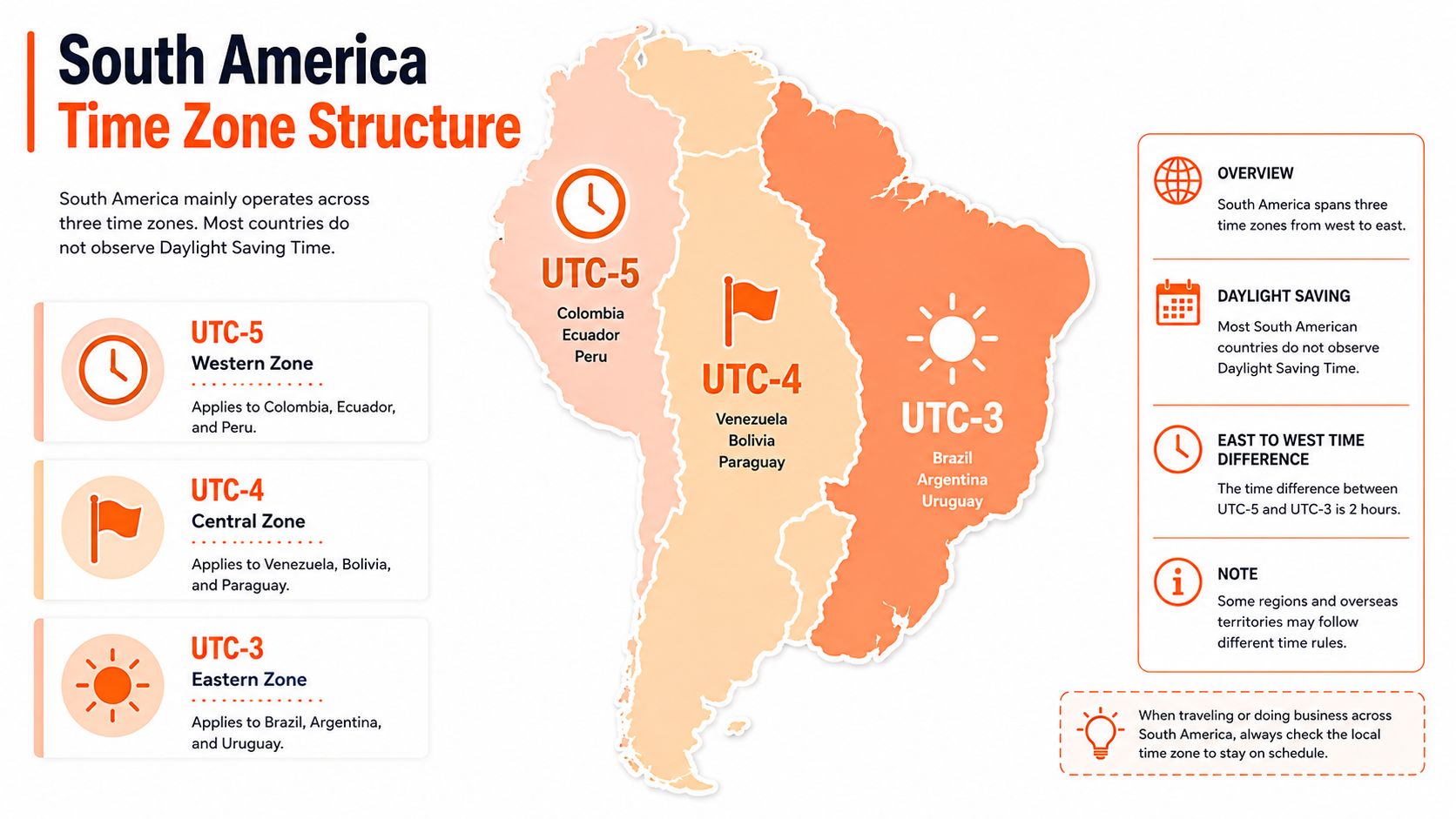
Most countries keep a fixed annual offset. Mainland Chile remains the scheduling exception, generally shifting between UTC−4 standard time and UTC−3 summer time. The daylight saving overview for the Americas records that Argentina, Bolivia, Brazil, Colombia, Ecuador, French Guiana, Guyana, Peru, Suriname, Uruguay, and Venezuela do not currently observe DST.
For U.S. teams, the narrower mainland range can preserve a workable collaboration window without pushing South American staff outside normal hours. The recurring source of confusion is usually the U.S. clock change. A mostly fixed LATAM schedule can move by one hour relative to a U.S. calendar when U.S. daylight saving time begins or ends.
A nearshore hiring plan should begin with offset fit, then verify the candidate's city and IANA zone. UTC−5 locations can align closely with U.S. Eastern or Central schedules, depending on the U.S. season. UTC−3 locations sit nearer to the U.S. Eastern workday during U.S. standard time, while Chile requires a seasonal review before recurring meetings are set.
The offset also affects role design. A team that needs frequent live collaboration should favor locations with a stable, overlapping workday. Roles built around asynchronous handoffs can tolerate a wider offset spread, provided calendars display local times and recurring events use location-aware settings.
Language adds another coordination variable. A shared agenda, named facilitator, and explicit local-time confirmation reduce avoidable meeting errors. Teams working across languages can apply these multilingual meeting best practices to keep participation clear for every attendee.
A country label is too broad for scheduling. The reliable technical unit is an IANA time zone identifier, which pairs a location with its historical and current rules. The IANA South America database, release 2026c lists distinct America/* zones, preserving changes that a fixed UTC offset cannot represent.
The principal UTC−5 business locations are:
America/Lima.America/Bogota.America/Guayaquil. The Galápagos Islands use a different offset, so applications should record the actual location.These countries generally support stable recurring schedules because they do not observe DST. Record the candidate's city, not only the country, since island and regional exceptions can change the local clock. For salary bands and English levels alongside the offset, see the country breakdowns for hiring remote talent in Colombia and Brazil.
The UTC−4 group includes:
America/Caracas.America/La_Paz.America/Asuncion moved to a permanent UTC−3 after its last clock change on 15 October 2024, so it now sits with Argentina, Uruguay, and Brazil.America/Guyana.America/Port_of_Spain, although it is outside the South American mainland.Venezuela changed from UTC−4:30 to UTC−4 in 2016. The IANA current-zone table is a safer production reference than a remembered historical setting because it identifies current canonical zones.
For Argentina-specific recruiting context, pair the location record with this guide to hiring in Argentina. A large labor market can contain different scheduling profiles, especially when teams span cities.
UTC−3 covers:
America/Sao_Paulo.America/Argentina/Buenos_Aires.America/Montevideo.America/Santiago.America/Asuncion, permanently on UTC−3 since October 2024.Antarctica/Palmer.Argentina does not observe DST despite its detailed Argentina-specific identifier, and its fixed UTC−3 clock is one reason it shows up so often in Argentina hiring plans. Brazil ended national daylight saving time in 2019, while America/Sao_Paulo retains historical rules. Fernando de Noronha uses UTC−2 through America/Noronha.
For hiring, the identifier affects whether a recurring meeting remains inside normal local hours as U.S. clocks change. Store the identifier, not only −03:00, because it carries location-specific history and future rule changes.
Use the table below as a difference calculator. A positive value means the South American location is ahead of the U.S. reference zone. A negative value means it's behind. The standard and DST columns matter because U.S. clocks move while most South American locations remain fixed.
| South American offset | U.S. Eastern standard, UTC−5 | U.S. Eastern DST, UTC−4 | U.S. Central standard, UTC−6 | U.S. Central DST, UTC−5 | U.S. Pacific standard, UTC−8 | U.S. Pacific DST, UTC−7 |
|---|---|---|---|---|---|---|
| UTC−5 | Same time | 1 hour behind | 1 hour ahead | Same time | 3 hours ahead | 2 hours ahead |
| UTC−4 | 1 hour ahead | Same time | 2 hours ahead | 1 hour ahead | 4 hours ahead | 3 hours ahead |
| UTC−3 | 2 hours ahead | 1 hour ahead | 3 hours ahead | 2 hours ahead | 5 hours ahead | 4 hours ahead |
| UTC−2 | 3 hours ahead | 2 hours ahead | 4 hours ahead | 3 hours ahead | 6 hours ahead | 5 hours ahead |
UTC−5 matches U.S. Eastern standard time. UTC−4 matches U.S. Eastern daylight time. UTC−3 is commonly one hour ahead of Eastern daylight time and two hours ahead of Eastern standard time, so the same recurring meeting can display differently across the U.S. year.
Scheduling rule: Calculate the candidate's local clock time from the meeting owner's U.S. zone, not from a manually typed offset.
The U.S. Mountain zone, UTC−7 standard, isn't in this table because it isn't a South American mainland offset. It still matters for distributed U.S. teams and other outliers, so calendar software should use the actual attendee zones rather than a three-zone shortcut. For hiring decisions, nearshore talent with U.S. time-zone overlap becomes a role-specific question rather than a broad regional label.
Most South American countries now keep fixed seasonal offsets. Brazil, Colombia, Argentina, and Peru therefore provide relatively stable local clocks, but U.S. Eastern and Central teams still switch between standard and daylight time. A recurring meeting can shift by an hour even when the LATAM team makes no change.
Chile is now the only South American country that still changes its clocks, and it does not do so everywhere. Treating "Chile" as one zone is the mistake that breaks recurring meetings. There are four distinct Chilean identifiers worth recording:
America/Santiago, most of the country: UTC−4 standard, UTC−3 summer, a one-hour seasonal change.America/Punta_Arenas, the Magallanes region: permanent UTC−3, no seasonal change.America/Coyhaique, the Aysén region: permanent UTC−3. This identifier is new. Chile announced in March 2025 that Aysén would stay on summer time year-round and IANA created a separate zone for it, so software running an older tz database will put Coyhaique on the wrong clock for part of the year.Pacific/Easter, Easter Island: UTC−6 standard, UTC−5 summer, well outside the mainland range.The hiring consequence is concrete: two candidates who both answer "Chile" can be on different clocks for half the year. Record the region, not the country, and keep the tz database current.
Paraguay stopped being an exception in 2024. It ran daylight saving time for decades, then abolished the seasonal change and stayed on UTC−3 permanently after its final transition on 15 October 2024. Any system, salary sheet, or scheduling doc that still files Paraguay under UTC−4 with seasonal rules is running on pre-2025 information, and it will be an hour off.
Brazil ended daylight saving time by decree in April 2019, after using it annually since the mid-1980s. The Rio Times coverage of Brazil's decree documents that change. Calendar exports created before the abolition may still contain outdated seasonal assumptions, even though Brazil's current local clock is stable.
Venezuela changed from UTC−4:30 to UTC−4 effective May 1, 2016. Older spreadsheets and manually configured calendar entries may still use the former half-hour setting, creating an avoidable scheduling error.
A U.S. clock change moves a fixed LATAM location by one hour relative to the U.S. That difference can turn a practical afternoon meeting into a late-day commitment or remove part of a planned overlap window. Revalidate recurring meetings when either side changes its time-zone rules, and record the remote professional's local time instead of relying on an abbreviation such as “ET.”
For work that should continue outside the reduced live window, async sync communication LATAM practices separate decisions from meetings and preserve handoffs across the seasonal shift. This is particularly useful when a team's hiring plan depends on dependable U.S. overlap rather than nominal regional proximity.
A useful overlap calculation needs a defined workday. The examples below use 09:00 to 18:00 local time on both sides, then identify the intersection rather than counting the entire theoretical workday.
| U.S. pairing | U.S. standard-time local window | South American local window | Full shared hours |
|---|---|---|---|
| New York and São Paulo | 09:00 to 18:00 ET | 11:00 to 20:00 | 7 |
| Chicago and Buenos Aires | 09:00 to 18:00 CT | 12:00 to 21:00 | 6 |
| San Francisco and Bogotá | 09:00 to 18:00 PT | 12:00 to 21:00 | 6 |
Those totals describe the full intersection of broad working hours, not an ideal meeting block. In practice, the most usable collaboration window is narrower because managers protect opening work, lunch, customer coverage, and end-of-day handoffs.
For a recurring schedule built around concentrated overlap, the more operationally useful windows are:
When the U.S. springs forward, New York to São Paulo drops from a four-hour planning block to three hours under the stated schedule, while Chicago to São Paulo can shrink to two hours. The exact calendar dates depend on the applicable rules, but the mechanism is constant: the U.S. clock moves, and a fixed South American offset doesn't.
The six-hour overlap often advertised for nearshore work is a broad workday intersection, not a promise that six productive meeting hours exist every day.
Before selecting a location, test the actual role's required contact pattern. A support escalation queue has different needs from a bookkeeping handoff. This overview of how to speed up hiring with nearshore is useful only after the schedule requirement has been made explicit.
Time-zone selection should follow the work pattern. I use a three-tier role matrix that asks one question first: does the remote professional need to be present for decisions, available for structured collaboration, or complete a reliable handoff?
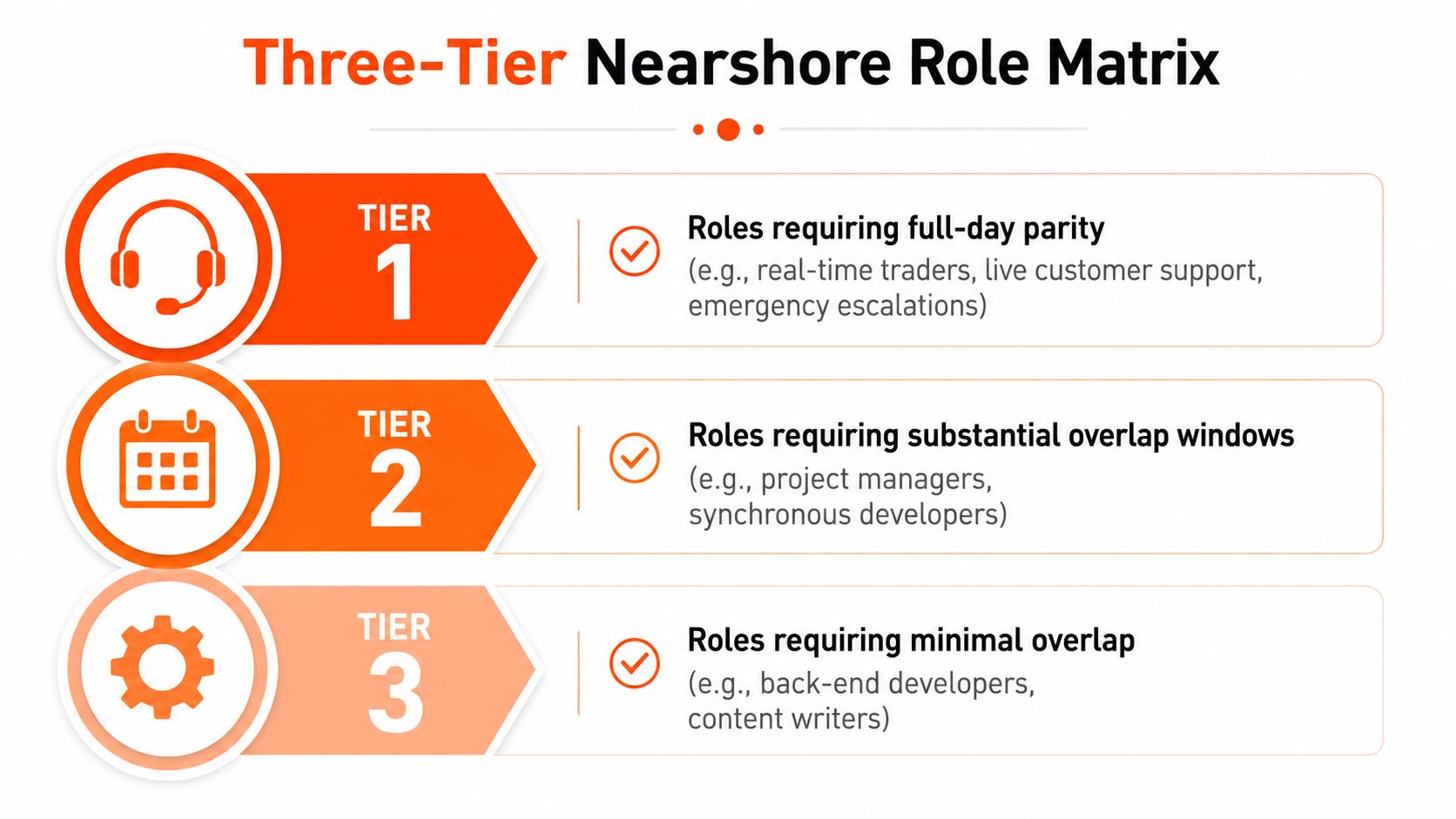
Real-time traders, live customer support agents, and emergency escalation workers need substantial schedule alignment with the U.S. operation. For an East Coast team, UTC−5 locations such as Colombia or mainland Ecuador are the first places to evaluate because their local clock is close to the U.S. reference zone.
Engineering, QA, RevOps, project management, and pair programming don't require every working hour to overlap. They need dependable windows for standups, sprint reviews, debugging, approvals, and handoffs. Brazil, Argentina, and Uruguay at UTC−3 can work well when leaders protect a defined block rather than scheduling meetings across the entire day.
Back-office accounting, content production, and data annotation often gain more from a clean handoff than from constant live access. Peru and Bolivia can fit this model when the team documents inputs, deadlines, exceptions, and acceptance criteria. The location isn't “better” in isolation. It's better only when the operating model doesn't depend on immediate conversation.
For implementation, compare practical schedule strategies with the role's actual handoff needs, then review available LATAM remote talent by role. A staffing provider such as Virtustant can source, vet, place, and manage contracts, payroll, HR, and compliance for remote professionals across LATAM, but the hiring brief should still specify the required overlap tier.
A timestamp database should store a UTC moment, then convert it for each attendee when the application displays it. Retain the attendee's IANA identifier, such as America/Sao_Paulo, America/Argentina/Buenos_Aires, or America/Santiago, instead of saving only -03:00.
The distinction matters for historical records and recurring schedules. Brazil's rules changed after the 2019 DST abolition, while Chile continues to use seasonal clock behavior. The IANA zone data preserves these locality-specific rules, so systems can resolve a local time according to the applicable date rather than applying one permanent offset.
Wall-clock fields belong in the interface, not the system of record. “Tuesday at 10:00 in Santiago” is a user-facing rule that must be resolved against the current zone database for that date. This approach also keeps historical timestamps reproducible when local rules change.
Consider a 30-person operations group distributed across Boston, Bogotá, and Buenos Aires. The U.S. leader needs standing touchpoints during the week, but the meetings must stay inside each location's core workday.
Boston anchors the schedule in Eastern standard time. Bogotá uses UTC−5, and Buenos Aires uses UTC−3. That produces a four-hour separation between the westernmost and easternmost sites, so a single meeting time can't optimize every participant equally.
Set the architecture review for 10:00 EST. The conversion is:
| Location | Local time |
|---|---|
| Boston | 10:00 |
| Bogotá | 09:00 |
| Buenos Aires | 12:00 |
That placement protects the Colombian engineers' morning start and reaches Buenos Aires before the afternoon becomes crowded with other work. It also gives the U.S. leader a meeting early enough to leave room for follow-up decisions.
Move the operations standup to 16:00 EST:
| Location | Local time |
|---|---|
| Boston | 16:00 |
| Bogotá | 15:00 |
| Buenos Aires | 18:00 |
This timing catches end-of-day wrap-up for Buenos Aires while keeping Bogotá in a productive afternoon block. It isn't a universal template, but it shows how alternating meeting anchors can distribute inconvenience instead of assigning every early or late slot to one location.
Written updates cover the remaining hours. Each team posts decisions, blockers, ownership, and next actions before the next touchpoint, so synchronous meetings handle judgment and escalation rather than status reporting.
The schedule must be recalculated when Boston enters daylight time. Bogotá and Buenos Aires don't move with the U.S., so the displayed local times change unless the calendar stores the zones correctly.
The table below is designed for a calendar sidebar. The local times show where a 09:00, 12:00, or 16:00 Eastern standard-time meeting lands. The overlap ranges are planning blocks, not a guarantee that every role should meet throughout them.
| Offset | Major locations and IANA identifier | 09:00 EST | 12:00 EST | 16:00 EST | EST overlap | CST overlap | PST overlap | DST behavior |
|---|---|---|---|---|---|---|---|---|
| UTC−5 | Colombia, Peru, mainland Ecuador. America/Bogota, America/Lima, Ecuador zone | 09:00 | 12:00 | 16:00 | Strong alignment | 1 hour ahead | 3 hours ahead | Fixed |
| UTC−4 | Venezuela, Bolivia, Guyana. America/Caracas, America/La_Paz, America/Guyana | 10:00 | 13:00 | 17:00 | 1 hour ahead | 2 hours ahead | 4 hours ahead | Fixed |
| UTC−3 | Brazil, Argentina, Uruguay, Paraguay. America/Sao_Paulo, America/Argentina/Buenos_Aires, America/Montevideo, America/Asuncion | 11:00 | 14:00 | 18:00 | 2 hours ahead | 3 hours ahead | 5 hours ahead | Fixed. Chile is the exception, see above |
| UTC−2 | Fernando de Noronha. America/Noronha | 12:00 | 15:00 | 19:00 | 3 hours ahead | 4 hours ahead | 6 hours ahead | Fixed |
Venezuela's former UTC−4:30 setting changed in 2016, and Fernando de Noronha is the notable UTC−2 island exception. Chile is now the only South American country that still moves its clocks, and it does so in only part of its territory, so production calendars should resolve Chilean attendees against IANA before creating recurring meetings.
Yes. Venezuela moved from UTC−4:30 to UTC−4 in 2016, with the change effective May 1 according to the regional time-zone references. Legacy calendar entries that contain a manually entered half-hour offset can still produce incorrect invitations, so convert them through America/Caracas.
The Galápagos Islands use UTC−6 and Easter Island uses UTC−6 standard, UTC−5 summer, both far off the mainland range. Venezuela now uses a whole-hour UTC−4 setting, Suriname uses UTC−3, and Fernando de Noronha uses UTC−2. Inside Chile, Magallanes and Aysén sit on a permanent UTC−3 while the rest of the country still shifts seasonally. These are the details that make a country-only dropdown insufficient for scheduling across South America.
They generally use fixed offsets and don't observe DST. Their stability makes them easier to schedule, but the application should still store the correct IANA zone for the specific location.
UTC−2 is used on Brazil's Atlantic islands, including Fernando de Noronha and Trindade, through America/Noronha. It isn't the standard setting for Brazil's principal mainland business centers.
Yes. The examples above assume standard U.S. time. When the U.S. moves to DST and the South American location doesn't, shift the relationship by one hour and verify the result in a current IANA database before publishing a recurring meeting.
Yes, and more so than before. Paraguay abolished daylight saving time and has stayed on UTC−3 permanently since its last clock change on 15 October 2024, which puts it in the same fixed group as Argentina, Uruguay, and most of Brazil. The risk is now the opposite of what it used to be: systems still configured for the old UTC−4 seasonal rule will be an hour off.
Virtustant connects U.S. companies with vetted remote professionals across Latin America and handles sourcing, assessment, placement, contracts, payroll, HR, and compliance under one all-in hourly rate. Visit Virtustant to define the overlap tier for your role and review candidates whose working locations fit the meeting windows your operation needs.