8 Interview Questions Executive Assistant Hiring Teams Need
September 14, 2026
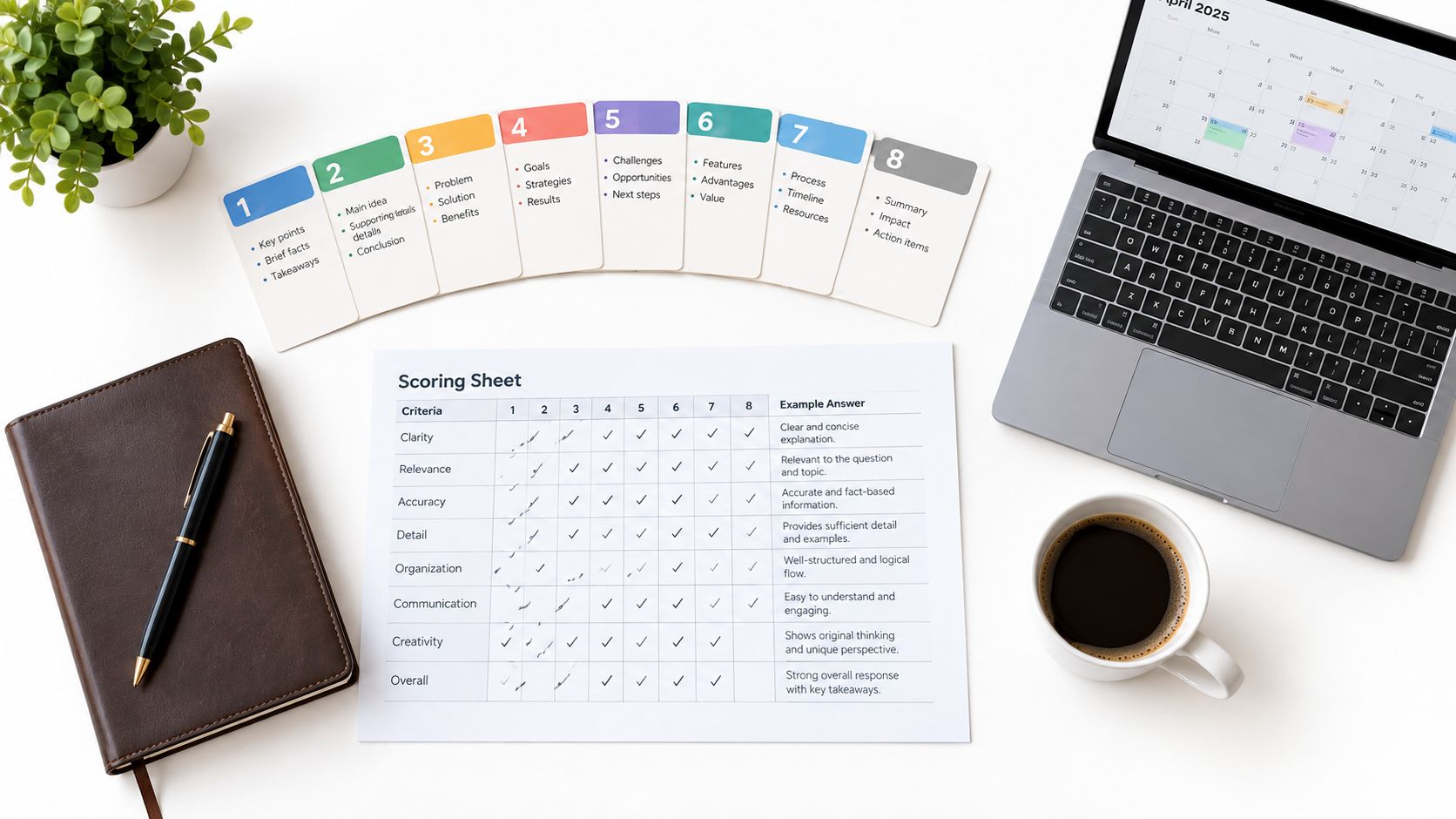

The strongest executive assistant interview questions test judgment and operating behavior, not familiarity with calendar software alone. The evidence that matters is whether a candidate can protect executive time, handle sensitive information, communicate clearly across distance, and improve workflows, and the stakes are set by what the role costs. The US Bureau of Labor Statistics puts the median pay for executive secretaries and executive administrative assistants at $76,590 a year across 489,300 positions, with employment projected to hold flat, 0% change, from 2025 to 2035 (checked September 2026). A hiring mistake at that price is expensive, and a structured interview is the cheapest control you have.
At that cost, consistency matters more than polished interview performance. A candidate who waits for instructions can complete assigned tasks, while a stronger remote professional anticipates priorities, flags risks, protects confidentiality, and leaves the operating system better than they found it. The eight questions below are organized around those decisions, with follow-ups, weak and strong answer signals, and a practical scorecard based on judgment, execution, communication, and measurable impact.
The interview should produce evidence, not impressions. Use the candidate's examples to distinguish what they personally did, what changed afterward, and how they know the change lasted. Structure each answer as situation, task, action and result, then evaluate whether the candidate can perform the role rather than merely describe it.
A useful role-fit comparison is simple:
If you're comparing responsibilities before interviewing, review the remote executive assistant role to separate calendar administration from broader executive support.
Calendar management is a judgment test disguised as a scheduling question. The candidate must show how they decide which request deserves executive time, what information they gather before moving a meeting, and how they communicate a decision to people whose priorities compete.
Ask the candidate to describe a real conflict, not a typical day. A useful follow-up is: “Two senior stakeholders need the same hour tomorrow. What do you verify before you move either meeting?” Strong answers mention the executive's stated priorities, business impact, preparation requirements, participant seniority, time sensitivity, and the cost of postponement. They also explain how the candidate would offer alternatives without making the executive the bottleneck.
Practical rule: A calendar is well managed when it reflects the executive's priorities, not when every request fits.
Weak answers focus on software features or say they'd “ask the executive what to do” for every conflict. That may show caution, but it doesn't demonstrate useful autonomy. Average answers describe rescheduling successfully but omit the decision framework and stakeholder communication.
Look for examples involving calendar audits, recurring meeting reviews, protected focus time, or coordination with other assistants. The candidate should explain the process, the tools used, and the result. They might describe identifying low-value recurring calls, creating a conflict-resolution protocol, or using time-zone labels and asynchronous updates to reduce unnecessary meetings.
The most important remote signal is handoff discipline. Ask how they'd document an unresolved conflict at the end of their workday, what the U.S. executive would see first thing in the morning, and how they'd distinguish an urgent issue from a request that can wait.
Score the answer from one to five across four dimensions:
A score of five requires a specific example and a repeatable method. A candidate who only lists Google Calendar or Outlook experience hasn't yet shown executive-level calendar ownership.
Initiative matters when supervision is limited. This question tests whether the candidate can spot recurring friction, verify its cause, choose a proportionate intervention, and gain adoption without exceeding their authority.
Ask the candidate to reconstruct the workflow: What was the original process? Where did work stall? What changed? How did they know the fix worked? Strong answers identify the tools involved, such as Notion, Asana, Slack, Google Sheets, or an invoice platform. They also explain who adopted the change, what resistance appeared, and how the new process was maintained.
Use scattered meeting notes as a practical scenario. A strong response could involve a centralized Notion template, clear ownership for follow-up actions, and a check that stakeholders could locate decisions without sending clarification messages. The platform is incidental; what matters is whether the candidate converted an observation into a controlled operating improvement that supports sustainable productivity for U.S. founders.
Personal organization does not demonstrate operational ownership. Color-coding personal tasks may improve an individual's workflow, but it says little about the executive's operation. Be cautious when a candidate celebrates changing a shared process without explaining approval, stakeholder communication, or adoption.
Use follow-ups that expose decision quality:
Strong candidates distinguish a quick workaround from a repeatable operating change. They can describe the observation, the test, the communication plan, and the result without exaggeration. They also explain when a process change requires executive approval, security review, or input from the people affected.
Score the answer from one to five across four dimensions:
A score of five requires a specific example, a repeatable method, and evidence that the improvement lasted.
Confidentiality isn't demonstrated by saying “I'm discreet.” It's demonstrated when a candidate recognizes a gray area, limits access, escalates appropriately, and resists pressure from people who may have legitimate status but no right to the information.
Ask for an example involving financial information, personnel matters, legal work, board communications, investor activity, or strategic plans. Strong answers protect the facts while still describing the decision. They might explain that they noticed sensitive details in a widely visible calendar title, identified an email risk before distribution, or declined to answer a colleague's question and alerted the executive that information was circulating.
Weak answers are either vague or over-detailed. A candidate who says “I follow company policy” gives you no evidence of judgment. A candidate who repeats unnecessary confidential details during the interview may demonstrate the very risk you're trying to detect.
Present a short situation: “A senior colleague asks whether a confidential personnel change is happening. What do you say?” Look for a firm, professional refusal, followed by appropriate escalation. The candidate shouldn't improvise a story, confirm indirectly, or treat rank as permission.
For a remote professional in Latin America, ask how they'd handle company data on personal devices, shared workspaces, messaging platforms, and cross-border collaboration. The answer should address access controls, approved systems, clean communication habits, and escalation. Don't assume cultural familiarity with U.S. confidentiality expectations. Test the candidate's understanding directly, including how they'd handle NDA-covered information and potential securities-sensitive material.
References matter more here than self-assessment. Ask a former executive whether the candidate protected sensitive information, recognized risks without prompting, and handled pressure from internal stakeholders. Confidentiality belongs in the scorecard alongside calendar management, communication, judgment, technology proficiency and working style, and it is the one competency where a single lapse outweighs a strong average.
Give the highest score only when the candidate provides a concrete example, describes a boundary, explains escalation, and avoids exposing unnecessary details.
The strongest answer shows a repeatable allocation system, not personal endurance. Ask the candidate to describe the leaders supported, the requests competing for attention, and the method used to rank deadlines, consequences, dependencies, and executive direction.
Use a concrete test: a CEO needs investor preparation, a CFO requests an urgent finance review, and a board meeting requires materials that day. Ask what the candidate would clarify first, how they would sequence the work, and what each executive would be told. A strong response identifies the decision owner, checks business impact and deadlines, exposes tradeoffs, and proposes a revised commitment when the original timing cannot hold. It does not automatically favor the most senior requester.
Ask for the operating mechanism behind the example. Evidence includes a shared intake channel, written priority definitions, a weekly planning review, calendar holds, and a visible list of blocked or waiting items. The candidate should explain how those tools reduced duplicate requests and made capacity clear. “I stayed organized” is too vague unless the answer names the record, rule, or update cadence used.
Weak answers describe juggling, longer hours, or treating every request as urgent. Average answers show personal organization but leave tradeoffs invisible. Strong answers preserve service quality by setting expectations early, declining or renegotiating diplomatically, and escalating only decisions that require executive input.
Remote support adds a handoff test. Ask how the candidate would close the day across time zones, document unresolved work, identify the next owner, and send each executive a concise status update without creating another meeting. Look for clear written communication through email, Slack, Microsoft Teams, or project tools, with no dependence on constant messaging.
Score the answer on a five-level scale:
Award the highest score when the example includes a real conflict, an explicit tradeoff, stakeholder communication, and a measurable result such as work delivered on time, a conflict resolved, or a missed commitment prevented.
Finance administration exposes operational depth quickly. Many candidates have touched expense reports or purchase requests. Fewer can explain how they prevent errors, preserve documentation, identify exceptions, and escalate a questionable transaction without damaging the executive relationship.
Ask what the candidate did in each system. “I used Concur” is incomplete. Ask whether they created reports, matched receipts, checked policy, tracked approvals, monitored vendor terms, maintained purchase orders, or reconciled statements. Follow with a practical scenario: “An executive asks you to code a personal expense as business-related. What do you do?”
Strong answers apply policy consistently, seek clarification when needed, and escalate rather than conceal. They can describe a control, such as a monthly variance review, a vendor tracker, a receipt checklist, or an approval workflow. They also understand that accuracy includes knowing when they don't have authority to approve a transaction.
Weak answers claim general comfort with numbers but cannot describe a workflow. Another concern is overconfidence around accounting software. An assistant doesn't need to be a controller, but they must know where administrative responsibility ends and finance ownership begins.
Look for experience with tools such as Concur, QuickBooks, Ramp, NetSuite, Bill.com, Excel, or Google Sheets, while asking what the candidate personally completed. The platform list is less important than the control behavior.
A candidate might describe consolidating vendor records, flagging duplicate invoices, monitoring recurring charges, or creating a tracker that shows missing approvals. Treat any claimed savings or improvement as meaningful only when the candidate explains the baseline, the action, and how the result was verified.
Reference questions should go to a finance lead or executive who relied on the candidate's accuracy. Ask whether reports were complete, deadlines were met, exceptions were surfaced early, and the candidate protected company policy under pressure. For additional buyer context, review Virtustant's FA outsourcing buyer's guide, then define which finance tasks belong in the executive assistant role and which require dedicated accounting ownership.
An executive assistant shapes how quickly a leader can act. Ask the candidate to explain how they present the facts, identify urgency, describe the impact, recommend a next step, and specify the decision or response required.
Use a real example of bad news. Strong answers state the problem early, explain what changed, assess the consequences, and show when the executive was informed. They may describe a short written update, a one-page summary, or a structured message followed by a live discussion. The timing matters: waiting for a perfect solution can remove the executive's opportunity to respond.
Weak answers focus on avoiding discomfort or say they delayed escalation until every detail was confirmed. Average answers report the issue accurately but cannot explain how they set urgency or offered workable options. Ask what information was known, what remained uncertain, and what they did while awaiting direction.
Remote communication works through predictable visibility, clear urgency, and early escalation, rather than constant availability.
Present this situation: the candidate discovers a travel problem while the executive is in another time zone and in meetings. Ask for the first message they would send. A strong response includes the issue, deadline, consequence, available options, recommendation, and required response. Follow up by asking what belongs in Slack, what belongs in email, and what requires a call.
Written communication should also reflect the executive's operating preferences. Some leaders want a daily digest, while others expect immediate alerts for defined categories or prefer decisions grouped for a scheduled review. Strong assistants establish these rules early and update them when the executive's needs change.
Score the response on four dimensions:
A strong answer makes bad news easier to act on. The practical hiring test is whether the candidate can reduce decision time without hiding uncertainty, creating noise, or waiting for permission to surface a material risk.
Travel planning tests detail management under changing conditions. A capable candidate can coordinate flights, hotels, ground transportation, meetings, visas, itinerary documents, preferences, and expenses without treating the booking confirmation as the finished product.
Ask for the most complex itinerary the candidate has handled. Complexity may come from multiple countries, visa requirements, tightly connected meetings, executive preferences, or several stakeholders traveling together. Strong answers describe a master itinerary, local contacts, backup options, document checks, and a process for handling changes while the executive is moving.
A practical scenario is a multi-city international trip with a canceled critical flight and an investor meeting that cannot move. Ask what the candidate checks first, which options they present, who needs an update, and how they preserve a record of the decision. Weak answers jump directly to rebooking without considering visas, meeting dependencies, executive fatigue, or downstream transportation.
Look for a documented preference profile, calendar synchronization, confirmation of passport and visa requirements, and a clear escalation path. Ask how the candidate verifies health or entry requirements rather than relying on memory. International travel requires current information, so the candidate should know when to consult the airline, corporate travel provider, consulate, or another authoritative source.
Technology questions should be specific. Ask about Concur, corporate booking platforms, travel agency relationships, itinerary tools, and expense reconciliation. Don't award points for naming software unless the candidate can explain the workflow they completed inside it.
For U.S. founders who want to hire a virtual assistant, travel ownership should be defined in the role description. Clarify whether the remote professional books travel, manages changes, handles expenses, supports guests, or coordinates only the executive's calendar. The broader the ownership, the more important the live exercise becomes.
The eight questions should produce one operating assessment. A candidate may execute accurately yet miss priority conflicts, or explain confidentiality well yet fail to close follow-ups. Evaluate the pattern across examples, scenarios, tools, and references.
Use a five-part evidence model:
Request evidence such as time protected, conflicts prevented, faster turnaround, or costs identified. If the prior role did not track a metric, ask how the candidate recognized improvement, who adopted the change, and whether the process stayed in use. Strong answers connect an action to an observable result. Weak answers rely on general traits such as being organized or proactive.
Test tool depth separately. Ask the candidate to share a screen and explain how they would triage an inbox, resolve a calendar conflict, prepare an itinerary, or route an expense exception. Score the workflow, decision points, documentation, and escalation logic. Software names alone show résumé familiarity, not operating competence.
Nearshore hiring requires checks on overlap, written English, and asynchronous work. Ask the candidate to draft a concise executive update, respond to a sensitive request, and document an end-of-day handoff. Verify references with prior executives, focusing on discretion, initiative, and reliability. For teams evaluating a nearshore staffing company, candidate quality matters, while the operating model's support for consistent communication, compliance, and performance oversight matters just as much.
Use a practical scorecard with a five-point rating for each evidence area. Set a minimum standard for judgment, confidentiality, and remote reliability, then record specific evidence for every score. This prevents polished communication from masking weak ownership.
Compare the rubric with the role's risk profile before you weight it. A C-suite assistant requires tests for the workflows that could create the greatest cost, exposure, or executive distraction if handled poorly.
| Item | Implementation complexity | Resource requirements | Expected outcomes | Ideal use cases | Key advantages |
|---|---|---|---|---|---|
| Managing executive calendars and stakeholder priorities | Medium, ongoing coordination, time-zone juggling | Calendar platforms (Outlook/Google), CRM, relationships with peer assistants | Fewer conflicts; higher executive focus | C-suite scheduling, high meeting volumes, nearshore remote executives | Reclaims executive time by removing scheduling conflicts before they reach the executive |
| Identifying process inefficiency and implementing fixes proactively | Medium to high, analysis plus change management | Data access, automation tools (Zapier), dashboards, stakeholder buy-in | Time and cost savings; fewer errors | Ops bottlenecks, manual workflows, remote autonomy | Reduces hours and errors, and surfaces recurring costs nobody had been tracking |
| Handling confidential or sensitive information | Medium, judgment-heavy, context sensitive | Clear policies, encrypted storage, escalation and legal channel | Risk mitigation; preserved trust | M&A, investor communications, HR and legal matters | Lowers breach and legal risk; protects reputation and competitive information |
| Supporting multiple executives and competing priorities | High, balancing SLAs and expectations | Task managers (Asana), shared trackers, written SLAs, regular syncs | Scalable support; fewer priority conflicts | Startups scaling, co-founder support, small leadership teams | Improves transparency and capacity allocation, and removes end-of-day scrambling |
| Financial, expense, or procurement workflows | Medium to high, controls and compliance required | Expensify/Coupa/QuickBooks, reconciliation processes, vendor master file | Accurate reporting; audit readiness | Roles owning expenses, vendor management, procurement | Detects errors, enforces controls, and surfaces costs nobody had been tracking |
| Communicating status, updates, or problems (including bad news) | Medium, timing, framing, and channel selection critical | Async channels (Slack/email), one-pagers, confidence-level notes | Better decisions; fewer surprises | Crisis escalation, remote executives, high-stakes updates | Preserves executive credibility; accelerates resolution and reduces follow-ups |
| Travel planning, logistics, and expense management | High, multi-leg, international, visa and contingency planning | Concur/booking tools, vendor contacts, master itineraries, contingency options | Smooth travel; minimized disruptions | Frequent international travel, client roadshows, multi-city trips | Time savings, cost optimization, fewer itinerary failures |
| Synthesis: hiring guidance and cross-cutting evaluation for nearshore EAs | Medium, synthesizing rubrics and interview design | Composite scorecards, case exercises, reference checks, nearshore checklist | Better hiring decisions; improved role fit | Nearshore hiring, designing EA interview processes | Reduces hiring risk; improves retention and alignment with executive needs |
Convert each question into a scored rubric before interviews begin. A simple five-point scale works when the anchors are explicit:
Normalize each competency score to its maximum before comparing candidates. Then weight judgment, confidentiality, calendar management, and communication most heavily for C-suite support. Execution, technology proficiency, initiative, and travel or finance depth still matter, but a technically capable candidate who mishandles confidential information or fails to escalate a calendar risk creates more exposure than one who needs limited tool training.
Add a short written or live exercise tied to the role's highest-risk workflow. For a calendar-heavy position, provide overlapping requests and ask the candidate to rank them, draft stakeholder messages, and identify what requires executive confirmation. For a finance-oriented role, provide a small set of expense exceptions and ask the candidate to classify, document, and escalate them. For international support, use a time-zone handoff with a delayed response, a travel change, and a confidential meeting.
Validate English proficiency through realistic written and spoken scenarios, not conversational comfort alone. Ask the candidate to summarize a complex update in writing, deliver bad news verbally, and clarify an ambiguous instruction without sounding defensive. Document the required U.S. time-zone overlap, expected response windows, meeting coverage, and any after-hours travel requirements before making an offer.
References should test behavior directly. Ask previous executives whether the candidate anticipated needs, protected sensitive information, communicated problems early, maintained accurate calendars, and followed through without repeated reminders. Reference feedback should confirm the interview pattern, not merely validate employment dates.
Finally, compare sourcing and managed-operations options against the support model you need. Review nearshore staffing options, broader remote staffing services, and agency comparisons based on vetting, time-zone overlap, compliance responsibility, replacement terms, and ongoing management. Virtustant is one option for connecting U.S. companies with vetted remote professionals across Latin America, with sourcing, assessment, placement, contracts, payroll, HR, and compliance handled through its operating model. The right choice is the one that makes the evidence you collected easier to trust and the resulting support relationship easier to manage.
Ask eight questions that test judgment rather than tool familiarity: calendar and stakeholder prioritisation, a process fix made without being asked, handling confidential information, supporting competing executives, financial and procurement workflows, how they deliver bad news, complex travel and logistics, and a synthesis question on evidence. Score each from one to five on judgment, execution, communication and measurable impact, and set a minimum standard on judgment, confidentiality and remote reliability before you compare candidates.
Give a conflict rather than a description. Ask what the candidate does when two senior stakeholders need the same hour tomorrow, then ask for the rule behind the decision and how they would document it at the end of their workday. A candidate who lists Google Calendar or Outlook experience has described a tool; a candidate who describes a priority rule, a communication step and a handoff note has described a method.
The US Bureau of Labor Statistics puts the median pay for executive secretaries and executive administrative assistants at $76,590 a year across 489,300 positions, with employment projected to hold flat from 2025 to 2035. A dedicated bilingual executive assistant from Latin America through Virtustant is $8.50 an hour all-in at the published median, about $17,680 for a full-time year at 2,080 hours, with zero recruitment fees.
Add three checks the in-person process does not need: time-zone overlap with the executive's working day, written English under real conditions, and handoff discipline. Ask the candidate to draft a concise executive update and to explain how they would close the day across time zones, documenting unresolved work and naming the next owner.
Do not accept a self-assessment. Present a gray area, such as a senior colleague asking whether a confidential personnel change is happening, and look for a firm professional refusal plus an escalation path. Then verify it with a reference: ask a former executive whether the candidate protected sensitive information and recognised risks without being prompted.
Through Virtustant, a first shortlist of 3 to 5 vetted bilingual candidates arrives within 48 hours of the first call and a hire can start within 72 hours, including weekends. Contracts, payroll, HR and compliance are handled by the agency, and every placement carries a lifetime replacement guarantee with no time cap.
Virtustant connects U.S. companies with vetted remote professionals in Latin America for executive assistant and other full-time remote roles, with assessment, placement, contracts, payroll, HR, and compliance support included in one operating model. If your interview process needs stronger candidate screening, U.S. time-zone overlap, and structured follow-through after placement, see how hiring a remote executive assistant works, or compare rates on the pricing page.