Managed Staffing Services: A Practical Buyer's Guide 2026
August 17, 2026

The staffing industry generated about USD 648 billion in revenue in 2022, and the U.S. alone accounted for 34% of global staffing revenue, which puts managed staffing services inside one of the largest labor markets in the world, not a narrow outsourcing niche. That scale matters because buyers are not adopting a fringe workaround, they're using a mature operating layer to reduce hiring friction, payroll complexity, and compliance risk while still getting work done.
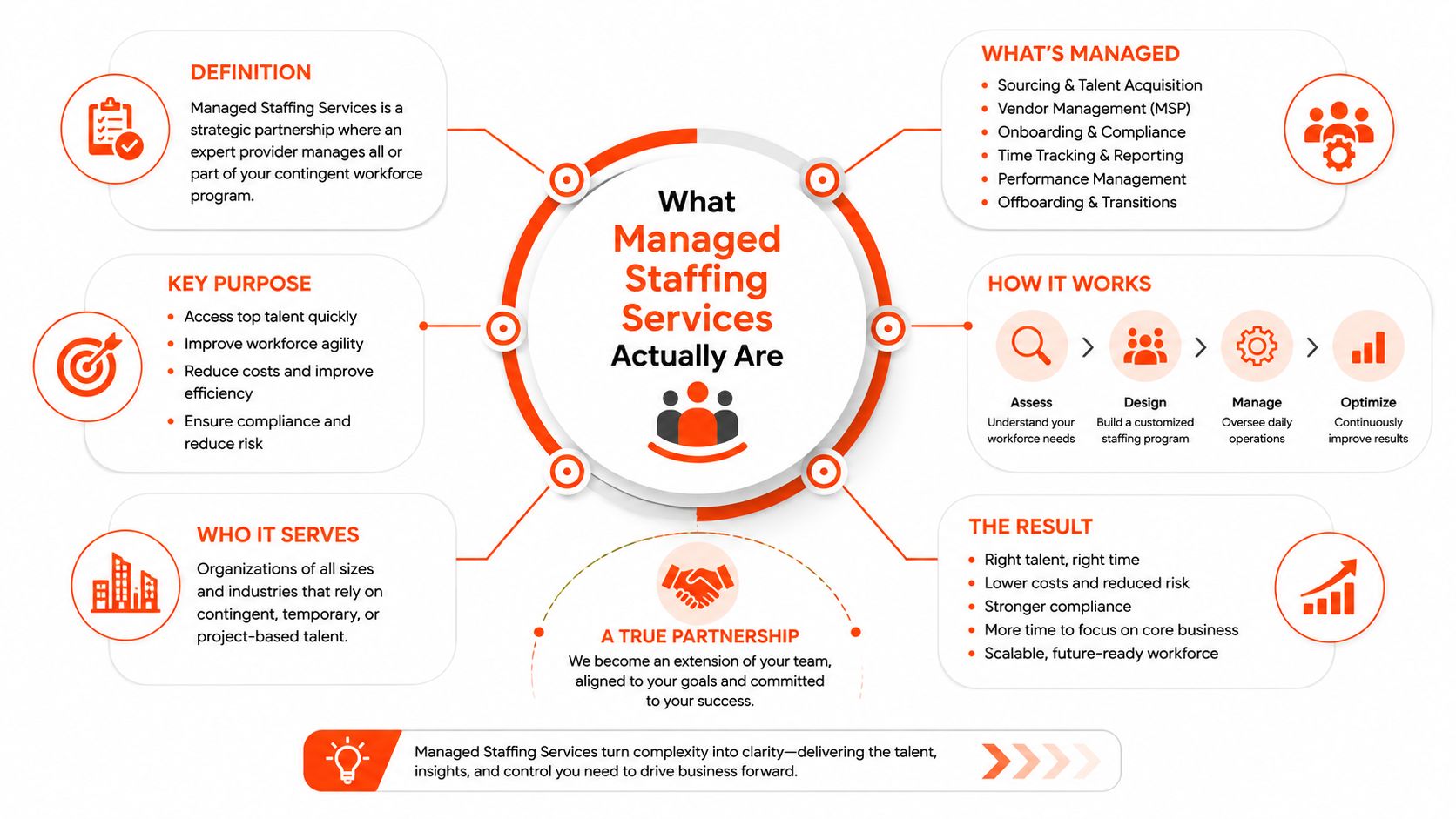
Managed staffing services sit inside a global staffing ecosystem that's already massive, which is why the model makes sense for buyers who need repeatable hiring rather than ad hoc recruiting. The global staffing industry generated about USD 648 billion in 2022, and the U.S. represented 34% of that total, showing that staffing is mainstream labor infrastructure rather than a specialized back-office tactic (global staffing industry statistics). That context matters because managed staffing isn't “just outsourcing,” it's a structured way to move work into a system built to source, screen, place, and administer people at scale.
A managed staffing provider usually takes over the pieces that slow companies down most. That can include sourcing candidates, vetting them, handling contracts, running payroll, managing HR support, and keeping compliance aligned across jurisdictions. The buyer gets one coordinated process instead of juggling recruiters, payroll vendors, legal review, and local admin work across multiple teams. When that same package is delivered by a professional working from another country on your hours, it is usually called remote staffing, and our explainer on how remote staffing works walks through the engagement step by step and who it fits.
Companies usually adopt managed staffing services when hiring starts creating operational drag. Managers want qualified people faster, finance wants fewer vendor relationships, and operations wants less time spent on vacancy management and paperwork. The value is not only speed, it's fewer handoffs.
Practical rule: if a role requires repeated screening, recurring compliance checks, or cross-border administration, it's already behaving like an operations problem, not a simple hiring request.
That's why this model is especially useful for U.S. companies that need a dependable external workforce process without building an internal staffing function from scratch. If you want a simple contrast with traditional agency work, the basics are useful, but the point here is broader. Managed staffing becomes the layer that coordinates the employment lifecycle, while a standard recruiting arrangement often stops after placement. For a plain-language primer on agency mechanics, see what a staffing agency does.
The cleanest way to think about it is this. Traditional recruiting sells a hire, managed staffing services sell a managed workflow around the hire. That difference explains why the model keeps showing up in companies that care as much about administration and continuity as they do about candidate supply.
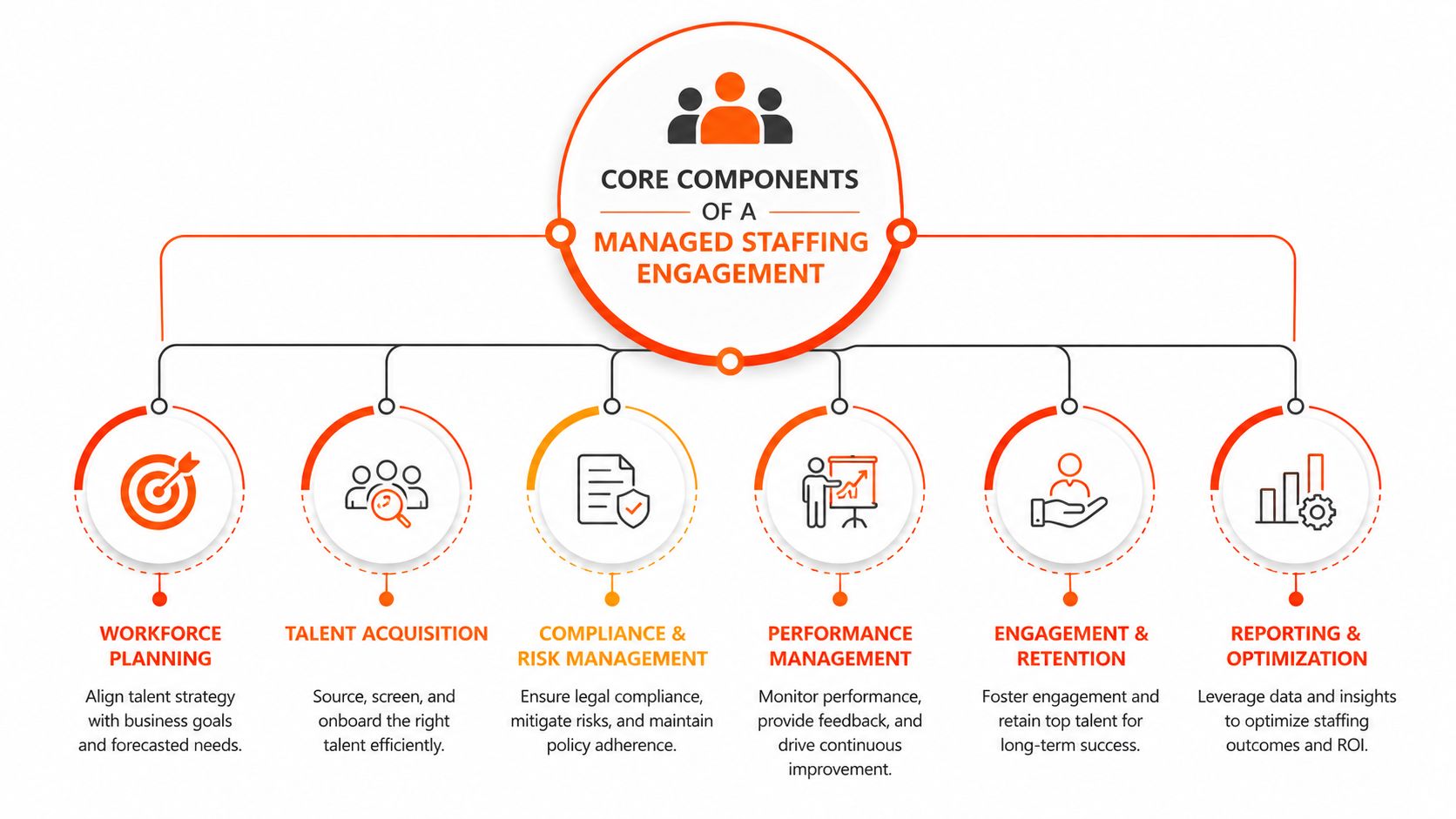
A managed staffing engagement is a connected operating model, not a single hire request. It starts with candidate sourcing, where the provider searches for people who fit both the role and the work environment. It then moves into vetting, which removes weak fits before internal managers spend time on interviews.
That vetting usually combines language screening, skills tests, experience review, and reference checks. In nearshore hiring, providers often also test communication comfort and collaboration readiness, because the work depends on daily coordination, not resume alignment alone. The practical result is less time spent sorting applicants and more time spent choosing between qualified finalists.
After selection, managed staffing services usually take over the paperwork that makes cross-border hiring difficult. That includes contracts, local payroll, HR administration, and compliance processes in the worker's country. The buyer gets one managed relationship instead of piecing together payroll, legal, and contractor tools.
The next layer is ongoing management. Many providers handle account oversight, watch for issues, and help resolve performance problems before they lead to attrition or missed deadlines. Some also support replacement placement if the first match does not hold up.
A provider is doing real managed staffing only when it owns more than sourcing. If it does not handle administration, payroll, or post-placement support, you are probably buying recruiting with a cleaner wrapper.
The right way to evaluate these layers is to ask what burden disappears on your side. If the provider only shortlists people, your managers still own onboarding, documentation, and follow-up. If the provider manages the engagement end to end, your team can focus on work output instead of worker administration. For five models side by side on cost and on who does what, see our comparison of virtual staffing solutions.
For companies comparing models, the strongest fit is usually a role that needs steady support, recurring oversight, and low tolerance for administrative friction. For a service example that reflects this full-stack structure, review Virtustant's managed staffing service and compare what is included against your current hiring stack.
Traditional recruiting, managed staffing, and MSP programs solve different problems, even though buyers often lump them together. Recruiting is mainly a placement function. MSPs sit at the enterprise program layer, managing contingent labor spend and governance at large scale. Managed staffing sits between them, because it takes on more operational responsibility than a recruiter but doesn't require the same buyer scale as a full MSP program.
The scale gap is important. The MSP market was estimated at USD 226 billion in spend under management in 2024, and organizations with 10,000+ employees drove 67% of that spend (WEC Economic Report 2023). That tells you MSPs are designed for large, programmatic labor environments. Most managed staffing buyers are smaller, or they're growing fast enough that they need structure before they reach enterprise-level program complexity.
| Criteria | Traditional Recruiting | Managed Staffing | MSP Programs |
|---|---|---|---|
| Main purpose | Fill a role | Fill and manage a role | Govern contingent workforce spend |
| Scope of responsibility | Sourcing and placement | Sourcing, placement, payroll, HR, compliance, and ongoing support | Program oversight, vendor management, spend governance |
| Buyer scale | Any size | Small to midsize teams, and growing businesses | Large enterprises |
| Time horizon | Transactional | Ongoing engagement | Continuous workforce program |
| Administrative burden on client | High after placement | Low to moderate | Low, but requires mature internal governance |
| Best fit | One-off hires | Repeated hiring plus administration | High-volume contingent labor programs |
A simple recruiter relationship ends when the candidate starts. Managed staffing continues after that point, which is why it can feel closer to an operating service than a talent transaction. The provider becomes responsible for coordination that would otherwise sit on the buyer's internal team.
That distinction changes the buying question. With recruiting, you ask, “Can you find someone good?” With managed staffing, you ask, “Can you find them, place them, administer them, and keep the workflow stable?” If your business needs that second answer more than the first, the model is probably the better fit.
Pricing confusion usually starts when buyers compare a placement fee to an all-in hourly rate as if they were interchangeable. They're not. Traditional recruiting typically charges for the hire itself, while managed staffing services usually bundle compensation, payroll processing, compliance, HR management, and provider margin into one rate. That makes the model easier to forecast, but it also means you need to read what's inside the rate, not just the headline number.
There's a reason this bundling exists. Industry benchmarks put average cost-per-hire around $4,700 and average time-to-fill at 44 days, which helps explain why providers compress sourcing, vetting, and placement into one outsourced workflow (staffing benchmarks). The economics aren't just about shaving recruiter effort, they're about reducing vacancy drag and limiting how many internal people get pulled into the hiring cycle.
Role complexity matters. A general support role won't price the same way as a specialized finance, design, or technical position because sourcing difficulty and vetting depth change. Geographic market matters too, since local payroll, labor rules, and administrative overhead vary by country. Volume commitments can also influence the rate because providers can standardize process work when the buyer has recurring demand.
If you want a second layer of context on how worker categories are managed over time, our breakdown of the five types of contingent worker is useful for understanding how this pricing structure fits broader labor governance.
Buyer test: if a quoted rate looks low, ask what's excluded. The lowest price often becomes expensive when payroll, replacement handling, or compliance support are billed separately.
A useful comparison is to treat pricing as an operating decision, not a purchase order. With recruiting, the cost is concentrated upfront. With managed staffing, cost is spread across the engagement, which can help with budgeting when you expect recurring work rather than a single hire.
For buyers comparing full-service providers, the Virtustant pricing model is an example of how all-in staffing can be packaged into one rate instead of split across setup fees, placement fees, and payroll add-ons. That matters most when you want one vendor accountable for delivery, not three vendors sharing the blame.
The most important change in managed staffing services isn't about sourcing at all, it's about what buyers are really purchasing. Recent industry coverage shows Statement of Work spending reached 39% of MSP spend in 2025, up from 18% in 2017 (state of MSP in 2025). That shift says something structural. Buyers are moving away from buying seats and toward buying deliverables, tasks, and capabilities.
That matters because headcount supply and outcome management are not the same operating problem. If the provider is only responsible for filling a role, the buyer still carries the burden of defining success, managing dependencies, and absorbing missed handoffs. If the work is packaged as a task or project, the provider has to manage toward a result, not just a start date.
Pricing changes first. A role-based model can be easier to quote, but it hides delivery risk inside the client's workflow. An outcome-based model forces clearer scope definitions, milestone tracking, and escalation rules. Governance changes too, because someone has to decide what counts as completion, acceptable quality, and timely handoff.
This is the point where managed staffing starts to resemble an operating system rather than a sourcing channel. The provider isn't just feeding people into an org chart, it's coordinating contracts, pay, and compliance around measurable work. That's a much harder service to run, and it's the reason buyers need better KPIs than “candidate submitted” or “position filled.”
If your provider can't discuss delivery standards, milestone ownership, and accountability boundaries, it's probably still selling labor supply, not managed outcomes.
The buying question is sharper now. When does managed staffing stop being a sourcing solution and become a working model for how the company gets tasks done? For some teams, that shift happens the moment they need recurring admin support. For others, it happens when they begin treating the provider as a component of project execution.
The implication is simple. Buyers should compare providers on the quality of the workflow they create, not only on how quickly they can place a person. As work shifts from roles to results, the best managed staffing partner is the one that can hold the process together when scope, timing, and responsibility start to blur.
The cleanest way to evaluate managed staffing providers is to look for evidence that they can reduce friction without hiding risk. Start with vetting rigor. Ask how many stages the provider uses, how it screens communication and role fit, and what happens when someone clears the shortlist but fails early in the engagement. If the process looks vague, your managers will inherit the screening work later.
Next, look at time-to-shortlist and time-to-hire. Buyers care about speed because vacancy costs are real, but speed only matters if the shortlist is usable. A provider that delivers candidates fast but forces your team to restart the process isn't saving time. That's why you should ask for recent examples of turnaround, not broad promises.
A useful adjacent resource is managing SaaS vendor partnerships, because the same discipline applies here, clear ownership, escalation paths, and performance visibility matter more than polished sales language.
Time-zone alignment deserves separate attention if your team collaborates daily. A provider can be operationally competent and still be a poor fit if communication happens outside your business hours. That's especially relevant for remote or nearshore staffing, where workflow speed depends on real overlap.
Red flag: if every answer stays at the level of “we take care of everything,” the provider may be masking weak process detail behind convenience language.
The last filter is governance. A serious provider should be able to describe how it protects continuity when a hire exits, how it tracks service quality, and how it escalates problems before managers feel them. That's the difference between a staffing vendor and a workforce partner. One fills requests, the other helps maintain operating stability.
A U.S. company needs a bilingual operations coordinator and wants someone who can join standups the same day problems come up. A nearshore provider in Latin America starts with scope, then filters candidates through a structured vetting process and returns a short list instead of a flood of resumes. If you want to compare that model with broader nearshore sourcing patterns, what nearshore outsourcing means gives helpful context.
The practical advantage is time overlap, and it rests on published clock offsets rather than on any provider's claim. Colombia is at UTC-5, Mexico at UTC-6, and Argentina and Brazil at UTC-3, so the region's major markets all sit within UTC-3 to UTC-6. On a 9-to-18 local schedule, that arithmetic gives U.S. East Coast teams 6 to 8 hours of same-day overlap. For a wider view of how companies plan around it, see this nearshore hiring in Latin America guide. The overlap makes clarification cycles faster and reduces the handoff lag that often slows offshore coordination.
After the hire is selected, the provider handles the cross-border work, contracts, payroll, and compliance, while the client gets one consolidated relationship. That's where the model becomes tangible, because the company experiences the hire as a functioning part of the team instead of a stack of administrative tasks. For a quick outside check on whether a company's web presence is being used to support the hiring funnel, see your website traffic score can be a useful benchmark alongside recruiting metrics.
Value shows up on day one and week one. The manager doesn't need to chase payroll questions, legal setup, or onboarding logistics, and the worker doesn't get stuck waiting for internal admin to catch up. That's the operational promise of managed staffing services when the model is executed well. What that looks like after the hire, and what to hold the provider's dedicated account manager to, is its own checklist.
Virtustant works in that exact lane, handling sourcing, vetting, placement, payroll, contracts, HR, and compliance for nearshore LATAM hires under one all-in hourly model. If you're comparing staffing options for a U.S. team and want a provider that manages the full employment workflow, visit Virtustant and review how the service structure fits your hiring needs.
Managed staffing services are an end-to-end model where one provider sources, vets, and places workers and then runs the surrounding administration: contracts, payroll, HR support, and compliance. Traditional recruiting sells you a hire; managed staffing sells a managed workflow around the hire.
A recruiter or staffing agency mainly fills a role and steps back after placement. Managed staffing continues past the start date, owning payroll, HR administration, compliance, and ongoing support, so the buyer coordinates one relationship instead of several vendors.
Most managed staffing is priced as one all-in rate that bundles compensation, payroll, compliance, HR management, and provider margin, rather than a one-time placement fee. Price varies with role complexity, country, and volume, so always ask what is included in the rate and what triggers extra fees.
An MSP (managed service provider) governs contingent-workforce spend and vendors for large enterprises, often 10,000-plus employee organizations. Managed staffing sits below that: it takes on more operational responsibility than a recruiter without requiring enterprise-level program scale, which fits small to midsize and fast-growing teams.
When hiring starts creating operational drag: repeated screening, recurring compliance checks, cross-border payroll, or roles that need ongoing administration. If a role behaves like an operations problem rather than a one-off hire, managed staffing usually fits.
Yes. Nearshore providers in Latin America (Colombia, Mexico, Argentina, Brazil, roughly UTC-3 to UTC-6) give 6 to 8 hours of same-day overlap with US East Coast teams, which speeds up clarification cycles versus far-offshore models. Virtustant places vetted LATAM talent and can save up to 70% versus a comparable US hire.