Dedicated Account Manager in Remote Staffing: What to Expect After the Hire
September 28, 2026


A dedicated account manager in remote staffing is the one named person at the provider who owns your placement after the hire: onboarding logistics, early check-ins with you and with the professional, payroll and paperwork on the provider's side, and a replacement if the fit breaks. At Virtustant, the average search runs 11.2 days from opening to start date (468 placements, 12 months to 23 Sep 2026). Everything after day 11 is account management.
That makes account management the part of a staffing contract buyers evaluate least and live with longest. What happens in month four, after the onboarding attention is gone, usually gets one line on a features page. This guide covers what the role should include, how it differs from a support inbox or a sales rep, the KPIs worth asking about, and a scorecard you can run on any provider before you sign: the Month-Four Test.
The idea is not new in B2B. TOPO's 2019 Account Based Benchmark Report, a January 2019 survey of more than 150 practitioners at account-based organizations, found that the best performers were 96% more likely to involve account management than underperformers, and 75% of respondents said their account-based approach improved retention rate (benchmark report). That is seller-side data from 2019, but the lesson carries into staffing: someone has to own the account after the deal closes.
What should a dedicated account manager own after a remote professional starts work? Four things, and a provider should be able to describe each one without reaching for adjectives.
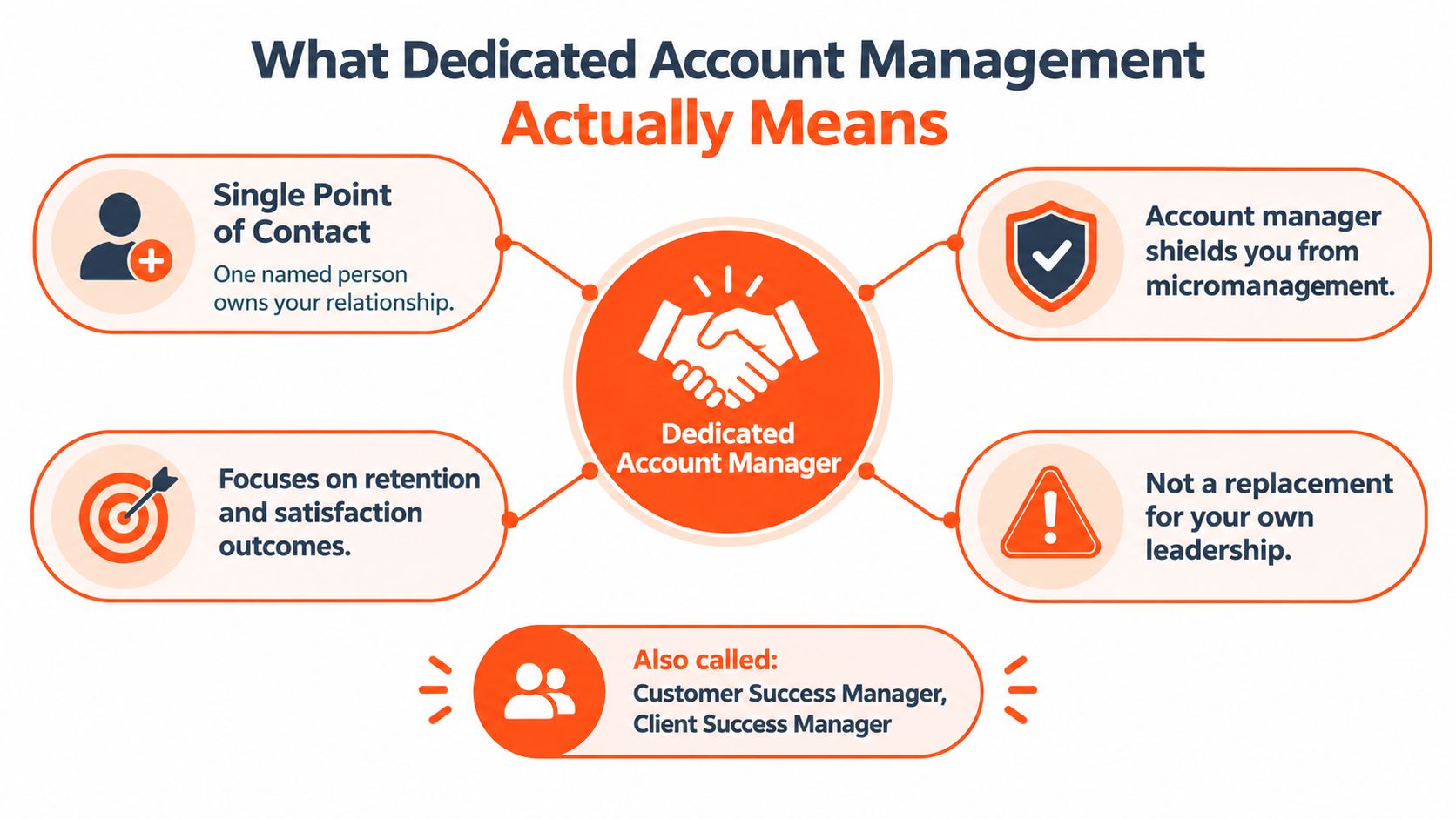
What the role is not matters just as much. The account manager is not the professional's boss. In a staffing model you direct the day-to-day work: priorities, tools, deadlines, quality bar.
Practical rule: the account manager should absorb coordination effort, not managerial authority. If you cannot direct the work, the model is wrong. If the provider does not own the administrative side, the service is incomplete.
These are the lines to check when you evaluate managed remote staffing. A shared support inbox can answer questions. It does not watch the working relationship or remember why the same issue keeps coming back.
The first weeks decide whether a good candidate becomes a good engagement. A strong professional still looks slow if system access arrives on day four or nobody wrote down the first week's priorities. Those are coordination failures, and coordination is what the account manager is for.
From any provider, you should expect four things right after the hire:
Setup quality on your side matters too. Virtustant's remote onboarding tips cover the access, documentation and feedback habits that make the first month easier, especially if you have never managed someone in another country.
Here is what our own process looks like, with the numbers behind it. Virtustant first-party placement data.
| Stage | What happens | Data (n, window) |
|---|---|---|
| Search to shortlist | 3 to 5 vetted candidates for you to interview | Shortlist in 48 hours |
| Search to start date | Average time from opening a search to the professional's first day | 11.2 days, n=468 placements, 12 months to 23 Sep 2026 |
| Hire day | An account manager becomes your main point of contact and reaches out the same day to coordinate onboarding, start date, tools access and the first-week plan | Process, not a metric |
| First weeks | We follow up with you and with the professional to catch issues early | Process, not a metric |
| Ongoing | You direct the day-to-day work; we handle payroll, paperwork and everything administrative on the professional's side | Process, not a metric |
| If it stops working | Lifetime replacement guarantee, no time cap, no placement fee | Applies at any point |
| What you pay | One all-in hourly rate; rates start at $7.00/hr | Median $12.75/hr, middle 50% $10.67 to $14.50, n=462 placements that started 22 Sep 2025 to 22 Sep 2026 |
Two things this table deliberately does not include: a fixed check-in calendar and account-manager KPIs. We do not publish either as a number here, so ask for the schedule that applies to your role on the discovery call, and hold every provider, including us, to what they put in writing. For how the 11.2-day figure is measured and why published hiring-speed benchmarks disagree, see our time-to-hire breakdown.
All three involve talking to the client, which is why providers blur them.
| Dimension | Dedicated account manager | Standard support | Sales-side account manager |
|---|---|---|---|
| Owns | The post-placement engagement, relationship health and the escalation path | The resolution of one ticket | Renewals, expansion and commercial continuity |
| Triggered by | Planned check-ins and early warning signs | A request or incident | A contract event or sales opportunity |
| Talks to | You and the remote professional | Whoever filed the ticket | The buyer or budget owner |
| Measures | Fit, satisfaction on both sides, issue resolution, replacement events | Response and resolution time | Renewal and expansion revenue |
| Fits when | An ongoing placement where continuity matters | Discrete questions such as billing | Growth of the commercial account is the main goal |
Standard support handles a password reset or an invoice question; it is not built to notice that your professional is getting conflicting priorities from two of your managers. A sales-side account manager may never speak to the person doing the work at all.
If a provider's "account manager" turns out to be the rep who sold you the contract, ask who talks to the professional. Teams that want to understand how technical pre-sales roles support revenue can browse sales engineering resources, but sales alignment is a different job from post-placement account ownership.
The simplest test is the question each model answers. Support asks, "What issue was reported?" Sales asks, "What is the next commercial step?" Dedicated account management asks, "Is this engagement working for both sides, and what needs attention before it stops working?"
Every provider looks good in week one. The Month-Four Test asks you to picture the engagement about 90 days in and score what the provider would actually do then.
Score each question 2 if the provider shows it in writing or demonstrates it, 1 if you only get a verbal yes, and 0 if the answer is no or vague.
| # | Criterion | Question to ask | 2 points looks like | 0 points looks like |
|---|---|---|---|---|
| 1 | Named owner | Who becomes my main point of contact after the hire, and will I know their name before I sign? | A named role with a backup when they are out | "Our team" or a shared inbox |
| 2 | Hire-day contact | What happens on the day I hire, and who contacts me? | Same-day outreach covering start date, tools access and a first-week plan | "Your new hire will reach out" |
| 3 | Two-sided check-ins | Do you talk to the professional as well as to me in the first weeks? | Yes, separately, with a way to raise issues from either side | Only the client is contacted |
| 4 | Control line | Who directs the day-to-day work? | You do; the provider stays out of task management | The provider inserts a supervisor you did not ask for |
| 5 | Admin in writing | Which of payroll, contracts, compliance and the professional's HR questions are yours in the agreement? | All four named as the provider's job | Some are left to you or unstated |
| 6 | Month-four replacement | If the fit breaks in month four, what happens and what does it cost me? | Replacement still covered, no new placement fee | Guarantee expired or a new fee applies |
| 7 | Escalation path | Walk me through what happens when I report a performance concern. | Steps, owners and a follow-up point | "Just let us know" |
| 8 | Evidence | What do you track on my account, and will you answer the KPI questions below? | Specific signals and how you will see them | No answer, or a generic dashboard pitch |
The maximum is 16 (8 questions × 2 points).
A worked example: a provider scores 2 on named owner, 2 on hire-day contact, 1 on check-ins (verbal only), 2 on control line, 1 on admin (payroll named, HR questions not), 0 on month-four replacement (guarantee ends at 90 days), 1 on escalation and 1 on evidence. That is 2 + 2 + 1 + 2 + 1 + 0 + 1 + 1 = 10 out of 16, a probe. The zero is the one to push on, because in month four a full-time placement at the $12.75 median has already billed about $8,840, and a new search with a new fee lands on you.
Most published account-management KPIs come from software companies, and a lot of them do not fit a staffing placement. HubSpot's customer success software, for example, is built around "a 360-degree view of each customer account that brings together product usage, support history, and CRM data" (customer-success management guidance). Product usage does not describe a person doing a job. The HubSpot blog's customer-success metrics overview (updated August 31, 2026) lists 15 metrics, from NPS and CSAT to MRR and free-trial conversion; the ones that translate are the relationship measures, such as churn rate, which it defines as customers lost divided by customers at the start of the period, times 100.
For a placement, the useful signals are narrower. Treat the list below as questions to ask a provider, not targets; no published staffing standard exists for any of them, so the point is whether the provider can answer at all.
| Signal | Question to ask the provider | Why it matters to you |
|---|---|---|
| Replacement events | How do you record a replacement, and can you tell me why each one happened? | Separates a bad match from a scope problem you could fix |
| Time to replace | When a replacement starts, how long until a new professional is working? | Every day without coverage is work that stops |
| Escalation resolution | From the day I report a concern, what are the steps and who owns each? | A named path beats a promise of responsiveness |
| Client satisfaction | Do you ask me how the engagement is going, and how? | HubSpot's CSAT, for reference, is the share of 4 and 5 ratings among all responses |
| Professional-side satisfaction | How do you hear if the professional is unhappy or overloaded? | Retention risk often shows up here before a resignation |
| Scope changes | Who notices when the work I assign has drifted from the original brief? | Month-four problems are often scope, not skill |
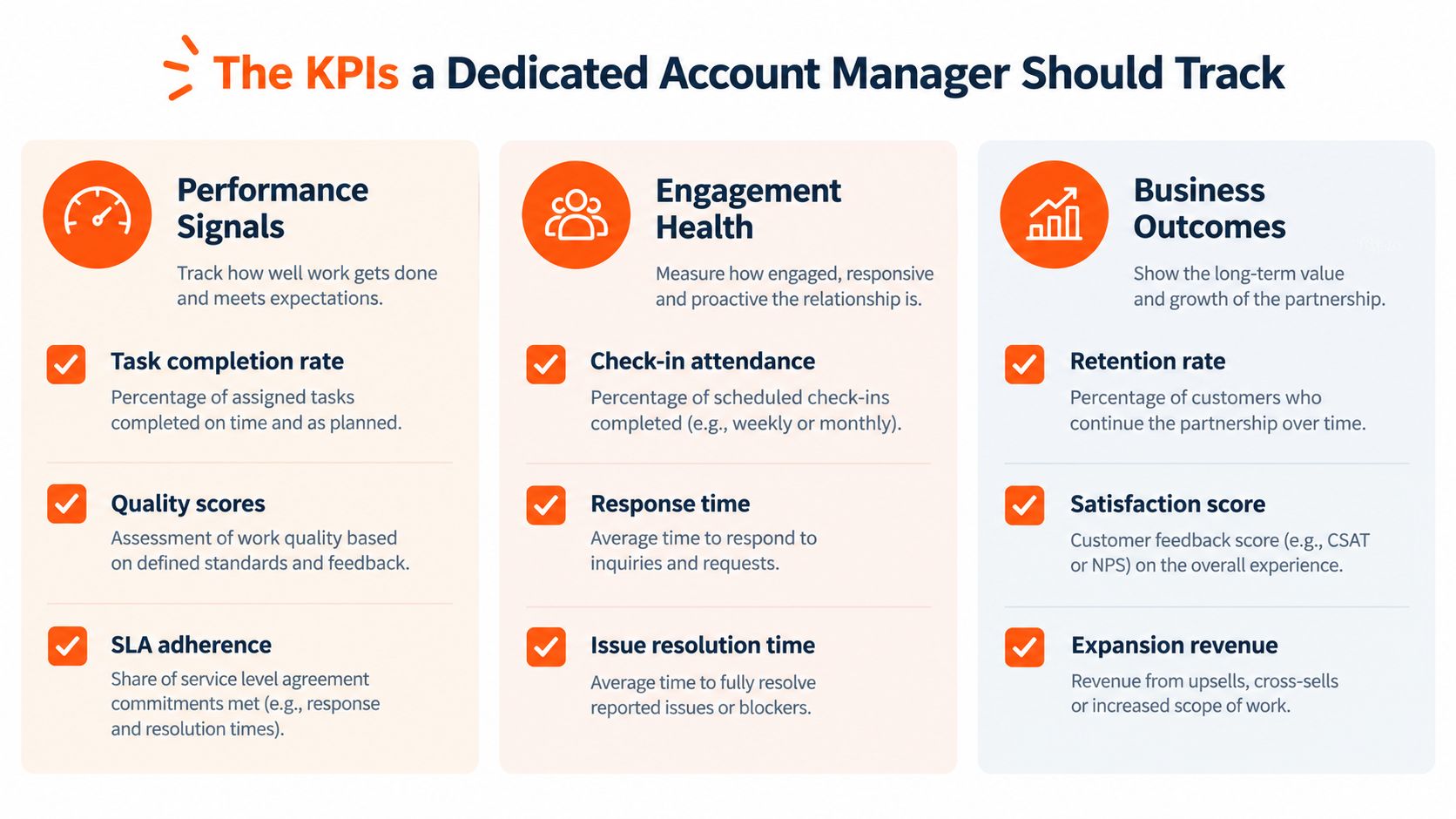
Does ownership actually move results? The best evidence is from the seller side of B2B. RivalSense's key account management benchmark summary relays research from RAIN Group, and RAIN Group's own write-up attributes the figures to its Top Performance in Strategic Account Management Benchmark Report: organizations that are best at key account management were 3.1X more likely to grow revenue by 20% or more in their key accounts, 3.4X more likely to grow profit by 20% or more, and 4.5X more likely to see year-over-year client satisfaction improvement than the rest. That is sales research on large accounts, not staffing data; it supports the principle, not a specific promise.
If you want a working view of your own side of the relationship, nearshore team productivity dashboards shows how to organize output and engagement signals without reducing a person to one score.
Ask it directly, because a named contact with no capacity is a mailbox with a name on it. There is no staffing-specific standard to hold a provider to. The closest published reference is from sales: Arpedio, an account-planning software company, says in its account-management guidance that a key account manager typically handles between 10 and 30 accounts depending on complexity, 3 to 10 for global enterprise accounts, and 20 to 30 for less complex mid-market ones.
Those ranges are for enterprise sales and do not transfer directly. Ask about behavior instead of ratios:
The line between client and provider is the part most worth getting in writing. In a remote staffing model, the standard split looks like this:
| Stays with you | Stays with the provider |
|---|---|
| Daily priorities, task assignment and deadlines | Contracts with the professional in their country |
| Tools, workflows and the quality bar | Payroll every cycle |
| Feedback on the work itself | Compliance and the professional's HR questions |
| Deciding whether the fit is working | Coordinating onboarding logistics, check-ins and replacement |
Published service lists vary in what they name, so read them closely. The Hello Team's remote staffing page, for example, says the client interviews and approves each hire while the company handles "recruiting, onboarding, compliance, workforce oversight, performance tracking, and ongoing support" (managed staffing administration). Ask every provider, including us, to put payroll, contracts, compliance and who answers the professional's HR questions in the agreement by name.
Also confirm whether you need a local entity in the professional's country (with Virtustant you do not), how invoices arrive, and what happens to the admin side if you pause or end the engagement. Before choosing a remote staffing agency, compare these mechanics side by side rather than candidate quality alone. Still choosing a model? See freelance vs agency vs managed VA and how much staffing agencies charge.
Here is how our process lines up against the eight questions, using only what we commit to. Where we do not publish something, the table says so.
| Criterion | What Virtustant does | What to confirm on the call |
|---|---|---|
| Named owner | An account manager becomes your main point of contact after the hire | The name and how backup works |
| Hire-day contact | Same-day outreach to coordinate onboarding, start date, tools access and the first-week plan | What the first-week plan covers for your role |
| Two-sided check-ins | We follow up with you and with the professional during the first weeks | The check-in schedule for your role; we do not publish a fixed calendar |
| Control line | You direct the day-to-day work | Nothing; this is the model |
| Admin in writing | We handle payroll, paperwork and everything administrative on the professional's side | That the agreement names each item |
| Month-four replacement | Lifetime replacement guarantee, no time cap, no placement fee | How a replacement search starts |
| Escalation path | Your account manager is where a concern goes | The steps for your situation |
| Evidence | We do not publish account-manager KPIs on this page | Ask what we track on your account |
No single item on that list is unusual on its own; other providers offer named contacts, payroll handling or replacement terms too. What we would ask you to compare is the combination: zero recruitment or placement fees, one all-in hourly rate that starts at $7.00/hr (median $12.75/hr across 462 placements), month-to-month terms, a 48-hour shortlist, and a replacement guarantee with no time cap. Rates by role and schedule are on our pricing page, and the full model is on what managed staffing services include.
If you are hiring an assistant, the same account management applies to dedicated virtual assistants. Virtustant is a remote staffing agency that places vetted professionals from Latin America with US companies; book a discovery call, bring the Month-Four Test, and score us on it.
A dedicated account manager is your main point of contact after the placement. They coordinate onboarding, start date and tools access, check in with you and with the professional in the first weeks, keep the provider's administrative side running, and start a replacement if the fit breaks. They do not direct the professional's daily work; you do.
The jobs overlap and some companies use the titles interchangeably. In software, customer success centers on product adoption and renewal. In remote staffing, the focus is the placement itself: whether the professional and the client are working well together.
You do. In a remote staffing model the client sets priorities, assigns tasks and reviews the work. The provider handles contracts, payroll, compliance and the professional's HR questions.
There is no industry standard, so ask each provider for its schedule in writing and check that it includes the professional as well as you. At Virtustant, the account manager reaches out the same day you hire and we follow up with both sides during the first weeks; ask on the call what that looks like for your role.
No staffing-specific benchmark exists. In sales, Arpedio's guidance puts a typical key account manager at 10 to 30 accounts depending on complexity. For staffing, ask who covers your account when your manager is out and how your history is handed over if they leave.
It depends on the replacement guarantee, which is why month four is the test. If a guarantee is capped at 90 days, you pay for a new search yourself. Virtustant's replacement guarantee has no time cap and no placement fee, so a replacement is covered at any point.
No separate fee. Virtustant charges one all-in hourly rate with zero recruitment or placement fees, and the account manager comes with the placement. Rates start at $7.00/hr; the median across 462 placements that started 22 Sep 2025 to 22 Sep 2026 is $12.75/hr.
Run the Month-Four Test: who owns the account, what happens on hire day, whether check-ins include the professional, who directs the work, which admin items are in writing, what replacement costs in month four, how escalation works, and what the provider tracks. Score each 0 to 2 out of 16.