Virtual Staffing Solutions in 2026: 5 Models Compared on Cost and Who Does What
September 28, 2026


Virtual staffing solutions are the ways a business fills a role with a remote professional: a freelance marketplace, a subscription virtual assistant service, a recruiter for a direct hire, an employer of record (EOR), or a remote staffing agency. They differ in who finds, employs, pays and replaces the person. In Virtustant's 332 most recent placements, 74.1% asked for exactly 20 or exactly 40 hours a week, so this guide prices every model at those two points.
Third-party prices below are what each source publishes on its own site, checked on 28 September 2026. Virtustant figures are first-party placement and intake data, with the sample size and window stated next to each one. One note on the search term: there is also a company named Virtual Staffing Solutions. This guide is about the category, not that company.
Virtual staffing means the person works remotely, you direct the day-to-day work, and some or all of the jobs around the hire sit with a third party: finding candidates, vetting them, contracting and paying them, keeping the arrangement compliant, and replacing them when it doesn't work. The model you pick decides which of those jobs stay with you. That is the real comparison. The hourly rate is only part of it.
Be careful with market-size numbers. Most reports filed under "virtual assistant" measure software, not people. The Virtual assistant market analysis from Research and Markets values its market at $10.11 billion in 2026 and $23.97 billion by 2030, but it defines virtual assistants as software applications, with chatbots and smart speakers as the main products. The related report behind its Virtual staffing market coverage is the same kind of study: it describes AI assistants such as Siri, Alexa, Cortana and Google Assistant, and projects growth of $394.68 billion from 2025 to 2030. Neither figure sizes the market for hiring a remote professional, so we don't use them to make a business case.
Each model is described by how it works and what its providers publish, not by how good any one provider is.
You post a job or search profiles, hire an independent contractor and pay through the platform. Upwork's pricing page lists a 5% client marketplace fee on its Basic plan (3% for eligible US clients paying from a checking account) and 10% on Business Plus, plus a contract initiation fee of $0.99 to $14.99 per new contract on Basic. Upfirst's analysis of 201 Upwork virtual assistant profiles, last updated May 2026, found a median rate of $14.50 an hour and an average of $20.50, with rates from $5 to $89.
The marketplace gives you reach and flexibility. It also leaves you the most work: as Prialto's comparison of virtual staffing models puts it, on a marketplace you handle sourcing, vetting, onboarding and ongoing management yourself.
A service sells you a monthly block of hours, and its assistants do the work. One US service publishes four plans: 10 hours for $390, 20 for $760, 40 for $1,480 and 60 for $2,160, which is $39 an hour on the smallest plan and $36 on the largest. Unused hours roll over on the 20-hour plan and up, and there is no setup fee. Note that these are hours per month, not per week.
A pay-per-task version exists too. Fluidwave's guide to on-demand staffing solutions describes flexible staffing as growing or shrinking your team on demand, and Fluidwave itself sells virtual assistant work on a pay-per-task basis. Both versions fit steady but small workloads better than a dedicated seat.
A recruiter finds the candidate, you hire them onto your own payroll, and you pay a one-time fee. Staffing Industry Analysts reports that the most common direct hire fee is 20% of salary, cited by 42% of staffing firms in its North America Staffing Company Survey (published April 2022). After the placement, the person is yours to pay, manage, keep compliant and replace. If they live in another country, you also need a local entity or an EOR to employ them.
An EOR becomes the legal employer in the worker's country, runs local payroll and handles statutory obligations, while you direct the work. Deel lists EOR at $599 per employee per month and Remote lists $699 per employee per month on their pricing pages, both flat fees. An EOR does not find the person for you. You bring the candidate, set the pay and restart the search if it doesn't work out.
The agency sources and vets candidates, places a dedicated remote professional, handles their contract, payroll and paperwork, and bills you one all-in hourly rate. This is the model behind Virtustant's remote staffing services: a shortlist of 3 to 5 vetted candidates in 48 hours, zero recruitment or placement fees, month-to-month terms and a lifetime replacement guarantee with no time cap. Other agencies price the same model differently, some with a placement fee on top of an hourly markup, so compare published terms, not labels.
Every remote hire comes with the same five jobs, whoever does them. Directing the day-to-day work stays with you in every model, so it is left out. Here is who does each of the other five by default.
| Job | Freelance marketplace | Subscription VA service | Recruiter + direct hire | EOR | Remote staffing agency |
|---|---|---|---|---|---|
| Find candidates | You, searching the platform | Provider | Recruiter | You | Agency |
| Vet skills and English | You | Provider | Shared: recruiter screens, you decide | You | Agency screens; you pick from the shortlist |
| Contract and pay | Platform processes payments; terms are yours | Provider | You | EOR | Agency |
| Local compliance and classification | You | Provider | You, plus an entity or EOR abroad | EOR | Agency, on the professional's side |
| Replace if it doesn't work | You | Provider reassigns | Recruiter within its guarantee window, then you | You | Agency |
| Jobs left with you | 4 of 5 | 0 of 5 | 2 of 5 (3 after the guarantee ends) | 3 of 5 | 0 of 5 |
These are defaults by model, not promises from any single provider, so ask each one to confirm every row in writing. The last row is the one to read carefully. Staffing contract guidance from our team lists the continuity question to put in the agreement: does the provider owe a replacement, a refund or nothing when a placement ends?
Two things stand out. First, the subscription service and the agency both leave you zero of the five jobs, but you buy different things: a block of hours done by the service's assistants, or a dedicated professional working your hours. Second, the marketplace and the EOR look cheap on the fee line because the jobs they leave with you never appear on an invoice. They show up as your time.
Pricing pages invite you to compare plans in whatever units the provider sells: 10 hours, 55 hours, a flat monthly fee. Buyers don't hire that way. Our virtual assistant pricing guide runs the full 20/40 test across pricing models; here is the same test applied to the five staffing models, using four-week months of 80 and 160 hours.
| Model | Published price (checked 28 Sep 2026) | 20 h/week (80 h/month) | 40 h/week (160 h/month) |
|---|---|---|---|
| Freelance marketplace | Median $14.50/hr across 201 Upwork VA profiles, plus the 5% Basic-plan fee | $1,218 | $2,436 |
| Subscription VA service | $36 to $39/hr, in plans of 10 to 60 hours a month | No published plan; $2,880 if the 60-hour plan's $36 rate applied | No published plan; $5,760 at $36 |
| Recruiter + US direct hire (administrative assistant) | 20% fee on the $48,310 BLS median salary; benefits 30.0% of compensation | About $2,876 a month if prorated, plus a one-time fee of about $4,831 | About $5,751 a month, plus a one-time fee of $9,662 |
| EOR | $599 (Deel) or $699 (Remote) per month, flat | Pay + local employer costs + $599 ($7.49 per working hour in fees) | Pay + local employer costs + $599 ($3.74 per working hour in fees) |
| Remote staffing agency, Virtustant median across all roles | $12.75/hr all-in (n=462); no placement fee | $1,020 | $2,040 |
Method: marketplace, $14.50 × 80 × 1.05 = $1,218. Subscription, $36 × 80 = $2,880, an extrapolation, since no plan above 60 hours is published. In-house, the BLS median wage for secretaries and administrative assistants is $48,310 a year ($23.23 an hour, May 2025), and wages were 70.0% of private-industry compensation costs in June 2026 (BLS, Employer Costs for Employee Compensation): $48,310 ÷ 0.70 ÷ 12 = $5,751 a month, half is $2,876, and the fee is 20% × $48,310 = $9,662. EOR, $599 ÷ 80 = $7.49. Virtustant rows: first-party placement data, placements started 22 September 2025 to 22 September 2026, n=462 with a derivable rate.
Three things the arithmetic shows.
Staffing agencies themselves charge in different ways, from one-time placement fees to recurring markups. Our breakdown of what staffing agencies charge compares those structures.
The Carry Test puts every model on one line. It has three parts:
The rule: only compare cost per hour between quotes with the same carry score. Every job you carry costs manager time that no invoice shows, so a lower rate with a higher carry score isn't a saving until you have priced that time.
Worked example 1, EOR against an agency at 20 hours a week. Say you found a professional yourself and agreed pay of $10 an hour (an assumption for the example). Through Deel's EOR: $10 × 80 = $800, plus $599, is $1,399 a month, or $17.49 per working hour, before local employer contributions. Carry score: 3 of 5. At 40 hours: $1,600 + $599 = $2,199, or $13.74 an hour. The agency at Virtustant's all-roles median: $1,020 a month at 20 hours ($12.75 an hour) and $2,040 at 40, carry score 0 of 5.
Worked example 2, a direct hire that leaves early. The $9,662 fee spread over 12 months adds $805 a month, so year one averages $5,751 + $805 = $6,556 a month. If the hire leaves at month six, the fee works out to $9,662 ÷ 6 = $1,610 for each month you actually had them, and the carry score rises from 2 to 3 once the guarantee window has passed.
Worked example 3, the marketplace. $14.50 × 1.05 = $15.23 an hour at the median, plus $0.99 to $14.99 per new contract. Carry score: 4 of 5. Each replacement restarts the search on your calendar.
Virtustant first-party placement data, n=462 placements with a derivable rate, started 22 September 2025 to 22 September 2026. The rate is the client's all-in hourly rate; the monthly figures are that rate times 80 or 160 hours.
| Role | Median all-in rate | Middle 50% (p25 to p75) | Placements (n) | 20 h/week | 40 h/week |
|---|---|---|---|---|---|
| Virtual assistant | $10.73/hr | $9.23 to $12.00 | 42 | $858 | $1,717 |
| Executive assistant | $11.94/hr | $9.88 to $13.68 | 16 | $955 | $1,910 |
| Appointment setter | $12.00/hr | $10.46 to $13.50 | 68 | $960 | $1,920 |
| Social media manager | $12.00/hr | $10.66 to $12.89 | 46 | $960 | $1,920 |
| Sales development rep | $13.00/hr | $12.00 to $13.00 | 41 | $1,040 | $2,080 |
| Customer service | $14.00/hr | $9.00 to $16.00 | 33 | $1,120 | $2,240 |
| Bookkeeper | $15.00/hr | $12.64 to $16.38 | 12 | $1,200 | $2,400 |
| All placements | $12.75/hr | $10.67 to $14.50 | 462 | $1,020 | $2,040 |
Four patterns from the same data matter for choosing a model:
Rates start at $7.00 an hour. Roles not shown above, such as developers or marketing specialists, are scoped on the discovery call rather than quoted from a median.
If 91% of assistant searches name a US time zone, overlap is part of what the buyer is paying for. Nearshore staffing time-zone guidance from Wow Remote Teams, a nearshore staffing company, puts Latin America's daily overlap at six to nine hours with US Eastern Time and four to six with Pacific.
The HBS analysis of time zones in remote work shows why that matters. In a study of more than 12,000 workers at one multinational, synchronous communication such as calls and video chats fell 11% when the time difference between colleagues grew by one hour, and the hour of lost overlap meant a 19% reduction in opportunities to talk in real time during a typical workday.
That makes overlap a model question: on a marketplace or through an EOR it is whatever your candidate's location gives you, while an agency can recruit for it from the start. That is the case for Virtustant nearshore staffing: professionals across Latin America who work your business hours, for roles such as sales development, customer support and executive assistance, where a question asked at 10 a.m. should be answered before lunch.
International hiring most often goes wrong at the administrative layer, where a cross-border relationship gets treated as a simple contractor payment. Global payroll guidance from ADP defines global payroll compliance as meeting legal and regulatory requirements in multiple countries, from tax rules and filing requirements to employment laws, statutory benefits, pay frequencies and reporting deadlines. In the ADP survey the page cites, 75% of more than 1,800 organizations said keeping up with local payroll regulations across countries is a major challenge.
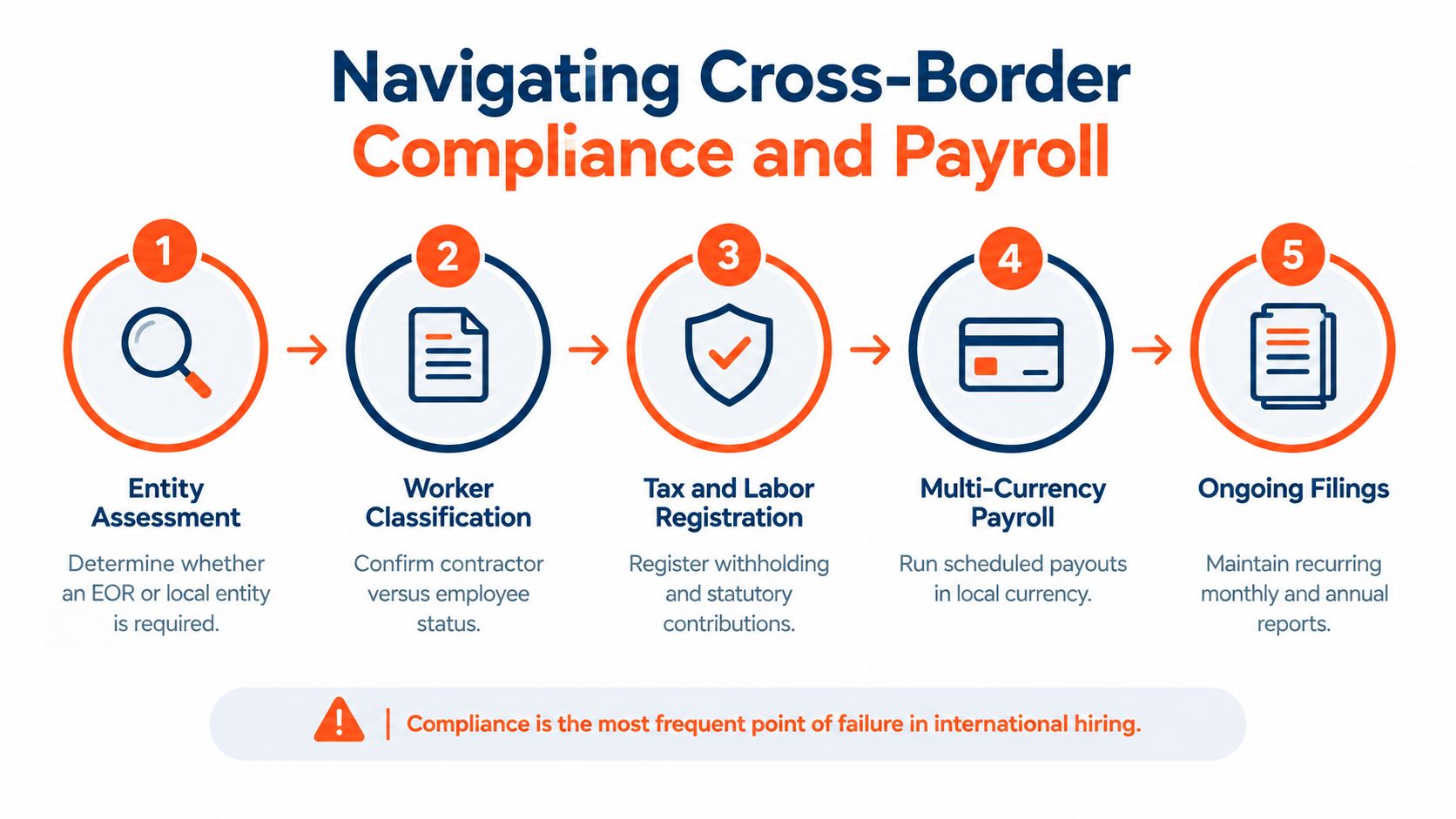
By model, the employer-on-paper question has a different answer:
None of these makes your own responsibilities disappear, and a contract label doesn't settle classification: the actual relationship does. Before the first payment, confirm who contracts with the professional, who runs payroll, who files the recurring reports and what happens when the engagement ends. A practical founder's guide to global payroll helps you structure those questions for counsel and finance.
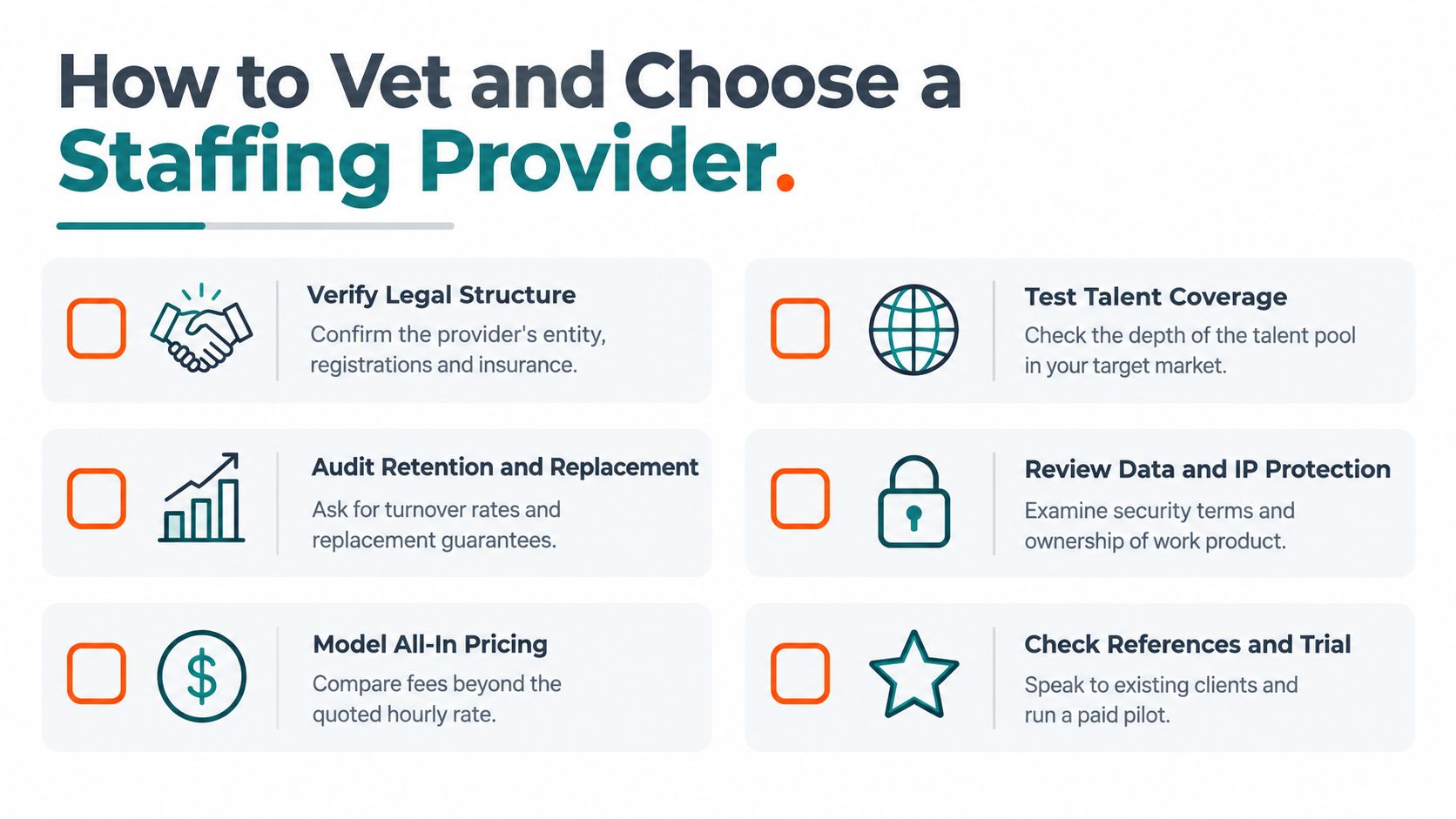
A provider's website won't tell you whether its shortlist is selective. Five checks will.
For the last one, here is what it looks like at Virtustant: an account manager becomes your main point of contact and reaches out the same day to coordinate onboarding, start date, tools access and the first-week plan. We follow up with you and the professional during the first weeks to catch issues early, and if it isn't working at any point, the lifetime replacement guarantee applies. No single item on that list is unique to us. The combination is what we compete on.
Our video walks through eight questions to ask a remote staffing agency before you sign:
If you want named providers rather than models, our list of the best remote staffing agencies compares them on published pricing, time to shortlist, payroll and replacement terms.
For assistant roles specifically, our comparison of freelance, agency and managed VA models goes deeper on the trade-offs. Once you know the model, pick the role: start from the remote roles we staff and rewrite the description around your own workflows, because the provider can find candidates but your company still owns the brief and the performance standard.
Virtual staffing solutions are the ways a business fills a role with a remote professional: a freelance marketplace, a subscription VA service, a recruiter for a direct hire, an employer of record, or a remote staffing agency. They differ in who finds, vets, pays, keeps compliant and replaces the person, and in what a month costs at the hours you buy.
At 20 hours a week (80 hours a month), a marketplace assistant at the $14.50 median of 201 Upwork VA profiles plus a 5% fee costs about $1,218, and Virtustant's $12.75 all-in median costs $1,020. At 40 hours, those become $2,436 and $2,040. An EOR adds a flat $599 to $699 a month on top of pay.
An EOR employs someone you already found and runs their local payroll and compliance for a flat monthly fee: $599 at Deel and $699 at Remote. A remote staffing agency also finds, vets and replaces the person, and bills one hourly rate for all of it.
For an administrative role, usually. A median US administrative assistant costs about $5,751 a month with benefits, based on BLS wages for May 2025 and benefits at 30.0% of compensation in June 2026. Virtustant's all-in median of $12.75 an hour is $2,040 at 40 hours, with no placement fee.
Not in Virtustant's data. Of the last 462 placements, 46% were part-time, and the part-time median was $12.41 an hour against $12.93 for full-time. Package plans and flat monthly fees work the other way: they cost more per hour the fewer hours you buy.
Virtustant sends a shortlist of 3 to 5 vetted candidates within 48 hours. Across 468 placements in the 12 months to 23 September 2026, the average was 11.2 days from opening a search to the professional's start date.
Not automatically. An EOR or an agency can hold the contract and run payroll, but you should confirm in writing who contracts with the professional, who directs the daily work and which obligations the provider takes on, and review the structure with qualified counsel.
For roles that need live collaboration, usually. In Virtustant's review of 75 assistant searches with a stated schedule, 68 (91%) named a specific US time zone, and Latin America shares most of the US business day. A global marketplace offers wider reach for asynchronous, project-based work.
Yes. JobsPikr's summary of Remote work trend data puts roughly a quarter of US workdays as remote, citing WFH Research, with about 28% of workers hybrid and 9% fully remote in 2025 surveys. The open question for most companies is how to staff remote roles, not whether to.
Tell us the role and the schedule. We send a shortlist of 3 to 5 vetted candidates within 48 hours, with one all-in hourly rate, no placement fee and month-to-month terms. Check the published rates on our pricing page, or visit Virtustant to book a discovery call and run the Carry Test on your own quote.