Staffing Company Contract: Essential Clauses and Negotiation
August 24, 2026


Most advice treats a staffing company contract as a plug-and-play service agreement. That's wrong, especially when a U.S. company engages a remote professional in LATAM. The contract must define who controls the work, who carries employment and compliance risk, how invoices are calculated, and what happens when the assignment ends or the worker leaves.
The stakes are substantial. The global temporary labor market was valued at $412.6 billion in 2025 and is projected to reach $698.4 billion by 2034, an increase of $285.8 billion, with a projected 6.0% compound annual growth rate from 2026 to 2034 according to Dataintelo's temporary labor market analysis. Contract staffing is now a durable operating model, not a temporary workaround. Your agreement should be written like an operating system for the relationship, not a form downloaded from the internet.
This guide is operational, not legal advice. Contract and classification rules differ by country and by the facts of each engagement, so have qualified counsel review any agreement before you sign it.
The popular assumption is that staffing contracts are simple because the client pays an agency and receives a worker. That model looks straightforward until the placement crosses a border, the client starts directing every detail of the worker's activity, or a regulator changes the classification test. At that point, vague language becomes a cost allocation mechanism, and it usually allocates costs to the buyer.
The scale of the sector makes weak administration more dangerous. Independent staffing-industry reporting places global temporary staffing revenue at about $512.4 billion in 2023, while U.S. temporary staffing agencies employed 15.2 million workers daily on average that year, equal to 10.1% of the nonfarm workforce. Temporary help services represented about 85% of staffing-industry revenue, according to GITNUX's temporary staffing statistics. When a business model moves workers quickly across roles and jurisdictions, contract precision becomes an operating requirement.
A domestic template often says the agency will “provide qualified personnel” and the client will “pay agreed fees.” That wording leaves critical questions unanswered:
These aren't drafting details. They determine whether a client can keep operating after a worker leaves, whether a disputed invoice can be resolved quickly, and whether the parties have documented a defensible allocation of risk.
Operator's rule: If a contract doesn't answer who does what, who pays what, and what happens next, it hasn't been negotiated yet.
Cross-border work adds another layer. A worker may follow U.S. business hours and report to a U.S. manager while remaining subject to local employment, payroll, and data rules. The overlap itself is arithmetic, not opinion: LATAM's main business centers run from UTC−3 (Argentina, Brazil, Uruguay, Chile) to UTC−6 (Mexico City, Costa Rica, Guatemala), which puts them within 0 to 3 hours of U.S. Eastern Time, so a standard local workday shares roughly 6 to 8 business hours with a U.S. team. In Virtustant's own candidate base, 42,716 candidates have confirmed they can work U.S. business hours. Here is the contract point most buyers miss: a confirmed availability is not a contractual commitment. If the overlap window is not written into the role schedule and the service levels, you have bought a preference, not an obligation. For wider remote-work practice, see Nearshore Business Solutions. Those operating facts belong in role expectations and service-level planning, but they don't replace a clear legal model.
A reliable staffing company contract has a visible skeleton. I review it in this order: scope, role, duration, commercial terms, governance, and exit rights. If one of those areas is missing, the agreement is incomplete even if the document looks polished.
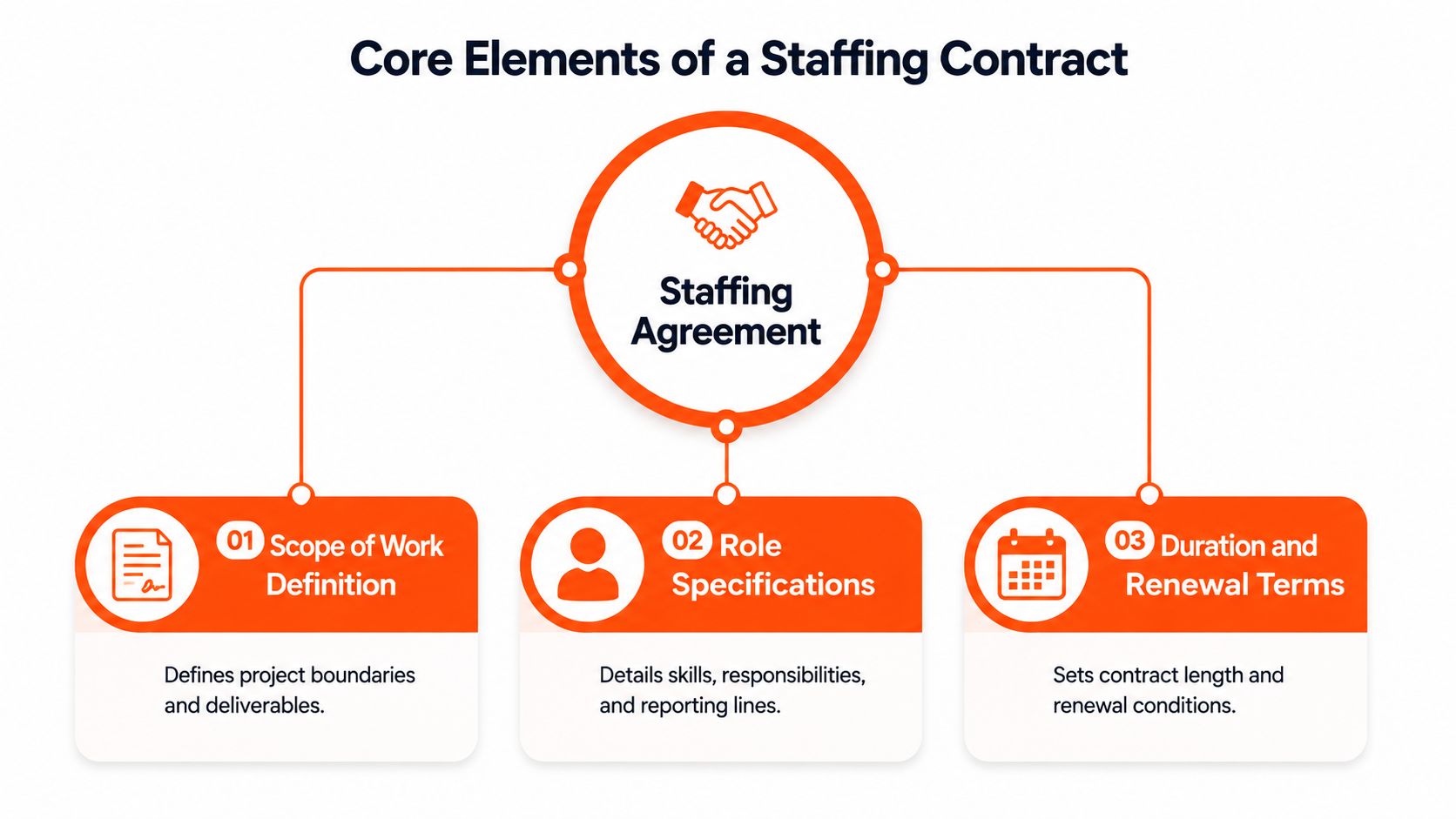
The scope should identify the service being purchased, the roles covered, the expected capacity, and the boundaries of agency responsibility. “Recruiting and staffing support” is too broad. A stronger clause might say that the provider will source, assess, place, and administer remote customer-support professionals, while the client will define role priorities, approve candidates, provide systems access, and supervise daily output.
That distinction prevents scope creep. It also separates delivery obligations from client obligations, which matters when performance falls short.
A job title doesn't establish accountability. The contract should include the role's responsibilities, required skills, reporting line, work schedule or overlap expectations, location, equipment assumptions, and approval process for material changes. If a client later turns a bookkeeping role into a sales role, the agreement should require a written change order or updated statement of work.
Use a role schedule rather than burying details in an email. The schedule can identify:
Write that schedule against a real role definition rather than a job title. Our published scopes for a remote bookkeeper, an executive assistant, an appointment setter and a sales development representative each list the duties, tools and success measures the role is normally contracted for, which is a faster starting point than drafting the schedule from scratch.
State the start date, initial term, renewal process, assignment end date, and notice rules. Then define governance, including timesheet approval, invoice disputes, performance escalation, data access, and regular account reviews.
A practical contract-control benchmark is to standardize scope of work, duration, payment terms, compliance clauses, confidentiality and IP ownership, and termination rights, then support those terms with centralized governance, classification review, and recurring audits of pay schedules, withholding, and record retention. KellyOCG's contingent-workforce checklist provides a useful control framework.
| Contract area | Weak language | Buyer-grade language |
|---|---|---|
| Scope | “Provide qualified staff” | Identifies roles, duties, capacity, and exclusions |
| Role | “Work as directed” | Defines reporting, responsibilities, schedule, and change control |
| Duration | “Until terminated” | States term, renewal, end date, and notice |
| Governance | “Parties will cooperate” | Sets approval, escalation, review, and dispute procedures |
The headline rate rarely equals the total cost. Staffing proposals usually use four structures: placement fees, hourly markups, all-in rates, or retainers. Each assigns uncertainty differently, and cross-border arrangements add exposure through currency conversion, local employment costs, and changing classification rules.
A placement fee is generally paid once. The invoice is simple, but the client carries more ongoing employment administration. An hourly markup creates a recurring bill based on time worked. The contract must show how wages, benefits, holidays, overtime, and administrative charges affect the final amount.
An all-in rate supports cleaner budgeting only when it includes talent cost, payroll, compliance, HR administration, and agreed support. A retainer reserves recruiting or staffing capacity, but it needs rules for unused capacity, candidate volume, response times, and work outside scope.
| Fee Model | Cost Components | Predictability | Best For |
|---|---|---|---|
| Placement fee | One-time fee tied to a hire or placement | High at placement, lower afterward | Buyers managing ongoing administration themselves |
| Hourly markup | Worker pay, employment costs, agency charge, and possible pass-throughs | Moderate unless exclusions are listed | Variable workloads and time-based assignments |
| All-in hourly rate | Talent, payroll, compliance, HR administration, and agreed service | High when inclusions are explicit | Companies seeking one operating rate and one invoice |
| Retainer | Reserved recruiting or staffing capacity plus defined services | Moderate to high if utilization rules are clear | Recurring hiring demand and planned workforce programs |
Reject “additional charges may apply” unless the contract includes a schedule. Identify overtime multipliers, holiday pay, benefits pass-throughs, equipment, currency conversion, payment processing, background checks, replacement work, and late-payment consequences. Require a rate-change clause that states whether local employment costs or worker-classification changes can alter pricing, what evidence the provider must supply, and how much notice the buyer receives. A nearshore provider may expect a different termination or payment timetable than a U.S. buyer, so write those expectations explicitly instead of relying on standard language.
A $7 per hour all-in nearshore rate still requires an hours assumption. At 40 hours per week across 52 weeks, the arithmetic is $14,560 annually before agreed exclusions. Compare that amount with a U.S. hire's market salary plus employer-side payroll, benefits, equipment, recruiting, and administration, not salary alone.
For a U.S. founder, ask, “What obligations remain outside the rate?” Review remote staffing pricing with that question in mind. A consolidated invoice can simplify forecasting, but only if the agreement identifies the provider's responsibilities, pass-through costs, currency rules, tax treatment, payment deadline, and remedies for disputed invoices. Set a written process for challenging charges, including the deadline to dispute an invoice and the undisputed amount the client must pay while the issue is reviewed.
The employment model decides where legal and administrative exposure sits. It also determines how much control the client can exercise without undermining the intended classification. Treat these models as different operating designs, not interchangeable labels.
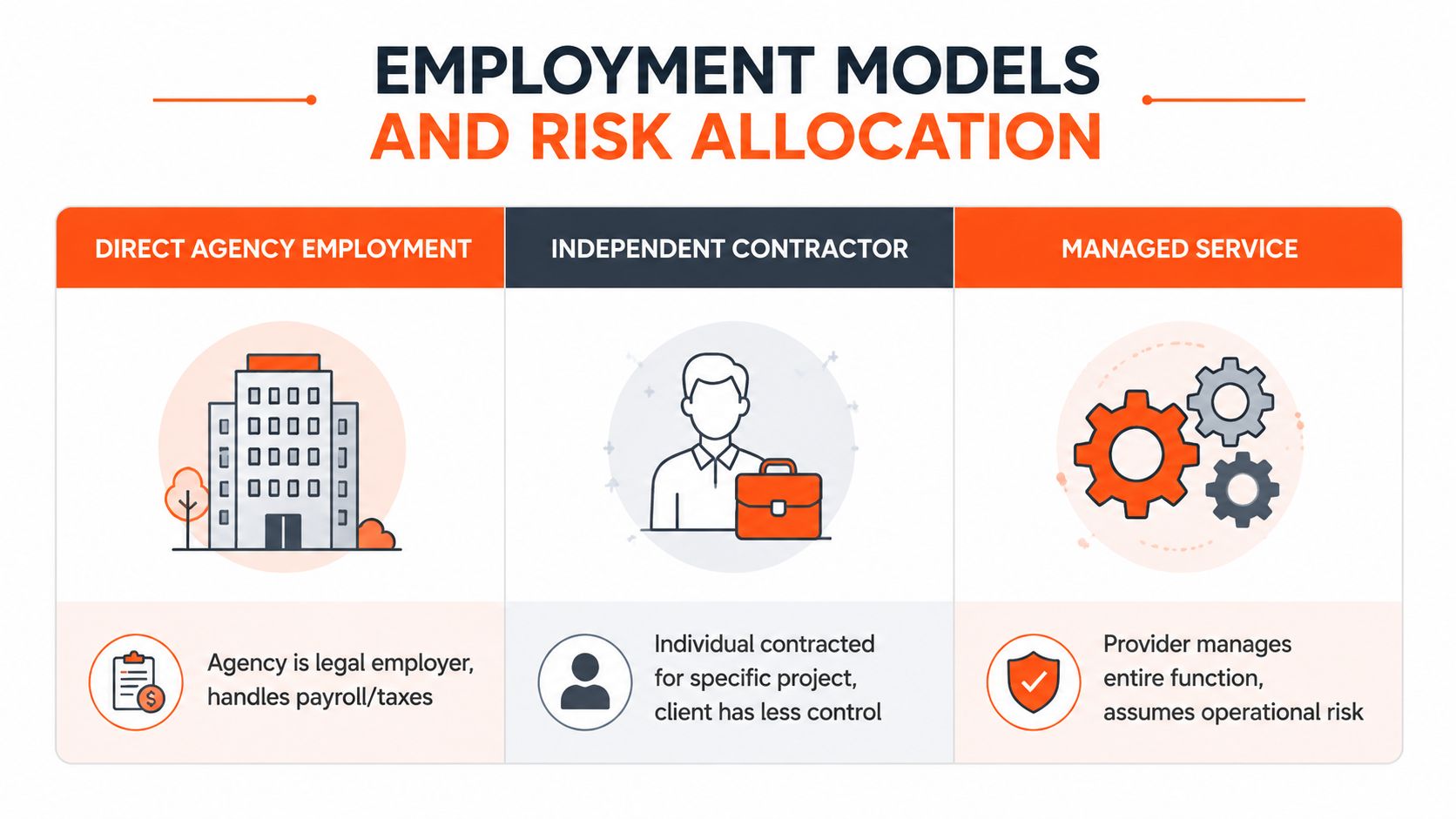
Under direct agency employment, the agency is the legal employer or otherwise retains the formal employment relationship. The agency typically handles wage calculations, tax withholding, payroll administration, benefits administration, and statutory compliance. The client directs day-to-day work and role requirements.
That split must appear in the contract. The client can set priorities and evaluate deliverables, while the agency manages employment administration, payroll records, statutory obligations, and formal employment actions. The agreement should also state who handles leave administration, complaints, workplace incidents, and required notices.
A contractor model can be appropriate for independent work, but the label alone doesn't establish independence. The contract should address project control, methods, opportunity for profit or loss, invoicing, tools, exclusivity, substitution rights where applicable, and the contractor's ability to serve other clients.
A client that requires fixed hours, directs every method, provides all tools, prohibits outside work, and pays like a regular payroll worker may create facts inconsistent with an independent relationship. For a practical reference on the classification questions behind this model, review how to classify a freelance consultant from RNC Group.
In a managed-service model, the provider may manage an entire function, workforce program, or employment administration layer. The contract should identify whether the provider is responsible for recruiting, supervision, payroll, compliance, performance management, and replacement, or only for selected functions.
| Model | Legal and administrative lead | Client control | Main drafting priority |
|---|---|---|---|
| Direct agency employment | Agency handles employment administration | Client directs daily work | Separate supervision from legal employment |
| Independent contractor | Contractor handles independent business obligations | Client controls defined deliverables | Preserve genuine independence in practice |
| Managed service | Provider manages agreed function or employment layer | Client governs outcomes and priorities | Define service levels, escalation, and risk ownership |
The operating contract should allocate legal employment, supervision, invoicing, and risk ownership in separate clauses. A client that assumes the agency handles compliance while independently engaging and paying the worker has created a gap. A provider that accepts employment responsibility but refuses to maintain records has created another.
For startups that need a simpler commercial structure, the zero-fee model, with no placement or recruitment fees, can be evaluated alongside the legal and operational terms, not instead of them. What a managed provider actually carries under that structure — sourcing, vetting, contracts, payroll in the professional's country, HR and compliance — is set out on our remote staffing services page, and it is worth reading beside the clause list above so you can check that the contract allocates everything the service description promises.
Worker classification is the most volatile part of a cross-border staffing company contract. Generic language fails because regulators assess the relationship in practice, not only the title printed above the signature line.
Reporting on U.S. rulemaking describes a 2026 proposed rule revisiting independent-contractor classification, with the core test again emphasizing control and opportunity for profit or loss, according to Everee's coverage of 2026 worker-classification rules. Rulemaking of this kind moves quickly and can change between proposal and final rule, so confirm the current status with counsel rather than relying on a secondary summary. Either way, the direction of travel makes old templates especially weak for remote and nearshore teams.
Start with a classification schedule that identifies the intended model and the facts supporting it. Then align the operating rules with that model:
Supervision practices matter as much as contract wording. A clause describing an independent contractor won't protect a client if managers control every task, schedule, and method as though the worker were part of the client's internal payroll.
Mexico requires providers of specialized services or specialized works to register with REPSE, the registry run by Mexico's Secretaría del Trabajo y Previsión Social (STPS) and created by the April 2021 subcontracting reform to the Federal Labor Law; the STPS published the registry's general provisions in the Diario Oficial de la Federación the following month. Mexico's framework can also treat a contractor as an employee when the worker is economically dependent on one company, works exclusively for it, and performs core business activities. For a practitioner walkthrough of how those rules land on a remote hire, see Remotely Works' LATAM contractor compliance guide.
The contract should therefore identify the provider's registration and compliance responsibility, the service category, the client's supervision limits, and the records each party must maintain. Don't assume that a U.S. contract can be translated and reused without a country schedule.
For a broader legal perspective, buyers can consult this classification guide for LA employers from Lerner & Weiss APC. A contract should also link compliance failure to a clear remedy, including cooperation duties, notice of investigations, record access, and responsibility for penalties caused by a party's breach.
Use our global payroll compliance guide to pressure-test payroll, withholding, records, and country-specific administration before approving the final draft.
Termination clauses reveal whether a staffing contract is flexible or merely flexible for one side. Clients often assume they can end an assignment immediately. Providers may still owe notice, payroll administration, continuity support, or offboarding work under local rules and the commercial agreement.
Public staffing terms show that notice can vary sharply by contract length. One major temporary staffing provider uses 2 weeks, 1 month, or 3 months of notice depending on order duration, as shown in Adecco's staffing terms. That range is a warning against using one universal notice period for every role and jurisdiction.
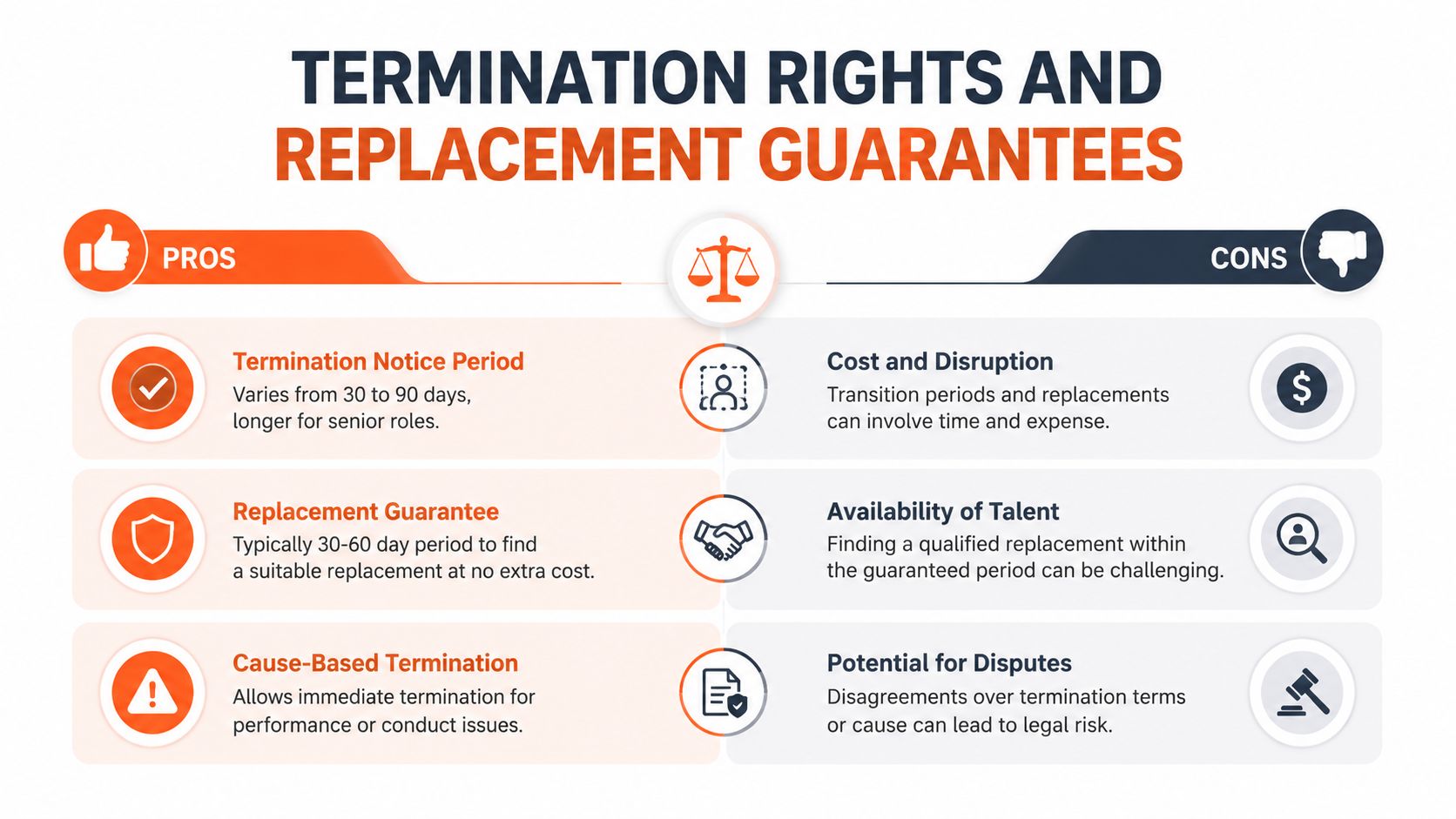
A complete termination clause should distinguish among:
The cost of an unprotected departure isn't limited to recruiting. It includes lost output, manager time, knowledge transfer, access removal, re-onboarding, and the delay before a replacement becomes productive. A contract can't eliminate those costs, but it can decide whether the provider must supply a replacement, whether the client pays another placement charge, and how quickly the process starts.
Replacement guarantees commonly promise that if a placed candidate leaves within a defined period, the agency will provide a replacement at no additional fee rather than issue a refund. Typical windows are often around 60 to 90 days, according to Contractable's staffing-agency service agreement guide.
Define what “replacement” means. Require a qualified candidate, set a response and shortlist process, clarify whether the guarantee applies to resignation and performance termination, and state whether the original role, rate, and scope must remain unchanged. A guarantee with no time cap is materially different from a 60-day window, so don't treat both as generic “replacement protection.” For comparison, Virtustant's replacement guarantee carries no time cap, which means a placement that fails in month nine is still the provider's to fix rather than the client's to re-hire.
Before signing, ask for a written transition plan. Include access removal, documentation transfer, client communication, final invoice timing, and the handoff of work in progress. Then compare managed staffing against traditional recruiting based on who manages the assignment after placement.
Negotiation should focus on risk concentration, not on winning every sentence. The clauses with the highest impact are liability, IP ownership, data handling, rate changes, termination, and replacement. Push hardest where a vague term could create an open-ended obligation.
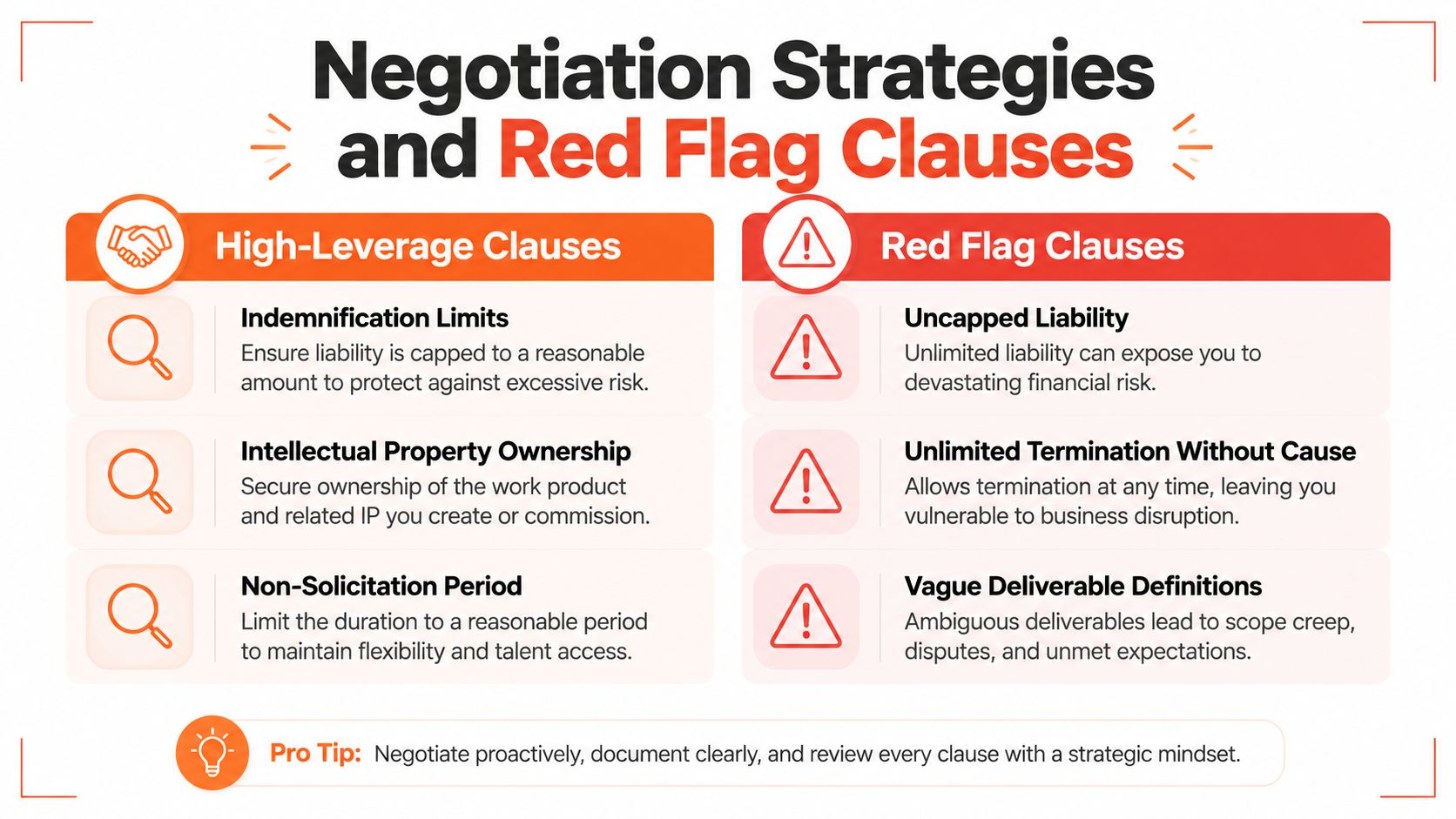
First, remove ambiguity. Replace “qualified personnel” with defined roles, skills, capacity, geography, schedule, and deliverables. Replace “promptly” with a response obligation tied to a stated business process.
Second, cap financial exposure. Ask for a fee cap, written approval for pass-through costs, a rate-change mechanism, and a defined invoice-dispute window. Liability caps should have carefully negotiated exceptions for confidentiality, IP infringement, fraud, willful misconduct, and legally non-limitable obligations.
Third, protect ownership and information. The client should receive rights to work product created for the engagement, subject to clearly identified provider or worker pre-existing materials. Confidentiality, security controls, access termination, breach notice, and data return should be mutual and specific.
Fourth, make exit rights symmetrical. A provider shouldn't be able to terminate without cause immediately while the client owes extended payment obligations. The agreement should address notice, cure periods, transition assistance, replacement, and final reconciliation.
Watch for these red flags:
For a related review of service-provider agreements, find PEO contract red flags from PEO Metrics. When evaluating providers, compare remote staffing agencies against the same risk matrix rather than choosing on rate alone.
Use a yes-or-no review before signing any staffing company contract. If an answer is “not sure,” treat it as unresolved.
Standard terms can work for a simple, domestic, low-risk placement with a clearly defined scope. Bring counsel into the review when the arrangement is cross-border, involves sensitive data, uses independent-contractor language, includes unusual indemnities, or creates material exposure through long notice periods and termination payments.
For U.S. founders and operations leaders hiring in LATAM, the strongest contract is usually the one that reduces handoffs. An all-in managed structure can combine sourcing, vetting, placement, contracts, payroll, HR administration, compliance, account management, and replacement into one operating relationship. Review the managed remote staffing service model, then verify every promise in the agreement.
Six areas need to be visible: scope, role, duration, commercial terms, governance and exit rights. Scope separates the provider's delivery obligations from the client's obligations. Role covers reporting lines, schedule and change control. Duration states the term, renewal and notice. Commercial terms let you calculate a full invoice unaided. Governance names the escalation path. Exit rights cover termination, transition and replacement. If any one of those is missing, the contract is incomplete no matter how polished it reads.
It depends on the model. Under direct agency employment the agency holds the formal employment relationship and handles payroll, withholding and statutory compliance while the client directs daily work. In an independent contractor engagement the worker carries their own business obligations. In a managed service the provider runs an agreed function or employment layer. The contract should allocate legal employment, supervision, invoicing and risk ownership in separate clauses, because assuming one of them covers the others is how gaps appear.
Yes. LATAM's main business centers sit between UTC-3 and UTC-6, within 0 to 3 hours of U.S. Eastern Time, which is why a nearshore professional can share six to eight business hours with a U.S. team. But geography only makes the overlap possible; it does not make it owed. Put the required window in the role schedule and, where response times matter, in the service levels, so the obligation survives a change of professional.
Typical windows run 60 to 90 days, but the window matters less than the definition. Require a qualified candidate, a stated response and shortlist process, clarity on whether resignation and performance termination both qualify, and confirmation that the original role, rate and scope stay unchanged. A guarantee with no time cap, such as Virtustant's, is a materially different product from a 60-day window, so compare the terms rather than the label.
Uncapped liability for ordinary operational mistakes, unlimited unilateral termination by the provider, deliverables described only as “support,” indemnification for losses a party did not cause, hidden conversion fees for hiring a worker directly, and permanent non-solicitation clauses that block normal hiring. Each one converts a vague sentence into an open-ended obligation, usually the buyer's.
Usually yes. A U.S. template translated into Spanish is not a country schedule. Mexico, for example, requires providers of specialized services or works to register with REPSE, the registry run by the Secretaría del Trabajo y Previsión Social under the April 2021 subcontracting reform to the Federal Labor Law, and its framework can treat a contractor as an employee where the worker is economically dependent on one company, works exclusively for it and performs core business activities. Assign registration, payroll duties, records and supervision limits country by country.
Convert both to an annual number on the same assumptions. A $7 per hour all-in nearshore rate at 40 hours a week across 52 weeks is $14,560 before any agreed exclusions. Compare that with a U.S. hire's market salary plus employer-side payroll, benefits, equipment, recruiting and administration, not salary alone, and ask what obligations remain outside the rate.
Standard terms can be fine for a simple domestic placement with a tight scope. Bring counsel in when the arrangement crosses a border, touches sensitive data, uses independent-contractor language, contains unusual indemnities, or creates real exposure through long notice periods and termination payments. This guide is operational, not legal advice.
Virtustant connects U.S. companies with vetted remote professionals across LATAM and handles contracts, local payroll, HR administration, and compliance under a consolidated all-in hourly rate. Visit Virtustant to evaluate a nearshore staffing arrangement built around clearer risk allocation and ongoing operational support.