HR Compliance Requirements for Hiring Contractors in Latin America (2026)
October 5, 2026


Hiring contractors in Latin America comes down to three HR compliance requirements: classify the relationship on its facts, follow the rules of the country where the person works, and document who pays, files and keeps records. The U.S. Department of Labor's Fact Sheet #13 weighs six factors and says what a worker is called "is not relevant." And under 29 U.S.C. § 213(f), the FLSA's core wage-and-hour rules don't apply to work performed in a foreign country.
This guide is general information for U.S. buyers, not legal or tax advice. Rules change and turn on your specific facts, so confirm your setup with local counsel in each country and with your CPA.
Below you'll find what the U.S. side actually requires, where our own hires live (the country layer you'll face), a Who-Carries-What Matrix for the four common engagement models, a seven-step workflow, the 2026 rule changes worth tracking, and the questions to ask any provider before you sign.
Start with the U.S. side. It's where most buyers start, and it's narrower than many expect once the person works outside the United States.
Classification is your call. The Department of Labor's DOL worker classification guidance states that "Employers are responsible for determining whether a worker is an employee under the FLSA." The same page warns that misclassified employees may not receive the minimum wage and overtime pay they're entitled to, or other benefits and protections the law gives them.
The test is economic reality, not the label. Fact Sheet #13 asks whether the worker is "economically dependent on the employer for work" or "in business for themself." It also says that signing an independent contractor agreement or receiving a 1099 doesn't by itself make someone a contractor. The fact sheet reflects the March 2024 rule, which it notes is the subject of current litigation, and points to Field Assistance Bulletin 2025-1 (May 1, 2025) for the Wage and Hour Division's enforcement position.
Here are the six factors, with the plain-English question (our paraphrase) and what a red flag looks like in a remote setup:
| DOL factor (Fact Sheet #13) | Plain-English question | Red flag in a remote engagement |
|---|---|---|
| 1. Opportunity for profit or loss depending on managerial skill | Can the worker change their own results through business decisions? | A fixed hourly rate with no way to grow or lose money |
| 2. Investments by the worker and the employer | Does the worker invest in their own business, or do you supply everything? | You supply the laptop, the company email address and the software licenses |
| 3. Permanence of the work relationship | Is the engagement open-ended and continuous? | Full-time, no end date, renewed automatically |
| 4. Nature and degree of control | Who sets the schedule and how the work gets done? | Fixed U.S. hours and required daily internal stand-ups |
| 5. Whether the work is integral to the employer's business | Is this a core daily function of your company? | They run your inbox, pipeline or support queue every day |
| 6. Skill and initiative | Do they use skill the way an independent business would? | They follow your SOPs exactly like a team member |
The red flags in the last column aren't only our reading. Vetty's remote worker hiring compliance guidance names the same U.S. warning signs: dictating working hours, requiring contractors to attend daily internal stand-up meetings, and supplying company laptops, email addresses and software licenses.
Work performed abroad sits mostly outside the FLSA. 29 U.S.C. § 213(f) says the FLSA's minimum wage, overtime, recordkeeping and child labor provisions (sections 206, 207, 211 and 212) "shall not apply" to anyone whose services during the workweek are performed in a workplace within a foreign country. That doesn't make the engagement rule-free. It moves the questions that matter most to the country where the person works, and those are questions for local counsel.
Tax paperwork still starts on your side. The IRS page on Form W-8 BEN says a foreign person gives the form "to the withholding agent or payer" and should submit it when requested "whether or not you are claiming a reduced rate of, or exemption from, withholding." If you pay a contractor directly, you are the payer in that sentence, so ask your CPA what to collect and keep on file. Our guide to paying international contractors covers the payment rails and the paperwork that travels with them.
A U.S. buyer rarely hires "in Latin America." You hire in Argentina, Brazil, Mexico or Colombia, and each country has its own contracts, contributions, holidays and termination rules. Our own records show how quickly that spreads.
Virtustant first-party data. On October 5, 2026, we read the candidate profiles marked "Hired" in Virtustant's recruiting database that have a country of residence on file: 449 profiles. It's a snapshot of where hired candidates live, not a count of placements.
| Country of residence | Hired-status profiles | Share of 449 |
|---|---|---|
| Argentina | 107 | 23.8% |
| Brazil | 77 | 17.1% |
| Mexico | 42 | 9.4% |
| Colombia | 39 | 8.7% |
| Venezuela | 16 | 3.6% |
| Ecuador | 14 | 3.1% |
| Peru | 12 | 2.7% |
| Chile, Uruguay, Paraguay and Bolivia (combined) | 23 | 5.1% |
| Central America, the Caribbean, Guyana and Suriname (combined) | 74 | 16.5% |
| United States and Canada | 1 | 0.2% |
| Outside the Americas (combined) | 44 | 9.8% |
| Total with a mapped country | 449 | 100% |
Three things stand out:
How to read this: it's a status snapshot, not a count of placement starts. "Hired" status can include people whose placement has since ended, and country is self-reported at sign-up. It describes where our talent lives, not where any law applies.
Every cross-border engagement carries the same obligations. What changes from one model to the next is who carries each one. The Who-Carries-What Matrix is our framework for making that visible before you sign anything.
We mark a cell only where the model itself settles the answer. An EOR, by definition, is the legal employer in the worker's country, so local payroll sits with it. Where the answer turns on a contract or on the facts, the cell says "ask." Each "ask" cell is a question to get answered in writing.
| Obligation | Direct contractor | Employer of record (EOR) | Remote staffing agency | Freelance marketplace |
|---|---|---|---|---|
| 1. Find and vet the person | You | You (usually; ask if sourcing is offered) | Provider | You |
| 2. Decide whether the relationship is genuinely independent | You | Provider (the EOR employs the person) | Depends on contract, ask | You |
| 3. Sign the contract with the worker | You | Provider (local employment contract) | Depends on contract, ask | Depends on platform terms, ask |
| 4. Pay the worker across borders | You | Provider | Provider (you pay the agency) | Provider (platform processes payment) |
| 5. Collect tax forms such as W-8 BEN | You (as payer) | Provider (local payroll paperwork) | Depends on contract, ask | Depends on platform, ask |
| 6. Local social contributions and statutory benefits | Depends on the facts, ask counsel | Provider (as legal employer) | Depends on contract, ask | Depends on the facts, ask counsel |
| 7. Direct the day-to-day work | You | You | You | You |
| 8. Replace the person if they leave | You | You | Depends on guarantee terms, ask | You |
| 9. Keep the records | You | Split, ask | Split, ask | Split, ask |
| "You" cells / "ask" cells | 8 / 1 | 3 / 1 | 1 / 6 | 4 / 4 |
The arithmetic. Count the "You" cells to see how much you keep, and the "ask" cells to see how much is still unknown:
A low "You" count isn't the same as low risk. The agency column looks light only once all six "ask" cells have written answers. That's why the provider checklist further down is built from these exact rows. For a deeper side-by-side of a staffing agency against an EOR platform, see our staffing agency vs EOR platform comparison.
Compliance starts before a candidate gets an offer. The workflow below makes the engagement model a decision point, not a detail someone fills in after selection.
Most companies have the documents. Fewer can show the process works. HR.com's survey of 207 HR professionals (July to October 2023) found that 86% of organizations had established some sort of compliance process, but only a third had a highly mature system with clearly mapped processes that employees understand well (HR compliance maturity research). To find the gap in your own setup, score it against our remote hiring maturity model, and see our candidate vetting process for the assessment side of the record.
Country rules move. Ogletree Deakins, an employment law firm, flagged several 2026 changes in its roundup of global employment law updates for 2026. Three matter for a U.S. company hiring in the region, and one matters for anyone using AI to screen candidates.
Two cautions. The roundup doesn't cover Argentina, Colombia or Chile, so silence there isn't a sign nothing changed. And these rules bind whoever employs people in that country, which is exactly the matrix question: if you engage directly, ask counsel whether any of it reaches you; if a provider employs or engages the person, ask the provider how it's handled.
If you use AI tools to screen applicants, document which tool scores or ranks candidates, who reviews its output, and why a candidate was rejected. That record helps wherever disclosure rules apply.
Price comparisons go wrong when buyers compare a rate to a fee without asking what each covers. Here are the four fee categories you'll run into, described as categories rather than vendors:
| Fee model | How you're charged | What it usually pays for | What to confirm |
|---|---|---|---|
| Placement fee | A one-time charge when a candidate is hired | Sourcing and screening up to the hire | What happens if the hire leaves early, and who handles payroll after day one |
| Markup on the hourly rate | An hourly bill rate that includes the provider's share | Varies: sourcing, payroll, admin and replacement may or may not be in it | Which matrix rows the rate covers, in writing |
| EOR monthly fee | A fee per worker per month on top of their pay | Local employment, payroll and statutory administration | Whether sourcing and vetting are included or left to you |
| Marketplace service fee | A percentage on payments made through the platform | Profiles, contracts tooling and payment processing | Who classifies the worker and who replaces them |
Map each quote back to the Who-Carries-What Matrix. A lower visible fee that leaves five "You" cells on your side isn't cheaper once you count the internal time, legal review and payroll work you take on.
For reference, Virtustant's terms are public: zero placement fees, month-to-month, one weekly invoice per placement, and virtual assistants from $7/hr all-in. As evidence of where rates land, the median client-side rate for a virtual assistant in Virtustant's H1 2026 placement data (441 starts, January to June 2026) was $10.10/hr (n=24), per our 2026 rate report. How we make money is simple: if you pay your agent $10/hr, we give them $9 and keep the dollar in the middle. Every role's starting price is on our pricing page.
Use these questions with any provider, including us. Each one maps to a row of the matrix, so a complete set of written answers closes every "ask" cell.
Our short video walks through more of these questions:
Video: How to Choose a Remote Staffing Agency: 8 Questions to Ask First (Virtustant).
Virtustant is a remote staffing agency. We recruit and vet remote professionals, mostly in Latin America, and place them with U.S. companies. You direct the day-to-day work, and Virtustant handles payroll, paperwork and everything administrative on the professional's side. We're not an employer of record, and nothing here is a promise about how any law applies to your situation. Here's how our model fills in the matrix rows:
| Matrix row | With Virtustant |
|---|---|
| Find and vet the person | Virtustant: a shortlist of 3 to 5 vetted candidates within 48 hours of your first call |
| Pay the worker and handle the paperwork | Virtustant handles payroll, paperwork and everything administrative on the professional's side |
| How you're billed | One weekly invoice per placement, month-to-month, zero placement fees |
| Direct the day-to-day work | You |
| Onboarding | Your account manager coordinates the start date, tools access and the first-week plan, and we follow up during the first weeks |
| Replace the person if they leave | Virtustant, under a lifetime replacement guarantee with no time cap |
| Classification and local obligations for your specific engagement | Ask on the discovery call and get the answer in writing |
Vetting. "Top 1%" has a specific meaning here: 100% of applicants apply, 22% pass the recruiter screen, 9% pass skills and English testing, 3% reach a live interview, and 1% are hired. Every candidate on your shortlist has been through that funnel.
Speed. Shortlist in 48 hours. Start in 72 hours. You get a shortlist of 3 to 5 vetted candidates within 48 hours of your first call, and your hire can start in 72 hours.
We've made 2,000+ placements for 1,000+ US companies, and clients rate us 4.9/5 on G2 (70 reviews). If you're still deciding between models, start with what remote staffing is, then browse the roles we place. When you're ready, see how Virtustant works and book a discovery call to bring the matrix questions with you.
Mostly not. Under 29 U.S.C. § 213(f), the FLSA's minimum wage, overtime, recordkeeping and child labor provisions don't apply to anyone whose services during the workweek are performed in a workplace within a foreign country. The rules of the country where the person works then matter most, so confirm them with local counsel.
DOL Fact Sheet #13 asks whether the worker is economically dependent on the employer or in business for themself, using six factors: profit or loss opportunity, investments, permanence, control, whether the work is integral, and skill and initiative. It says what the worker is called is not relevant.
For FLSA purposes, the DOL says employers are responsible for determining whether a worker is an employee. If you engage a contractor directly, that call sits with you. If an EOR or a staffing agency is involved, ask in writing who makes it and under which country's law.
The IRS says a foreign person gives Form W-8 BEN to the withholding agent or payer, and should submit it when requested whether or not they claim a reduced rate or exemption. If you pay the contractor directly, you are the payer, so ask your CPA what to collect and keep on file.
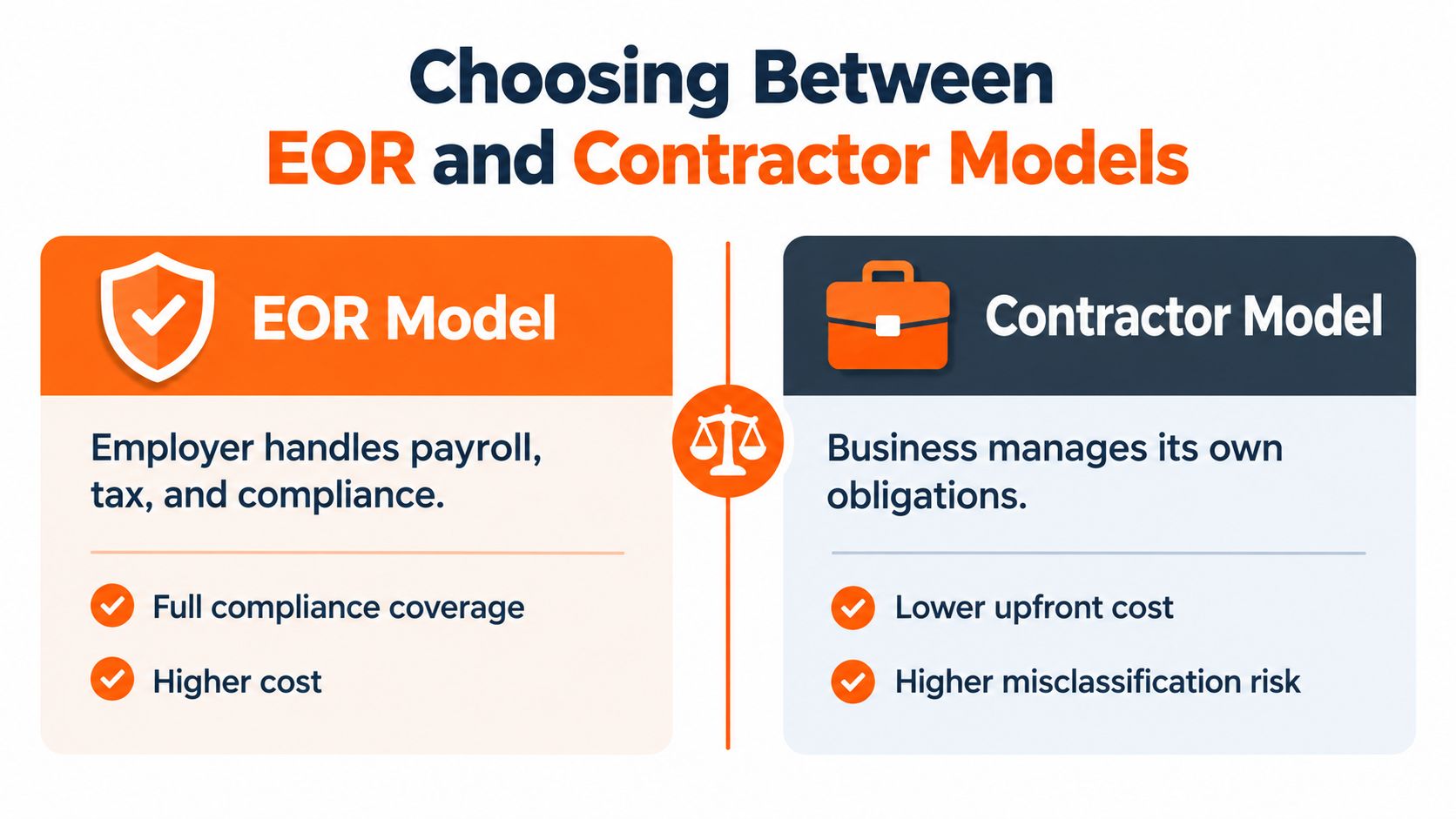
An EOR becomes the legal employer in the worker's country and runs local payroll, usually for a person you already found, for a monthly fee per worker. A remote staffing agency recruits and vets the person for you, and what it carries beyond that depends on its contract, so ask.
No. Virtustant is a remote staffing agency. We recruit and vet remote professionals, you direct the day-to-day work, and we handle payroll, paperwork and everything administrative on the professional's side, billed as one weekly invoice per placement, month-to-month, with zero placement fees.
You get a shortlist of 3 to 5 vetted candidates within 48 hours of your first call, and your hire can start in 72 hours.
Ogletree Deakins flags Mexico's constitutional reform cutting the standard workweek from 48 to 40 hours without wage cuts, phased in through 2030, and Brazil's updated NR-1, with formal enforcement of its psychosocial risk rules set to start on May 26, 2026. Ask whoever employs your hire how they handle both.