Differences Between Outsourcing and Offshoring Explained
September 9, 2026


The popular advice is wrong: outsourcing and offshoring aren't competing choices. Outsourcing answers who runs the work, while offshoring answers where the work is performed. For most U.S. SMBs hiring people for live collaboration, the practical decision is often a third model, nearshore managed staffing, not a forced choice between a domestic vendor and a distant offshore operation.
The usual comparison starts with the wrong question. Outsourcing and offshoring are independent choices: outsourcing defines who runs the work, while offshoring defines where the work happens. The OECD makes the same split explicit in Offshoring, Reshoring, and the Evolving Geography of Jobs (Social, Employment and Migration Working Paper No. 308, 2024): "Offshoring is sometimes confused with outsourcing, but these are not the same thing. Outsourcing refers to contracting out a specific part of business operations to a third party." Its framework separates location, abroad or domestic, from ownership, third party or in-house, with offshore outsourcing sitting where the two overlap. A company can outsource to a domestic agency, move work to its own foreign operation, or combine both through offshore outsourcing.
That matters because founders are deciding more than a vendor location. They are setting managerial control, time-zone overlap, employment administration, compliance responsibility, and the way work enters the business. A finished service from a vendor requires a different operating model from a dedicated professional who works inside the founder's daily workflow.
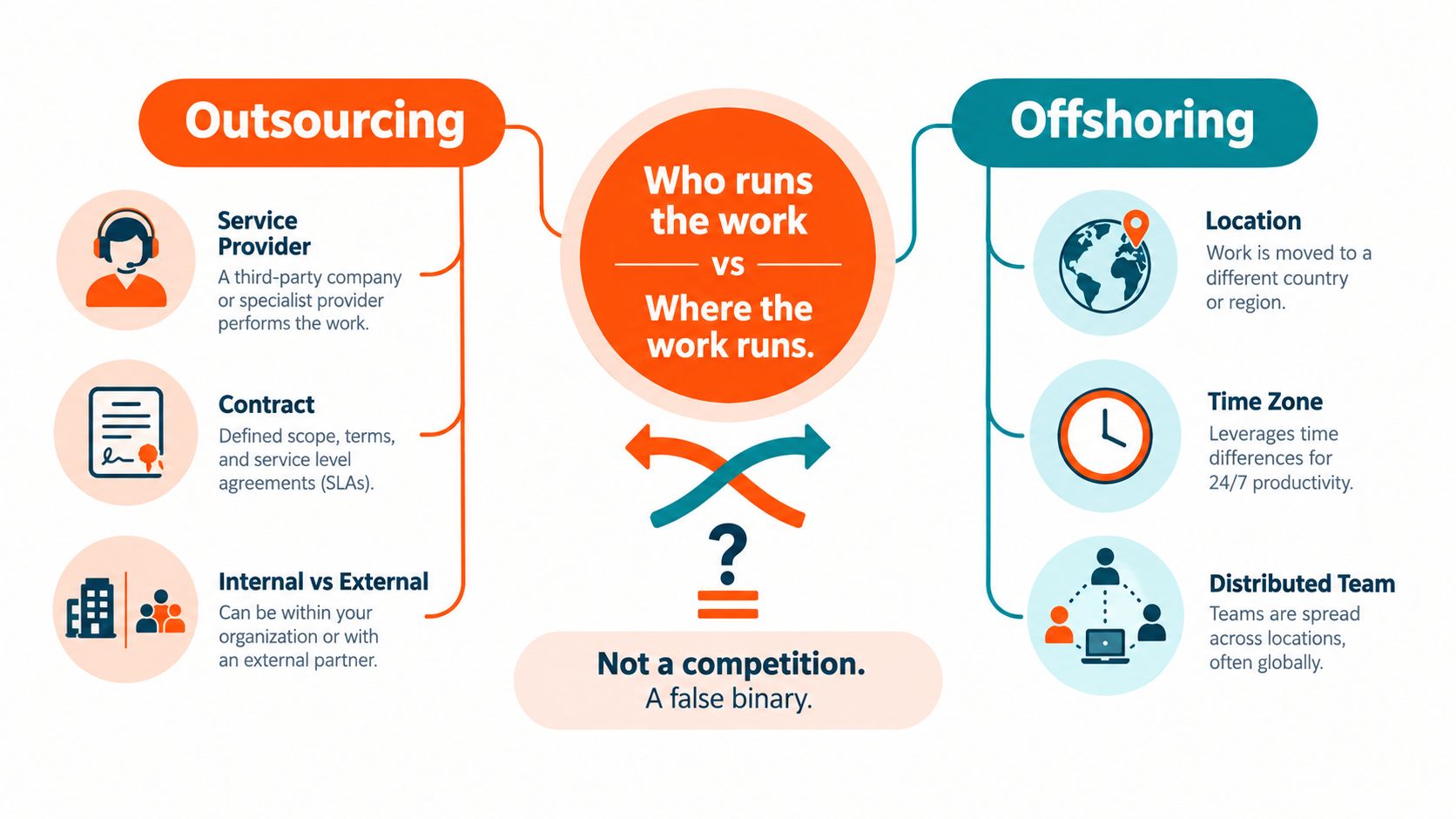
Ask who owns the workday:
Then ask where the work is performed:
These choices create four valid configurations. Domestic outsourcing places a function with a U.S. agency. Offshore outsourcing assigns it to a foreign provider. Internal offshoring means your company operates a foreign subsidiary or direct team. Domestic insourcing keeps the function with your existing U.S. staff.
The guide to outsourcing helps assess the provider relationship, not the geography. A third-party vendor may operate near headquarters or on another continent.
A founder choosing only between outsourcing and offshoring may overlook nearshore managed staffing: a dedicated remote professional in a nearby country, with a staffing partner handling contracts, payroll, and compliance while the founder manages daily priorities.
For U.S. SMBs running real-time knowledge work, this model often fits the operating need better than a domestic vendor or distant BPO. It combines external administrative support with internal control over the workday, communication, and standards. The available choices include domestic vendors, offshore BPO, nearshore staffing, and hybrid teams. For more context on motivations and trade-offs, see the business case for outsourcing.
Operator rule: Decide who must own the workday before deciding where the worker should sit.
Treat outsourcing and offshoring as separate decisions. Outsourcing answers who runs the work. Offshoring answers where the work sits. Combining those axes produces four valid configurations.
| Configuration | Who Runs It | Where It Sits | Example |
|---|---|---|---|
| Internal domestic team | Your managers and internal function | United States | A U.S. SaaS company hires a customer success lead who works with its existing team |
| Outsourced domestic work | A U.S. agency or vendor | United States | An e-commerce brand contracts a domestic contact center for overflow support |
| Internally managed offshore operation | Your company | Foreign country | A U.S. company operates its own development team through a foreign subsidiary or local employment structure |
| Offshore outsourcing | A foreign provider | Foreign country | A U.S. company contracts a BPO to process support tickets or data-entry work |
The third row is the distinction most comparisons miss, and missing it produces a specific error: the claim that outsourcing means low control and offshoring means high control. That is only true if you assume offshoring is always internally managed and outsourcing never is. Control is set by the ownership axis, not the location axis, which is why a domestic vendor can leave you with less day-to-day direction than a nearshore professional working inside your own tools. Offshoring doesn't require outsourcing. A company can place work in another country and keep direct management responsibility. It must then handle local recruiting, employment, tax, labor-law, and infrastructure obligations. The OECD definitions place offshoring within a longer shift from manufacturing relocation to IT tasks and knowledge-intensive functions.
The second row establishes the reverse. Outsourcing doesn't require offshoring. A domestic agency can perform the work entirely inside the United States. The company transfers execution to an external provider while keeping the delivery team domestic.
Offshore outsourcing combines both decisions: a foreign third party performs the function. This can reduce the buyer's direct hiring workload, while creating less visibility into daily execution. A project-based vendor may own delivery end to end. A managed staffing arrangement can instead provide a dedicated remote professional who works within the client's routines.
That difference matches how Virtustant defines staff augmentation. The buyer keeps more day-to-day direction than it would with a conventional outcome-based vendor, while the staffing partner handles the employment relationship.
Nearshore managed staffing adds a practical fifth configuration. The worker operates from a nearby country, and the staffing partner manages cross-border administration. The founder sets priorities, reviews work, and manages performance. The provider handles contracts, payroll, and compliance.
For U.S. SMBs running real-time knowledge work, that division often matters more than the label. Choose the model based on who must control the workday, then evaluate geography for collaboration and administration.
The cleanest comparison separates commercial control, geography, and operating friction. “Outsourcing” alone isn't enough information because the vendor may be domestic or foreign. The table below uses domestic outsourcing as the baseline, then compares it with distant offshore delivery and nearshore LATAM staffing.
| Dimension | Outsourcing, domestic vendor | Offshoring, such as India or the Philippines | Nearshoring, LATAM |
|---|---|---|---|
| Cost profile | Usually higher than foreign delivery because the vendor operates in the U.S. | Often strongest on raw labor cost | Can reduce total labor cost while keeping closer collaboration |
| Control | Vendor controls staffing and delivery process | Buyer may control an internal foreign team, or a vendor may control delivery | Client can direct a dedicated remote professional while the staffing partner handles administration |
| Compliance | Primarily domestic vendor and contract review | Foreign labor, tax, data, and regulatory obligations can apply | Local contracts, payroll, and labor compliance still matter, but a managed provider can carry those tasks |
| Time-zone overlap | Usually full U.S. business-day overlap | Depends on location and shift design, with wider coordination gaps common | Often aligns closely with U.S. working hours |
| Cultural fit | Typically easiest for U.S.-facing work | Requires deliberate communication and process design | Often supports same-day communication and U.S.-oriented customer interaction |
| Best fit | Defined projects, domestic expertise, or sensitive workflows | Asynchronous, high-volume, or shift-based work | Real-time knowledge work and dedicated team integration |
Pure offshoring can win on quoted labor cost, particularly when the work is repetitive, asynchronous, or scheduled outside U.S. hours. It loses its advantage when a product manager waits overnight for clarification, a customer escalation crosses multiple handoffs, or a security review requires unfamiliar local processes.
Nearshoring isn't automatically superior. A distant offshore team can be the correct answer for a night-shift queue, and a domestic vendor can be the right answer for a short, tightly specified project. Nearshore staffing earns its place when the role depends on frequent judgment, immediate feedback, and a worker who functions as part of the operating team.
Cross-border staffing may involve local employment, tax, and labor-law handling. A U.S. buyer may still want one vendor relationship and one consolidated invoice, which is why managed nearshore arrangements commonly bundle contracts, payroll, and compliance rather than leaving each step to the founder. The operational mechanics are outlined in this comparison of Virtustant on nearshore models.
Don't compare a U.S. salary with a foreign hourly rate and call the difference savings. Compare the landed operating cost, including management time, security controls, coordination, rework, and compliance administration.
Nearshore LATAM staffing isn't merely a compromise between expensive domestic hiring and distant offshore labor. For U.S. SMBs running real-time knowledge work, it often fits the operating problem better than either alternative.
The first advantage is the clock. LATAM locations offer varying degrees of overlap with U.S. business hours. Mexico's Pacific Time and much of Central America share or closely overlap U.S. business hours, while Colombia and Peru are one hour ahead of U.S. Eastern Time. Argentina and Chile are typically several hours ahead, so the exact country still matters. These geographic differences affect whether a California project manager and a Bogotá engineer can pair on a blocker during the same workday, rather than exchange messages across a sleeping window. See the regional time-zone discussion from Penbrothers.
A dedicated nearshore professional can join Slack standups, review a customer issue, update a CRM, and resolve an ambiguous task while the U.S. team is still online. That matters more for RevOps, customer success, sales development, bookkeeping coordination, project management, and software delivery than it does for structured data processing.
English fluency also has a practical dimension. U.S.-facing work requires the worker to understand urgency, tone, implied context, escalation thresholds, and customer expectations. A language test alone doesn't prove that capability. The hiring process should assess written communication, live conversation, role-specific judgment, and references.
| Dimension | Onshore, U.S. | Nearshore, LATAM | Offshore, Asia or distant Europe |
|---|---|---|---|
| Live collaboration | Strong | Strong when location and schedule align | Variable, often requires planned overlap |
| Management distance | Low | Manageable | Higher when the time gap is wide |
| Administrative burden | Familiar domestic processes | Cross-border processes require a capable partner | Cross-border processes and geographic distance add complexity |
| Customer-facing fit | Usually strong | Strong when English and role fluency are validated | Depends heavily on worker, process, and shift design |
| Best operating pattern | Sensitive or highly local work | Integrated knowledge work | Async delivery, volume operations, or follow-the-sun coverage |
The founder doesn't have to choose between direct daily management and handling every foreign employment task. A managed staffing partner can handle contracts, payroll, HR, and compliance while the client sets the worker's priorities and evaluates output.
That model is why U.S. teams should hire nearshore professionals for roles where same-day collaboration is a requirement, not a preference. The decisive question isn't whether a distant market quotes a lower rate. It's whether the role can absorb the coordination pattern that comes with that distance.
The right model depends on latency, volume, regulation, and IP sensitivity. Headline cost should come after those triggers, not before them.

A five-person SaaS startup needs night-shift data entry for U.S. customers. Choose an offshore BPO when the queue is structured, volume is predictable, and customers don't need live judgment from the worker. The trigger is schedule coverage and repeatability, not team integration.
A growth-stage startup is hiring its first RevOps analyst. Choose a dedicated nearshore remote professional when the analyst must join daily Slack standups, maintain pipeline logic, investigate CRM issues, and work directly with the founder or sales leader. The trigger is real-time collaboration and ownership.
A 30-person e-commerce brand needs seasonal customer support overflow. Use a nearshore or onshore contact center when the business needs a trained queue, documented scripts, and flexible capacity during demand spikes. The trigger is volume and service-level coverage. If the work requires brand judgment, prioritize a partner that can train and supervise consistently.
An agency needs a one-off landing-page build. Use an onshore freelancer or domestic project vendor when the scope is clear, the engagement is short, and the buyer wants simple contracting. The trigger is defined deliverables and limited ongoing coordination.
A regulated fintech needs audit-grade bookkeeping under U.S. oversight. Choose onshore or carefully governed nearshore delivery. Don't send sensitive work offshore to a jurisdiction that doesn't satisfy the company's data-residency, access-control, and audit requirements. The trigger is regulatory exposure and data sensitivity, not the lowest quote.
The point is simple: a role can be low-cost and still be expensive to operate if every decision needs a delayed clarification. Conversely, a higher-cost domestic vendor may be wasteful for a repeatable queue that can run independently.
Hiring filter: If the worker must make judgment calls with your team during the day, treat overlap and control as requirements, not perks.
The most misleading offshore comparison uses one visible number, the quoted labor rate, and ignores the management system around it. Coordination gaps, rework, security controls, and compliance tasks can consume much of the apparent advantage in knowledge work.
The cost drag usually appears in five places:
Don't ask, “What does the worker cost per year?” Ask:
Landed cost = provider or labor cost + management time + rework + security controls + compliance administration + replacement and ramp cost.
A hypothetical $40,000 annual offshore role illustrates the problem without pretending to be a universal benchmark. If the role creates substantial coordination, rework, security, and replacement expense, its landed cost can move far above the quoted amount. The exact result depends on the role, process maturity, manager involvement, and provider structure, so a founder should model those inputs rather than borrow a generic multiplier.
The same logic applies to outsourcing. A vendor may remove recruiting and payroll work but introduce scope-management overhead, change-order friction, and less direct visibility. Lower administrative burden doesn't automatically mean lower total cost.
Offshore delivery is strongest when the process is documented, the output is easy to inspect, and the work can proceed asynchronously. It becomes less attractive when the worker handles sensitive data, represents the brand, makes frequent judgment calls, or must resolve issues with a U.S. team in real time.
The smart hiring vs fast hiring LATAM distinction is useful here. Fast hiring focuses on filling a seat. Smart hiring evaluates whether the worker, schedule, management model, and compliance setup will keep producing value after onboarding.
Run every cross-border hiring decision through five filters. Each filter should produce a clear pass or fail, not a vague preference.
Real-time roles need live interaction, rapid escalation, and shared context. Customer success, RevOps, project management, sales development, and many engineering roles usually belong here. Async roles can tolerate written handoffs and delayed feedback, which makes distant offshore delivery more viable.
Write down the minimum daily overlap the role needs. If the answer is four or more hours, a distant location must prove it can reliably cover that window without shifting the burden onto U.S. managers. Nearshore locations generally make this easier because several LATAM markets closely align with U.S. business hours.
Separate basic comprehension from customer-ready communication. A back-office worker processing structured records may need a different standard than a customer success lead handling objections, explaining product behavior, and documenting account risk.
List the data and systems the worker will access. Review employment structure, payroll, labor law, tax handling, privacy obligations, security controls, and audit requirements before signing. Cross-border payroll and compliance aren't minor onboarding details. They determine whether the model is workable.
Set a ceiling for the full operating cost, not just the advertised rate. Include manager time, tools, onboarding, rework, replacement risk, and vendor administration. A model that misses the target after those costs are included isn't economical.
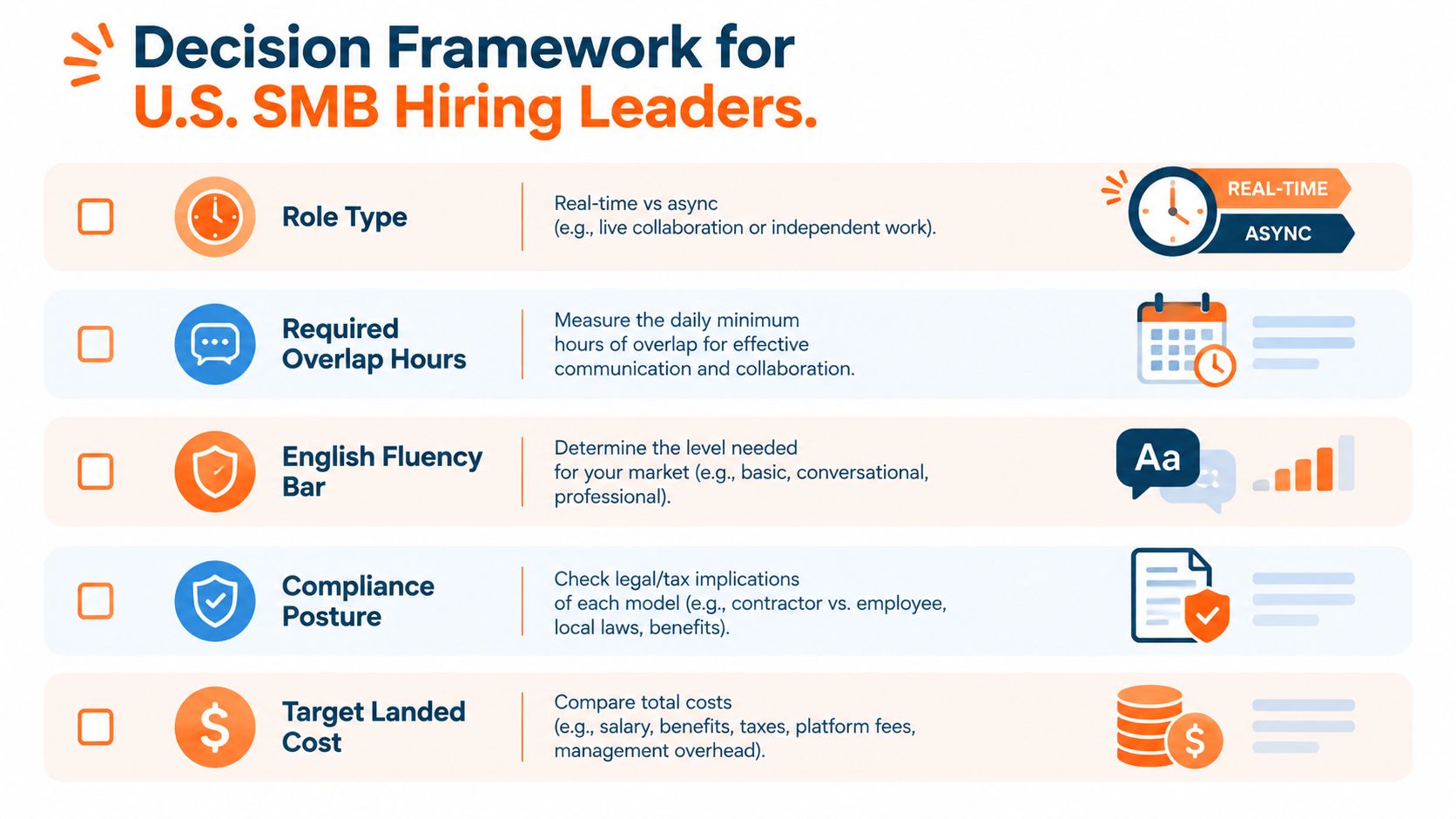
A U.S. SaaS founder hiring a customer success lead should mark real-time for role type, require meaningful daily overlap, set a high English fluency bar, and review access to customer and product data. The founder also needs a worker who can operate inside the company's existing tools and routines, rather than a vendor that returns work through a separate queue.
That combination points to nearshore managed staffing. The client retains daily management, while the staffing partner handles local contracts, payroll, and compliance. If the target landed cost must remain below 60 percent of the fully loaded U.S. cost, the model still has to be evaluated on actual scope and risk rather than assumed savings. The decision is justified when nearshore delivery satisfies the overlap and communication requirements without recreating the full domestic cost structure.
Use this two-question triage:
If the answer to both is yes, nearshore managed staffing is the default model to investigate first. If the role is fully asynchronous and highly repeatable, offshore outsourcing may win. If the work is short, sensitive, or tightly local, domestic outsourcing or an onshore freelancer may be cleaner.
No. They answer different questions and can be used separately or together. Outsourcing is about ownership: whether a third party runs the work or your own team does. Offshoring is about location: whether the work is performed in your country or abroad. A company can outsource domestically, offshore internally through its own foreign operation, or combine both as offshore outsourcing.
Outsourcing answers who runs the work. Offshoring answers where the work is performed. The OECD treats them as two independent dimensions, location and ownership, with offshore outsourcing as the overlap. Treating them as a single either-or choice is what leads founders to miss the configuration that usually fits them best.
Domestic outsourcing: a US e-commerce brand contracts a US contact center for overflow support. Internally managed offshoring: a US company runs its own development team through a foreign subsidiary and manages it directly. Offshore outsourcing: a US company contracts a BPO abroad to process support tickets. Nearshore managed staffing: a dedicated remote professional in Latin America works inside the client's tools while a staffing partner handles contracts, payroll and compliance.
Crossing the two axes gives four: an internal domestic team, outsourced domestic work, an internally managed offshore operation, and offshore outsourcing. Nearshore managed staffing behaves as a practical fifth, because the client directs the workday while the partner carries the cross-border administration.
Control comes from the ownership axis, not the location axis. This is where the usual comparison gets it backwards. An outcome-based vendor, domestic or foreign, controls its own staffing and process. A dedicated professional you direct, whether onshore or nearshore, leaves the workday with you. Distance affects coordination, not authority: a wide time gap makes your control harder to exercise, but it does not transfer it.
Nearshoring is offshoring to a nearby country, so it sits inside offshoring on the location axis. The reason it gets its own name is operational rather than geographic: overlap with the client's working hours. Several Latin American markets align closely with US business hours, which changes whether a blocker gets resolved the same day or waits for the next window.
Yes, outsourcing and offshoring are both lawful business arrangements in the US. What creates exposure is how they are implemented: worker classification, payroll and tax handling, data privacy and residency, industry-specific rules, and access controls. Those obligations depend on the role, the jurisdiction and the data involved, so they should be reviewed with qualified counsel rather than assumed. This is general information, not legal advice.
The label is losing usefulness faster than the practice is declining. What has changed is that buyers increasingly want dedicated capacity they can direct rather than a finished service returned through a separate queue, which is why managed staffing has grown as a distinct category. Outcome-based outsourcing still fits documented, inspectable, asynchronous work.
Use landed cost rather than the quoted rate: provider or labor cost, plus management time, rework, security controls, compliance administration, and replacement and ramp cost. The drag usually shows up in five places: meeting tax from a wide time gap, rework from ambiguous requirements, compliance exposure, turnover drag when process knowledge leaves, and tooling overhead for access and monitoring.
Run two questions. Does the role need four or more hours of live overlap? Does it touch regulated or sensitive data? If both are yes, nearshore managed staffing is the first model to investigate. If the work is fully asynchronous and highly repeatable, offshore outsourcing may win on cost. If it is short, sensitive or tightly local, a domestic vendor or onshore freelancer is usually cleaner.
If the work is documented, inspectable and asynchronous, an outcome-based vendor is a reasonable answer and this framework is your specification for scoping it. If the role needs judgment during your workday, the next step is a shortlist rather than a vendor search.
Virtustant places pre-vetted bilingual professionals across Latin America and carries sourcing, assessment, contracts, payroll, HR and compliance through one vendor relationship, while you direct the work. Bilingual candidates are hired from the top 1% of applicants through a four-stage vetting funnel: a live English screen, a cognitive assessment, a role-specific skills test, and experience and reference verification. Engagements run month-to-month with a lifetime replacement guarantee and no time cap, a first shortlist of 3–5 vetted candidates within 48 hours, and a start in 72 hours. Rates start at $7/hr all-in and zero placement fees, which lets you save up to 70% versus a comparable US hire once payroll, benefits and compliance are counted.
Book a discovery call, check what your role costs, or read how the nearshore staffing model works first.