How to Hire Offshore Employees Without the Usual Headaches
August 10, 2026

You're staring at a hiring board that keeps growing while your U.S. salary quotes keep blowing up the budget. The backfill for one role has already sat open for weeks, resumes are piling up, and the candidates who look good on paper keep disappearing somewhere between the third interview and the offer. That's usually the moment leaders start asking whether offshore employees are a shortcut or the only practical way to keep the team moving.
Offshore hiring is no longer a fringe workaround. A large 2026 market snapshot estimates the offshore development market grew from $45 billion in 2016 to $198.3 billion in 2026, with a projection of $509 billion by 2035. The same source says employers can cut salaries by 40%-70% versus U.S., U.K., or Australian hiring, while total hiring costs can fall by up to 75% and operating expenses by 30%-60%. Independent labor data points in the same direction, with Revelio Labs reporting that offshore worker growth at U.S.-based companies has outpaced onshore growth since 2019, and that the share of employees working abroad at U.S.-based conglomerates is now just over 30%.
The problem isn't whether offshore hiring works. The problem is that most companies treat it like a sourcing trick instead of an operating model. That's where mis-hires, legal exposure, and churn creep in, and that's what this guide is built to avoid.
A founder with three open roles doesn't usually wake up thinking about global labor strategy. They wake up to payroll pressure, a recruiter sending weak candidates, and a sales or support queue that's getting longer because one more U.S. hire would push the budget past what the business can carry. Offshore staffing becomes interesting when those pressures collide with slow local hiring and a market that doesn't deliver enough qualified people fast enough.
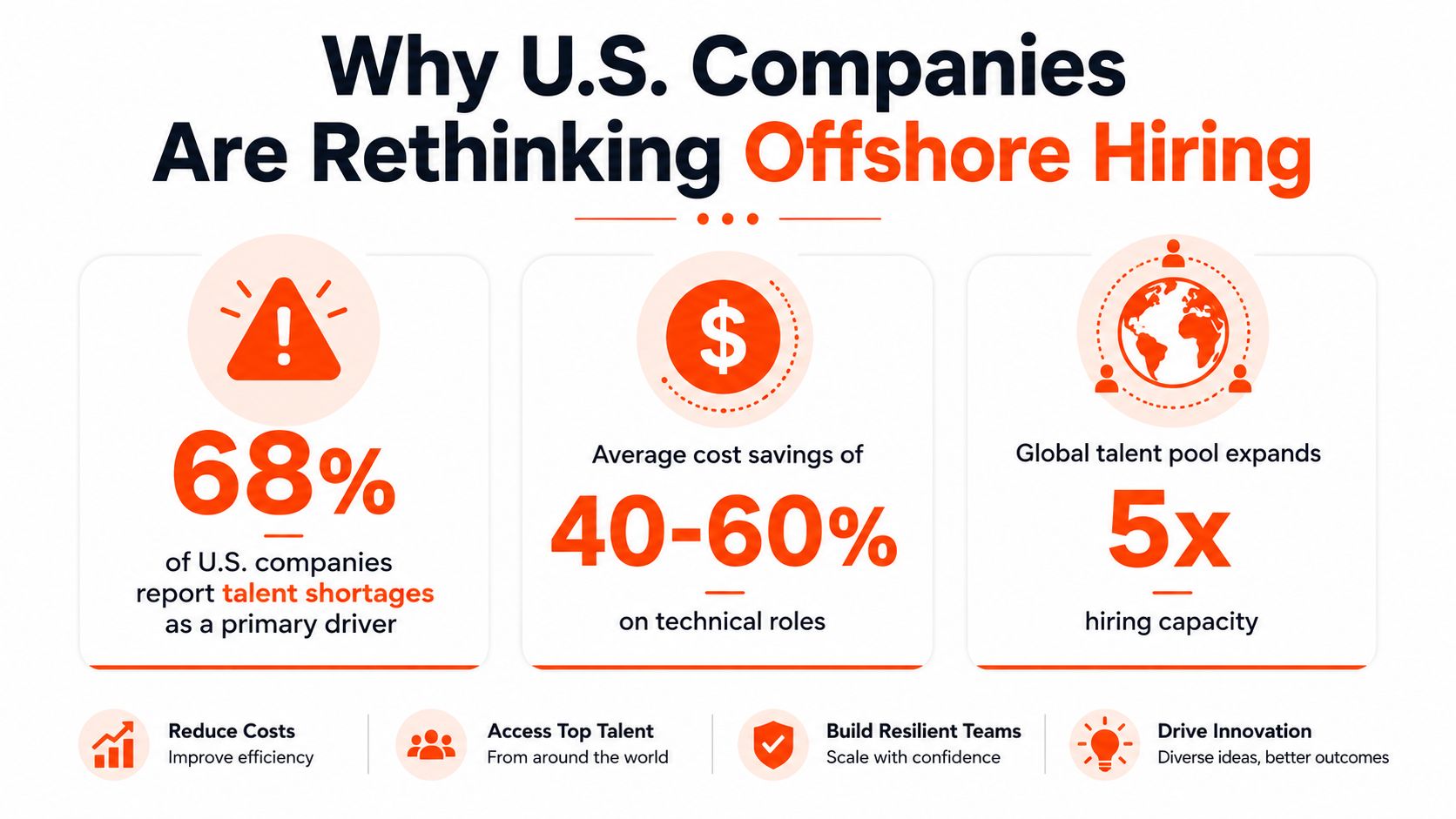
The biggest mistake is to frame offshore hiring as a cheap labor play. The market data says the cost relief is real, with salary savings and total hiring-cost reductions that can materially change the math for growth-stage companies. But the bigger shift is that offshore workers have become embedded in the operating model of many U.S. firms, not just tucked into edge cases.
That matters because the old assumptions no longer fit. If a company can't fill a role locally without overpaying or waiting months, offshore hiring is often the difference between shipping work and leaving it undone. It also helps explain why offshore teams are showing up in functions that used to be considered too sensitive to move. The strategy isn't only about reducing expense, it's about keeping execution on track when the domestic pipeline is thin.
Practical rule: if a role can be described clearly, measured clearly, and trained without a lot of institutional guesswork, it's a stronger offshore candidate than a role that depends on local relationships or a lot of improvisation.
For teams comparing models, a useful starting point is a nearshore option with tighter time-zone overlap and managed staffing support, especially when the business doesn't want to build a cross-border hiring operation from scratch. A concise overview of that setup is available in this guide on what nearshore outsourcing looks like in practice. Virtustant's managed remote staffing service is one version of that model: LATAM hires in US time zones, with contracts, payroll and compliance handled for you.
The usual sequence is familiar. A company starts by posting on job boards, gets flooded with unqualified applicants, burns time on screening, then discovers that the few promising candidates are priced above plan or unavailable on the needed timeline. Offshore hiring can reduce that bottleneck, but only if the company treats sourcing, vetting, and onboarding as one connected workflow instead of separate handoffs.
That's the mindset shift this space has gone through. Offshore hiring is now a mainstream labor channel, and the companies that benefit most are the ones that build the process around the work, not around the resume.
A clean offshore pipeline starts before sourcing begins. The role has to be written around measurable outputs, clear inputs, and work that can be repeated without constant interpretation. If the manager can't explain what success looks like in observable terms, the hiring process will drift into vague screening, and vague screening is where bad offshore hires slip through.
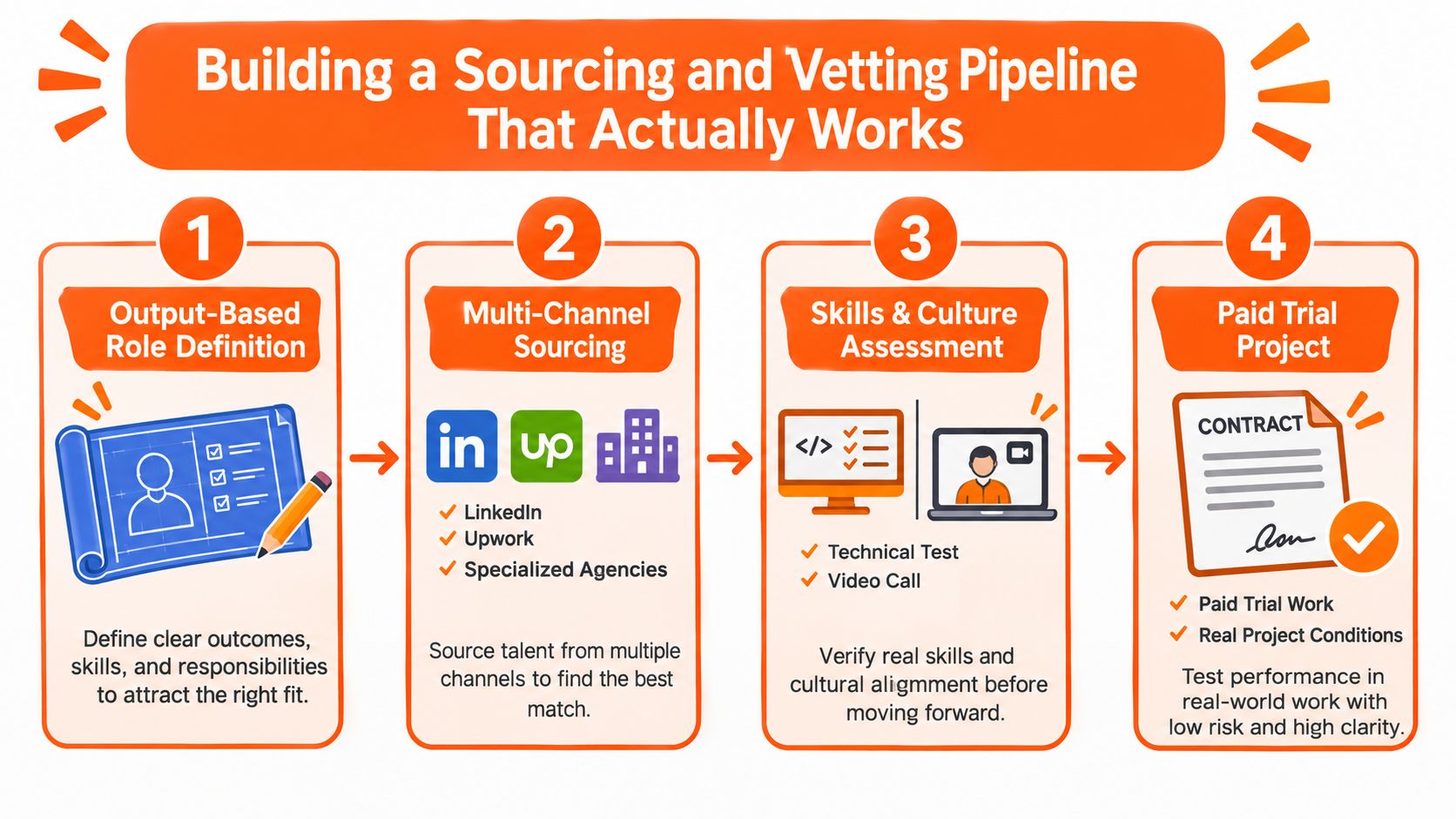
The strongest offshore roles are usually repetitive, time-heavy, and trainable. That doesn't mean they're simple, it means they're processable. Before you look at a single resume, define what the person will produce, what tools they'll use, what decisions they can make on their own, and what has to be escalated.
A practical sourcing workflow often works better with a curated shortlist than with a wide-open application funnel. One operating benchmark in nearshore staffing is to deliver 3-5 pre-vetted candidates quickly, with CVs, skills results, and video introductions, rather than forcing managers to sift through a mountain of weak applicants. That approach protects attention and makes side-by-side comparison possible.
The other advantage is that you can standardize feedback. If every candidate is evaluated against the same outputs, the discussion stops being "who feels best" and becomes "who can do the work." That is a much safer way to hire across borders.
The strongest practical workflow is a 4-stage vetting stack: live English screen, cognitive assessment, role-specific skills test, and experience or reference verification. Each gate answers a different question. Can this person communicate clearly? Can they think through ambiguity? Can they perform the actual task? Have they done something similar in a real setting?
Skip the skills test, and you're not hiring talent. You're hiring a polished interview.
That warning shows up again and again because the resume doesn't reveal how a person executes under real conditions. A structured interview helps, but the trial task or simulation is the point where competence becomes visible. For roles where English matters, the screen should be tight enough to show whether the person can handle live collaboration without constant translation overhead. The same logic applies to reference checks, which should confirm that the person has delivered in environments similar to yours. For the live conversation itself, the 50+ unique interview questions guide covers what to ask and how to score the answers consistently.
For teams comparing sourcing partners, a practical checklist is available in questions to ask before hiring a staffing agency. It helps keep the conversation focused on process quality instead of sales language.
A clean sequence is simple: issue a clear hiring brief, source candidates, screen applications, conduct structured interviews, test practical fit, verify references, then issue documents and onboard gradually. That order matters because each step removes a different kind of risk. If you reverse it, you end up onboarding someone before you know whether they can perform the core work.
The companies that do this well do not rely on charisma in interviews. They verify execution.
The hidden failures usually show up around the edges, not in the interview itself. A role can be filled by a strong resume and still break operationally if the scope drifts into work that needs local judgment, if the manager expects constant real-time coverage, or if the employment structure creates permanent establishment risk. Those are not recruiting problems. They are planning problems, and the pipeline should surface them before an offer goes out.
Onboarding rhythm matters just as much. Early churn often starts when a new hire gets a vague first week, too many tools, and no clear owner for feedback. The fix is deliberate pacing, one process at a time, one manager accountable for review, and enough structure that the person can show progress without guessing what good looks like.
A strong candidate can still become a poor hire if the employment model does not match the role, the time horizon, or the level of control you need. Offshore hiring gets messy quickly when the structure is wrong, because compliance exposure can build long before anyone spots a problem. Teams often focus on cost first and discover later that the legal wrapper created more work than the hire itself.
An independent contractor model works best when the engagement is short-term, the output is narrow, and the company does not need to control how the work gets done hour by hour. An Employer of Record (EOR) makes more sense when you want a full-time hire without setting up a foreign entity. A foreign entity is usually justified when you're building a larger, more permanent team and want direct control over local employment.
The right choice depends on more than cost. It depends on control, time horizon, and compliance risk. That is why a company can be perfectly comfortable with contractors for a specific project and still need an EOR for a long-term operator.
| Factor | Independent Contractor | Employer of Record (EOR) | Foreign Entity |
|---|---|---|---|
| Control | Lowest, best for defined deliverables | Moderate, structured employment without full local setup | Highest, direct employer control |
| Speed | Fastest to start | Fast once the provider is set | Slowest because entity setup takes time |
| Compliance burden | Higher if misclassified | Lower on day-to-day employment administration | Highest internal burden, but more direct control |
| Best fit | Project work, limited scope, low supervision | Full-time roles without entity creation | Large teams, long-term commitment |
| Main risk | Misclassification and hidden control issues | Provider dependency and model fit | Tax, payroll, and local compliance overhead |
A concise comparison of the broader strategic trade-offs is also laid out in nearshore vs offshore outsourcing, which helps when you're deciding whether geography or operating model is the primary issue.
Many companies think contractor risk is about the contract template. Contractor risk comes down to whether the company behaves like an employer in practice, regardless of what the paper says. If you dictate schedules, oversee daily work closely, and expect ongoing availability, the model starts to resemble employment.
Practical rule: if the person is core to the business and should be managed like an employee, stop trying to make a contractor arrangement do employee work.
That is also why EORs are useful for many U.S. teams. They reduce the administrative lift without forcing the company into a foreign entity before the business case is ready. On the other end of the spectrum, a foreign entity makes sense when the offshore team is no longer peripheral and needs stable local infrastructure. Once the model is settled, how to pay international contractors covers the payment routes and the U.S. tax paperwork that attaches to each one.
Use this sequence. If the work is discrete and low-control, contractor can fit. If the role is ongoing but you do not want entity setup, EOR is usually the cleaner route. If you are building a real local hub, an entity may be worth the overhead.
The mistake is jumping straight to the cheapest wrapper. That choice often becomes expensive later.
Not every role can be moved offshore without friction. The companies that get this right separate repeatable work from context-heavy work, and they're honest about where local market fluency matters more than raw talent. That distinction gets ignored in a lot of offshore hiring content, which is why some teams are disappointed even after finding strong candidates.
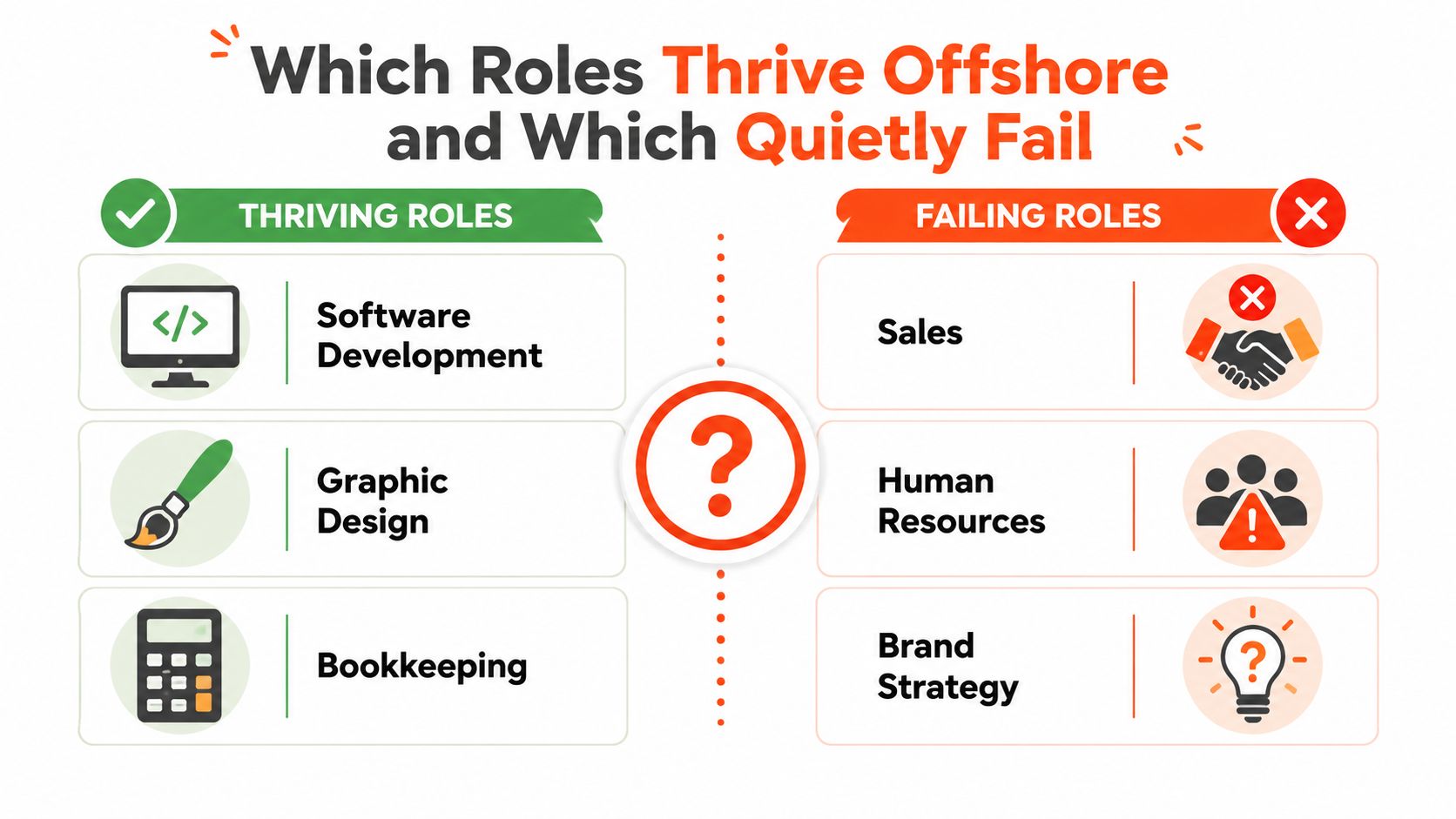
Virtual assistance, bookkeeping, customer support, data work, and other repeatable functions tend to perform well because the work can be documented, reviewed, and measured without a lot of local nuance. That doesn't make them easy. It makes them governable.
Offshore hiring becomes harder when the role needs deep familiarity with a specific market, buyer behavior, or culture of selling. U.S.-market outbound sales, enterprise account management, and some brand-sensitive marketing work are the usual trouble spots because the person needs more than task completion. They need local context, judgment, and language that maps closely to the market they're serving.
That framework is blunt, but it saves time. A role that looks cheap offshore can become expensive if it drags local managers into constant correction or forces the company to rebuild lost relationships. On the other hand, a role that is highly processable can become a stable part of the operating model very quickly. For a role-by-role view of which functions travel well, see the 10 virtual assistant skills worth hiring for.
Nearshore hires with U.S. time-zone overlap reduce some of the coordination drag that makes offshore setups frustrating. Same-day collaboration is easier when teams aren't trying to patch together communication across half the planet. That's one reason LATAM-based professionals often fit U.S. companies better than more distant offshore setups, especially for roles that still need frequent live feedback.
If a role depends on fast clarification, don't optimize for the lowest hourly rate. Optimize for the lowest coordination cost.
That point matters because many hiring mistakes are really communication mistakes. The talent wasn't the issue. The operating rhythm was.
A qualified offshore hire can still fail if the first 90 days are loose. Early churn usually isn't about one dramatic mistake, it's about a manager failing to create enough structure for the person to succeed inside the actual workflow. Offshore programs that last treat onboarding as a managed transition, not a welcome email and a calendar invite.
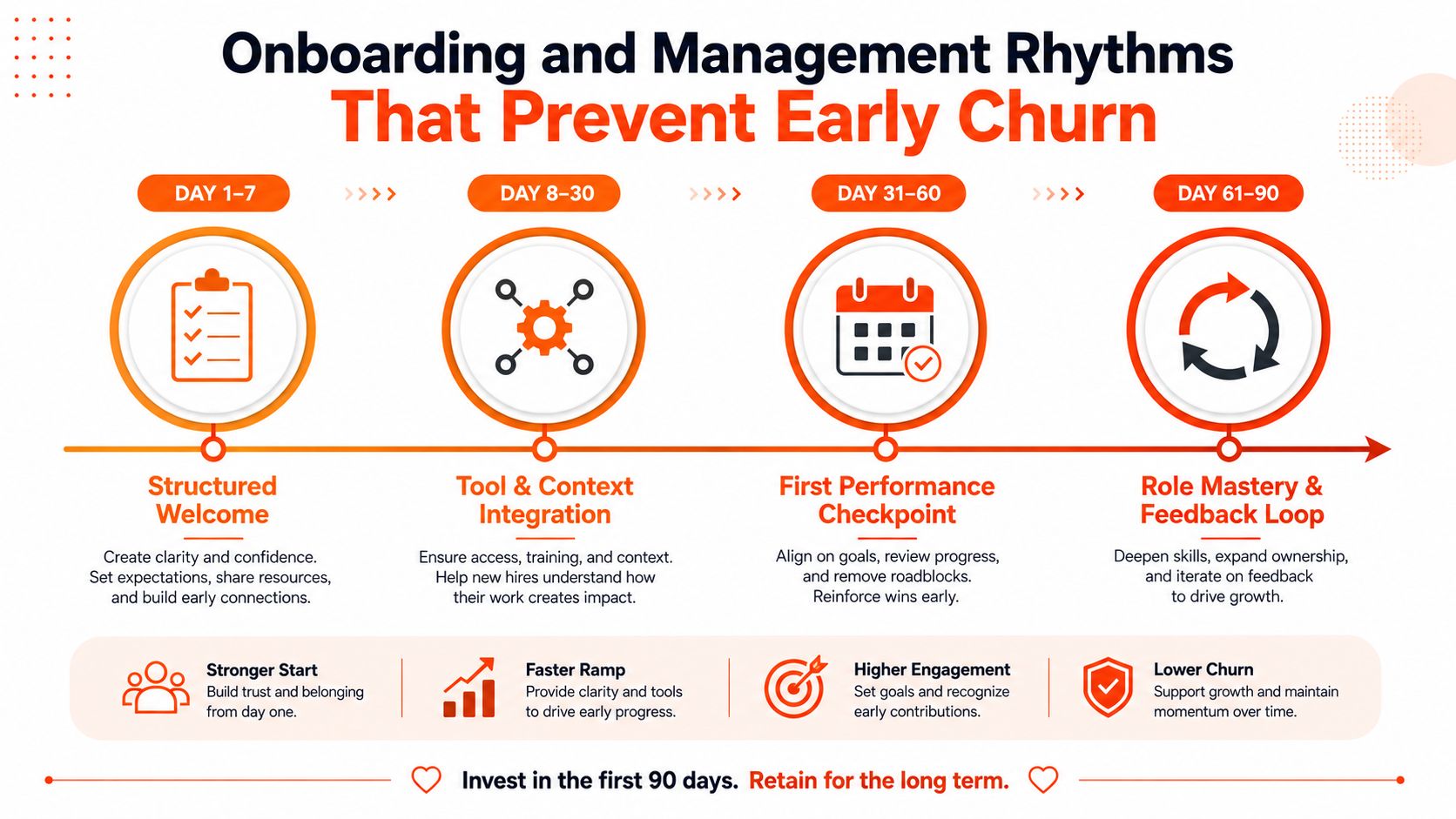
The first week should cover paperwork, tools and access, an onboarding buddy, and daily check-ins. The goal is not to flood the person with information. The goal is to remove avoidable confusion before it turns into silence, delay, or guesswork.
A clean first-week rhythm usually looks like this:
That structure matters because remote hires don't absorb context through hallway conversations. If no one explains how the team works, the new hire has to infer it, and inference is a weak substitute for process. The virtual assistant onboarding checklist works as a ready-made version of this first-week sequence.
The next phase should shift into role training, shadowing, small defined tasks, and twice-weekly feedback sessions. The work should be broken into pieces that can be reviewed quickly, because offshore hires need fast calibration early on. If the first assignments are too large, mistakes get buried and confidence drops.
If you want a good external reference for the retention side of that rhythm, the improve new hire retention tactics resource from Benely pairs well with this stage of the process. The useful part is the emphasis on making the early experience structured instead of passive.
A 90-day success review is one of the cleanest ways to catch misalignment before it becomes churn. By that point, the manager should know whether the person can work independently, communicate clearly, and handle the actual pace of the role. If not, the issue is usually not the hire's intelligence. It's the mismatch between expectations, training, and workflow design.
A mature offshore program treats the transition as phased. Pre-assessment, planning, implementation, integration, and optimization are all different jobs, and skipping one tends to show up later as slippage. The manager also needs clear decision rights and escalation paths. If the hire has to guess when to escalate, the team wastes time on avoidable reversals.
A lot of offshore hiring advice stops at "contractor or employee?" That's too narrow. Cross-border work can create tax, labor, payroll, and data-handling problems that don't show up in the first week, but can surface later when the relationship is already embedded.
The hidden issue is permanent establishment risk, the possibility that a remote worker in another country could create a taxable presence for your company. Recent guidance emphasizes that the right model depends on control, time horizon, and PE exposure, and notes that home offices and work patterns can still create compliance questions that vary by jurisdiction.
That's why location and duration matter, not just the title on the contract. A company that lets people work abroad casually can create a paper trail it didn't intend to create. The safer approach is to track days abroad, document the business purpose, and get country-specific legal review before the arrangement becomes routine.
Cross-border hiring also touches payroll, mandatory benefits, termination rules, and privacy obligations under local law. These aren't side issues. They're part of the employment model, whether the business wants them or not.
If your team handles customer, employee, or financial data across borders, it's worth reviewing a serious resource on cross-border data transfer issues from By Design Law Firm & Legal Consultancy, PLLC before the arrangement expands. That kind of review is especially useful when data access, processing location, and employment structure overlap.
The safest path is to decide early whether you want to own the compliance stack or outsource it to an EOR or managed staffing partner. If your company is still testing the role, a provider can absorb a lot of administrative friction. If the team is becoming permanent, legal review should happen before the arrangement hardens into a de facto local office.
Offshore hiring isn't risky because it's offshore. It gets risky when companies treat legal structure as an afterthought and hope the paperwork catches up later.
Offshore means hiring in a distant country, often with little or no working-hours overlap. Nearshore means hiring in a nearby region, which for U.S. companies usually means Latin America, where the working day largely overlaps with U.S. business hours. The talent pools can be comparable; what changes is coordination cost.
Yes. An Employer of Record hires the person locally on your behalf and handles payroll, contracts and statutory benefits, so you get a full-time employee relationship without registering an entity. A managed staffing provider covers the same ground and adds sourcing and vetting.
Misclassification and permanent establishment exposure. Misclassification is a control problem: the more you direct schedules and methods, the harder a contractor arrangement is to defend. Permanent establishment risk is the possibility that a worker abroad creates a taxable presence for your company in that country.
Roles that are repeatable, documentable and objectively reviewable: virtual assistance, bookkeeping, customer support, data work, scheduling and research. Roles that depend on local market context, such as U.S.-market outbound sales and enterprise account management, tend to underperform offshore regardless of candidate quality.
Running the search in-house typically takes several weeks. Through a managed nearshore provider it is much faster: Virtustant delivers a first shortlist of 3-5 vetted candidates within 48 hours and averages about 3 days to hire.
Market data puts salary savings at 40%-70% versus U.S. hiring. Through Virtustant, vetted bilingual LATAM professionals start at $7/hr all-in with zero placement fees, which covers talent, payroll and compliance in a single rate.
If you want a structured way to hire offshore employees without turning your managers into compliance and recruiting specialists, Virtustant's nearshore staffing service handles sourcing, vetting, contracts, payroll, and compliance for LATAM hires in U.S. time zones, from $7/hr all-in with zero placement fees. Compare the numbers on the pricing page. It's a practical fit when you need a managed process, not a pile of resumes. Start with a free 20-minute scoping call and you leave with a rate for your role.