Payroll Compliance Checklist: 8 Items to Verify
September 24, 2026


A complete payroll compliance checklist must verify classification, worker documentation, contracts, U.S. and local tax handling, benefits, termination payments, and records. The obligations depend on the worker's country, status, and work arrangement, while the IRS failure-to-deposit penalty climbs through four tiers: 2% at 1 to 5 days late, 5% at 6 to 15 days, 10% past 15 days, and 15% once more than 10 calendar days have passed since the first IRS notice, or immediately on a demand for immediate payment. The tiers do not stack — a deposit 20 days late is penalized at 10%, not at 2% plus 5% plus 10% (IRS, Failure to Deposit Penalty).Payroll compliance guidance
Payroll compliance isn't just paying an invoice. It means assigning an accountable operator to every control, preserving evidence, and confirming deadlines before a payment is released. For a U.S. company hiring remote professionals in Latin America, the correct process starts with a country-by-country control matrix containing five fields: obligation, responsible party, evidence, deadline, and escalation path.
A founder or operations leader should confirm worker classification and local requirements before choosing a payment route. A direct arrangement may leave the client responsible for contracts, tax coordination, local filings, benefits, and records. A managed nearshore staffing model can assume contracts, payroll, HR, and local compliance in the professional's country without requiring the client to establish a foreign entity. Review the scope of nearshore staffing services before treating an all-in invoice as a complete compliance solution.
Classification is the first gate because it determines which documents, withholding rules, benefits, and reporting duties apply. U.S. guidance distinguishes employees from contractors through the practical relationship, including who controls work methods, who supplies tools, how payment is structured, and whether the relationship is ongoing. A U.S.-based employee generally requires Form W-4 and Form I-9; a U.S.-based contractor generally requires Form W-9 and supporting contract terms.Worker classification guidance
Those forms do not travel. A professional who is not a U.S. person and performs the work from their own country is outside that set, and the single most common paperwork error in cross-border hiring is collecting a W-9 from them anyway. Form W-9 is a U.S. person’s request for taxpayer identification number. The correct document is Form W-8BEN, the certificate of foreign status that a foreign beneficial owner gives the payer (IRS, About Form W-8 BEN). A W-9 in that file is not a harmless mismatch — it is a false U.S.-person certification sitting in the evidence pack you would hand an auditor.
The rule underneath it is the sourcing rule for personal-services income: the IRS looks at where the services are physically performed, not where the contract was signed, where the payment was sent, or where the payer lives (IRS, Source of Income — Personal Service Income). Work performed entirely in Colombia by a Colombian resident is foreign-source income, which generally means no U.S. withholding and no Form 1099. That is the part founders hear as good news and stop reading. The obligations did not disappear; they moved to the worker’s country, which is item 4 of this checklist.
The accountable operator is the client's finance or HR owner for a direct hire. That person should document the actual arrangement before the first payment, not just select “contractor” because the worker lives outside the United States. A U.S. SaaS company that sets a LATAM developer's daily hours, provides equipment, requires vacation approval, and directs the work closely has created facts that may conflict with contractor treatment. By contrast, a bookkeeper with a project-based scope, monthly invoices, and flexibility over delivery timing presents a different control profile.
Keep the signed agreement, scope of work, invoices, communications showing control over the work, equipment arrangements, and the classification rationale. Review state rules for the company's state and consult counsel in the worker's country because a classification that appears defensible under U.S. principles may still create local employment obligations.
Use Form SS-8 when the relationship is unclear, and reassess classification when the work arrangement materially changes. Written agreements should identify contractor status, payment terms, and the absence of an ongoing employment relationship, but the operating facts still matter. Founders can also review this worker status guidance for founders.
A managed provider can own the local worker relationship and payroll setup, but the client still needs to approve the role and describe how the professional will work. Virtustant's operating models for payroll can help a client compare direct and managed arrangements without treating classification as a paperwork-only decision.

The payment route must follow classification. For a U.S. employee, the payroll operator must configure the applicable federal withholding and employment taxes, maintain the worker's withholding documentation, and reconcile payroll filings. For a contractor, the operator must track payments and determine whether information reporting applies. Manual payment records are especially risky when invoices arrive in different currencies or through several systems.
The client's CFO, controller, or payroll processor should own the U.S. reporting decision. A managed staffing provider can own the operational filings when its agreement expressly assigns that responsibility, but the client should retain approval over compensation and receive payroll reports. The evidence file should include the worker's tax form, payment ledger, currency conversion record, filing confirmation, and any advice from U.S. or local tax counsel.
Employers on the IRS monthly deposit schedule must deposit employment taxes for a month by the 15th day of the following month, and if the 15th falls on a Saturday, Sunday, or legal holiday in the District of Columbia, the deposit is due the next business day.IRS employment tax due dates
The deadline that actually catches people is earlier than the due date. To be treated as on time, the deposit must be scheduled by 8 p.m. Eastern time the day before it is due (IRS, Topic No. 757). Miss that cutoff and EFTPS will not settle in time, but the deposit is not lost: the same IRS guidance points to the Federal Tax Collection Service for a same-day payment, which your bank will usually charge a fee for. Put both times in the calendar — the 8 p.m. scheduling cutoff as the real deadline, and the statutory due date as the backstop.
Practical rule: Treat the deposit deadline as an internal approval deadline, not as the moment someone begins the transfer.
For contractor payments, reconcile the ledger monthly against invoices, bank records, and the worker's country-specific tax requirements. Keep USD and local-currency amounts visible rather than overwriting one with the other. That record gives the operator a defensible trail if a payment is questioned.
Cross-border withholding can create obligations in both jurisdictions, so a U.S. founder shouldn't rely on a generic contractor template. Virtustant's guide to paying contractors abroad is a useful reference when comparing payment administration options.
A contract should translate the approved work arrangement into enforceable terms. It should state compensation, payment currency, working hours, flexibility, confidentiality, intellectual property, termination conditions, dispute resolution, and the classification of the remote professional. For a LATAM worker, the document also needs to acknowledge local rules governing statutory benefits, notice, severance, and other minimum protections.
The accountable operator is the HR or legal owner, with local counsel responsible for country-specific review. A U.S. template can create false confidence if it assumes at-will termination or uses language that conflicts with mandatory local rules. For example, a contract that says there is no notice or severance may not remove statutory rights in the worker's jurisdiction. Similarly, an English-only document can create interpretation risk when the worker or local authority relies on another language.
Use separate templates for employees and contractors. Retain the signed agreement, every amendment, the approved version, the local-language version where appropriate, and the legal review record. Specify how exchange rates will be determined if the commercial agreement is denominated in USD but payments are made in local currency.
A good contract also describes the operational reality. “As needed” work is difficult to administer because it doesn't explain expected availability or control. State the working window, deliverables, approval process, and invoicing method clearly enough that the payroll operator can apply them consistently.
A contract should answer the question, “What happens on the last day of the relationship?” before the first day begins.
The client approves commercial terms and role expectations. The provider, where engaged, can prepare country-appropriate contracts, coordinate signatures, and maintain the contract record. Virtustant's material on contract compliance for remote placements can support that comparison.

Local payroll compliance belongs to the worker's country, not merely to the country where the client's bank account sits. The operator must identify the applicable income tax, social security, payroll reporting, and remittance requirements in the worker's residence country. The exact obligations vary by jurisdiction and by worker status, so a U.S. company shouldn't copy a process from Mexico into Colombia or Argentina.
For a direct arrangement, the client's finance team needs local tax and payroll support. For a managed arrangement, the provider's local payroll operator can prepare filings, calculate contributions, remit amounts, and return receipts to the client. The client still needs a named reviewer who checks the payroll report, confirms the approved compensation, and escalates missing evidence.
The evidence pack should include registration records where required, payroll registers, tax calculations, social security receipts, filing confirmations, exchange-rate records, and reconciliation reports. Set a recurring review for every country, with the local processor's deadline preceding the authority's deadline.
A practical monthly workflow looks like this:
The key control is separation of duties. The person approving a salary change shouldn't be the only person validating the resulting tax calculation. A managed staffing model can centralize the operational work, but the client should still receive a country-level evidence trail rather than a single unexplained charge.
A remote professional's physical location doesn't eliminate identity, work authorization, or tax-residency checks. Before the hire date, the operator should confirm government-issued identity, authorization to work or provide services in the residence country, tax identification, and the worker's tax-residency position. The required identifier may differ by country, such as a RUC, RFC, or CUIT.
The accountable operator is HR or the provider's onboarding team. The finance owner should block the first payment until the file contains the required documents. Retain the identity record, signed tax-residency certification, tax ID verification, work authorization evidence, sanctions screening result, and any local social security registration evidence that applies to the worker's status.
Don't treat onboarding as a one-time checkbox. Recheck work authorization and tax residency when the worker changes country, status, or work arrangement, and schedule periodic review for active workers. The operator should also maintain a clear escalation path to local counsel when documents conflict or the worker's residence is unclear.
The client's role is to provide accurate hiring and work-location information. A provider can collect documents, perform screening, maintain the file, and notify the client of exceptions. That division prevents an operations manager from approving a payment based only on a passport while overlooking local tax registration or an expired authorization.
A useful control matrix records four dates separately: document collection, verification, expiration, and next review. This avoids a common failure mode in which the company has a document but no process for determining whether it remains valid. It also gives the finance team a clear answer when a payment is held for compliance reasons.
Benefits compliance applies differently depending on classification, but employee treatment usually requires country-specific administration of health coverage, pension or social security contributions, paid leave, sick leave, and parental protections. The operator must identify the statutory package at hire, enroll the worker where required, calculate deductions and employer contributions, and retain proof of payment.
The client's HR or finance owner approves the intended compensation and benefits design. A local HR administrator or managed staffing provider can perform enrollment, calculate contributions, communicate eligibility, and maintain receipts. The distinction matters because a U.S. company may approve a monthly budget without knowing which portion represents base pay, statutory contributions, benefits, or accrued leave.
Review benefit enrollment against the payroll register every pay cycle. A worker listed as enrolled but absent from the contribution file is a control failure, as is a deduction that doesn't match the plan or local requirement. Store enrollment forms, provider communications, contribution receipts, leave records, and changes to benefit status.
Track vacation and leave accrual monthly rather than waiting for termination. The final-pay calculation depends on that history, and missing records can turn a disagreement into a payment dispute. Communicate eligibility and contribution treatment in writing during onboarding and whenever the terms change.
Operator opinion: The most reliable benefits control is a three-way match between the worker record, the payroll register, and the provider receipt.
A managed nearshore staffing arrangement can assume the country-level administration while the client retains responsibility for approving the role, compensation, and performance expectations. Virtustant's nearshore staffing services are relevant when the buying decision includes local payroll and HR administration, not just candidate sourcing.

Termination is where incomplete payroll records become expensive. Before ending a relationship, the operator must identify the worker's status, country, notice requirement, severance formula, unused leave, bonuses, deductions, and final-payment deadline. The decision owner may be the U.S. manager, but the calculation should be reviewed by local HR or payroll personnel before the notice is delivered.
For a direct hire, the client's HR and legal owners should produce the termination calculation and evidence. Under a managed model, the provider can coordinate the local process, prepare the final payroll, document payment, and communicate required steps. The client still approves the business decision and supplies the factual record supporting it.
The worksheet should include:
Don't assume a U.S. “at-will” approach transfers to a LATAM country. Local requirements may govern notice, severance, documentation, and dispute rights even when the commercial decision originates in the United States. The operator should obtain country-specific advice before communicating the termination, not after the worker contests the calculation.
Set an escalation rule for disputed amounts. A provider should notify the client immediately when the local processor identifies missing leave data, an unclear termination reason, or a potential reclassification issue. That gives the client time to correct the record before the local deadline expires.
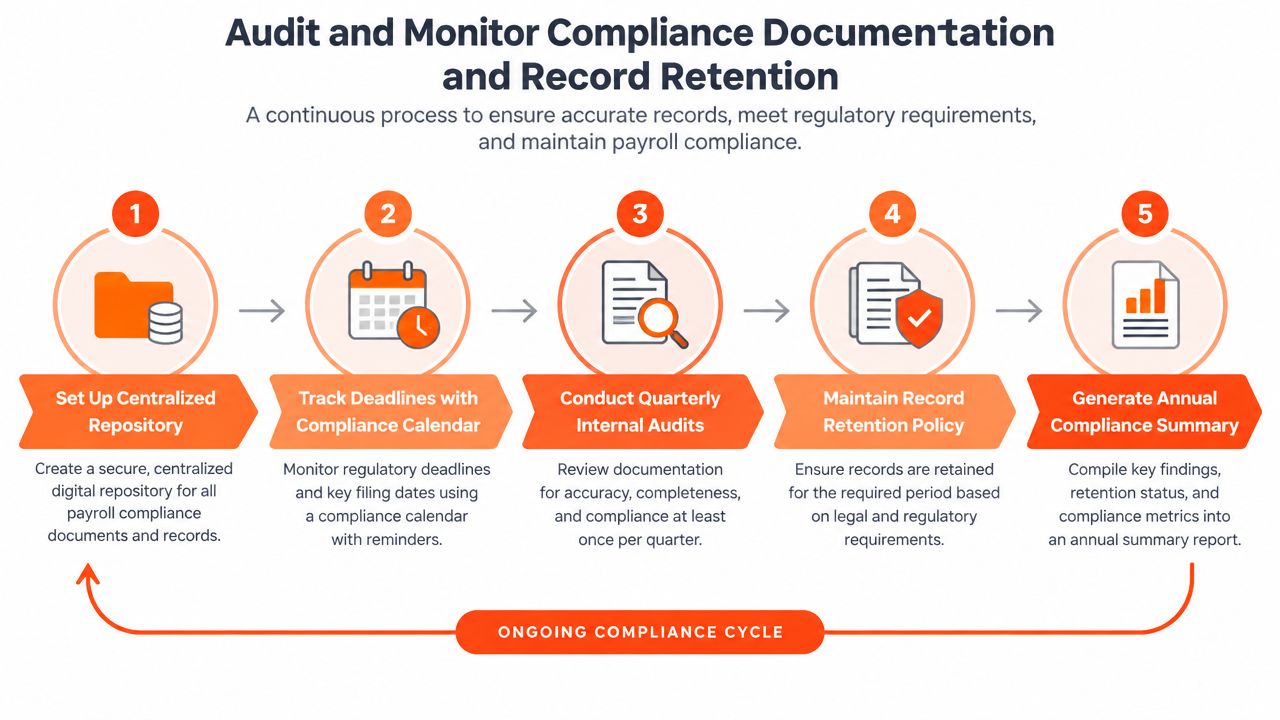
A payroll compliance checklist is effective only when the company can prove that each control occurred. Store contracts, worker records, payroll registers, filings, receipts, benefit records, leave balances, payment confirmations, and termination documents in a secure, version-controlled repository. Retention periods vary by jurisdiction and document type, so apply a documented schedule rather than one universal rule. The Global payroll compliance checklist sets a general expectation of roughly five to ten years under local data-retention rules, but it does not break retention down by document type or country. Treat that band as the floor you start from, then confirm the specific period per document with local counsel — a payroll register and a termination file rarely carry the same clock.
Assign one accountable operator, such as the CFO, HR manager, or payroll processor. That person owns the master calendar, assigns deadlines, reviews provider reports, and escalates late or rejected filings. A shared inbox does not establish ownership.
A quarterly review should test completion, accuracy, and evidence:
U.S. and LATAM obligations require separate timing controls. IRS deposit schedules and local filing calendars should remain visible in one consolidated calendar, with each task labeled by country, authority, owner, deadline, and payment status. Do not reduce them to one generic payroll reminder. For the document-control layer underneath the calendar, compliance templates for VideoLearningAI covers how policies, SOPs, training records, attestations, and audit logs get versioned, owned, and retained. That pattern is generic across regulated functions rather than payroll-specific, so borrow the evidence structure and write the payroll deadlines yourself.
For a managed nearshore model, assess whether Virtustant's remote staffing services provide country-level records, payroll evidence, recurring HR reviews, and escalation documentation. The client should retain approval authority and access to the repository. The provider can assume contracts, payroll, HR administration, and local compliance coordination without requiring the client to establish a foreign entity.
| Item | Implementation Complexity 🔄 | Resource Requirements ⚡ | Expected Outcomes 📊 | Ideal Use Cases 💡 | Key Advantages ⭐ |
|---|---|---|---|---|---|
| Classify Workers Correctly Under IRS and State Guidelines | High, multi-jurisdiction legal analysis and ongoing monitoring | Tax & employment counsel, documentation systems, audit trail | Reduced reclassification risk; accurate tax treatment | Hiring remote LATAM professionals with ambiguous control or terms | Protects against retroactive taxes, penalties, and audits |
| Establish Tax Withholding and Reporting for Cross-Border Payments | High, integrates U.S. payroll, treaties, and foreign rules | Payroll provider, tax counsel, W-8BEN collection, FX tracking | Accurate withholding/reporting; minimized IRS penalties | Paying LATAM-resident professionals; foreign-status certification on file | Ensures compliance, proper tax credits, and audit defense |
| Maintain Compliant Cross-Border Employment Contracts | Medium‑High, dual‑jurisdiction drafting and translations | Local employment counsel, translations, contract templates | Clear enforceable terms; reduced disputes over IP/termination | Formalizing employee vs contractor relationships, IP work | Clarifies rights, IP, termination and shows good‑faith compliance |
| Track and Report Income and Payroll Tax Obligations in LATAM | High, frequent, country‑specific filing and remittance cycles | Local payroll processor, employer tax registrations, cash flow for contributions | Timely LATAM filings; correct employer cost accounting | Employing LATAM‑resident workers subject to local payroll rules | Avoids LATAM penalties and protects worker benefit records |
| Document and Verify Work Authorization and Tax Residency | Medium, document collection and periodic re‑verification | Onboarding verification, tax ID checks, background screening | Correct sourcing and withholding decision; lower unauthorized‑engagement risk | Onboarding remote hires lacking clear work/tax documentation | Enables correct withholding and reduces legal exposure |
| Establish Benefits Administration and Statutory Contribution Compliance | High, country‑specific mandates and enrollment deadlines | Local benefits providers, HR admin, budget for contributions | Compliant benefit enrollment; improved retention and defense | Engaging LATAM-resident professionals on ongoing contracts | Prevents benefit claims and costly retroactive liabilities |
| Plan for Termination, Severance, and Final Payment Compliance | Medium‑High, complex severance formulas and strict rules | Legal counsel, payroll calculations, termination documentation | Predictable separation costs; reduced wrongful‑termination risk | Layoffs, terminations, M&A or employment disputes | Ensures lawful separations and reduces litigation exposure |
| Audit and Monitor Compliance Documentation and Record Retention | Medium, process setup and recurring internal audits | Document repository, compliance calendar, dedicated reviewer | Strong audit defense; fewer missed filings and penalties | Organizations with multiple LATAM hires or high compliance burden | Early error detection and organized evidence for audits |
The eight controls work best as a sequence rather than a static document. Before the offer, verify classification, work authorization, tax residency, country, and work arrangement. Before the first payment, execute the country-appropriate contract, collect worker documentation, configure tax handling, and confirm who will file and retain evidence.
Each pay cycle, reconcile approved compensation, hours where relevant, deductions, benefits, local contributions, currency conversion, and payment confirmation. The operator should close the cycle only after the evidence pack is complete. A payroll error is not only a wrong net payment. An EY survey published in December 2022 put the average cost of a single payroll error at $291 and found that about one in five U.S. payrolls contains an error. Read the denominator before quoting it: that survey covered 508 payroll practitioners at companies with 250 to 10,000 employees, so it describes staffed payroll departments, not a twelve-person company paying three professionals abroad. The direction holds — errors are routine, not exceptional — but the dollar figure benchmarks a payroll function, not your first LATAM hire.Payroll compliance legislation and common mistakes
Quarterly, test the calendar, sample payroll calculations, review benefits and contribution receipts, and resolve gaps. At separation, calculate notice, severance, unused leave, bonuses, deductions, and final payment before the local deadline. For U.S. employers, deposit timing remains a separate control. Monthly depositors must follow the IRS deadline and scheduling requirement, even when a local provider manages the LATAM side.
Not necessarily. A client may use a managed staffing provider that contracts with the professional in the country, handles local payroll and compliance, and invoices the U.S. company. The legal and tax structure depends on the worker's country, classification, and arrangement, so local review remains necessary.
The provider can own operational controls such as contracts, local filings, payroll calculations, HR check-ins, and records. The U.S. company still approves the role, budget, work expectations, and business decisions. The agreement should name each owner and specify the evidence the provider must deliver.
A professional who is not a U.S. person gives Form W-8BEN, the certificate of foreign status. Form W-9 is for U.S. persons. Because the IRS sources personal-services income to the place where the services are performed, work done entirely from the worker’s own country is foreign-source income, which generally means no U.S. withholding and no Form 1099 — while local obligations in that country still apply.
LATAM countries don't share one payroll rulebook. Classification, benefits, social contributions, notice, severance, tax IDs, filing dates, and record retention can differ by country and worker status. A provider may administer the process, but local counsel remains the right escalation path for unusual or disputed situations.
Virtustant describes a managed model that combines sourcing, multi-stage vetting, contracts, local compliance, payroll, HR check-ins, and performance oversight. That vetting funnel runs four sequential screens — 100% of applicants → 22% past the recruiter screen → 9% past skills and English testing → 3% to a live interview → 1% hired — and that funnel is what the top 1% figure refers to. Its operating model focuses on professionals across LATAM with U.S. time-zone overlap, on a bench that also extends to South Africa and the Philippines. Those points describe the service model, not a substitute for reviewing the actual statement of work.
For U.S. founders and SMB operators, the buying question is whether the provider assumes the controls that the internal team can't reliably operate. Compare managed remote staffing solutions by contract ownership, country coverage, payroll evidence, escalation duties, benefits administration, and invoice clarity before choosing a route.
Virtustant connects U.S. companies with vetted remote professionals across Latin America and can manage contracts, local compliance, payroll, HR check-ins, and one consolidated USD invoice. If your payroll compliance checklist exposes gaps in country-specific administration, visit Virtustant to review a managed staffing option and compare its service scope with your direct-hiring process.