How to Manage Contracts for Remote Teams That Scale
September 14, 2026

Poor contract management can erase almost 9% of annual revenue, with average value erosion reaching 8.6%, according to WorldCC's August 2025 contract management research (checked September 2026). To manage contracts for a remote team that scales, assign one accountable owner, use standardized agreements, centralize every document, connect contracts to payroll and compliance, and track obligations after signature. A signed agreement sitting in an inbox isn't a management system.
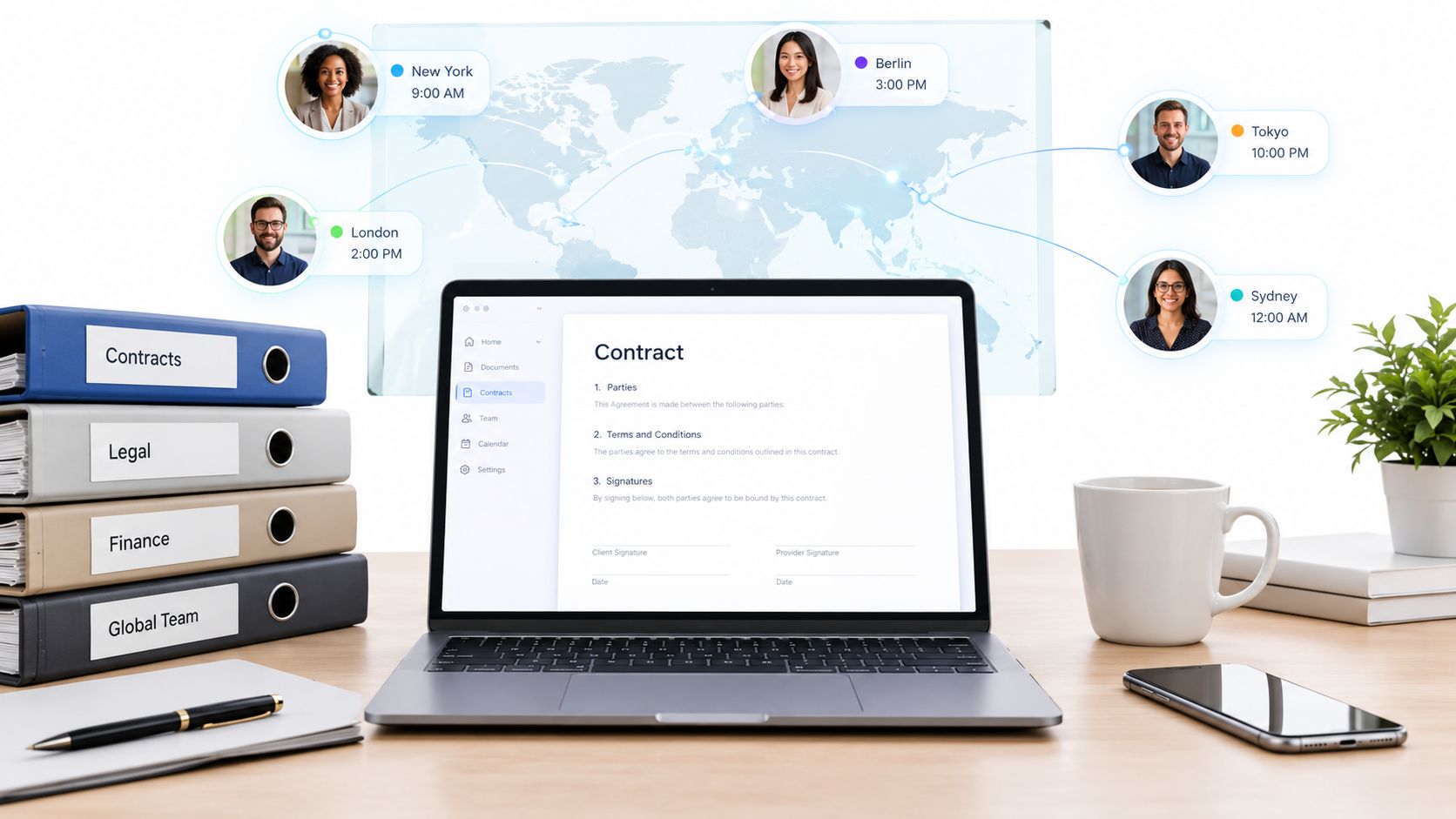
For U.S. companies hiring remote professionals in Latin America, contracts should function as a living operating system. They define the work, control money movement, record obligations, and give legal, finance, HR, and operations one source of truth. The practical question isn't just how to write a contract. It's how to make sure the business can find it, understand it, act on it, and enforce it throughout the relationship.
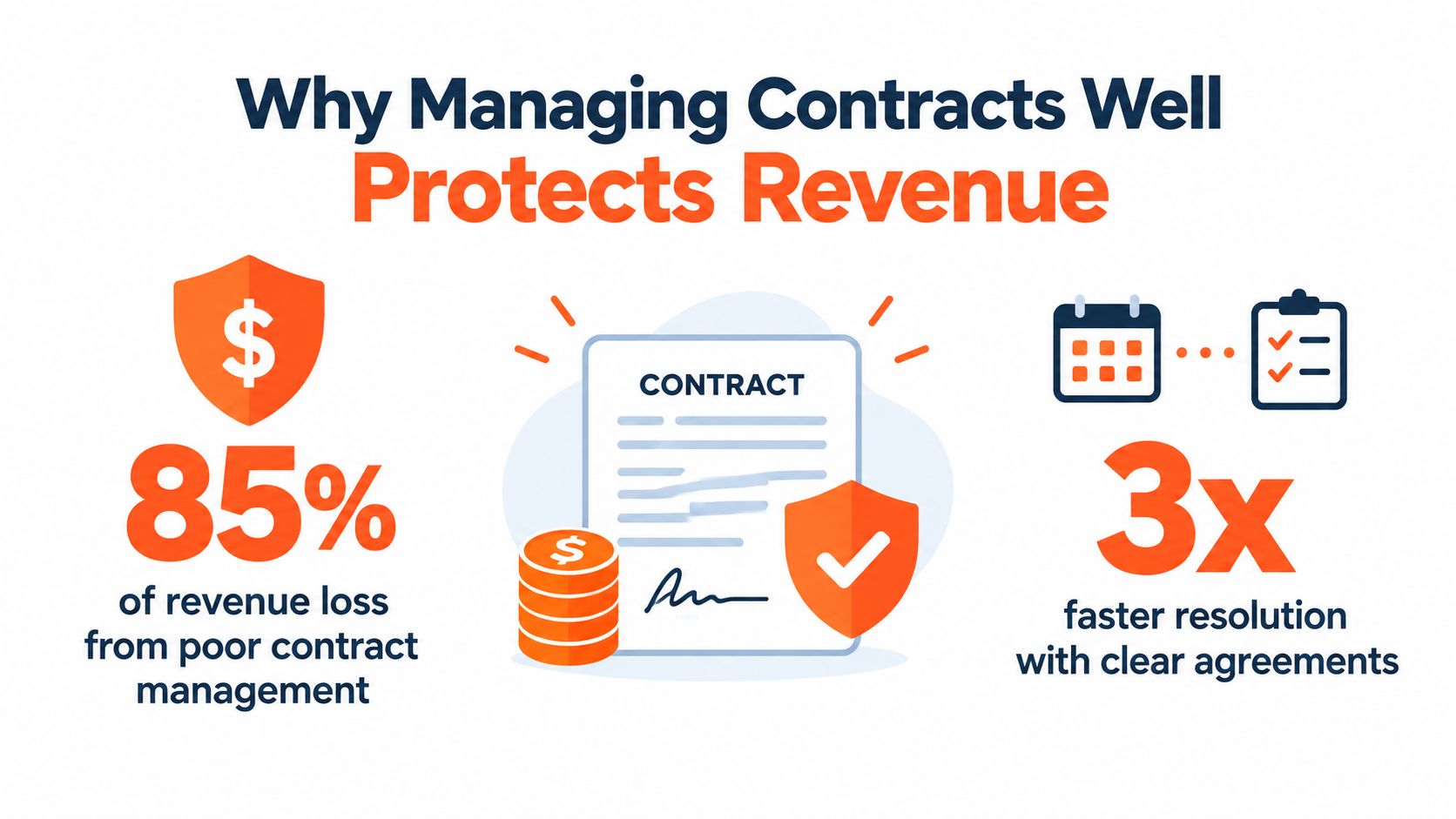
Contract management protects revenue through daily operating discipline. WorldCC reports that best-performing businesses lose about 3% of contract value, while the worst performers lose 15% or more, according to its August 2025 research. The same research connects contract-related information with scattered systems. Revenue leakage usually starts with missed notice windows, unclear deliverables, unapproved changes, billing disputes, or obligations without an owner.
A nearshore hiring contract must work across the entire relationship. A U.S. founder may hire a professional in Colombia, Mexico, Argentina, Brazil, or another LATAM market while finance, HR, payroll, and the hiring manager use different tools. The agreement must remain usable through time-zone differences, changing priorities, local payment requirements, and handoffs between people who were not part of the original negotiation.
A contract protects the business only when the right person can answer four questions quickly:
WorldCC also reports that 83% of executives say their contracts are too rigid to adapt to change in its August 2025 research. Rigid agreements usually reflect weak operating design. Teams document the initial arrangement, then fail to define how changes must be approved, recorded, and communicated.
Operator rule: If a manager must search email, Slack, a shared drive, and a payroll portal to understand one contract, the company lacks contract visibility.
Standardization removes avoidable friction. Use a repeatable agreement structure, an approved clause library, and a documented change process, so every deviation from the template is a deliberate decision rather than an accident. Legal counsel should review the agreement, while business users should understand the commitments they must execute.
Cost decisions also belong in the operating model. A managed nearshore arrangement can consolidate contract administration, payroll, HR, and compliance into one relationship. Direct hiring gives the company more control but places more administrative work on internal teams. Compare transparent staffing pricing with the internal cost of sourcing, contracting, paying, and supervising remote professionals. Evaluate total administrative exposure, not hourly rate alone. The contract is a living operating system when ownership, storage, payroll, compliance, and post-signature obligations stay connected.
A remote contract should answer five questions before anyone signs it: what work gets done, when it gets done, how success is measured, who owns the output, and how either party can end or change the arrangement. Clear language protects both sides. Dense language that business users can't interpret creates disputes even when the legal drafting is technically sound.
Start with a short commercial summary at the top. Identify the parties, role, start date, engagement structure, currency, payment cadence, primary contact, and expected time-zone overlap. Then organize the legal terms beneath it. This makes the agreement usable for a founder, finance manager, hiring lead, and remote professional, not just counsel.
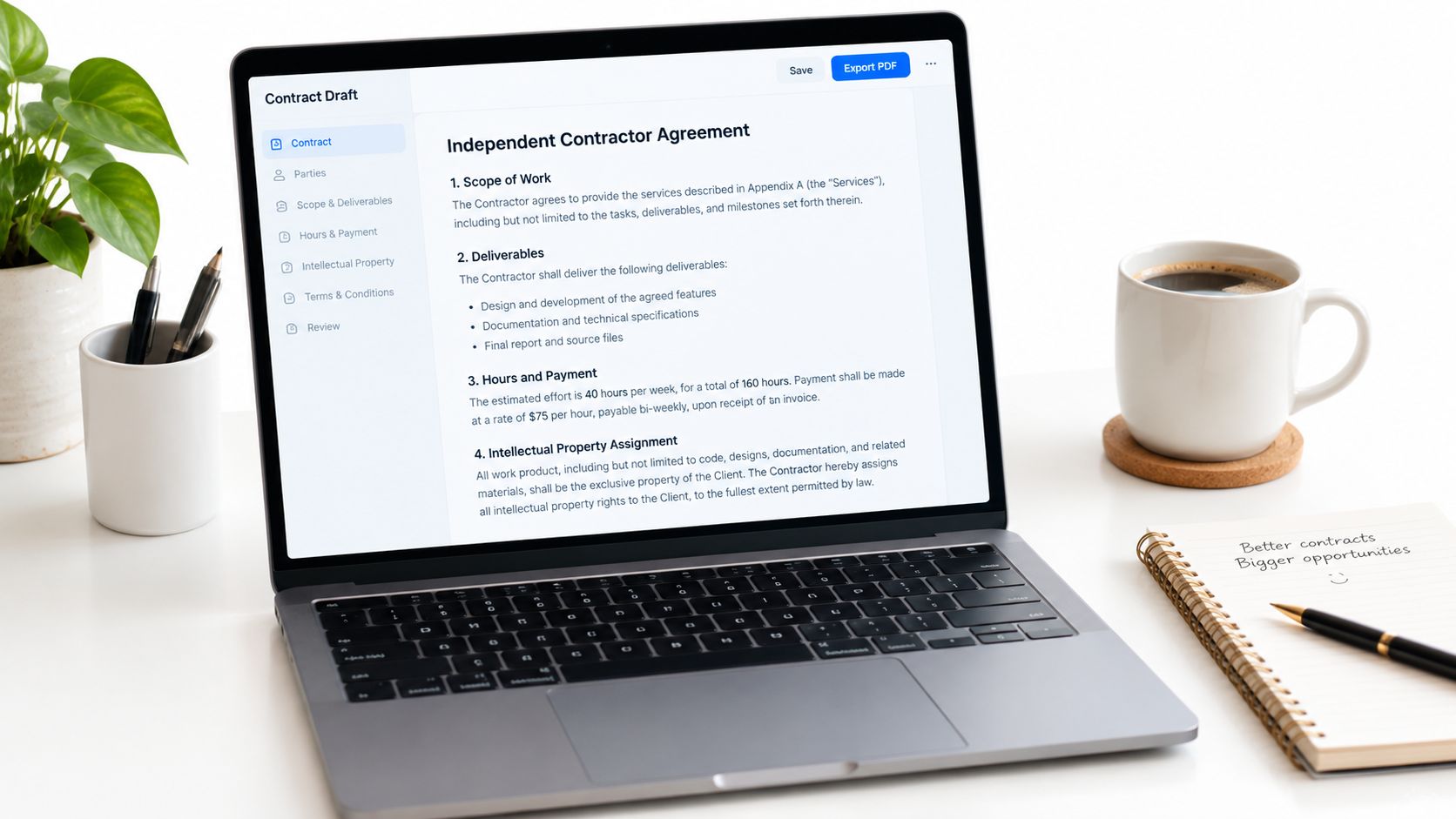
Use concrete requirements instead of broad promises.
A good contract also has a change-control clause. If the role expands from customer support into sales development, the manager should know who approves the change, how compensation is reviewed, and where the amendment is stored. Without that mechanism, the team creates a second agreement informally through chat.
Use plain English for business terms and reserve specialized language for issues that require it. Work through the essential components in plain terms first, then have local counsel review jurisdiction-specific language and classification questions.
Before using an agreement repeatedly, test it with the people who'll operate it. Ask a finance lead where payment instructions appear, ask the hiring manager how deliverables are measured, and ask the professional what happens when priorities change. For additional context on role-specific agreements, see this staffing company contract overview.
Founders usually face two choices. They can contract directly with an independent professional and manage the administrative burden themselves, or they can use a managed staffing structure that handles contracting, local compliance, payroll administration, and ongoing support in the professional's country.
The direct model can work when the company has internal expertise and a well-defined process. The managed model is more practical when the company wants one commercial relationship and doesn't want to establish a foreign entity or coordinate country-specific filings alone. The important distinction is not where the professional works. It's who carries responsibility for the local employment, tax, payment, and documentation process.
| Model | Who Handles Compliance | Payroll Flow | Best For |
|---|---|---|---|
| Direct independent contractor | The U.S. company and contractor coordinate classification, documentation, and local responsibilities | The company pays the contractor under the agreed terms | Businesses with internal legal, finance, and cross-border administration capacity |
| Managed staffing arrangement | The staffing provider manages the contract, local compliance, payroll administration, and HR support in the professional's country | The client receives one consolidated invoice, typically in USD, while the provider manages payment locally | Founders and operations teams that want one accountable operating partner |
| Internal foreign entity | The company establishes and maintains its own local structure and processes | The company runs local payroll or engages local providers directly | Organizations with sustained country-specific operations and dedicated local administration |
For an independent contractor arrangement, the worker is generally responsible for their own taxes. Businesses typically don't withhold payroll taxes and may issue a Form 1099-NEC where applicable. In the U.S. context the contractor carries the 15.3% self-employment tax. None of that resolves classification by itself. The IRS common law rules weigh three categories of evidence, behavioral control, financial control, and the type of relationship, and state plainly that there is no set number of factors and that no single factor decides the outcome on its own. Where the answer stays unclear, either party can file Form SS-8 and ask the IRS to determine status, a process that usually takes at least six months. Assess the actual working relationship and obtain professional advice for every country involved.
The all-in hourly model simplifies budgeting because the client sees one rate that can include contract administration, payroll coordination, HR support, and compliance operations. It doesn't eliminate the need for a clear scope or performance management. It changes the administrative owner.
Decision test: Choose direct contracting only if someone inside the business can own classification, documentation, payments, renewals, and escalations. If nobody owns those tasks, the company hasn't chosen a low-cost model. It has accepted unpriced risk.
Founders evaluating the models should also understand tax and social security for remote teams, then confirm the arrangement with qualified counsel or tax professionals familiar with the worker's country and the U.S. company's facts.
The lifecycle should run as one connected workflow, not as disconnected legal and HR tasks. Start with a standard template, route the draft through defined approvals, execute it electronically, store the signed version centrally, assign obligations, and calendarize the notice deadline. Each stage should create information the next stage can use.
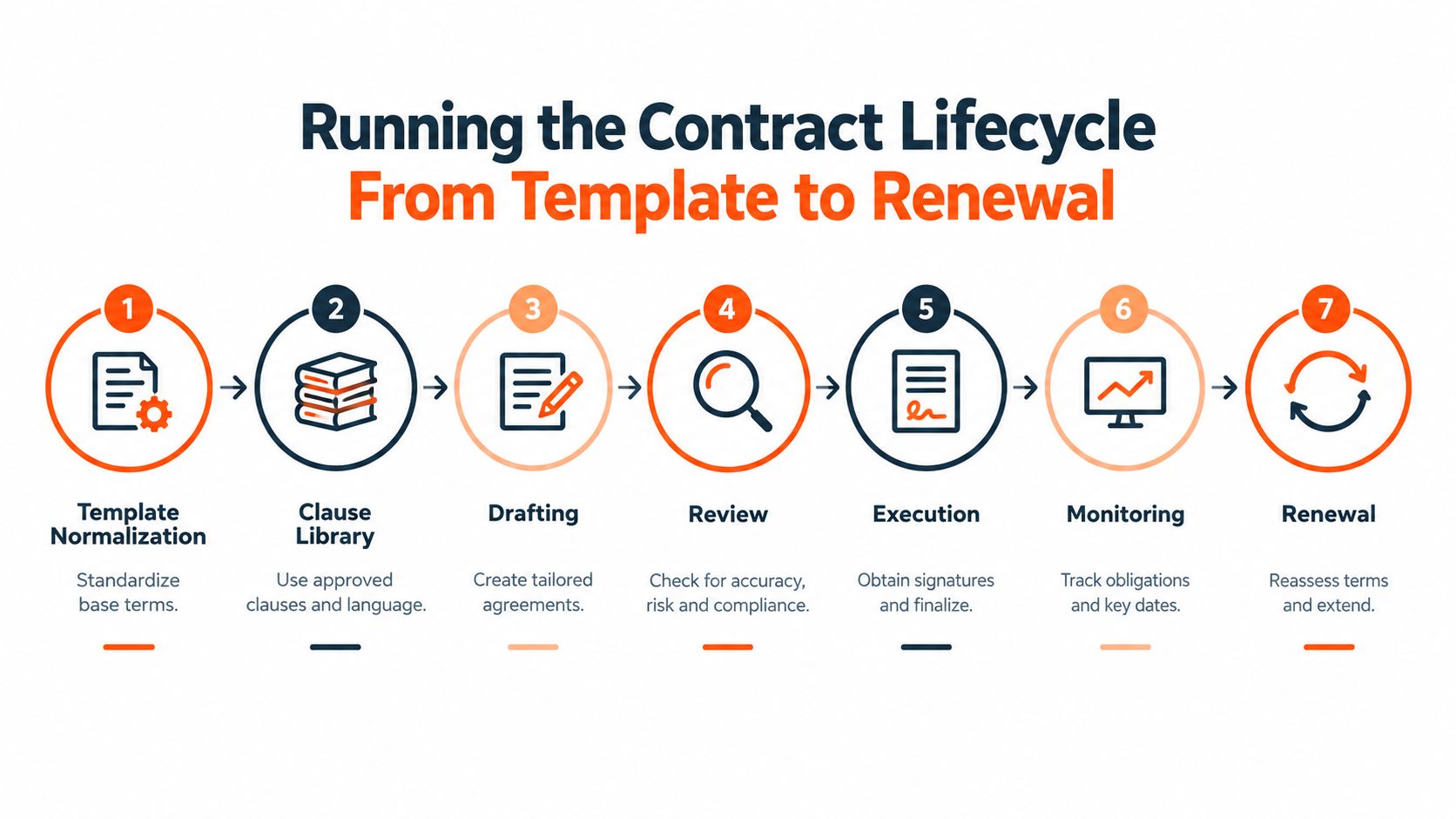
Template normalization comes first. Remove duplicate versions and establish approved fields for role, rate, scope, schedule, confidentiality, intellectual property, termination, and payment. A template should reduce avoidable negotiation, not prevent legitimate exceptions.
A clause library handles controlled variation. Store approved alternatives for contractor confidentiality, customer data, intellectual property, equipment, and notice language. Label each clause by use case and approval authority. Don't let managers copy language from an old contract without knowing whether the underlying business situation still matches.
Drafting and review should follow a single route. The hiring manager submits the commercial request. Legal or the designated reviewer handles exceptions. Finance validates payment terms and budget. HR or operations confirms onboarding and performance ownership. The system should show who has the next action, not merely that a document exists.
Execution creates the official record. Use electronic signature, then save the completed agreement, exhibits, amendments, and approval history in the same contract record. An unsigned draft in a folder isn't evidence of an active arrangement.
After signature, convert the agreement into an operating checklist. Assign owners for deliverables, access, payments, equipment, performance reviews, data-security tasks, and any customer-specific commitments. Link the contract record to the systems that show actual activity, such as payroll, finance, project management, and HR documentation.
Renewal management deserves its own calendar. Review the agreement 60 to 90 days before the notice deadline, not merely before the renewal date, because the business must decide before the cancellation window closes. For a more staged process, teams can use checkpoints around 90 days, 75 days, 60 days, 30 days, 15 days, and 7 days before expiry for review, strategy, proposal, follow-up, escalation, and final notice.
Practical rule: Calendarize the notice deadline, name the decision-maker, and record the decision. A renewal date without an owner is a future dispute.
A renewal review should cover performance, scope changes, rate, attendance or availability expectations, access requirements, data exposure, and whether the role still belongs in the current operating model. Use a documented amendment when the answer changes. For teams comparing external support options, compare staffing service pricing models based on administration included, accountability, replacement terms, and compliance coverage, not just the displayed hourly figure.
Small teams don't need a complicated legal operations department. They need a single source of truth, a consistent naming system, and one person accountable for each contract family. That lightweight structure addresses the most common visibility failures without creating unnecessary process.
The visibility gap is substantial. 60% of organizations identify lack of visibility as their top contract management challenge, 52% lack standardized CLM processes, and 49% say contracts are misplaced or missing, according to Wolters Kluwer's contract entity management research. CLM adoption remains 42% overall and 16% among solo in-house lawyers in the same source, which is why a smaller team should start with disciplined basics instead of buying software it won't maintain.
Use a central repository with access controls. It might be a dedicated CLM platform, a structured document system, or another controlled workspace that supports permissions, search, version history, and auditability. The tool matters less than the operating rules.
The owner should schedule recurring HR check-ins, verify performance expectations, confirm scope changes, and ensure that amendments reach the contract record. If a professional leaves, the owner coordinates access removal, final payment, equipment return, and documentation.
Virtustant's operating model is one example of a managed approach. It sources candidates and uses a four-stage vetting funnel consisting of a live English screen at C1 to C2 level, a cognitive assessment, a role-specific skills test, and experience or reference verification. The funnel produces a top 1% acceptance rate, and the service includes a shortlist within 48 hours, contract and payroll administration, HR check-ins, and a lifetime replacement guarantee. Those facts describe the service structure, not a guarantee of individual performance.
This can reduce contract churn when the client wants one operating partner for sourcing, contract administration, payroll, compliance, and replacement coordination. Teams assessing the model can review Virtustant hiring reduction insights alongside their own requirements for ownership, reporting, and escalation.
Most contractor disputes start before the formal dispute. A manager changes the scope in chat, a professional misses a deliverable that nobody defined, finance delays payment because approval ownership is unclear, or a renewal rolls forward without a performance decision. The remedy is better operating evidence, not a longer agreement alone.
Set expectations during onboarding and record changes in one place. When the role, hours, deliverables, rate, reporting line, or data access changes, require written approval and update the contract record. Legal, finance, HR, and operations should be able to see the same current terms.
For termination communications, write the notice against the agreement itself, state the clause relied on and the effective date, and have counsel adapt it to the applicable jurisdiction before it is sent. A replacement guarantee can also function as a continuity control when the business uses a managed staffing model. It doesn't remove the need to document performance or follow the contract, but it can reduce the operational impact of a departure.
Before approving any remote engagement, an executive should be able to answer:
Assign one accountable owner, work from a standard agreement and an approved clause library, centralise every signed document in one place, connect each contract to payroll and compliance, and track obligations after signature. WorldCC's August 2025 research puts average contract value erosion at 8.6%, and the best performers lose about 3% against 15% or more for the worst, so the gap is operating discipline rather than legal drafting.
Visibility. Wolters Kluwer reports that lack of visibility is the most common challenge at 60%, that 52% of organisations lack standardised contract lifecycle processes, and that 49% have misplaced or missing contracts. If a manager has to search email, Slack, a shared drive and a payroll portal to understand one agreement, the company does not have contract visibility.
No, when you work through a remote staffing agency that holds the contracting, payroll and local compliance. The agency is the counterparty in the worker's country, you direct the work, and you pay one all-in hourly rate rather than standing up a local entity, a payroll provider or an employer of record.
In the United States the IRS weighs three categories of evidence: behavioral control, financial control, and the type of relationship. It states plainly that there is no set number of factors and that no single factor decides the outcome. Where the answer stays unclear, either party can file Form SS-8 and ask the IRS to determine status, which usually takes at least six months. Classification rules differ in every other country involved, so take local advice.
Review 60 to 90 days before the notice deadline, not before the renewal date, because the decision has to be made before the cancellation window closes. A staged cadence works better than a single reminder: checkpoints at 90, 75, 60, 30, 15 and 7 days before expiry for review, strategy, proposal, follow-up, escalation and final notice.
Under a managed staffing model the agency holds the contract, payroll and compliance, so a departure is a replacement rather than a re-contracting exercise. Every Virtustant placement carries a lifetime replacement guarantee with no time cap. That does not remove the need to document performance or follow the agreement, but it limits the operational impact.
Virtustant connects U.S. companies with vetted LATAM remote professionals and manages contracts, payroll, HR, compliance, and ongoing account support under an all-in hourly model. See the remote staffing services page to evaluate a managed structure that keeps ownership, payment administration and post-signature operations in one workflow, or compare rates on the pricing page.