Time Zone Overlap: What It Means for Remote Teams
September 10, 2026


You've hired a remote professional who's talented, responsive, and ready to start. Then the first week reveals the problem: your team is online when the candidate is finishing the day, approvals wait overnight, and a simple customer or product question takes two calendar days to resolve. Time zone overlap is the number of working hours two locations share, and it should be treated as an operating constraint before you hire, not discovered after onboarding.
For U.S. teams hiring in Latin America, the practical answer is usually favorable. Major LATAM business centers sit close enough to U.S. working hours for same-day collaboration, but the right location depends on the role, the required customer coverage, and who absorbs the inconvenient meetings.
Every overlap figure in this guide is computed the same way: the LATAM professional works 9:00 to 18:00 local time and the U.S. team's usable day is 9:00 to 17:00 in its own zone. Both the standard-time and the U.S. daylight-saving result are shown, because they differ. Third-party figures are those each source publishes on its own site.
Want your own zone instead of an average? Virtustant's interactive overlap tool detects whether you are on Eastern, Central, Mountain, or Pacific time and ranks every LATAM country by how much of your 9-to-5 it actually covers.
Time zone overlap is the intersection of two working schedules. It isn't the difference between UTC offsets, the distance between cities, or a general sense that two regions are geographically close. If a New York team works from 9:00 to 18:00 and a remote professional in another location works from 9:00 to 18:00 locally, overlap is the portion of those schedules that occurs at the same clock time.
The calculation is straightforward:
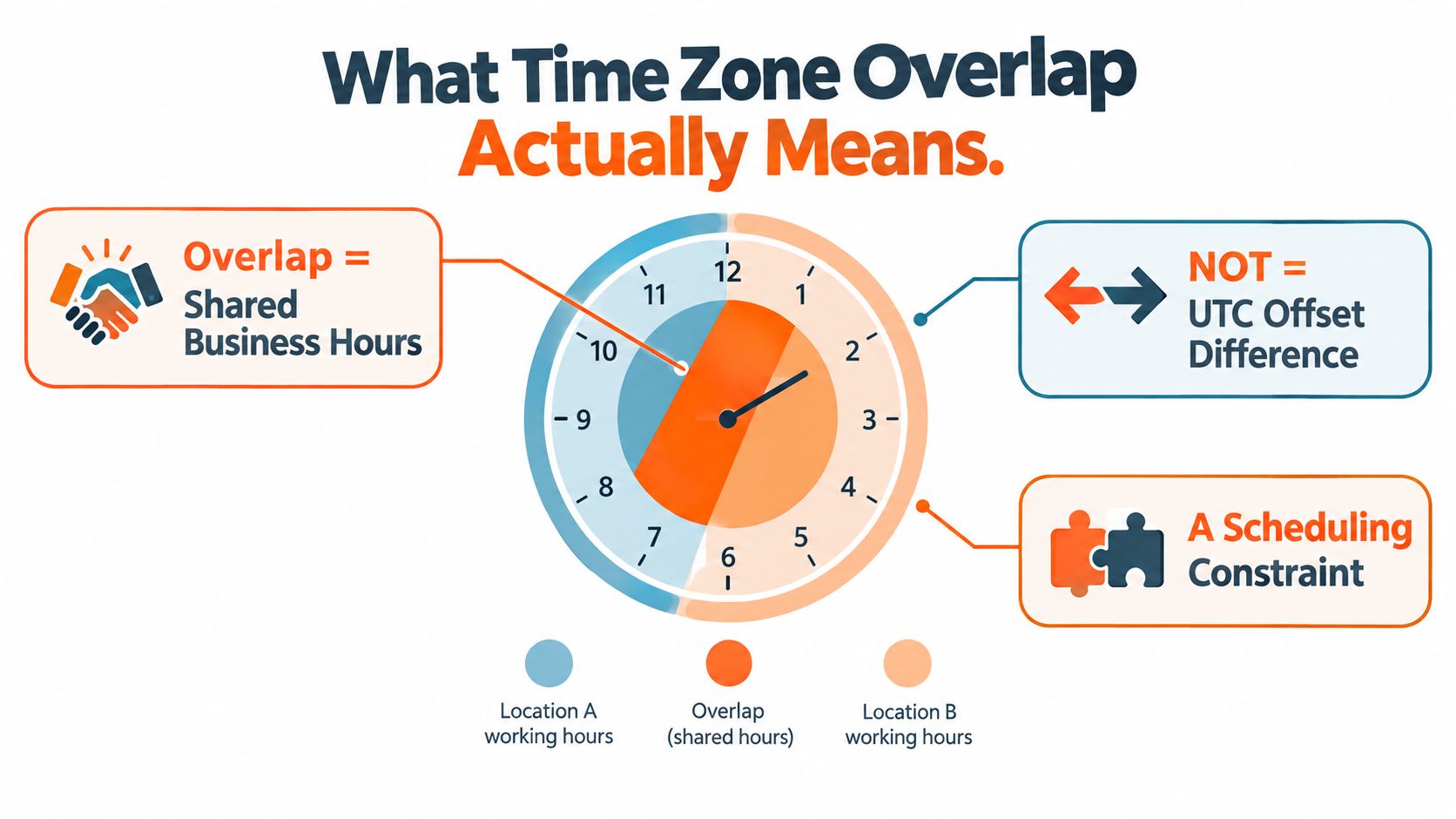
Every shared hour gives a team time for decisions, blockers, reviews, coaching, and customer conversations without waiting for the next workday. That makes overlap a measurable input alongside staffing capacity, project deadlines, and communication load.
The constraint becomes more visible as teams spread across locations. The GitLab Remote Work Report 2025 reports that 57% of distributed teams span three or more time zones, up from 39% in 2022. A Gartner HR survey finds that teams with fewer than two hours of daily overlap have 31% lower on-time delivery than teams with four or more overlap hours, and Doodle's State of Meetings puts the cost of arranging a single cross-time-zone meeting at 8.5 back-and-forth exchanges and 2.7 days to confirm. The three figures are collected together in this 2026 time zone management research roundup, which is a secondary compilation rather than the primary research itself.
Those figures don't mean every role needs four hours of live collaboration. They show why overlap creates operational efficiency. An engineer may work effectively with a short decision window, while a support agent handling U.S. customers needs live coverage through much more of the customer's day.
Operating rule: Treat overlap as a resource to allocate. Spend it on work that loses value when delayed, and move everything else into documented asynchronous workflows.
Time zone overlap also isn't a substitute for cultural or communication fit. A team can share the same hours and still struggle with unclear ownership, weak documentation, or language friction. For the async side of the operating model, teams can use these async work best practices to preserve context between live windows. That distinction is central to evaluating nearshore outsourcing cost savings, because lower coordination friction matters only when the role benefits from shared U.S. business hours.
The cleanest way to measure time zone overlap is to use local working hours, then correct the result for seasonal clock changes and actual availability. Start with a U.S. Eastern team whose usable day is 9:00 to 17:00 ET and a Mexico City developer working 9:00 to 18:00 local time.
Mexico City is UTC-6, one hour behind Eastern Standard Time. The developer's workday therefore maps to 10:00 to 19:00 ET, and the shared interval with the U.S. team is 10:00 to 17:00 ET: seven hours. When New York moves to daylight saving and Mexico City does not, the developer's day maps to 11:00 to 20:00 ET and the shared window narrows to six hours.
Now compare Bogotá, which is UTC-5 and matches Eastern Standard Time exactly. A 9:00 to 18:00 Bogotá schedule covers the full 9:00 to 17:00 Eastern day: eight hours. During the U.S. daylight-saving period New York moves one hour ahead of Bogotá, so the same schedule maps to 10:00 to 19:00 ET and the shared window becomes seven hours.
That is the arithmetic in full. It is worth doing explicitly, because the intuition that Bogotá gives a U.S. Eastern team only a few hours is wrong by roughly half a workday.
A good operator records both numbers: theoretical overlap and protected collaboration overlap. The first answers whether the locations can work together. The second answers whether the team can use the time.
| U.S. zone | LATAM hub | Standard time | U.S. daylight saving | What moves the number |
|---|---|---|---|---|
| Eastern | Mexico City | 7 hours, 10:00–17:00 ET | 6 hours, 11:00–17:00 ET | Mexico no longer observes daylight saving, so the U.S. change costs an hour |
| Eastern | Bogotá or Lima | 8 hours, full 9:00–17:00 ET | 7 hours, 10:00–17:00 ET | UTC-5 year-round, so it matches Eastern Standard Time exactly |
| Eastern | São Paulo | 7 hours, 9:00–16:00 ET | 8 hours, 9:00–17:00 ET | The only pairing here that gains an hour when U.S. clocks move |
| Pacific | Bogotá or Lima | 6 hours, 9:00–15:00 PT | 7 hours, 9:00–16:00 PT | Covers the Pacific morning through mid-afternoon, not just early morning |
| Pacific | Mexico City | 7 hours, 9:00–16:00 PT | 8 hours, full 9:00–17:00 PT | The strongest Pacific pairing in the region |
The broader planning guide gives a useful reference point: Eastern Time and Central European Time share roughly three hours of direct business-hour overlap, while Pacific Time and Central European Time share about one hour under a standard 9:00 to 18:00 assumption (working-hours overlap guide). Both figures check out against the arithmetic, and they set the contrast: the worst LATAM pairing in the table above still beats the best U.S.-to-Europe pairing.
A hiring manager doesn't schedule against UTC. They schedule a standup at 10:00, a customer call at 14:00, or a review before the U.S. team closes. The useful comparison is therefore the shared local-clock window between the U.S. base and the LATAM hub.
The table below runs every pairing. Each cell shows the overlap under standard time and, where it differs, under U.S. daylight saving. The LATAM professional works 9:00 to 18:00 local; the U.S. usable day is 9:00 to 17:00.
| LATAM hub | vs Eastern | vs Central | vs Mountain | vs Pacific |
|---|---|---|---|---|
| Mexico City (UTC-6) | 7 h / 6 h | 8 h / 7 h | 8 h full day | 7 h / 8 h full day |
| Bogotá (UTC-5) | 8 h full day / 7 h | 8 h full day | 7 h / 8 h full day | 6 h / 7 h |
| Lima (UTC-5) | 8 h full day / 7 h | 8 h full day | 7 h / 8 h full day | 6 h / 7 h |
| Santiago (UTC-4 / UTC-3) | 8 h full day | 7 h | 6 h | 5 h |
| São Paulo (UTC-3) | 7 h / 8 h full day | 6 h / 7 h | 5 h / 6 h | 4 h / 5 h |
| Buenos Aires (UTC-3) | 7 h / 8 h full day | 6 h / 7 h | 5 h / 6 h | 4 h / 5 h |
Three things fall out of that grid that the usual regional summary hides.
LATAM spans four primary time zones from UTC-3 to UTC-6, and most major hubs sit within 0 to 3 hours of U.S. Eastern Time. Those offsets are not anyone's proprietary finding: they are public record in the IANA Time Zone Database, the reference that operating systems and calendar software resolve against. Bogotá, Lima, and Quito share UTC-5, while Mexico City and several Central American markets align with UTC-6. A published LATAM time zone guide walks the same ground if you want a second pass over it. One published alignment guide puts Brazil and Argentina at about six hours of shared time with the U.S. East Coast (U.S.-LATAM time-zone alignment guide); on the 9-to-18 and 9-to-17 schedules used here the arithmetic gives seven hours under standard time and eight under U.S. daylight saving, so treat six as a conservative floor rather than the ceiling.
A city isn't a strong match merely because the total overlap looks large. Ask where the overlap sits.
For a deeper city-by-city view, use this time zone South America guide, or run your own zone through the country-by-country overlap tool. The practical filter is simple: choose the pairing where the shared window falls inside roughly 9:00 to 17:00 local time for the people who need to attend. A theoretically longer overlap is less useful if it forces one side into recurring late-night work.
The common recommendation of two to four hours of overlap is a starting point, not a staffing policy. It confuses the amount of shared time with the type of work that must happen inside it. It is also below the floor for every LATAM pairing in the table above, which makes it the wrong test for a nearshore decision in the first place.
An embedded engineer can often ship with a 90-minute decision window if tickets are specific, code reviews are written clearly, and the team doesn't require constant live supervision. A customer success manager covering U.S. accounts has a different requirement. If customers expect live responses through the U.S. afternoon, a short early-morning overlap won't cover the role, even if internal meetings fit.
| Role pattern | What needs to happen live | Practical overlap implication |
|---|---|---|
| Product engineering | Blockers, architecture decisions, incident escalation | A protected decision block may be enough |
| Design and product | Critique, iteration, stakeholder alignment | More frequent shared windows improve feedback |
| Sales development | Prospect calls, objection handling, manager coaching | Customer and prospect availability sets the floor |
| Customer support | Live tickets, escalations, handoffs | Coverage should follow the customer day |
| Executive or operations support | Calendar changes, approvals, urgent coordination | Match the principal's core hours |
Meeting cadence changes the answer too. A daily standup needs a reliable recurring slot. A weekly review can move across the week or use a recorded update. A production incident needs an escalation path even when the team has no shared hours.
The peer-reviewed research supports this task-specific view, and one finding cuts against the rule of thumb directly. Chauvin, Choudhury and Fang studied 12,038 employees of a large multinational firm and found that temporal distance produced "sizable but smaller than expected reductions in volumes of rich, synchronous communication," because employees time shift to compensate, most of all in non-routine jobs and in strong collaborative relationships (Working Around the Clock, Organization Science, 2024). Time shifting works. It also means the cost of thin overlap gets paid by individuals working outside their own hours, which is exactly the cost that shows up later as turnover.
A controlled laboratory experiment found something sharper still. Testing dyadic teams under full, two-thirds, one-third, and no-overlap conditions, Nan, Espinosa and Carmel report that "a small amount of time separation has a negative effect on production speed but, surprisingly, speed actually increases with further increases in time separation – a 'U' shaped curve," while time separation hurt accuracy throughout (ICIS controlled team experiment).
The counterintuitive part: a sliver of overlap can be worse than none. A little shared time invites teams to coordinate synchronously and fail at it. No shared time forces them to build real asynchronous discipline instead.
That is the argument against "get two to four hours" as a target. Two hours is not a safe midpoint between plenty and none; it can be the worst place on the curve. Either buy enough overlap to run the decisions live, or design honestly for async and stop pretending a daily 90-minute window is a substitute. The useful question is which decisions, handoffs, and customer interactions must happen synchronously, then staffing for that requirement.
For a practical communication policy, compare the role against Virtustant async sync communication. Async work should absorb status reporting and documentation. It shouldn't be used to disguise a role that requires live coverage.
Overlap creates value only when the team protects it. If every meeting lands inside the shared window, the team has no room left for focused work. If nobody reserves the window, urgent messages consume it and the most important decisions still wait.
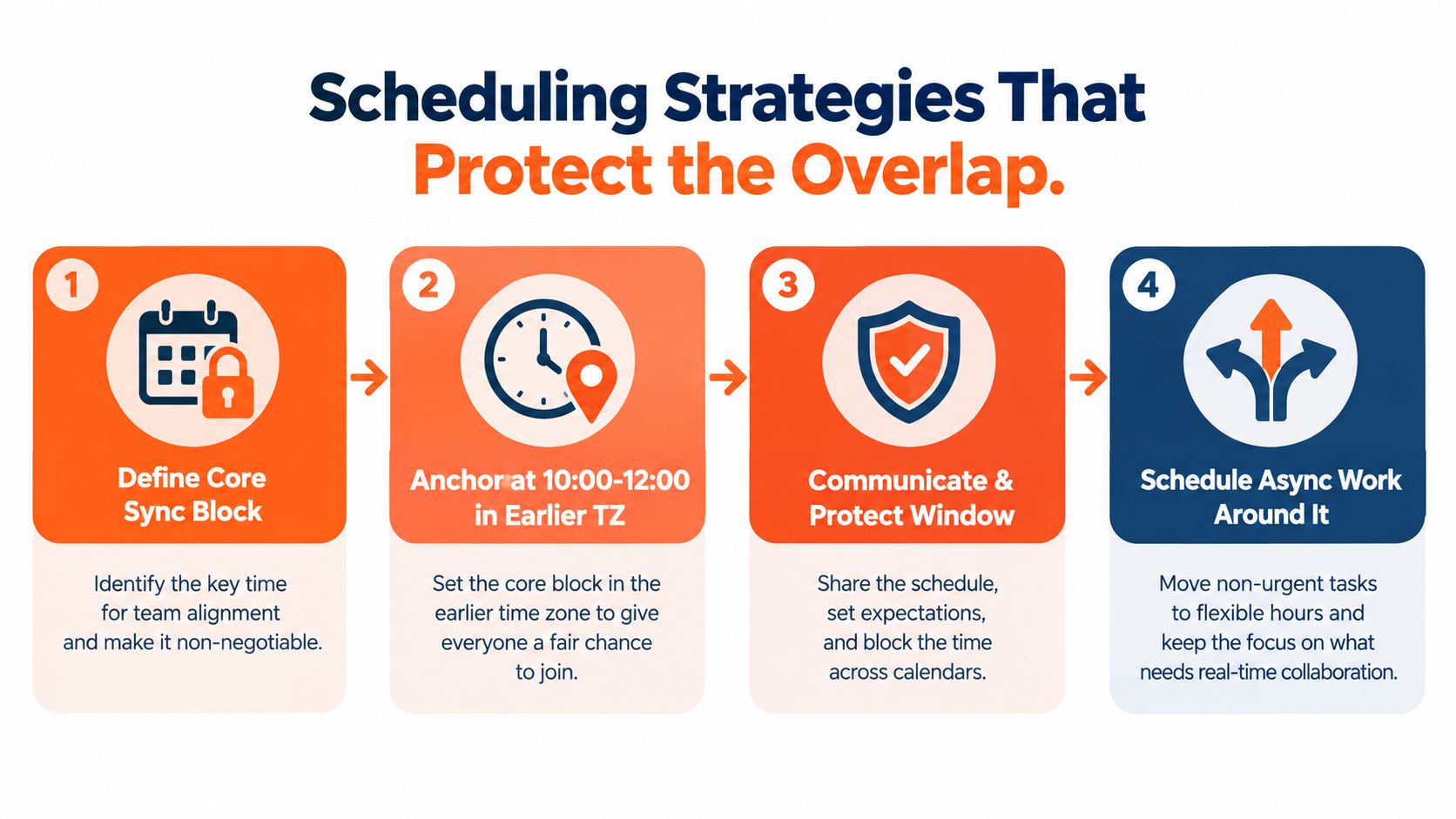
A fixed meeting time may look efficient until the same person repeatedly starts before normal hours or finishes late. That burden eventually appears as lower energy, missed context, and avoidable turnover risk. It is also the mechanism the 12,038-employee study measured: time shifting absorbs temporal distance, and someone is doing the shifting.
Fairness rule: Rotate the inconvenient end of the schedule. Don't call permanent off-hours availability “flexibility.”
Publish the rule before the team grows. A quarterly rotation works for recurring meetings, while high-stakes customer coverage may require a role-specific schedule instead. The policy should state which meetings require attendance, which can be watched asynchronously, and how urgent issues escalate outside overlap.
For broader remote-work operating guidance, these 2026 remote work tips provide useful context on connectivity and distributed-work routines. Tools help, but they won't repair a schedule that spends every shared hour on meetings. Reserve the live window for work that changes when someone is present.
For U.S. companies that need more than async-friendly engineering, nearshore LATAM staffing is an overlap strategy. Mexico City, Bogotá, Medellín, São Paulo, Buenos Aires, and Santiago can place remote professionals inside or near the U.S. workday, allowing teams to collaborate without building a permanent overnight schedule.
The advantage is strongest when the role depends on rapid feedback. Sales development, customer support, executive assistance, finance operations, and product delivery all benefit from same-day questions and approvals. The choice still has trade-offs. Payroll registration, tax withholding, employer contributions, contractor classification, and local compliance vary by country, and employers with remote workers abroad generally need to address those obligations in the relevant jurisdiction (global remote-work compliance guidance).
| U.S. base | LATAM hub | Overlap, standard time | Overlap, U.S. daylight saving | Where the window sits |
|---|---|---|---|---|
| New York | Bogotá | 8 hours, full 9-to-5 | 7 hours | Whole Eastern day; loses the last hour in summer |
| Miami | São Paulo | 7 hours | 8 hours, full 9-to-5 | 9:00–16:00 ET, widening to the full day in summer |
| Chicago | Mexico City | 8 hours, full 9-to-5 | 7 hours | Whole Central day at standard time |
| Austin | Mexico City | 8 hours, full 9-to-5 | 7 hours | Whole Central day at standard time |
| Los Angeles | Mexico City | 7 hours | 8 hours, full 9-to-5 | Best Pacific pairing in the region |
| Los Angeles | Bogotá | 6 hours | 7 hours | 9:00–15:00 PT; the gap is the late afternoon |
| New York | Buenos Aires | 7 hours | 8 hours, full 9-to-5 | 9:00–16:00 ET, widening in summer |
The table deliberately carries no compensation figures. Overlap is a schedule question with a verifiable answer; cost depends on role, seniority and scope, and should be evaluated from a complete quote that includes sourcing, vetting, contracts, payroll, HR, compliance, and replacement terms.
A managed provider is useful when the buyer doesn't want to build country-specific administration. Virtustant is a remote staffing agency that sources, assesses, and places LATAM remote professionals while handling contracts, payroll, HR, and compliance through one relationship. Candidates come from the top 1% of applicants through a four-stage vetting funnel: a live English screen, a cognitive assessment, a role-specific skills test, and experience and reference verification.
The strongest case for nearshore talent with U.S. time-zone overlap isn't just labor-cost reduction. It's overlap arbitrage: access to a broader talent pool while preserving live collaboration during the hours when U.S. managers make decisions. The right provider should also explain country-level compliance instead of presenting cross-border hiring as a simple international payment.
A candidate's resume won't tell you whether the schedule will work. Test overlap fit before extending an offer, using the actual role, city, calendar, and escalation expectations.

Treat the checklist as a hard filter. A candidate who fails two items is a higher-risk hire than their technical background suggests, because the team will pay for the mismatch through delayed decisions and repeated rescheduling.
For sourcing and assessment guidance, review Virtustant on hiring in Latin America. If you're hiring from a region more than six hours away, weigh overlap fit as heavily as the candidate's time zone. Async documentation can preserve context, but it can't fully replace relationship-building, rapid iteration, customer conversations, or incident response during an early-stage company's critical working hours.
Time zone overlap is the intersection of two working schedules: the hours during which two people in different time zones are both inside their normal working day. It is not the difference between UTC offsets. If a New York team's usable day is 9:00 to 17:00 ET and a Bogotá professional works 9:00 to 18:00 local, the overlap under standard time is the full eight hours, because Bogotá is UTC-5 and matches Eastern Standard Time exactly.
It depends on what has to happen live, not on a universal number. An embedded engineer can ship with a 90-minute protected decision block if tickets are specific and reviews are written. A customer success manager covering US accounts needs coverage through the customer's active afternoon. Decide which decisions, handoffs and customer interactions must be synchronous, then staff for that.
It means four hours of the two workdays fall at the same clock time, so both people are available for live calls, reviews and decisions during that window. It says nothing about where in the day the window sits, which matters more for customer-facing roles. Four hours landing in the US morning is a different product from four hours landing at 16:00.
No, and a controlled experiment suggests it can point at the worst option. Nan, Espinosa and Carmel found a U-shaped curve: a small amount of time separation hurt production speed, but speed rose again as separation increased further. A sliver of shared time invites teams to coordinate synchronously and fail at it, while no shared time forces real asynchronous discipline. Either buy enough overlap to run decisions live or design honestly for async.
On a 9-to-18 local LATAM schedule against a 9-to-17 US day, every major hub clears four hours and most clear seven or eight. Eastern teams get a full 9-to-5 from Bogotá, Lima and Santiago. Central teams get a full day from Mexico City, Bogotá and Lima. Pacific teams get a full day from Mexico City during US daylight saving. The weakest pairing in the set is Buenos Aires against Pacific at four to five hours.
There is no single answer, because it depends on the buyer's zone. Bogotá, Lima and Santiago are strongest for Eastern teams. Mexico City is strongest for Central, Mountain and Pacific teams. São Paulo and Buenos Aires are strongest for Eastern and Central. Any recommendation that names one best country without asking which US zone you are in is not answering the question.
Yes, and not always in the same direction. Mexico ended nationwide daylight saving in 2022 and Brazil suspended it in 2019, so when US clocks move the offset changes on one side only. That costs an Eastern team an hour with Mexico City and Bogotá, but it gains an hour with São Paulo and Buenos Aires. Chile runs a southern-hemisphere calendar, which shifts the opposite way.
Yes, and the constraint is smaller than most guides suggest. Bogotá and Lima give a Pacific team six to seven hours, running from 9:00 to roughly 15:00 or 16:00 PT. The missing piece is the late Pacific afternoon, not the morning. Mexico City is the stronger Pacific pairing, covering a full 9-to-5 during US daylight saving.
Lock one recurring core block for decisions, customer calls and unblocking, and move status updates, dashboards and routine review comments out of it. Add written end-of-day and start-of-day handoffs at the edges, publish working hours in shared calendars, and keep a decision log. Overlap consumed entirely by meetings leaves no room for the work the meetings were about.
Rotate it, on a published schedule rather than on goodwill. A fixed time that always lands outside one person's hours shows up later as lower energy, missed context and turnover risk. The peer-reviewed evidence is that employees do time shift to absorb temporal distance, which is precisely why the burden needs to be shared rather than assumed.
Start by getting the number for your own zone rather than a regional average. The overlap tool detects whether you are on Eastern, Central, Mountain or Pacific time and ranks every LATAM country by how much of your 9-to-5 it covers, with the current daylight-saving rules already applied.
If the pairing works, the next step is a shortlist. Virtustant places pre-vetted bilingual professionals across Latin America and carries sourcing, assessment, contracts, payroll, HR and compliance, while you direct the work. Engagements run month-to-month with a lifetime replacement guarantee and no time cap, a first shortlist of 3–5 vetted candidates within 48 hours, and a start in 72 hours. Rates start at $7/hr all-in and zero placement fees, which lets you save up to 70% versus a comparable US hire once payroll, benefits and compliance are counted.
Book a discovery call, check what your role costs, or read how the nearshore staffing model works first.
Overlap figures in this guide are computed from current UTC offsets on the stated schedules, taken from the IANA Time Zone Database, and cross-checked against Virtustant's own country-by-country overlap tool. Third-party figures are those each source publishes on its own site.
Primary sources
Additional reading — secondary compilations and vendor guides. These are listed because they are useful background, not because any figure above rests on them.