
Virtual Assistant Contract Risks: 10 Terms to Negotiate Before You Sign (2026)
November 27, 2026


The U.S. Bureau of Labor Statistics counted 11.9 million independent contractors in their sole or main job in July 2023, 7.4% of total employment. Most virtual assistants are hired on some version of that contract, and the risk rarely sits in the signature. It sits in the exit: lock-in, notice, early-termination and conversion fees, replacement, and who keeps your files. Below are the 10 terms to negotiate, a way to price leaving, and how four hiring models compare.
Need the document itself? Use our copy-ready virtual assistant contract template. This guide is the other half: the buyer's side of the table, where you decide what to accept, what to push back on and when to walk away.
Not legal, tax or employment advice. Have counsel in your state, and in the assistant's country, review any agreement before you sign.
Virtual assistant work is a crowded category. Growth Market Reports, a market research vendor, sizes the overall virtual assistant market at USD 12.9 billion in 2024. The figure combines AI software and services, with software the larger share, so read it as a sign of crowding, not a count of human assistants.
More offers means more contract shapes, and the rate always sits on page one. Signing day is the cheapest day of the relationship. The expensive days come when something changes: the assistant is not working out, your workload drops, the provider raises the rate, or you want to hire the person directly. That is when a 12-month minimum, a 30-day notice period or a conversion fee becomes a real invoice. So read the contract backward, from termination to rate.
These clauses move money when the relationship changes. The red flag shifts the risk to you; the push-back is what a reasonable provider can accept.
| # | Term | Red flag | What to push for |
|---|---|---|---|
| 1 | Minimum term | 12-month commitment that auto-renews | Month-to-month, or a short first term that rolls monthly |
| 2 | Notice period | 60 to 90 days, or notice only at renewal | Notice in weeks, not months, and the same length for both sides |
| 3 | Early-termination fee | All remaining fees in the term become due | No fee, or a fixed cap you can price today |
| 4 | Conversion or buyout fee | Open-ended fee to hire the person directly | A written fee, a sunset date and no fee after it |
| 5 | Non-solicit | Bars you from ever working with the person again | Limited in time and tied to the conversion terms |
| 6 | Replacement | Guarantee ends after a short window, or a new fee applies | Who triggers it, how fast it starts, what you pay during the gap |
| 7 | Rate changes | Increases at the provider's discretion | Written notice, a fixed review date and a right to exit first |
| 8 | Hours and billing | Weekly minimum billed whether used or not | A clear minimum, billing on hours worked, a way to lower hours |
| 9 | IP on exit | Work product assigned only after every invoice is settled | Present assignment of work product, with any dispute handled separately |
| 10 | Data and access on exit | No return, deletion or revocation duty | Named return format, deletion confirmed in writing, access removed on the last day |
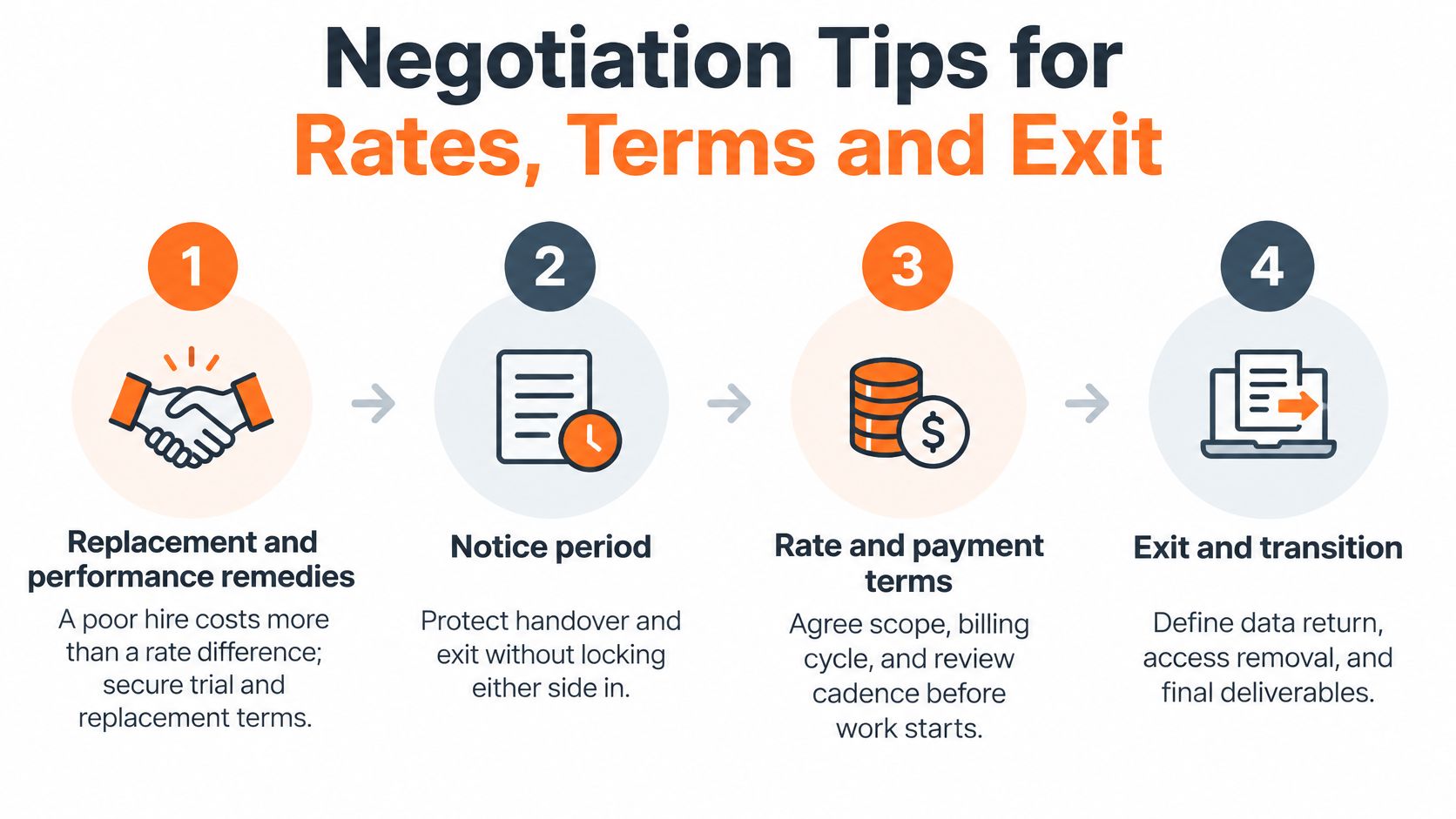
Two rows matter most. Minimum term plus early-termination fee decides whether you can leave at all. Replacement decides how long you go without coverage. They produce the biggest numbers in the test below.
Trade where the cost to the provider is low: a shorter notice period for a minimum term it will not drop, a sunset date for a conversion fee it will not cap. Every concession belongs in the signed document, not in an email.
To negotiate, you need to spot the sentence that hurts. These snippets illustrate a negotiation point; they are not clauses to paste.
Lock-in. Before: "This Agreement renews automatically for successive 12-month terms unless cancelled in writing 60 days before renewal." After: "This Agreement continues month to month. Either party may end it with two weeks' written notice." Miss the one window by a day and you have bought another year.
Early termination. Before: "If Client terminates before the end of the Term, all fees for the remainder of the Term become due." After: "Client may terminate at any time on notice. No fee applies beyond hours worked through the notice period." If a fee stays, get a fixed dollar figure.
Conversion. Before: "Client shall not engage the Professional directly or indirectly at any time without paying the Conversion Fee." After: "If Client engages the Professional directly within 6 months after this Agreement ends, Client pays the Conversion Fee in Schedule 1. No fee applies after that." The difference is a number and a date.
Rate changes. Before: "Provider may adjust rates from time to time." After: "Rates are fixed for 12 months. Any later change requires 30 days' written notice, and Client may end the Agreement before it takes effect."
The lengths above are illustrations. Set your own against the engagement and the mandatory rules in the assistant's country.
The Exit Cost Test turns the back of the contract into one dollar figure you can compare across offers.
Exit Cost = N + T + C + G
N = notice weeks you pay for but no longer want x weekly cost
T = early-termination fee, or the remaining minimum-term fees you owe
C = conversion or buyout fee, only if you keep the person and drop the provider
G = replacement gap: weeks without coverage x what an uncovered week costs you
Example inputs (illustrations, not quotes from any provider): a 20 hour-a-week assistant at an example rate of $10/hr in every model, so only the terms differ. Weekly cost: 20 x $10 = $200. Monthly billing: 20 hours x 52 weeks / 12 months = 86.67 hours x $10 = $866.67, rounded to $867. An uncovered week costs you an example $500: you cover 10 of the 20 hours yourself, at an assumed $50/hr of your own time. The scenario: in month four the person is not working out, and you need someone else doing the work.
| Example contract type | N: notice | T: termination fee | C: conversion | G: replacement gap | Exit cost |
|---|---|---|---|---|---|
| A. Locked agency contract (12-month minimum, 30 days' notice, fee of one month's billing, replacement window already expired) | 4 weeks x $200 = $800 | $867 | $0 | 3 weeks x $500 = $1,500 | $3,167 |
| B. Direct freelancer contract (14 days' notice, no fees, no replacement: you recruit again yourself) | 2 weeks x $200 = $400 | $0 | $0 | 5 weeks x $500 = $2,500 | $2,900 |
| C. Month-to-month agency with no fees and replacement included (provider swaps the person; billing continues for the work you use) | $0 | $0 | $0 | 1 week x $500 = $500 | $500 |
The arithmetic: A = $800 + $867 + $0 + $1,500 = $3,167. B = $400 + $0 + $0 + $2,500 = $2,900. C = $0 + $0 + $0 + $500 = $500.
What dominates the number. The replacement gap and the termination fee, not the rate. Compare that with the rate discount most buyers fight for: $1/hr off at 20 hours a week is $20 a week, or $1,040 a year over 52 weeks. One exit under contract A costs $2,667 more than under contract C, which is about 2.6 years of that discount ($2,667 / $1,040 = 2.56). Under contract B the gap is $2,400, or about 2.3 years.
The other exit: keep the person, drop the provider. Run the same formula with G at zero, because the person stays. Under contract A, with an example conversion fee of $2,500: $800 + $867 + $2,500 = $4,167. Under contract B there is no provider to leave. Under any agency contract, the answer is the conversion clause, so get its number and date in writing.

If a provider cannot give you N, T, C and G in writing, that is the answer.
The four common ways to hire a virtual assistant put the same clauses in different hands. Category columns describe what to check, not any named provider; the last column is our own standard placement.
| Term | Freelancer, direct | Freelance marketplace | Remote staffing agency | EOR platform | Virtustant standard placement |
|---|---|---|---|---|---|
| Who the assistant contracts with | You | You, under the platform's terms as well | Usually the agency | The EOR, as local employer | Virtustant |
| Pay and paperwork | You | You pay through the platform | The agency, in most models | The EOR runs local payroll | Virtustant: contracts, payroll and the paperwork on the professional's side |
| Fees to start | Usually none | Platform fees | Placement fee in recruiter models; none in some monthly models | A monthly fee per worker on top of pay | $0 placement fees |
| Lock-in and notice | Whatever you negotiate | Set by the platform's terms and your contract | Varies from month-to-month to multi-month minimums | Follows local labor law, including notice | Month-to-month |
| Keeping the person, leaving the provider | Not applicable | Check the platform's rules on moving off-platform | Check the conversion fee and non-solicit | Check the transfer terms | Ask for the terms in writing, as with any provider |
| Replacement | You recruit again | You post and screen again | Guarantee length and cost vary | Usually you recruit again | Lifetime replacement guarantee, no time cap |
| NDA | You draft it and chase the signature | You, on top of platform terms | Check whose NDA is signed, and when | Check that the contract covers your confidential data | Your professional signs your NDA, or ours, before day one |
An EOR arrangement is formal employment in the worker's country, so ending it follows that country's labor law. We offer an Employer of Record option for our placements, priced on the discovery call; our standard placements are not an EOR arrangement. Fees also hide in different places. Our breakdown of what staffing agencies charge lists the fee types to ask about, and our guide to choosing a remote staffing agency covers the questions beyond price.
People search for a virtual assistant with no contract because they have been burned by a lock-in, or do not want to buy a year of help before they know it works. The honest answer is that "no contract" should mean no long-term commitment, not no paperwork.
A relationship with no written terms is the riskiest version for you: nothing says who owns the work, what happens to your data or what notice either side owes. In the US, work a contractor creates is generally not yours just because you paid for it; ownership usually moves through a signed, written assignment.
What you want is a short agreement with no minimum term, plus an NDA and an IP assignment signed before the first login.
From our placement records. Between May and October 2026 we recorded 657 placement starts (73 in May, 132 in October). Every one carried zero placement fees and the lifetime replacement guarantee, so none of those clients paid to search, and none paid again when a seat had to be refilled.
Some terms are worth negotiating. These are reasons to walk away:
The last flag matters most when you contract with the assistant directly. The IRS sorts the evidence into behavioral control, financial control and the relationship of the parties. Its behavioral test asks whether the business has the right to direct and control the work, even where that right is never exercised. Under the relationship heading, the IRS lists benefits and an indefinite relationship among the facts it weighs, next to how the written contract is worded.
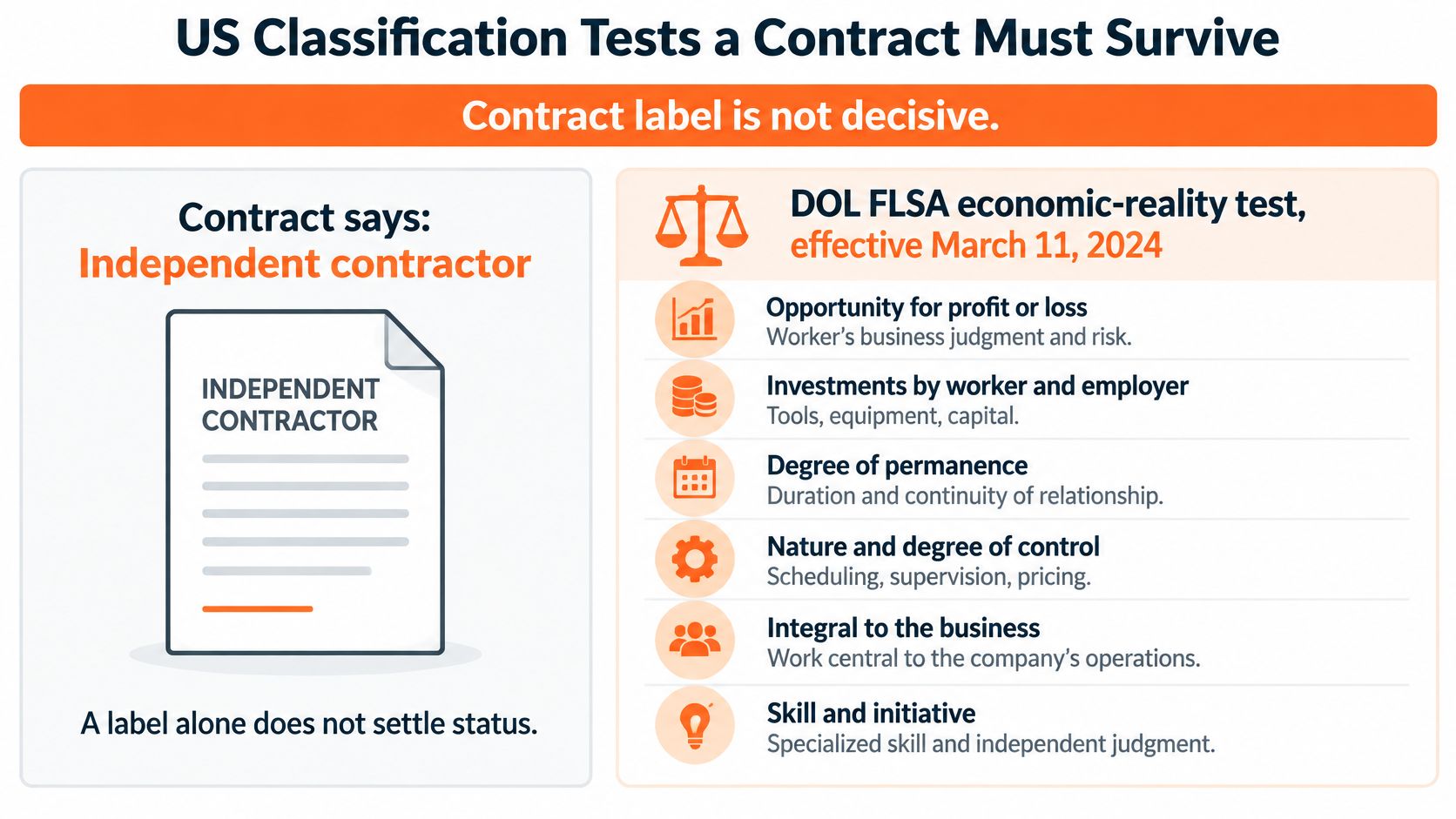
So a clause that writes in daily check-ins and fixed procedures can create the very right the label denies. Plaintiff-side lawyers make the same point from the worker's side: a Mississippi law firm's explainer on whether someone is a contractor or employee in Mississippi calls a signed contractor agreement evidence, not a final answer. If you want the tests side by side, our guide to contractor and W-2 status walks through them. The fix: make the paper match the week, or choose a model where the assistant does not contract with you.
Three questions decide how IP and data terms hold up at exit.
Who owns what was built? Push for a present assignment of work product, so ownership moves as the work is created, not at the end. Tying it to the final invoice turns a billing dispute into leverage over your files. As our NDA and IP protection page puts it, an NDA does not transfer ownership of what your hire creates, so most deliverables need a written IP assignment.
What comes back, and in what form? Name the systems, the export format and a deadline. A return clause with no format can be met with a zip file nobody can use.
What gets deleted, and how do you know? If the assistant processes personal data for you and the GDPR applies, GDPR Article 28 requires the processor contract to provide that, at the controller's choice, personal data is deleted or returned after the services end, and existing copies are deleted unless law requires storage. Even outside the GDPR, ask for deletion confirmed in writing.
Access you control yourself: individual logins in accounts you own make removal one action on the last day. Our independent contractor NDA guide covers what the confidentiality layer should define before anyone touches your systems.
Rates move. Ask for a fixed rate for a stated period, written notice before any change, and the right to leave before a new rate takes effect.
A weekly hours minimum is normal; one billed whether or not the hours were worked, with no way to lower it, is a lock-in by another name. Also ask whether the hourly rate rises if you cut hours. Current virtual assistant rates by role and region give you a market anchor before you push.
If you contract with an assistant abroad directly, payment terms carry their own risk: when the payment clock starts, what makes an invoice valid, which currency applies and who pays transfer and FX costs. Zaro, a cross-border payments company, has a guide to contractor payment terms that protect cash flow written for South African businesses; its points on payment triggers, dispute windows and fee allocation carry over. For the mechanics, see our guide on how to pay international contractors.
Virtustant is a remote staffing agency. Our standard placement, part by part:
| Exit Cost part | Virtustant standard placement |
|---|---|
| N: notice | Month-to-month; cancellation follows the terms in your agreement, so read that clause like any other |
| T: termination fee | No long-term contract and no early-termination penalty |
| C: conversion | Ask us for the terms in writing on the discovery call, as you would with any provider |
| G: replacement gap | Lifetime replacement guarantee, no time cap, through the same vetting |
The structure: the professional contracts with Virtustant, and Virtustant handles contracts, payroll and the paperwork on the professional's side. You direct the day-to-day work, grant and control every account permission, and get one weekly invoice per placement, with zero placement fees. Your professional signs your NDA, or ours, before day one; if you want a written IP assignment, you add it to your terms and it is signed with the NDA. Engagements start at 10 hours a week, at the same hourly rate part-time or full-time.
A replacement goes through the same vetting as the first hire. The funnel: 100% apply, 22% clear the recruiter screen, 9% pass cognitive (IQ), skills and English testing, 3% reach a live interview, 1% are hired. Timing is a capacity, not an average: a shortlist within 48 hours of the call; your hire can start within 72 hours of that same call. On price, a virtual assistant starts at $7/hr all-in. The Bureau of Labor Statistics puts the May 2025 median wage for secretaries and administrative assistants at $23.23/hr, so $7 is under a third of it ($7 / $23.23 = 30.1%). See the pricing page, how the Zero-Fee Model works, and our virtual assistant hiring page. Clients rate us 4.9/5 on G2.
Bring the contract you are being offered elsewhere, or your NDA, and book a discovery call. To draft the document yourself, start from our virtual assistant contract template with schedules.
You can avoid a long-term contract, but do not skip the paperwork. Without a written agreement, an NDA and an IP assignment, nothing says who owns the work, what happens to your data or how much notice either side owes. Look for month-to-month terms with those documents signed before day one.
Not always, but it needs a price. A 12-month minimum with auto-renewal and an early-termination fee of all remaining fees can cost thousands if the assistant does not work out. Ask for month-to-month terms, or a short first term that rolls monthly, and put any fee into the Exit Cost Test.
It can try, through a non-solicit clause or a conversion fee. What matters is whether the restriction has a number and an end date. Push for a fixed conversion fee written into the contract, and a sunset date after which no fee applies.
That depends on the exit clause. Ask for a present assignment of work product, a named return format and window, deletion confirmed in writing, and individual logins in accounts you own so you can remove access on the last day yourself.
Usually the agency's service agreement for fees, notice and replacement, with your own NDA and IP terms attached. If the agency will not accept your NDA or a written IP assignment, treat that as a red flag.
If the contract allows changes at the provider's discretion, yes. Ask for a fixed rate for a stated period, written notice before any change, and the right to end the agreement before a new rate takes effect.
One that says who can trigger it, how fast candidates arrive, what you pay during the gap and how long it lasts. Windows that expire in the first weeks leave you paying for the gap. Virtustant offers a lifetime replacement guarantee with no time cap.


