Virtual Receptionist Pricing Explained: What It Costs in 2026
September 18, 2026


Virtual receptionist pricing in 2026 falls into three bands. Published AI receptionist plans run about $14 to $199 a month for 60 to 400 included voice minutes, with overage around $0.25 a minute. Live answering services start at roughly $137 to $325 a month and land near $400 to $900 a month at realistic call volume, billed at $1.75 to $5.40 a minute. A dedicated remote receptionist starts at $7 an hour all-in, about $1,120 a month for full-time coverage. A fully loaded in-house receptionist costs roughly $4,525 a month, or about $54,300 a year, once employer benefit costs are added to the median wage.
The right comparison is not the cheapest monthly plan. It is how much reliable front-desk capacity you get after usage fees, scheduling work, bilingual coverage, payroll, compliance, supervision and replacement risk are counted. A tool that takes messages is not economically equivalent to a dedicated remote professional who books appointments, updates a CRM, handles intake and works alongside your team during U.S. business hours.
This guide gives you the published price of every model, the arithmetic for the point where one becomes cheaper than another, and what U.S. companies actually budget for the role in our own hiring pipeline.
The term virtual receptionist covers several different products sold under one name. At the low end, software answers calls, routes inquiries, handles basic questions and records messages. In the middle, a shared pool of human agents answers under your business name and takes messages from a script. At the high end, one named person performs front-desk work: appointment booking, caller qualification, CRM updates, follow-up coordination, bilingual communication and consistent coverage.
That spread is why quotes for the same job can differ by a factor of forty. The buyer is not comparing prices for one service. They are comparing prices for three services that share a job title.
A message-taking plan sells access to a communication channel. A dedicated receptionist sells managed capacity. Those are different purchases and they should be priced differently.
A low-volume business might need only call capture after hours. Another business may need someone to schedule consultations, confirm appointment details, enter caller information into HubSpot or Clio, escalate urgent requests and stay available all day. The second buyer should not be shopping by the minute. They are buying dependable execution across recurring administrative work.
The category has also moved from per-call and per-minute billing toward subscriptions and AI-assisted bundles. Providers increasingly package scheduling, CRM functions, routing and 24/7 availability into a single fee. That makes budgeting easier, and it also hides limits, overage charges and feature restrictions behind one number.
Operator rule: define the work before you compare the price. If the role carries recurring administrative responsibility, price managed capacity, not telephone minutes.
If the job is closer to a front desk than a call queue, start from the role rather than the plan: see what a dedicated virtual receptionist actually covers, and read our guide to hiring a virtual receptionist for the vetting and onboarding side of the decision.
Virtual receptionist pricing follows three models: flat AI subscriptions, usage-based live answering, and dedicated hourly or seat-based coverage.
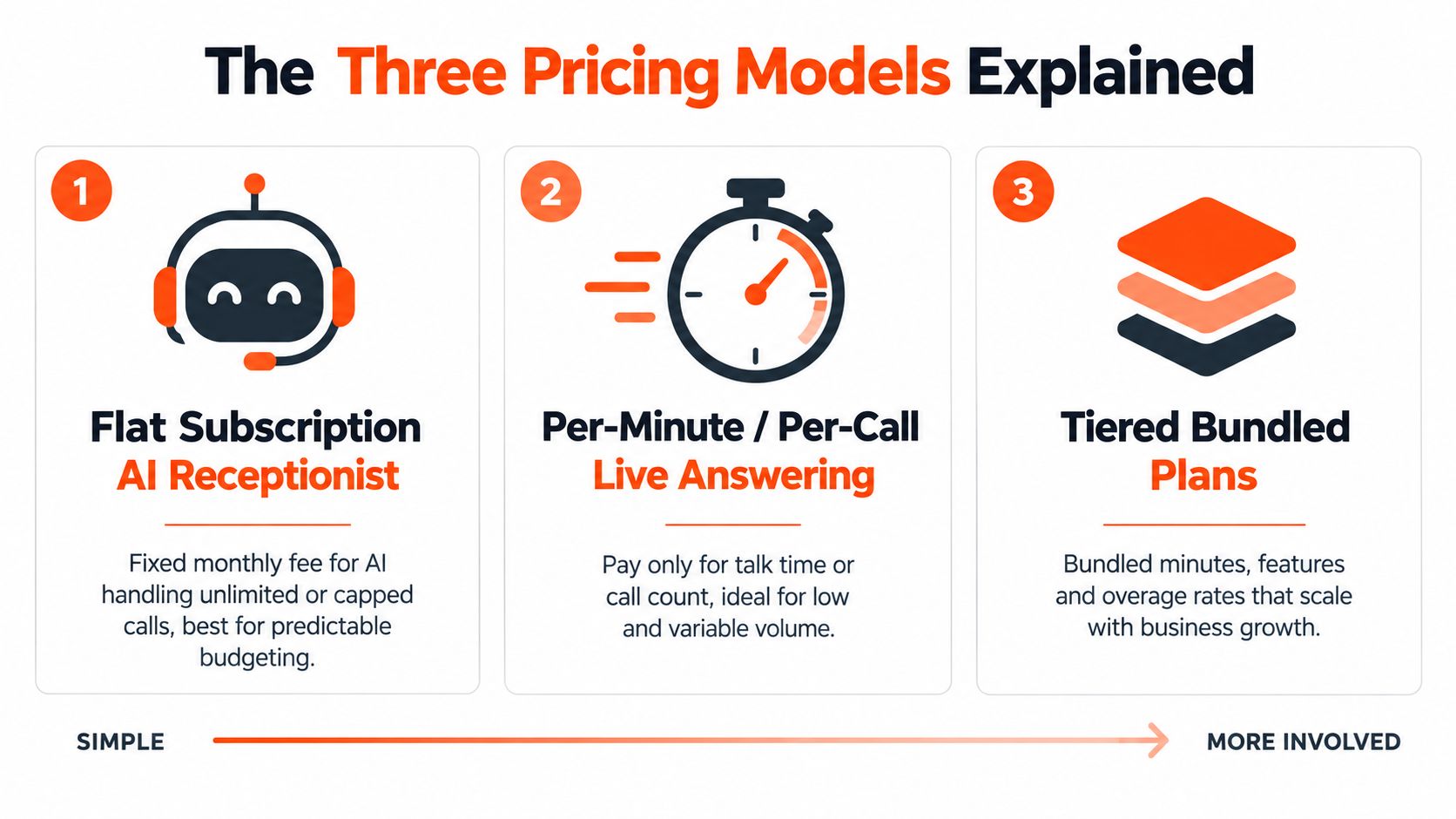
AI receptionist plans charge a fixed monthly fee against an included minute allowance. Published pricing in September 2026 shows the shape clearly. One vendor lists tiers at $14, $39, $99 and $199 a month for 60, 60, 200 and 400 included voice minutes, with additional minutes at $0.25. Another lists a single $99 a month plan carrying 200 voice minutes, 100 chatbot conversations and 400 SMS messages, with overage priced in credits that also work out to about $0.25 a voice minute. Enterprise tiers on both are quoted custom.
Read those two numbers together, because the allowance is what actually sets your bill. A $99 plan with 200 included minutes costs $0.50 a minute if you use exactly the allowance, and roughly $0.33 a minute at 400 minutes once overage is added. AI is cheap per minute, but it is cheap per minute of talk time, not per hour of availability.
This model suits a company that wants predictable budgeting, basic routing, FAQs, appointment requests and after-hours capture. It does not suit every conversation. AI struggles when callers use unusual phrasing, give incomplete information, or need judgment the configuration never anticipated. Ask whether the plan includes call recording, transcripts, scheduling, CRM writes, escalation to a human, and integrations. Those details decide whether the subscription handles the workflow or only the first thirty seconds of it.
Live answering providers charge for usage, by minute, by call, or through a tiered bundle. Entry plans across named providers start around $137 to $325 a month, and realistic call volume puts most small businesses at $400 to $900 a month. Per-minute rates are commonly published between $1.75 and $2.50, rising to $3.30 to $5.40 on overage tiers, and per-call overages of roughly $10.50 to $11.50 appear on at least one major provider, as documented in this answering service cost breakdown.
The attraction is that you do not pay for a seat during quiet periods. The trade-off is budget volatility. Long calls, transferred calls, after-hours coverage and overages push the effective rate well above the advertised package, and the rate that matters is the overage rate, not the headline one.
This model works best when agents take messages and follow a narrow script. It works badly when the business needs repeated CRM work, appointment coordination or all-day availability, because every one of those adds billable minutes to a meter.
A dedicated receptionist is leased capacity. You pay for an agreed schedule and a named person assigned to your process, not for each time the phone rings. Our own published rate starts at $7 an hour all-in, which is $1,120 a month at 160 billed hours and $13,440 a year for full-time coverage.
This model makes sense when coverage is consistent, the role carries administrative tasks, or the business needs someone who learns it over time. A nearshore arrangement adds U.S. time-zone overlap, and contracts, local compliance and cross-border payroll are handled in the professional’s country so the client receives a single USD invoice. That removes the need to open a foreign entity just to engage one remote professional.
Do not decide on the hourly figure alone. Evaluate hours covered, duties owned, supervision required, replacement process and administrative burden. Our transparent pricing page shows how the rate moves with role and seniority, and the 2026 nearshore rate report puts receptionist pay in context against other remote roles.
This short explainer on how staffing agencies charge covers the fee structures behind these rates:
A practical match looks like this:
| Model | Published entry price | Effective rate | Best fit |
|---|---|---|---|
| AI receptionist | $14 to $199 per month | About $0.25 to $0.50 per talk minute | After-hours capture, FAQs, routing, low volume |
| Live answering service | $137 to $325 per month entry; $400 to $900 at realistic volume | $1.75 to $5.40 per minute | Unpredictable volume, message taking, overflow |
| Dedicated remote receptionist | From $7 per hour all-in, about $1,120 per month | About $7 to $16 per coverage hour | Daily coverage, booking, intake, CRM ownership |
| In-house receptionist | About $4,525 per month fully loaded | About $26 per hour worked | On-site duties that require physical presence |
Most pricing guides stop at the ranges. The decision actually turns on one number, and you can calculate it in a sentence: divide the monthly cost of a dedicated seat by the per-minute rate you have been quoted. That gives the number of live talk minutes at which the answering service costs the same as a full-time person.
Using our published $7 an hour all-in rate, a full-time seat is $1,120 a month:
| Quoted per-minute rate | Break-even talk minutes per month | Roughly equivalent to | What you get for the same money with a dedicated seat |
|---|---|---|---|
| $1.75 | 640 minutes | About 11 hours of live conversation | 160 hours of covered time, plus booking, intake and CRM work |
| $3.30 | 339 minutes | About 5.5 hours of live conversation | 160 hours of covered time, plus booking, intake and CRM work |
| $5.40 | 207 minutes | About 3.5 hours of live conversation | 160 hours of covered time, plus booking, intake and CRM work |
Read the middle column again. At a mid-range overage rate, a business that spends five and a half hours a month actually talking to callers is already paying dedicated-seat money, and receiving only the calls. Everything else the front desk does, confirming appointments, chasing no-shows, entering caller details, answering the ones who email instead of ring, sits outside the meter and stays on somebody internal.
The same arithmetic works for part-time. A 20-hour-a-week seat at $7 an hour is $560 a month, so the break-even lands at 320 minutes at $1.75, 170 minutes at $3.30 and 104 minutes at $5.40. Businesses taking a couple of calls an hour cross that line inside a single week.
How to use this: ask your current provider for last quarter’s billed minutes, not last month’s. Divide the dedicated-seat monthly cost by your quoted overage rate. If your billed minutes are above that number in any of the three months, you are already paying for a person and receiving a queue.
The executive comparison starts with the fully loaded seat, not the advertised salary. Rather than repeat a range from a vendor blog, here is the derivation from two federal series, so you can check it and update it yourself.
Method: the U.S. Bureau of Labor Statistics puts the median annual wage for receptionists at $38,010, or $18.27 an hour, as of May 2025, across 947,500 jobs. The BLS Employer Costs for Employee Compensation release for June 2026 puts private-industry benefits at 30.0% of total compensation and wages at 70.0%. Dividing the median wage by 0.70 gives a fully loaded cost of about $54,300 a year, roughly $4,525 a month, or about $26.10 per hour worked.
That figure is still conservative. It covers wages and employer benefit costs. It does not include recruiting time, onboarding, equipment, desk space, supervision, or the cost of refilling the seat, and receptionist turnover is structural rather than incidental: BLS projects the occupation to decline 2% through 2035 while still generating about 105,100 openings a year, almost all of them replacements.
| Hiring option | Typical monthly cost | Annual cost | What is included |
|---|---|---|---|
| In-house receptionist | About $4,525 fully loaded | About $54,300 | Wages and employer benefit costs. Recruiting, equipment, space, supervision and replacement sit on top. |
| Live answering service | $400 to $900 at realistic volume | Usage-dependent | Human call handling, message taking, selected coverage hours. Scheduling and CRM work usually billable or excluded. |
| AI receptionist | $14 to $199 published | $168 to $2,388 | Software availability, included minutes, routing and FAQs. No judgment, no ownership of follow-up. |
| Dedicated remote receptionist | From $1,120 at $7 per hour all-in | From $13,440 | A named professional on an agreed schedule, with contracts, payroll and compliance handled in their country on one USD invoice. |
Salary-only comparisons understate the in-house seat, and minute-only comparisons understate the answering service. Hold the scope constant and the gap stops being a matter of opinion.
A dedicated nearshore receptionist compresses the cost gap without forcing the founder to build a foreign employment setup. The important distinction is administrative ownership: contracts, local compliance and cross-border payroll are handled in the professional’s country, and the client receives one USD invoice. A cross-border hiring problem becomes a managed services decision.
The second distinction is time zone. Latin America overlaps U.S. business hours end to end, which is what makes a receptionist viable there at all. A front desk that answers at 9 a.m. Eastern is a different product from one that answers at 9 a.m. somewhere twelve hours away. That is also why we describe the model as nearshore rather than offshore: the overlap is the point, not the rate.
Budgeting test: if you need the same person available every business day, compare a dedicated seat against a fully loaded in-house role. Do not compare it against a call-minute package that covers a fraction of the work.
Published price pages tell you what providers ask. They do not tell you what buyers set aside. Below is our own pipeline data, which is the part of this page you will not find on a vendor comparison site.
| Measure | Value |
|---|---|
| Receptionist and front-desk searches reviewed | 16 |
| Full-time searches with a stated monthly budget | 7 |
| Budget range, full-time | $1,000 to $2,600 per month |
| Median budget midpoint, full-time | $1,350 per month |
| Implied hourly at 160 billed hours | About $8.44 per hour |
| Searches from appointment-driven businesses | 11 of 16 (medical, dental, legal, aesthetics) |
| Most common schedule requested | Full business day, U.S. Eastern or Central |
Method: all receptionist and front-desk searches in Virtustant’s recruitment system as of 18 September 2026, including open, hired, declined and on-hold roles. Budget figures are the monthly client rate stated by the company, deduplicated by company. Searches without a stated monthly budget are excluded from the range and median. Small sample, reported in full rather than extrapolated.
Three things in that table are worth more than the ranges above it.
First, the median budget sits at $1,350 a month, above the $7 entry rate but well below a fully loaded in-house seat. Buyers are not shopping at the floor. They are scoping a real role and pricing it accordingly.
Second, the spread is wide, $1,000 to $2,600, and it tracks scope rather than geography. The high end of that range is a receptionist who also runs scheduling and intake for a practice. The low end is a phone that gets answered.
Third, and most useful if you are deciding today: 11 of the 16 searches came from appointment-driven businesses, medical, dental, legal and aesthetics practices. Those are the businesses where a missed call is a missed booking with a known dollar value, which is why they do the math and land on a person rather than a plan. If a single missed consultation is worth more than a week of coverage, per-minute pricing is the wrong instrument.
The base plan rarely tells you the operating cost. Call volume matters, but coverage hours, language requirements, task complexity, integrations and continuity change the economics more than the headline fee.
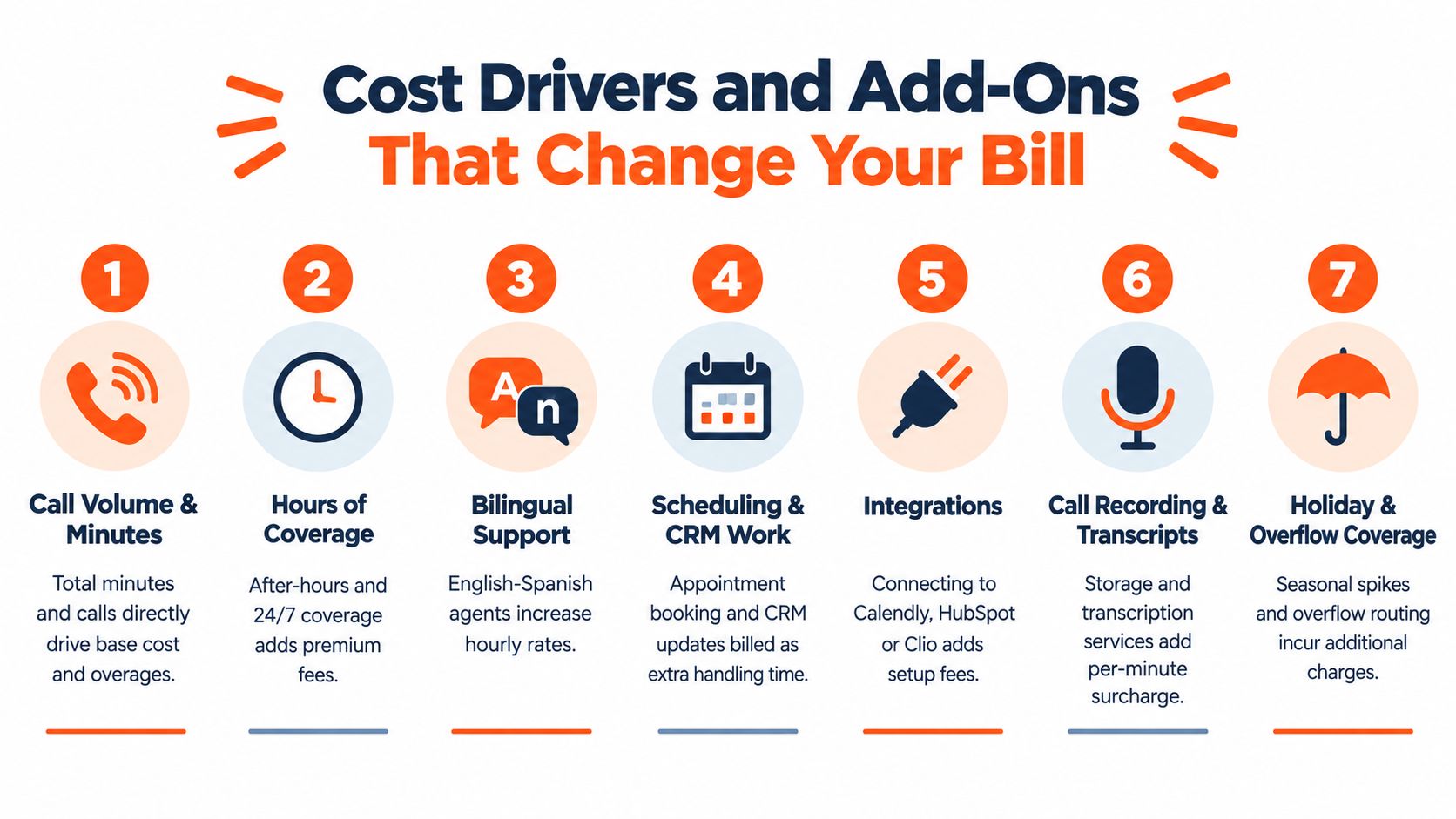
Volume. Count calls, minutes, transfers and follow-up interactions. A per-minute plan works at low usage and turns expensive as traffic rises. Ask how the provider rounds time and what happens after the allowance.
Coverage. Specify business hours, weekends, holidays, overflow and any 24/7 requirement. Extended coverage carries a premium on live services, while AI plans often include broader availability inside the subscription.
Complexity. Message taking is cheaper than appointment booking, caller qualification, bilingual support, CRM updates, legal intake or medical workflows. Every extra decision or data-entry step adds configuration, training or handling time.
Continuity. Decide whether the same person needs to learn your process. A rotating pool is fine for simple routing. A dedicated professional is more predictable the moment the role carries recurring administrative ownership.
When the role starts absorbing inbox, calendar and follow-up work beyond the phone, compare against broader administrative help instead: our breakdown of what a virtual assistant costs is the right benchmark at that point, and customer service outsourcing costs covers it when the volume is support rather than reception.
Practical rule: ask for an invoice simulation using your expected call pattern, coverage window and task list. A price sheet cannot expose costs created by work the plan never defines.
The figures below are illustrative assumptions, chosen to sit inside the published ranges above, not quotes from any provider. Use them as decision templates and substitute your own numbers.
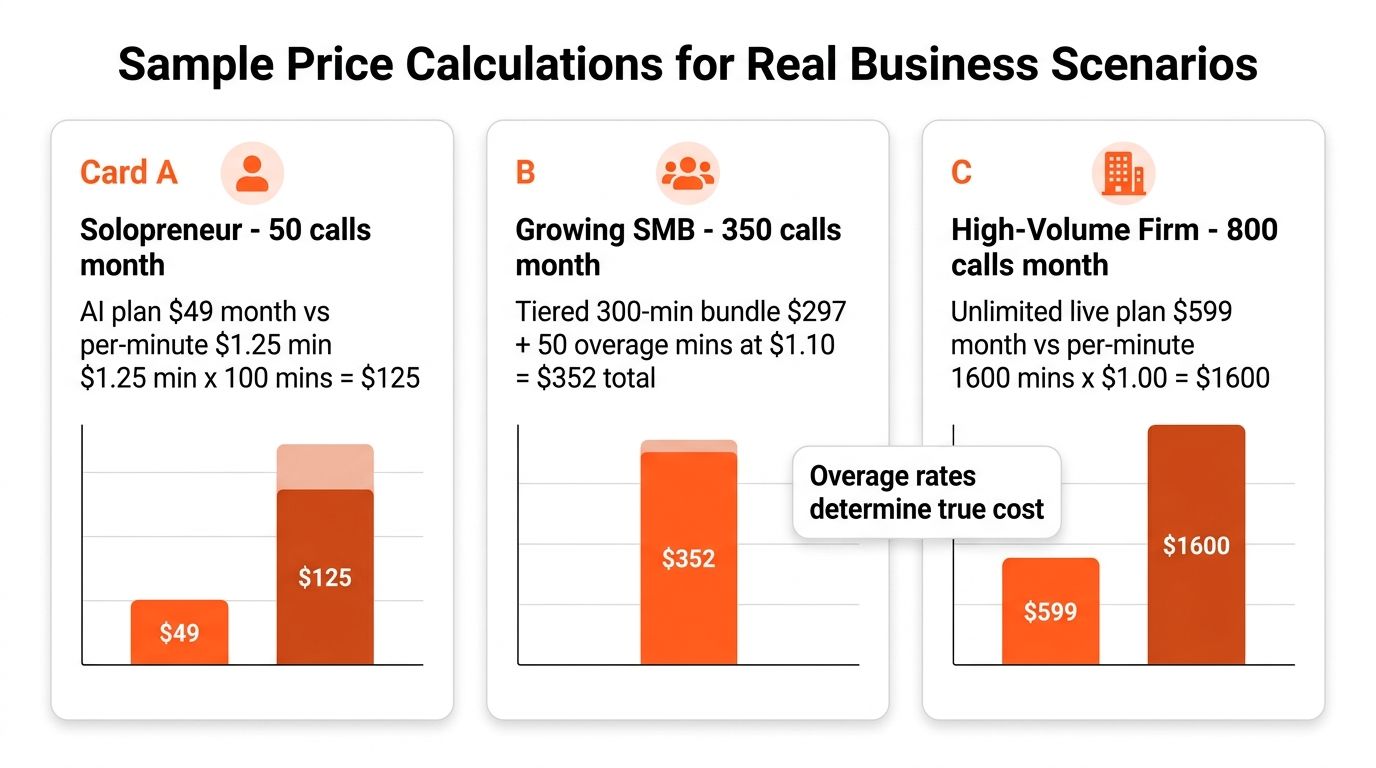
Assume 50 calls a month and about 100 talk minutes.
AI wins on price here, provided it can handle the caller experience and the tasks attached to it. For basic answering, routing and the occasional booking, software is the efficient starting point and a dedicated seat is overbuying.
Assume 350 talk minutes a month against a 300-minute bundle.
The lesson is in the overage, not the bundle. This business is paying $384.50 for under six hours of talk time and doing its own scheduling. Another $175 a month buys 80 hours of a person who also books the appointments. That is the moment the models cross.
Assume 800 calls a month and about 1,600 talk minutes.
At this volume the per-minute model is indefensible and the choice narrows to an unlimited plan or a person. The unlimited plan is cheaper on paper; confirm what "unlimited" excludes, because transfers, scheduling, CRM work and after-hours coverage are the usual carve-outs, and every one of them lands back on your team. The dedicated seat costs about $470 a month more and absorbs all four.
Price is the final filter, not the first. Prove the provider can deliver the caller experience you need and hold coverage when the assigned receptionist is unavailable. Then compare money.
For our own terms: candidates move through a four-stage vetting funnel, and the top 1% figure we publish refers to the share of applicants who clear that funnel, not to a market estimate. We deliver a shortlist of 3 to 5 vetted candidates in 48 hours, start in 72 hours, and carry a lifetime replacement guarantee. Treat every one of those as a contract term to verify, with us and with anyone else you shortlist.
To compare providers on like-for-like scope, start from our roundup of the best staffing agencies for remote roles, then request pricing with hours, duties, language requirements, system access, coverage and replacement expectations held constant. That is the only way the trade-off becomes visible: AI minimizes software spend, live answering fits variable demand, and a dedicated remote receptionist buys continuity without the payroll, compliance and replacement burden of a direct hire.
| Business need | Recommended model | Reason |
|---|---|---|
| Very low call volume | AI subscription | Low fixed cost and simple after-hours coverage |
| Unpredictable calls | Per-minute or tiered live answering | You pay closer to actual usage |
| More than roughly 340 talk minutes a month | Dedicated remote receptionist | You are already past the break-even against mid-range per-minute rates |
| Steady daily coverage | Dedicated remote receptionist | Capacity is easier to budget and manage |
| Appointment booking and CRM work | Human or hybrid model | The work requires workflow ownership, not call handling |
| Bilingual customer intake | Dedicated bilingual professional | Language and process consistency compound over time |
| Complex or sensitive calls | Live human coverage | Judgment and escalation are central to the role |
AI is the right first move when the problem is narrow and transactional. Live answering fits a business that needs human voices but not a person continuously assigned to internal work. A dedicated remote receptionist is the stronger option when the role must collaborate with the team, maintain calendars, manage intake and hold coverage over time.
The lowest sticker price is not the lowest operating cost. A cheap per-minute plan creates overage exposure and leaves scheduling and CRM work with an already-busy founder. A dedicated seat costs more than software and less than an in-house hire once payroll, compliance, supervision and replacement risk are counted, which is how a business can save up to 70% against comparable U.S. salaries without losing the front desk.
Published AI receptionist plans run about $14 to $199 a month for 60 to 400 included voice minutes. Live answering services start around $137 to $325 a month and land near $400 to $900 at realistic call volume. A dedicated remote receptionist starts at $7 an hour all-in, about $1,120 a month for full-time coverage. A fully loaded in-house receptionist costs roughly $4,525 a month.
It depends on your talk minutes. Divide the monthly cost of a dedicated seat by your quoted per-minute rate to find the break-even. At $1,120 a month, a dedicated full-time receptionist costs the same as an answering service at 640 minutes a month billed at $1.75, 339 minutes at $3.30, or 207 minutes at $5.40. Above that, the dedicated seat is cheaper and also covers booking, intake and CRM work.
Published per-minute rates for live answering commonly run $1.75 to $2.50, rising to $3.30 to $5.40 on overage tiers. Some providers bill per call instead, with overages around $10.50 to $11.50 per call. The overage rate matters more than the headline plan price, because that is what you pay once volume moves.
The U.S. Bureau of Labor Statistics puts the median receptionist wage at $38,010 a year, or $18.27 an hour, as of May 2025. BLS also reports that benefits make up 30.0% of total private-industry compensation. Dividing the median wage by 0.70 gives about $54,300 a year fully loaded, roughly $4,525 a month, before recruiting, equipment, space, supervision or replacement costs.
Across the 16 receptionist and front-desk searches in our recruitment system as of September 2026, the 7 full-time roles with a stated monthly budget ranged from $1,000 to $2,600 a month, with a median budget midpoint of $1,350 a month, about $8.44 an hour at 160 billed hours. Eleven of the 16 came from appointment-driven businesses: medical, dental, legal and aesthetics practices.
A dedicated remote receptionist can, and that is usually the reason to hire one rather than buy a plan. Most AI plans and per-minute answering services either exclude scheduling and CRM writes or bill them as add-ons, so the work returns to your team. Confirm in writing which workflows are included at the quoted rate.
An AI receptionist is software that answers, routes and captures within a configured script. An answering service is a shared pool of human agents who answer under your name and take messages. A dedicated virtual receptionist is one named remote professional assigned to your business who owns the front-desk workflow end to end, including booking, intake and follow-up.
With Virtustant, a shortlist of 3 to 5 vetted candidates arrives in 48 hours and a hire can start in 72 hours, both counted from the first call and including weekends. Placements carry a lifetime replacement guarantee.
If the arithmetic on this page points you toward a person rather than a plan, we can scope the role around your coverage hours, appointment booking, intake, CRM updates and bilingual needs. See virtual receptionist profiles and rates, review transparent pricing, or browse everything we staff if the role is broader than the front desk.
Virtustant is a remote staffing agency placing vetted, bilingual remote professionals from Latin America with U.S. companies, from $7 an hour all-in, with zero placement fees and a lifetime replacement guarantee.