Top 7 Customer Service Outsourcing Companies in 2026
August 17, 2026

Customer support outsourcing means paying an external provider to handle your support queue — phone, email, chat and tickets — instead of staffing it in-house. The options run from large offshore BPO call centers to dedicated nearshore agents who work only on your account, in your systems, on your time zone.
Customer support outsourcing means paying an external provider to run your support queue — phone, email, chat and tickets — instead of staffing it in-house. The market for it is large and still growing: Fortune Business Insights values outsourced customer care services at USD 83.32 billion in 2025, heading to USD 149.22 billion by 2034 at a 6.69% CAGR. The broader customer experience outsourcing services market, which also counts analytics, consulting and CX technology, is larger again at USD 116.88 billion in 2025. They are two different market definitions, and providers quote whichever one makes their category look bigger.
The number that should frame your decision is not a market forecast. It is a wage. The U.S. Bureau of Labor Statistics puts the median pay for customer service representatives at $21.53 an hour, or $44,770 a year, as of 2025 — and that is wage only, before payroll taxes, benefits, software seats, management time, or the cost of a seat sitting empty. BLS also projects about 289,500 openings a year through 2035, every one of them a replacement rather than a new job, because the occupation is shrinking 5% while turnover keeps churning the same desks. Turnover, not the hourly rate, is what makes an in-house support desk expensive.
That changes how you should compare customer support outsourcing companies in 2026. A mega-BPO may be the right choice for multilingual, regulated, high-volume operations. A boutique provider may give a growing brand stronger cultural alignment, while a nearshore staffing model can offer tighter collaboration and more direct control. This list ranks seven providers by the job they're best equipped to do, not by size alone — and it says plainly which ones will tell you a price. For additional context on outsourcing models and service design, see this 2026 outsourcing guide from Voicedial.ai.
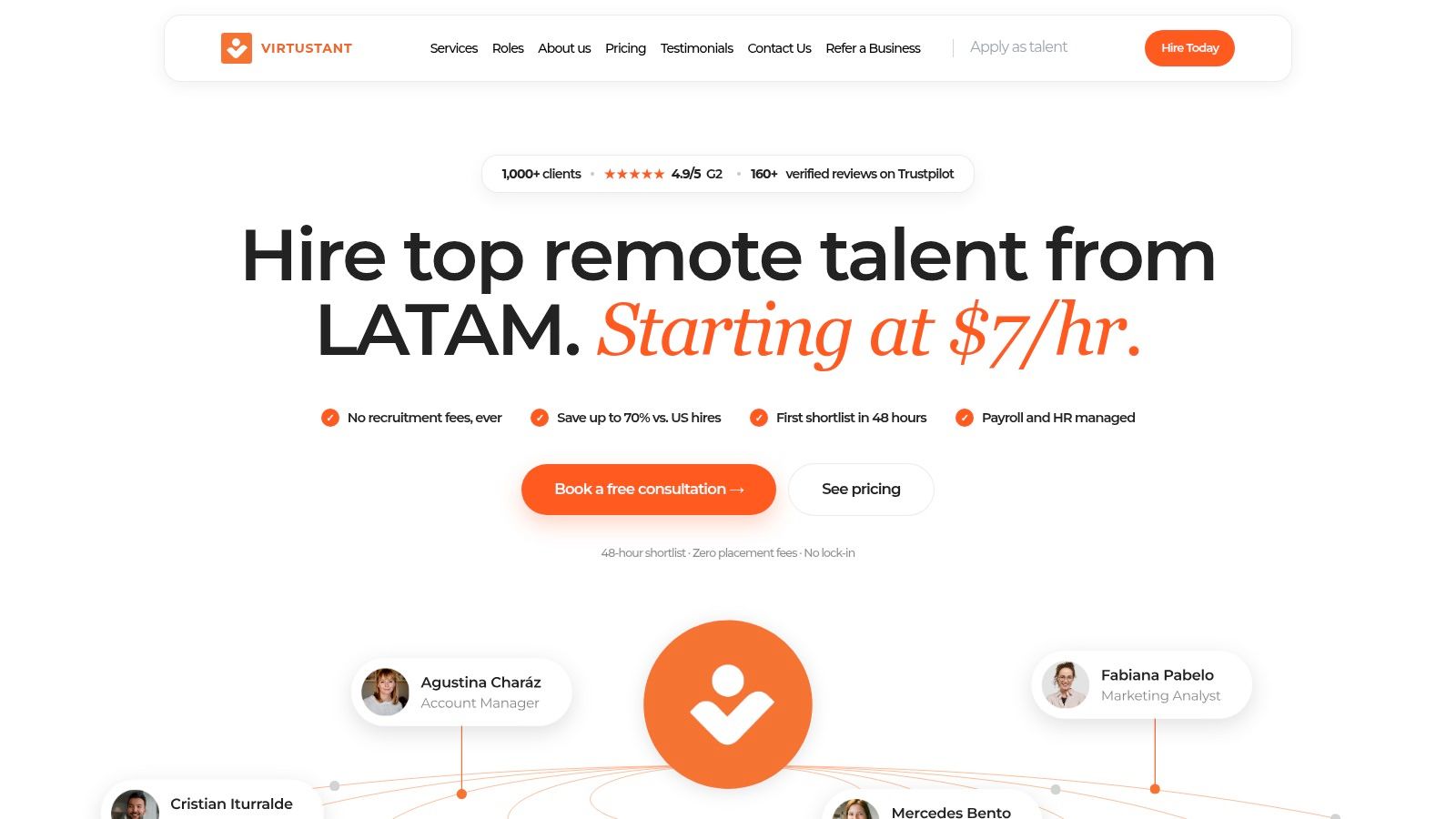
Virtustant is the strongest fit for U.S. companies that need nearshore customer service talent without building a foreign employment operation. The company connects U.S. businesses with vetted professionals across Latin America for full-time remote roles, including customer support, ecommerce virtual assistance, sales, and administrative work. Its model sits between traditional outsourcing and direct hiring. You get a dedicated professional working in your systems and processes, while Virtustant manages contracts, payroll, HR, and cross-border compliance. Its remote customer service specialists are hired to your account rather than pooled across clients.
The operating model is built around speed. Virtustant says it can provide three to five pre-vetted candidates within 48 hours, and reports an average of 11.2 days from opening a search to the professional's start date (468 placements in the 12 months to 23 Sep 2026). Its advertised all-in pricing starts at $7 per hour, covering worker pay and administrative services in one USD invoice, and is set out in full on its published pricing page. These figures come from the company's own service materials, so buyers should treat them as advertised starting points, not universal rates for senior or specialized roles.
Against the BLS median of $21.53 an hour in wages alone, a $7.00 all-in rate is roughly a third of the cash cost before a single benefit or payroll tax is added on the U.S. side. That is where the up to 70% saving comes from.
The practical advantage is same-day collaboration with U.S. teams, particularly those operating around East Coast business hours. Virtustant emphasizes core GMT-3 coverage and C1 to C2 English proficiency, which can reduce the friction that appears when agents work far outside a client's operating day or lack the language confidence required for nuanced customer conversations.
Its vetting funnel runs a recruiter screen, skills and English testing, and a live interview, and only about 1% of applicants are hired. Virtustant also advertises a lifetime, unlimited replacement guarantee, with no additional replacement fee. That shifts some hiring risk away from the client, although managers still need to provide product training, clear escalation rules, and ongoing quality review.
For a deeper explanation of the operating model, see Virtustant's guide to the benefits of nearshore outsourcing, or the side-by-side on how the LATAM staffing agencies compare. If you have already decided you want one dedicated person rather than a vendor team, the hiring playbook for a remote customer support specialist covers scoping coverage hours, setting a maximum rate from your monthly budget, agency vs EOR vs marketplace, the vetting stages, KPIs and a 30-60-90 ramp.
Pros
Cons
Best for: U.S. founders, small and midsize businesses, ecommerce brands, and agencies that want dedicated nearshore support professionals with managed employment administration. Teams serving Spanish-speaking customers can also request a bilingual customer support assistant who works both languages on one queue.
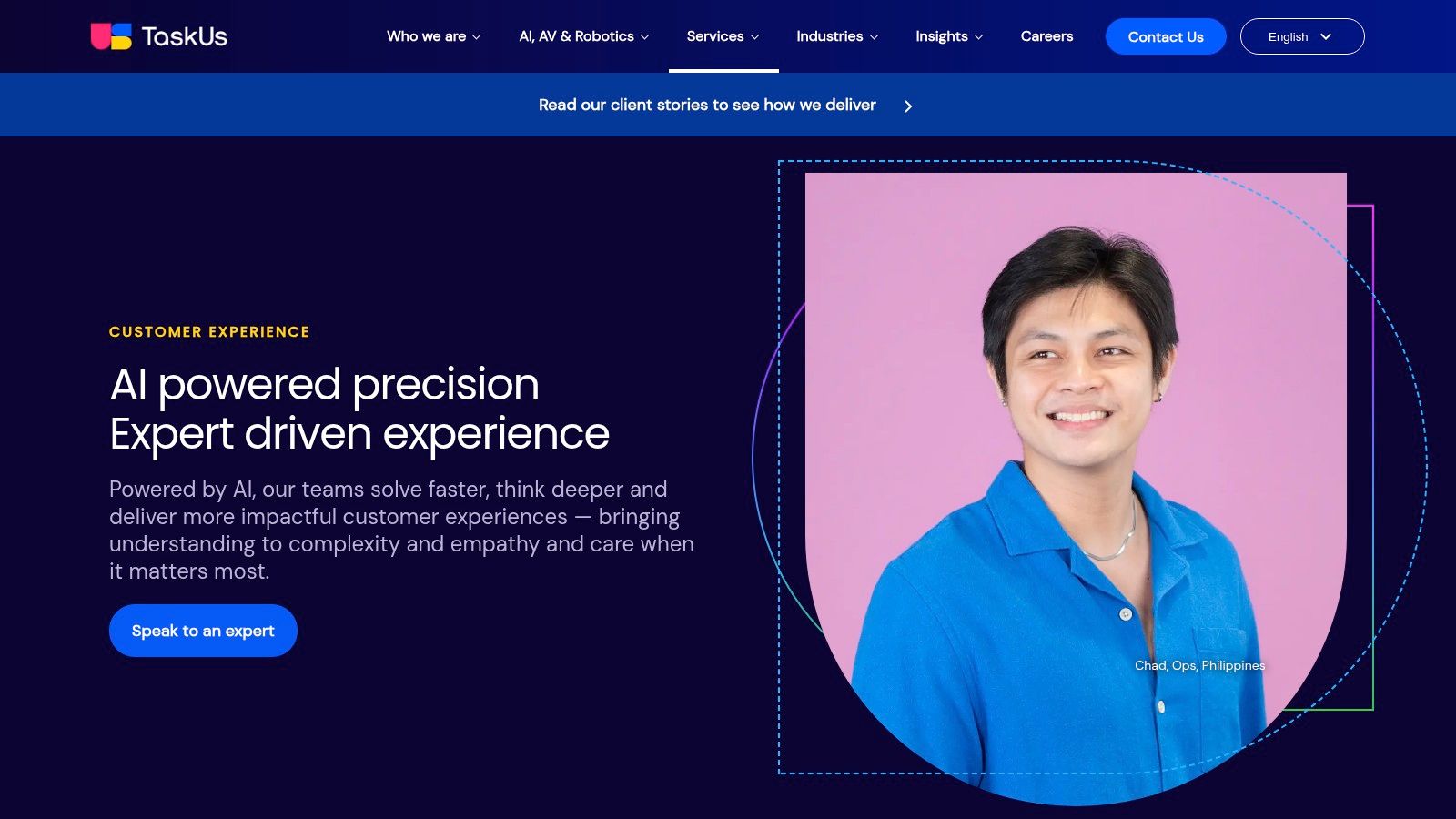
TaskUs is designed for digital-first companies that need more than basic ticket handling. Its service portfolio combines human-led support with AI-augmented customer experience, including agentic AI, voice, chat, email, multilingual operations, and continuous support models. The company also offers Trust & Safety, sales as a service, learning and training, and AI and data operations.
That breadth makes TaskUs particularly relevant to technology, ecommerce, fintech, and healthcare businesses whose support operation touches risk, growth, or user behavior. A customer support vendor that can also contribute to Trust & Safety or AI data work may reduce the number of separate partners a scaling company has to coordinate.
TaskUs is a better match for a company with an established operating model than for a founder who needs only a small number of generalist agents. Its enterprise-grade processes, global delivery structure, and consulting layer can support a complex program, but those same characteristics may introduce more governance and onboarding than a smaller team wants.
The company's AI positioning also deserves careful scrutiny. AI can handle routine workflows, but buyers need to ask how TaskUs routes complex cases, measures human intervention, and protects customer context during escalation. Industry commentary on 2026 outsourcing warns that automation may leave human agents with harder contacts requiring judgment, empathy, and service recovery. That makes staffing design and QA more important than an AI label alone.
Pros
Cons
Best for: Mid-market and enterprise digital businesses pursuing AI-enabled, omnichannel, or multi-service CX operations.
Concentrix is the broadest choice on this list for companies that want global CX operations combined with technology integration. Its capabilities span customer care, technical support, content moderation, collections, and other specialized workflows. The provider also promotes AI-powered service through products such as iX Hello and iX Hero, alongside CCaaS integration, self-service bots, and multilingual omnichannel support.
That combination matters for organizations modernizing a legacy contact center. Concentrix can participate in the operational work while also helping connect customer service technology, automation, and partner ecosystems. Its stated integrations include platforms such as Salesforce and Genesys, which may be relevant when support sits inside a larger CRM or contact-center architecture.
The company's scale is an advantage when service requirements are complex, geographically distributed, or likely to expand across channels. It also offers The Nest by Concentrix, a program positioned for startups and small or midsize businesses. That gives smaller buyers a possible entry point, although they should still confirm implementation scope, governance requirements, and expected operating volumes before assuming the enterprise model will translate neatly.
The main risk is operational weight. Large providers often bring mature processes, multiple stakeholders, and extensive integration requirements. That can be valuable for a transformation program, but it may feel excessive when the need is a focused team handling email, chat, or order support.
For a practical perspective on outsourcing design and management, read this guide to customer service outsourcing costs by model.
Pros
Cons
Best for: Global businesses, legacy contact centers, and organizations that need both outsourced operations and CX technology modernization.
Foundever, formerly associated with Sitel Group and SYKES, is a mature CX BPO for buyers that prioritize U.S.-aligned delivery, language coverage, and operational resilience. Its service portfolio includes customer care, technical support, back office, sales and retention, collections, and Trust & Safety. The company combines onshore U.S. delivery with multilingual hubs and at-home or site-based staffing options.
That mix gives Foundever a practical advantage for brands serving U.S. customers in industries where cultural fluency, sensitive conversations, or regulatory expectations matter. A buyer can explore an operating model that combines domestic coverage with broader language or capacity support, rather than treating onshore and offshore delivery as an all-or-nothing choice.
Foundever promotes automation and self-service alongside live support across channels. The relevant buyer question isn't whether automation exists. It's whether the specific account has the right knowledge management, escalation design, and QA controls to prevent routine automation from pushing complicated cases onto underprepared agents.
Foundever may appeal to procurement teams that prefer a proven BPO structure, defined delivery locations, and service continuity planning. It may appeal less to a small company seeking a highly personal relationship or rapid experimentation. The provider's mature operating model can deliver stability, but the innovation pace may vary by account and contract.
Pros
Cons
Best for: U.S.-focused brands, regulated industries, and enterprises that need a resilient blend of onshore, at-home, and multilingual operations.
TTEC is a strong choice when outsourcing is part of a wider customer experience transformation, not a staffing decision. Its CXaaS approach combines operations, technology, analytics, and consulting. The company provides customer care, technical support, AI operations, back office, and Trust & Safety through onshore, nearshore, and offshore delivery strategies.
This matters for complex organizations because the provider can address workforce management, quality, digital channels, automation, and analytics within a broader program. TTEC's service model is particularly relevant when a company wants to redesign how customers move from contact to resolution, rather than add agents to an existing queue.
TTEC's capabilities are most valuable when the buyer has enough process complexity to justify them. A smaller support team may not need consulting, analytics, technology integration, and multiple shoring options in a single engagement. It may also face higher minimum-volume expectations than a boutique or staffing-led alternative.
The evaluation should therefore focus on the operating design. Ask which channels TTEC will own, which analytics will be shared with the client, how AI-assisted workflows will be audited, and how the contract handles service recovery. The golden rules for customer service provide a useful lens for those discussions, particularly around ownership, consistency, and escalation.
Pros
Cons
Best for: Large or regulated organizations undertaking a broad CX transformation with analytics and technology requirements.
PartnerHero occupies the boutique-to-midscale position, making it a compelling alternative for high-growth startups and SMBs that care about brand fit. The company builds custom teams for live chat, email, social, and voice, with dedicated and on-demand models. Its talent footprint spans the Americas, EMEA, and APAC, while its positioning emphasizes English proficiency, cultural alignment, and brand-consistent support.
The provider's “pods” approach is strategically useful for startups. Instead of handing a customer queue to a generic pool, a company can structure a team around its product, tone, workflows, and customer profile. That can reduce the distance between an outsourced agent and the internal brand team, although the client still needs to supply strong documentation and product training.
PartnerHero also presents a people-plus-AI approach through its partnership with Crescendo. That makes it relevant to buyers experimenting with AI deflection while retaining human ownership for nuanced interactions. The important diligence question is how the AI layer affects staffing, coaching, and escalation. If automation removes simple contacts, the remaining queue may demand more product knowledge and emotional judgment.
PartnerHero's smaller scale can be an advantage for responsiveness and customization. It can also become a limitation when a buyer needs many language hubs, large international redundancy, or a highly standardized global operating model.
Pros
Cons
Best for: Venture-backed companies, SaaS businesses, and growing brands that value customization, cultural fit, and flexible team design.
SupportNinja is built for companies that want outsourced support organized around the customer journey, not just the support inbox. Its offerings cover customer support, technical support, onboarding, renewals, and customer success. The provider supports channels such as email, chat, phone, in-app, and social, with dedicated and managed service models.
That journey-based structure is a meaningful distinction for SaaS, ecommerce, fintech, and subscription businesses. The same customer may need pre-sale help, onboarding guidance, troubleshooting, renewal assistance, and escalation. A provider that organizes work around those stages can help a buyer connect service operations with retention and expansion goals, rather than measuring every interaction as an isolated ticket.
SupportNinja combines human-led support with its NinjaAI toolkit for QA, workflows, and self-service. That makes it a useful candidate for teams that want to introduce AI gradually. Rather than assuming automation should handle every routine interaction, buyers can ask where the toolkit improves knowledge access, consistency, coaching, and self-service while leaving sensitive cases with trained agents.
The provider's startup-friendly orientation may also make it easier to begin with a focused program and expand as volume grows. The trade-off is that its footprint is smaller than the largest global BPOs. A company with demanding language, regulatory, or geographic requirements should validate coverage before selecting it.
Pros
Cons
Best for: SaaS, ecommerce, fintech, and subscription companies that need technical support and customer-journey coverage while scaling gradually.
Six of the seven companies in this guide do not publish a price. Virtustant states $7.00 an hour all-in. TaskUs, Concentrix, Foundever, TTEC, PartnerHero and SupportNinja all quote by proposal, which means you cannot budget any of them before you are already inside a sales process.
That is not a mark against them. Enterprise CX programs genuinely are custom: headcount, channels, languages, hours of coverage, technology integration and QA design all move the number, and a public rate card would be misleading. But it does have a practical consequence that no provider page will tell you: on a list of seven, six comparisons cannot be made on cost at all until you have run six separate scoping calls. Budget three to six weeks for that if you want real numbers from more than one vendor.
The workaround is to compare on the things that are public before you compare on price:
| Provider | Published pricing | Staffing model | Implementation complexity | Ideal use cases | Key advantages |
|---|---|---|---|---|---|
| Virtustant | Yes — from $7.00/hr all-in | Dedicated, nearshore LATAM | Low, managed onboarding, payroll and compliance handled | U.S. teams needing quick, full-time nearshore hires with East Coast overlap | Rapid shortlists, all-in pricing, top 1% that clears a four-stage vetting funnel, lifetime replacements |
| TaskUs | Not published — proposal only | Managed teams, global | Medium to high, custom enterprise setup and AI integration | Mid to large digital brands that need rapid CX scale and innovation | Agentic AI plus human CX, omnichannel, CX consulting |
| Concentrix | Not published — proposal only | Managed teams, global | High, complex integrations and enterprise processes | Large global enterprises with complex, integrated CX needs | Extensive technology integrations, global footprint, partnerships |
| Foundever (Sitel/SYKES) | Not published — proposal only | Managed teams, onshore + hubs | Medium to high, onshore setups and regulated-industry onboarding | Regulated industries and U.S.-centric programs needing language coverage | Onshore presence, wide language support, flexible delivery models |
| TTEC | Not published — proposal only | Managed teams, multi-shore | High, end-to-end CXaaS and analytics integration | Enterprises needing comprehensive CX transformation and consulting | Mature CXaaS model, deep analytics, long track record |
| PartnerHero | Not published — proposal only | Dedicated or on-demand pods | Low to medium, tailored, brand-aligned team setups | High-growth startups and SMBs seeking flexible, brand-centric support | Culture fit, flexible pods, strong English (C1) frontline |
| SupportNinja | Not published — proposal only | Dedicated or managed | Low to medium, journey-based implementation and scale | SaaS, ecommerce and subscription businesses needing journey focus | Journey solutioning, NinjaAI for QA and workflows, startup scaling |
Pricing column reflects what each provider publishes on its own website as of September 2026. “Not published” means no public rate or rate range, not that the provider is expensive.
The right provider depends on the problem you're trying to solve. If you need dedicated professionals working closely with a U.S. team, Virtustant offers a nearshore staffing model with managed payroll, HR, contracts, and compliance. If you need a large multilingual operation, Concentrix, Foundever, TTEC, or TaskUs may offer the scale and delivery breadth required. If brand fit and flexible team design matter more than global capacity, PartnerHero or SupportNinja deserve closer evaluation.
Start with shoring strategy. Onshore delivery may help with cultural alignment and sensitive customer conversations. Nearshore delivery can support real-time collaboration with U.S. teams while giving the client a dedicated staffing model. Offshore delivery may suit broader coverage or cost-focused operations, but the buyer must test language, time-zone, and escalation requirements rather than assuming the lowest labor cost produces the best economics.
Next, map the service to volume and complexity. A provider that handles routine contacts efficiently may struggle if AI deflection leaves agents with mostly technical, emotional, or compliance-sensitive cases. Current industry commentary describes a shift toward outcome-level measures such as repeat inquiries, resolution rates, and satisfaction, rather than judging vendors only by coverage. Build those measures into the commercial discussion.
Practical rule: Ask every finalist to explain what happens after automation fails. The quality of escalation design tells you more than the presence of an AI feature page.
Review technology and governance together. Confirm integrations with your help desk, CRM, telephony, knowledge base, and reporting tools. Then establish who owns customer data, how access is controlled, how conversations are audited, and which team approves changes to automated workflows.
Finally, compare total operating economics, not hourly pricing alone. Include onboarding, training, QA, management time, technology costs, replacement terms, language coverage, and the cost of unresolved contacts. Anchor the comparison to what the work costs today: at the BLS median of $21.53 an hour in wages alone, a five-person in-house desk is roughly $224,000 a year in salary before benefits, software or management time — and BLS expects the occupation to shrink 5% through 2035 while still turning over about 289,500 seats a year.
Before signing, request a pilot or phased launch, define escalation ownership, and schedule regular performance reviews. For additional 2026 training and CX planning context, explore this VideoLearningAI guide.
If you need dedicated nearshore customer support professionals with U.S. time-zone overlap, Virtustant can present vetted LATAM candidates within 48 hours while managing contracts, payroll, HR, and compliance. See what a remote customer service specialist costs and handles, or compare the managed staffing model against the larger BPO and boutique options on the nearshore staffing page. Talk to Virtustant about your support queue and get a shortlist within 48 hours.
Customer support outsourcing means hiring an external team or provider to handle support, such as phone, email, chat, and tickets, on your behalf. It ranges from large BPO call centers to dedicated nearshore agents who work as an extension of your team.
In practice the two terms are used interchangeably, and every provider on this list sells the same thing under both labels. Where a distinction exists, “customer service” tends to describe the whole relationship including sales, retention and account questions, while “customer support” tends to describe resolving a specific problem: a broken order, a failed payment, a bug. Search either phrase and you get the same set of companies. Compare them on shoring model, dedicated versus pooled staffing, and published pricing, not on which word they use.
Of the seven providers in this guide, only Virtustant publishes a rate: $7.00 an hour all-in, covering the professional's pay, payroll, compliance and HR, with no recruitment fee on top. TaskUs, Concentrix, Foundever, TTEC, PartnerHero and SupportNinja all quote by proposal, so none of them can be budgeted before a sales call. That is not a mark of quality either way, since enterprise CX programs are genuinely custom, but it does mean six of the seven cannot be compared on cost until you are already in a sales process.
You define the scope and service levels, the provider sources and vets agents, then handles training, staffing, and often payroll and compliance. Dedicated models give you named agents in your time zone; pooled BPO models spread agents across many clients for volume coverage.
Cost depends on region, model, and volume. Far-offshore pooled seats have the lowest hourly rate but carry a time-zone and context gap; dedicated nearshore agents cost more per hour yet keep same-day overlap and lower rework. For a reference point on the in-house side, the U.S. Bureau of Labor Statistics puts the 2025 median pay for customer service representatives at $21.53 an hour, or $44,770 a year, in wages alone. Nearshore LATAM support can save up to 70% versus a comparable US hire.
Match the provider to your stage and needs: enterprise BPOs for massive scale and automation, boutiques for flexibility, and dedicated nearshore providers when you want US time-zone overlap and low agent turnover. Check vetting depth, dedicated vs pooled staffing, and who owns quality and escalation.
Offshore suits high-volume, script-driven queues at the lowest rate. Nearshore Latin America fits when tone, judgment, and same-day collaboration matter, because agents overlap US business hours and often speak English and Spanish. Many teams keep complex or bilingual support nearshore and route overflow offshore.
Usually when ticket volume outgrows your team, coverage gaps appear, response times slip, or you are scaling into new hours or languages. Start with a defined pilot on one channel before handing over the full queue.