Customer Service vs Support, Success, and Sales
September 15, 2026


Tickets are piling up, net revenue retention is flat, and your hiring discussion has collapsed into one question: customer service vs support, success, or sales support. The right answer isn't a job title. It's a decision about which tasks need ownership, which channels create workload, and where human coverage should sit.
For most U.S. companies, customer service handles transactional demand, customer support resolves product problems, customer success protects retention and expansion, and sales support moves qualified opportunities toward revenue. The practical choice depends on your growth stage, channel mix, and whether nearshore staffing can provide the coverage your customers need.
Start with the work, not the requisition. List the interactions consuming time, classify each by customer stage and complexity, then assign one accountable owner. A founder who posts for a “customer service representative” may need technical ticket resolution, onboarding coordination, or inbound lead qualification.
Customer service is the right owner for reactive, repeatable customer requests such as invoice questions, plan changes, account edits, and general information. Customer support takes over when the customer needs diagnosis, troubleshooting, product expertise, or escalation management. Customer success owns the relationship after purchase, especially adoption, renewal risk, expansion, and executive communication. Sales support works before the deal closes, qualifying demand, scheduling meetings, supporting demos, and keeping CRM records usable.
| Function | Primary job | Typical customer moment | Best initial question |
|---|---|---|---|
| Customer service | Resolve transactional requests | Before or after purchase | Can a trained agent solve this from a clear procedure? |
| Customer support | Diagnose and resolve product issues | During product use | Does this require technical investigation? |
| Customer success | Drive adoption, retention, and expansion | After purchase | Who owns the customer's business outcome? |
| Sales support | Qualify and advance opportunities | Before purchase | Does this lead need a fast revenue response? |
Don't treat self-service as a separate project owned by nobody. A working self-service layer can remove repetitive contacts, but someone still has to maintain knowledge articles, review failed searches, and decide when a conversation should reach a person.
Operator rule: The person who owns the customer outcome should also own the handoff criteria, not just the queue.
U.S. customers increasingly expect coordinated access, and they are now arriving through channels you do not control. In a Gartner survey of 3,566 B2B and B2C customers run in February and March 2026, customers were roughly three times more likely to use a third-party GenAI tool such as ChatGPT, Gemini or Copilot than a company-provided chatbot in their most recent service interaction, and 87% said access to a human agent is essential when a company uses GenAI (Gartner GenAI customer service survey). Your channel mix should shape staffing before titles do, and the human escalation path is now part of that mix, not an exception to it.
If you need to test the model without building a full department, start by defining the workflows and then hire a remote customer service specialist for the narrowest repeatable workload. The next decision is whether the role needs transactional speed, technical depth, relationship ownership, or revenue judgment.
The four functions may use the same CRM, help desk, phone system, or chat platform, but each owns a different type of work. Assign tasks by decision rights, investigation depth, and customer impact. Titles alone will not prevent duplicated replies or lost context.
Customer service handles routine requests through phone, email, and chat. Agents update accounts, explain charges, change plans, confirm orders, and answer general questions. The work is procedure-led, so managers need a current knowledge base, defined permissions, and escalation rules that agents can apply consistently.
Plan for 4 to 8 minutes of handle time on routine requests. Treat that as a planning range to staff against, not a published standard: average handle time varies so much by sector and channel that a single industry number is not worth building a roster on. Voice conversations, chat sessions, and email cases require different staffing assumptions, so do not apply one productivity target across every channel.
Customer support handles product and technical problems that require investigation. Agents work from a ticket queue, reproduce issues, review logs or account history, provide workarounds, and escalate defects to product or engineering. Tiering keeps a password reset from consuming the same expertise as an integration failure.
Expect tier-one tickets at 15 minutes and escalated investigations at 40 minutes or more. Use that range for capacity planning, especially as automation removes simpler requests and leaves a harder queue behind.
Customer success works proactively with customers. A CSM guides onboarding, monitors adoption, conducts health reviews and QBRs, identifies risk, coordinates internal resources, and supports renewals or expansion. The CSM should not become a second ticket agent. Support owns the technical fix while success protects the relationship, communicates impact, and keeps the customer aligned.
Sales support, also called sales operations or pre-sales support, works between marketing and the account executive. It responds to inbound leads, qualifies fit, schedules meetings, supports demos, routes opportunities, and maintains CRM data. It can support an SDR motion, including outbound calling, but qualification standards and closing authority must remain explicit.
For service standards, teams can use guidance to boost customer satisfaction in 2026. Assign each metric to the function that can change it. Customer service owns response and resolution for routine contacts, support owns diagnosis and defect coordination, success owns adoption and retention actions, and sales support owns pre-close speed and data quality.
Use the table as an ownership document, not as a list of job descriptions. The reporting line matters because the same agent can create conflicting priorities when service reports to finance, support reports to product, and success reports to revenue without a shared escalation model. Some metrics blur, especially first-response time, so define whether the target applies to every contact or only the queue a function owns.
| Function | Core Responsibility | Top KPIs | Reports To | Best-Fit Stage |
|---|---|---|---|---|
| Customer service | Resolve billing, account, order, and general inquiries | CSAT, first-response time, first-contact resolution | Operations or CX lead | Seed to enterprise |
| Customer support | Diagnose technical issues and coordinate resolution | First-contact resolution, resolution time, SLA compliance | Support or product operations leader | Seed to enterprise |
| Customer success | Drive adoption, retention, renewals, and expansion | Renewal rate, adoption health, expansion pipeline | Revenue, customer, or commercial leader | Post-PMF to enterprise |
| Sales support | Qualify leads, schedule meetings, assist demos, maintain CRM quality | Speed to lead, qualified-meeting rate, data completeness | Revenue or sales operations leader | Seed to enterprise |
One scorecard, weighted, beats five dashboards. The split we use to normalize service and support performance across locations is first-contact resolution 30%, customer satisfaction 25%, first-response time 20%, resolution time 15%, SLA compliance 10%. The logic behind the weighting matters more than the exact numbers: resolution outranks speed, because a fast reply that does not resolve anything simply moves the same contact to next week. Use that structure for service and support, then add relationship and revenue measures for success and sales support.
Don't reward a service agent for closing tickets if the closure merely transfers a customer problem to success. Don't reward a CSM for keeping a customer quiet if adoption remains weak. For guidance on service management for U.S. founders, focus on decision rights, escalation paths, and reporting ownership before adding headcount.
A B2B SaaS journey makes the boundaries visible. The functions should cooperate, but one person must own the next customer outcome at every stage.
Lead capture. Sales support owns the first reply and qualification within minutes. The account executive shadows qualified opportunities, while marketing owns acquisition. The risk is a lead sitting in a general inbox because nobody owns speed to lead.
Onboarding. Customer success owns the 30, 60, and 90-day onboarding plan and the QBR cadence. Sales support should provide deal context, while support joins when setup requires product expertise. The handoff fails when the CSM receives a contract but not the promised use case, stakeholders, or implementation conditions.
Active use. Success monitors adoption and account health. Product monitors engagement signals, and support remains available for issues. A declining usage pattern is a success alert, not a support ticket.
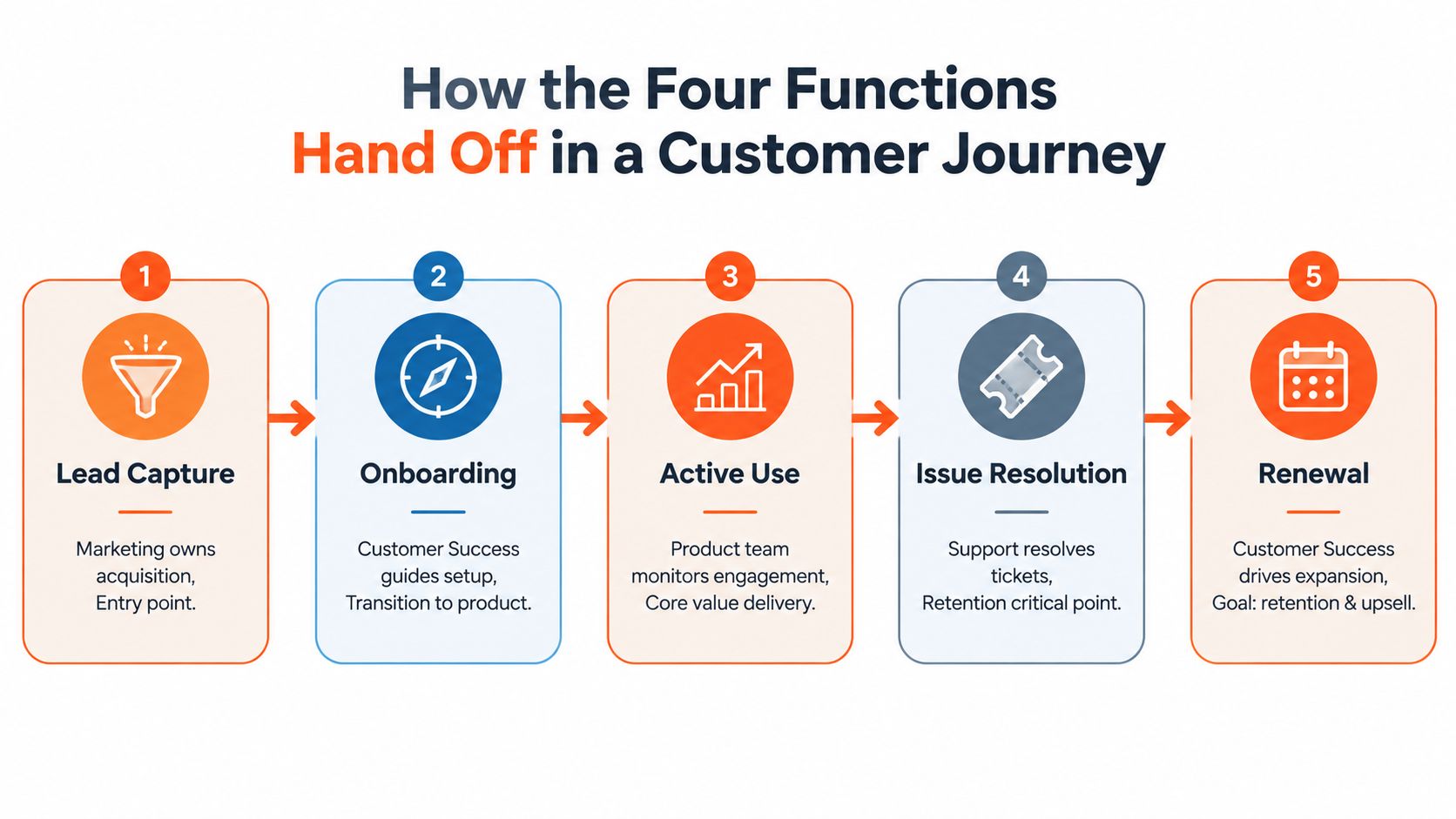
Issue resolution. Customer support owns the ticket once a technical or billing question requires investigation, with a first-response target under 1 business hour as the operating target in this model. Customer service catches long-tail inbound calls about invoices, plan changes, and account edits. Success shadows high-risk accounts and communicates business impact.
Renewal. Customer success owns the renewal and expansion conversation. Support supplies unresolved-issue history, service supplies account-request patterns, and sales support should not re-engage the customer unless success explicitly transfers ownership.
Three failures recur: support solves a churn risk that success should have detected, success chases a bug that support already triaged, and sales support re-engages a customer that success still owns.
Ownership rule: At each handoff, name one owner, one deadline, and one escalation trigger.
A password reset should not consume a staffed queue. A billing dispute should not disappear into a bot. Assign work by risk, judgment, and the customer's need for authority.
Routine requests belong in a knowledge base or guided automation when the answer is stable and the customer can verify the result. Password resets, order status, basic FAQ answers, and standard account instructions fit this model. Give every automated path a clear escape route when confidence is low or the customer repeats the question.
| Task Type | Best Channel | Why |
|---|---|---|
| Password reset | Knowledge base or automated assistant | Repeatable, low-risk procedure |
| Order status | Self-service portal or assistant | Data can be retrieved without judgment |
| FAQ answer | Searchable knowledge base | Customers can resolve simple questions quickly |
| Billing dispute involving substantial money | Human service or support agent | Requires judgment, explanation, and authority |
| Emotional complaint | Human agent | Trust depends on listening and accountability |
| Contract or terms question | Human owner with escalation path | Misinterpretation can create commercial risk |
| Product unblock request | Human support | The customer needs diagnosis and prioritization |
Gartner reports that 51% of customers are willing to use a GenAI assistant for service interactions on their behalf (Gartner customer service trends). Zendesk reports that 73% of agents are confident AI copilots improve their ability to do their job, and that 75% of consumers support human agents using AI to draft responses (Zendesk on agent copilots). These figures support an operating decision, not a cosmetic one. Set review rules, confidence thresholds, escalation ownership, and quality sampling before automation reaches customers.
Automation removes easy contacts first. Agents then inherit exceptions, ambiguity, and emotional load. Staff for that mix, not for the old average queue.
The remaining team needs stronger product knowledge and permission to resolve appropriate cases. Nearshore coverage can protect response time while keeping routine human work outside an expensive domestic-only model. Customer service can own account changes and straightforward requests, support can handle diagnosis and product unblocking, and success should receive cases that signal adoption or retention risk.
Use a practical framework for managing AI at work to assign automation ownership, audit responses, and define when a human must intervene. Automation should reduce avoidable demand. It should never hide unresolved customer frustration.
Nearshore staffing pays off when the coverage model matches the work. Latin America’s main business centers sit between UTC-3 and UTC-6, within 0 to 3 hours of U.S. Eastern Time, so depending on the pairing and on daylight saving changes, teams can share 6 to 8 business hours with U.S. colleagues.
That overlap is what U.S. companies are actually buying, and our own pipeline shows it plainly. Across the 25 most recent customer-service roles opened through Virtustant, every one of the 18 that specified a schedule was anchored to a named U.S. time zone — Eastern, Central, Mountain or Pacific — not to the agent’s local hours. And four of those eighteen asked for a four-hour window rather than a full day: 10am–2pm ET, 9am–1pm PT, 2pm–6pm ET. The demand is not for 24/7 coverage. It is for a specific, often partial, slice of the U.S. business day.
Operator rule: Write the coverage window into the role before you write the job title. A four-hour ET window and a 40-hour ET week are different hires, different candidate pools, and different retention risks.
Use that overlap for synchronous channels first. Phone and chat require live availability. Email and ticket queues tolerate more geographic distance. Bilingual English-Spanish coverage also supports customers across the U.S. and Latin America.
| Function | Nearshore Fit | Key Reason |
|---|---|---|
| Customer service | Strong | Repeatable workflows, bilingual coverage, live channel overlap |
| Customer support | Strongest | Ticket queues, technical playbooks, same-day collaboration |
| Customer success | Selective | Mid-tier portfolio coverage works; strategic accounts need closer commercial context |
| Sales support | Strong for inbound | Qualification and scheduling transfer well; closing requires deal judgment |
Customer support is the cleanest nearshore assignment. A 4-hour aligned shift in Mexico or Colombia can protect a 1-hour first-response target when the queue and escalation path are configured for U.S. hours. Customer service also transfers well when managers measure AHT and CSAT against the same standards used by domestic teams. Nearshore inbound service can save up to 70% against a comparable U.S. in-house hire, but treat that as a ceiling, not a forecast. The honest comparison is fully loaded: rate plus quality controls, management time, tooling seats and the channel coverage you actually need. Start that arithmetic from published per-role rates, not from a blended percentage.
Customer success requires tighter boundaries. Keep regional or strategic ownership of the highest-value accounts. Assign a nearshore success-operations layer to health scoring, account research, renewal preparation, and QBR preparation for mid-tier portfolios.
Sales support fits inbound SDR-style triage, calendar management, data enrichment, and routing. Keep complex deal closing with people who hold pricing authority, executive context, and negotiation responsibility.
Cross-border administration can consume operating capacity. In the PayrollOrg Global Payroll Week 2025 survey, 57% of respondents named ensuring local compliance as their single biggest global payroll challenge, and only 28% had a formalized global payroll strategy in place at all (Global Payroll Week 2025 survey results). Most companies hiring their first nearshore agent are not going to become the exception.
A managed provider such as Virtustant nearshore staffing can handle sourcing, vetting, contracts, payroll, HR, and compliance through one arrangement. Treat that as an administrative choice. Your team still owns role design, queue targets, quality reviews, and escalation rules.
Your growth stage determines how much specialization you can afford. Your channel mix determines where that specialization pays off.
| Stage / Channel | Customer Service | Customer Support | Customer Success | Sales Support |
|---|---|---|---|---|
| Pre-PMF or sub-$2M ARR | Part-time pod role | Part-time pod role | Founder or shared role | Part-time qualification support |
| $2M to $10M ARR | Nearshore tier-one coverage | Nearshore queue with escalation | In-house CS lead owns relationship | Keep inside revenue |
| $10M+ ARR | Dedicated service operation | Separate support organization, extended coverage | Distinct success organization | Keep in-house for deal context |
| Chat-heavy SaaS | Nearshore-first | Nearshore-first | Hybrid | Nearshore inbound triage |
| Phone-heavy B2B | U.S.-based or hybrid | U.S.-led escalation with nearshore coverage | U.S.-led strategic ownership | Revenue-led |
| Email-heavy fintech | Nearshore service and support split | Nearshore with strict controls | Hybrid | Revenue-led |
Pre-PMF and below $2M ARR: Don't build four departments. Create a two-person nearshore pod with explicit part-time ownership for tickets, onboarding calls, account requests, and upsell follow-ups. One person owns the queue and first response. The other owns onboarding and account risk. The founder retains strategic success and closing decisions.
Between $2M and $10M ARR: Hire one in-house customer success lead. That person owns the relationship, renewal narrative, and expansion priorities. Put tier-one support with a nearshore team and keep sales support inside the revenue organization, where lead context and pipeline discipline already live.
Above $10M ARR: Separate support from success. Run tier-one coverage across two LATAM time zones if the queue requires broader hours, keep strategic success close to the customer and commercial leadership, and retain sales support in-house for complex deal context.
Channel mix can override stage. Chat-heavy SaaS gains the most from nearshore overlap and concurrent handling. Phone-heavy B2B should keep escalation and high-context conversations U.S.-led. Email-heavy fintech can split work effectively, but permissions, auditability, and written quality controls must be strict.
Don't choose between customer service, support, success, and sales support as if only one can exist. Choose the smallest operating model that gives every customer request a clear owner, then add nearshore capacity where the workflow is repeatable and the channel benefits from same-day collaboration.
Customer service handles reactive, repeatable requests — billing questions, plan changes, account edits, order status — through phone, email and chat. The work is procedure-led. Customer support handles problems that require diagnosis: reproducing an issue, reviewing logs or account history, providing a workaround, and escalating a defect to product or engineering. The practical test is whether the request can be answered from a knowledge base or needs investigation.
Customer service is reactive and ticket-driven; the customer comes to you. Customer success is proactive and account-driven; you go to the customer. A CSM guides onboarding, monitors adoption, identifies renewal risk and works expansion. Customer service measures CSAT, first-response time and first-contact resolution. Customer success measures retention, net revenue retention, product adoption and renewal rate. If a CSM is spending the day closing tickets, the two functions have collapsed into one and the relationship work is not happening.
Hire against the interaction that is consuming the most time and carrying the highest failure cost, not against the title. If missed contacts risk churn, that points to success. If they block product use, that points to support. If they delay revenue, that points to sales support. Most companies under roughly $2M ARR are better served by one generalist who owns response and resolution end to end than by four specialized seats.
Yes, at early stage, but only with explicit boundaries. Write down which contacts require a revenue response and which require a resolution response, and set separate targets for each. The failure mode is a single queue where the fastest-to-close contacts win and qualified leads sit unanswered because a billing question was easier to clear.
It works for phone, and phone is usually where it pays off most, because live channels are the ones that need real-time overlap. Latin America’s main business centers sit between UTC-3 and UTC-6, within 0 to 3 hours of U.S. Eastern Time, which gives 6 to 8 shared business hours. Use that overlap for voice and chat first. Email and ticket queues tolerate more geographic distance, so they are the least urgent thing to move.
Define it before you write the job title. Across the 25 most recent customer-service roles opened through Virtustant, all 18 that specified a schedule were anchored to a named U.S. time zone rather than the agent’s local hours, and four asked for a four-hour window rather than a full day. A four-hour Eastern window and a 40-hour Eastern week are different hires with different candidate pools and different retention risks.
Virtustant connects U.S. companies with vetted remote professionals across Latin America for customer service, support, sales support, and operations roles, while handling sourcing, contracts, payroll, HR, and compliance. Compare a managed nearshore model with building each function in-house, or look at what a remote customer service specialist costs and covers.