How to Outsource HR and Payroll Without Losing Control
August 24, 2026


Most advice about outsourcing HR and payroll starts with cost. That's the wrong starting point. The better question is whether you can transfer payroll, tax, HR administration, and cross-border worker obligations without losing visibility into who owns each decision.
The strongest operating model isn't “set it and forget it.” It's a controlled system with one accountable owner, clean employee data, documented approval windows, and a vendor that can prove how exceptions are handled.
A note on the numbers below. Most percentage claims in this space come from vendor-published benchmarks and industry surveys rather than audited studies, and they are reported here with their sources so you can weigh them. Treat them as evidence that the problem is common, not as outcomes you can assume.
Payroll outsourcing means using a third-party provider to manage some or all of payroll processing, tax filing, payment administration, and related compliance work. That definition matters because payroll isn't merely an administrative queue. It connects compensation, tax withholding, worker classification, records, deadlines, and employee trust. ADP's overview of payroll outsourcing describes the practice in these operational terms, not as a simple software subscription.
The popular assumption is that outsourcing mainly reduces headcount or software expense. Those savings can matter, but the larger strategic value is risk control. One industry summary reports that 73% of organizations outsource some portion of payroll, making it the most frequently outsourced HR function. The reason is practical: payroll concentrates recurring deadlines and compliance exposure in a process that must run accurately every cycle. Mordor Intelligence's payroll outsourcing market analysis also cites outsourced payroll reducing costs by 27% and errors by 50% versus in-house processing, although those results depend heavily on implementation quality.
The liability doesn't disappear when a vendor takes over the work. A figure of over 1.17 million employment tax penalties assessed in FY2024, totaling nearly USD 19 billion, is cited in this small-business employee compliance guide. That figure comes from the guide rather than from the IRS directly, so check it against the IRS Data Book before quoting it anywhere that matters. The underlying principle is not in dispute, though: the employer remains ultimately responsible for tax compliance even when payroll duties are outsourced. Your contract can allocate tasks and require indemnification, but it can't replace management oversight.
The global payroll outsourcing market was valued at USD 12.44 billion in 2025, is put at USD 13.21 billion in 2026 and is projected to reach USD 17.83 billion by 2031, a 6.19% CAGR across 2026 to 2031. That estimate originates with the research house that produced it, Mordor Intelligence, whose report page carries the full series; we verified the figures there in September 2026. The same numbers circulate widely second-hand, including in this payroll outsourcing market data for 2026 roundup, which is a compilation rather than the origin of the estimate.
European adoption shows the same shift. A survey of 5,936 HR managers and 16,500 employees across 16 countries found that 50% of employers already outsource payroll software and services, while 57% plan to do so within three years. Full outsourcing is projected to rise from 6% to 10% by 2029 in that source's forecast. Note that this is European data, so read it as a direction of travel rather than a U.S. benchmark.
The decision problem is now operational. Fragmented providers create multiple data feeds, contracts, support queues, and compliance calendars. Our guide to global payroll compliance for founders covers how payroll responsibilities should be documented country by country. A clear employee compliance guide for small businesses is also useful for checking the obligations that stay with your company.
Operator rule: outsource execution, not accountability. Keep internal ownership of approvals, data accuracy, and vendor escalation.
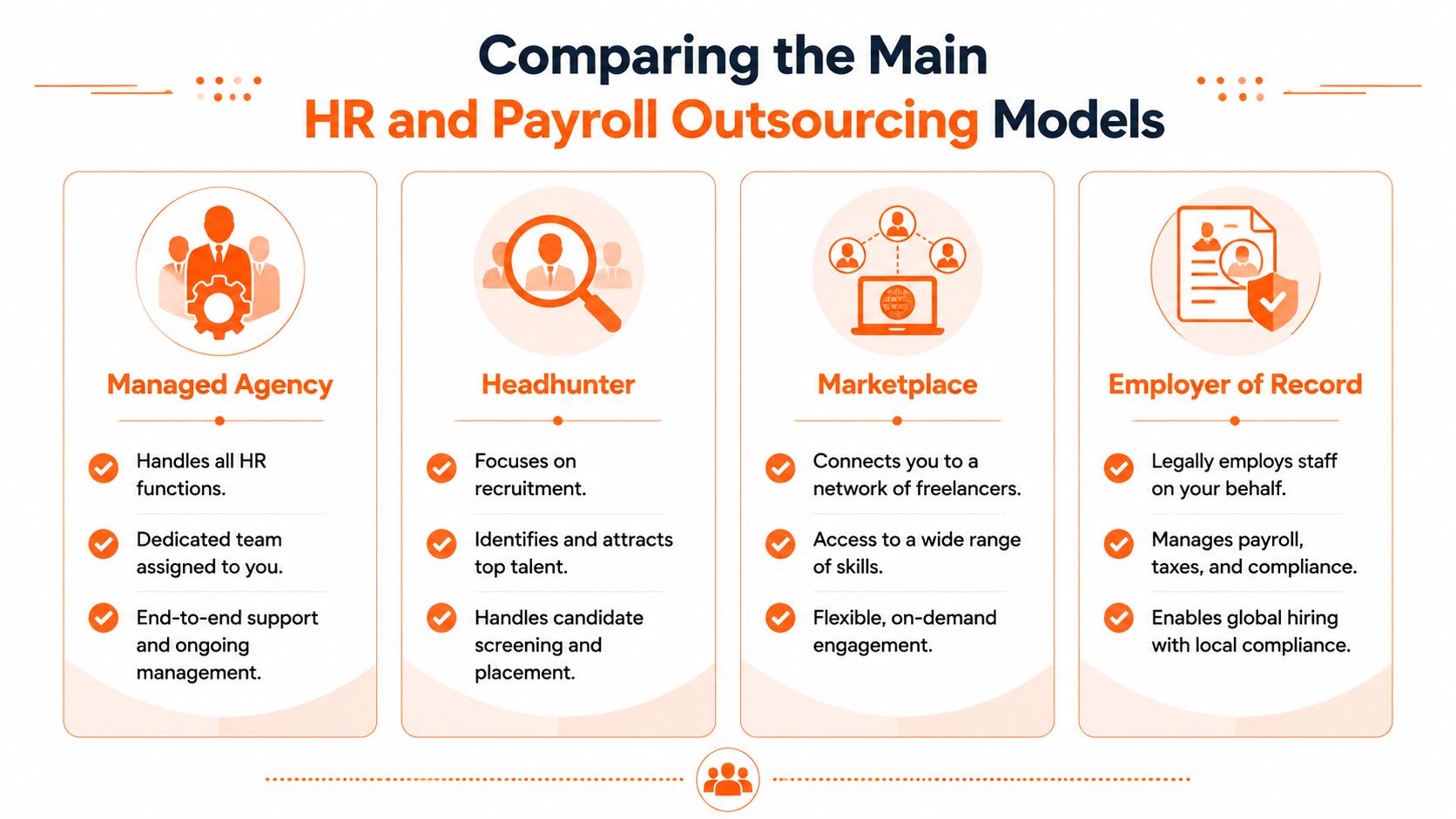
You'll encounter four models, and vendors often blur their boundaries in sales conversations. A managed agency handles a continuing operating function. A headhunter focuses on recruitment and placement. A marketplace connects you with independent professionals. An Employer of Record, or EOR, legally employs workers on your behalf in the relevant country.
The right choice depends on whether your main problem is payroll administration, talent access, legal employment infrastructure, or ongoing workforce management.
| Model | Pricing Structure | Replacement Guarantee | Vetting Depth | Best For |
|---|---|---|---|---|
| Managed agency | Usually an all-in service rate or recurring management fee | Often defined contractually, with terms varying by provider | Structured screening, role assessment, and account oversight | Companies needing recruitment plus continuing HR and payroll coordination |
| Headhunter | Placement fee, commonly tied to the hire | Usually limited to a defined guarantee period | Focused on candidate sourcing and interviews | A single specialist or senior search |
| Marketplace | Platform access, transaction fee, or worker-set pricing | Usually limited or absent | Profile and platform-based screening vary widely | Managers comfortable directing selection, contracts, and daily administration |
| EOR | Per-worker fee or bundled employment service charge | Usually not a recruitment guarantee | Employment compliance rather than deep role vetting | Companies hiring internationally without a local entity |
A managed agency can reduce coordination because one operating partner manages sourcing, contracts, payroll, and HR administration. That convenience comes with a trade-off: you must inspect the service boundary carefully. Ask whether the agency handles worker replacement, performance issues, payroll questions, and compliance escalations, or whether each issue moves to a different subcontractor.
An EOR solves a different problem. It provides a legal employment structure, but it doesn't automatically provide strong recruiting, role-specific assessment, or daily management. A marketplace can offer speed and choice, yet it leaves more responsibility with your internal team.
For a practical payroll sanity check, use a business payroll tax tool before comparing vendor proposals. It won't replace professional advice, but it can help you identify whether a quote excludes taxes, benefits administration, filing support, or other required services.
Choose a vendor by testing its operating controls, not its branding. A polished dashboard cannot compensate for unclear ownership, weak data controls, or support staff who cannot explain what happens when payroll data arrives late.
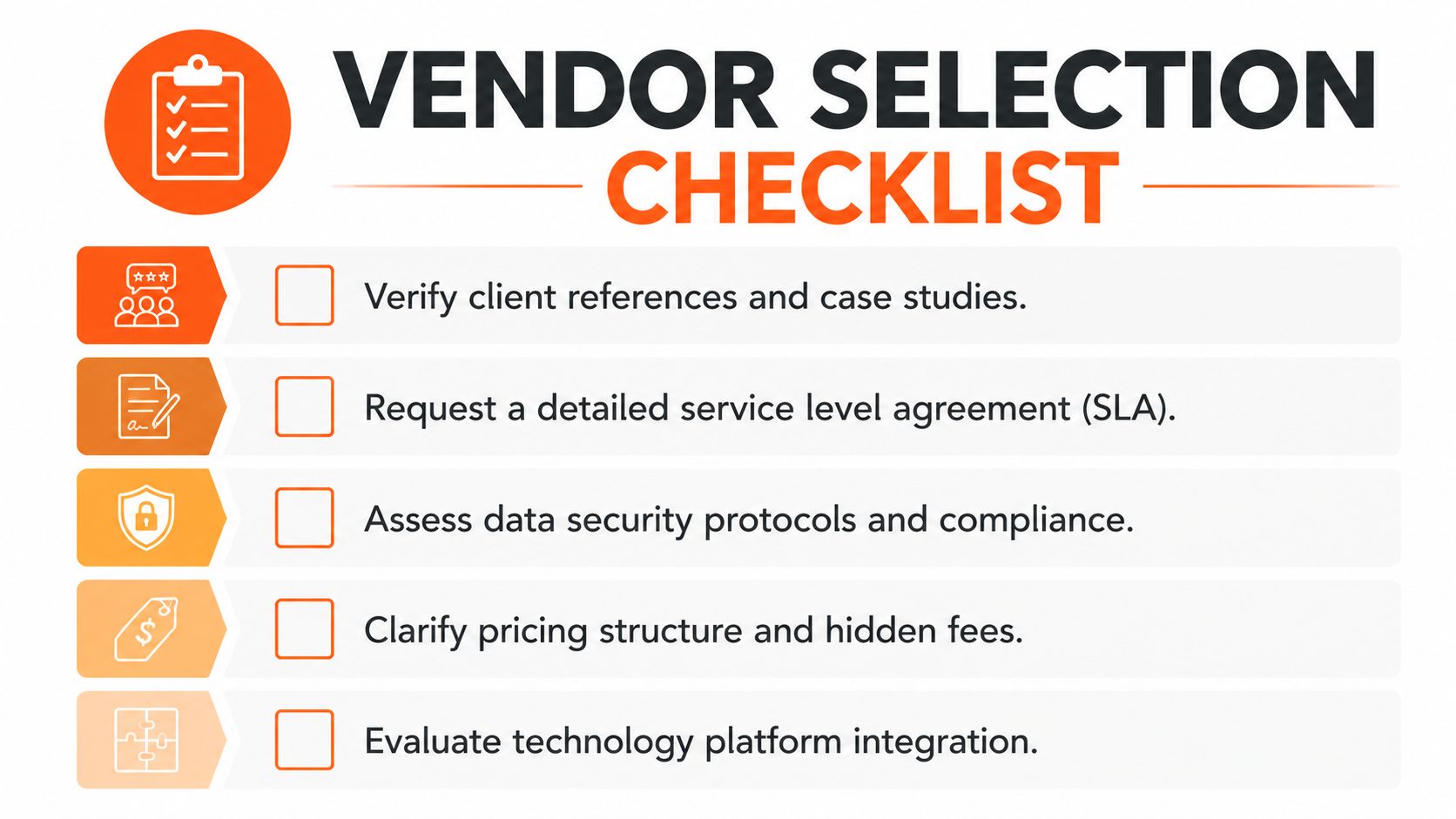
Verify the operating record. Request references from clients with similar workforce structures, jurisdictions, pay schedules, and role mixes. Generic testimonials are weak evidence. Apply a structured PeopleFinder vendor due diligence process to check the company, decision-makers, and relevant operating history.
Read the service level agreement. Require response times, payroll cutoffs, approval windows, escalation contacts, correction procedures, and responsibility for missed deadlines. “Compliance support included” describes a promise, not an SLA. Every handoff needs an owner.
Inspect the vetting funnel. Acceptance rates reveal little without the process behind them. Ask how candidates are screened, whether English is assessed live, whether skills tests match the role, and how references are verified. If a provider advertises a top 1% acceptance rate, require evidence of the screening steps that produce it. For reference, Virtustant's funnel is four stages: a live English screen, a cognitive assessment, a role-specific skills test, and experience or reference verification, and the top 1% figure describes what survives that sequence.
Reconcile the commercial model. Compare the public pricing page with the proposal. Separate placement fees, recurring management charges, payroll taxes, benefits, currency conversion, termination administration, replacement coverage, and optional technology costs. Unbundled charges often create the largest invoice surprises.
Test integration and visibility. Ask for a demonstration based on a realistic employee-data change. Adjust a pay rate, add overtime, update leave, correct bank details, and trace each approval. The test should reveal who reviews the change, where it is recorded, and how corrections are controlled.
Fragmented vendors create operational risk even when each performs its own task adequately. Separate systems can produce conflicting employee records, duplicated approvals, missed payroll cutoffs, and unclear compliance ownership. A new specialist should remove a known gap, not add another calendar, export, invoice, and escalation contact without a defined control.
In global payroll, 64% of organizations that outsource use up to 5 vendors, while 37% use a hybrid model and only 21% fully outsource to in-country providers, according to global payroll outsourcing trend data. Use those figures as context, not as a target operating model.
Set a vendor-sprawl threshold before signing. Assign one internal owner to maintain the vendor map, review handoffs, and confirm that data and compliance responsibilities remain covered. Outsourcing is not set and forget. Review the arrangement after payroll changes, market expansion, or repeated corrections.
For another perspective on evaluating staffing partners, see how to choose a remote staffing agency. Apply the same standard to payroll vendors: inspect the process behind the promise.
Outsourcing savings don't come from choosing the lowest hourly rate. They come from removing repeated administrative work, reducing corrections, consolidating systems, and giving managers more time for revenue-producing or operational work.
One source reports that outsourced payroll can cut costs by 27% and reduce errors by 50% compared with in-house processing. Another benchmark cites payroll-error reductions of about 80% versus manual in-house processing and accuracy rates up to 99.5%. Treat those figures as vendor-published benchmark claims, not automatic outcomes. They only become plausible when the provider controls the workflow and your team supplies accurate upstream data.
Your in-house baseline should include:
For a U.S. company hiring remote professionals in Latin America, the comparison also includes coordination and legal infrastructure. A lower labor rate doesn't create savings if your managers spend their time screening weak applicants, correcting payroll records, or coordinating several country-specific providers.
Nearshore hiring can provide meaningful U.S. time-zone overlap, and the offsets behind it are a matter of public record rather than any provider's proprietary finding. Colombia is UTC-5, which matches U.S. Eastern standard time and sits one hour behind during U.S. daylight time. Mexico City is UTC-6, while Argentina and Brazil are UTC-3. On a 9-to-18 local schedule, that arithmetic gives U.S. East Coast teams roughly 6 to 8 hours of overlapping business hours. For a wider view of how companies plan around it, see this LATAM nearshore hiring guide. The offsets shift relative to the U.S. twice a year because most of the region no longer changes its clocks, which is worth checking against our South America time zone guide before you publish recurring meetings.
That overlap has operational value, but it isn't the same as payroll compliance. You still need clear responsibility for contracts, local payments, records, and worker classification. If you're evaluating team capacity alongside payroll administration, compare the complete remote staffing pricing, not just an advertised rate.
The most important data point is upstream: 63.6% of payroll errors trace back to data-input mistakes, rather than calculation or system failure, according to benchmark analysis of payroll errors. Pay for validation, reconciliation, and exception reporting. A fast payroll engine can process bad data perfectly.
The first payroll cycle after migration is where weak projects become visible. A payroll outsourcing whitepaper reported that 20% of payslips were wrong in the first month of change, and 93% of respondents experienced payroll mistakes occasionally, frequently, or every month. The figures reinforce a practical point: transition controls matter more than launch-day confidence.
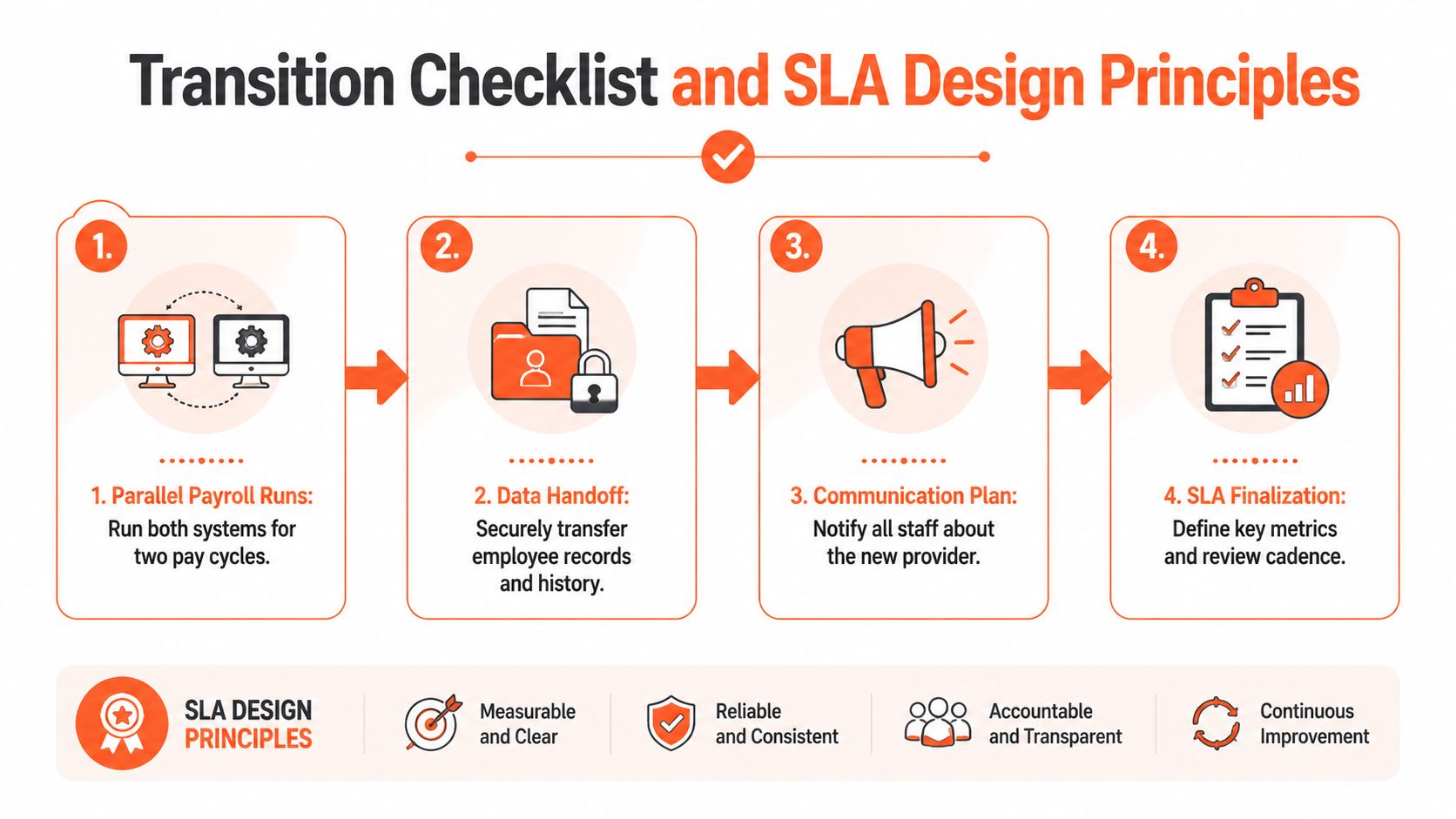
Inventory the source data. Identify employee records, compensation, tax codes, leave balances, deductions, payment details, historical payroll, and open corrections. Remove duplicates and document missing fields before transfer.
Build a secure handoff. Use an approved transfer method, restrict access, confirm the receiving owner, and record the file version. Don't move employee data through informal email chains or shared personal drives.
Run parallel calculations. During the first cycle, compare the incumbent and new provider line by line. Check gross pay, variable pay, deductions, taxes, employer costs, net pay, and reporting outputs. Run both systems for two full pay cycles, which gives the team time to identify recurring discrepancies rather than one-off entry mistakes.
Assign every data change. Your responsibility matrix should name the owner for pay rises, tax-code updates, overtime, leave, bank details, new hires, terminations, and corrections. “HR owns the data” is too vague to operate.
Notify workers before access changes. Explain where payslips will appear, who handles questions, when direct-deposit details change, and how workers can report an error.
The SLA should state the data cut-off time, approval window, payment-funding deadline, exception queue owner, response target, correction process, filing responsibility, and review cadence. It should also define what happens when your team submits information late and what happens when the provider misses its obligation.
The nine operational steps in global payroll typically include country-rule mapping, employee-data construction, pay-element configuration, pay-cycle setup, gross-to-net calculations, funding and foreign exchange, approvals and quality assurance, worker payment and payslip delivery, then filing, remittance, and period close. This global payroll compliance breakdown provides the process sequence. Your SLA should map an accountable owner to each step.
Our guide to outsourcing back-office operations is a useful reference when documenting which administrative functions can sit with one managed partner. Keep the responsibility matrix inside your operating documentation, not only inside the vendor contract.
Outsourcing HR and payroll shifts oversight from manual processing to control design. Keep ownership of the controls. Review automated compliance checks, reconcile employee master data, and inspect pre-payroll variance reports before approving every cycle.
Payroll accuracy depends on upstream data. Build controls around compensation, overtime, leave, tax details, bank information, worker classification, and start or end dates. A vendor cannot correct records your team submits incorrectly.
Local compliance remains difficult in global payroll. In the latest global payroll survey, 57% of respondents identified local compliance as their biggest challenge, followed by automating inbound HR data and outbound data to finance or data lakes, according to global payroll survey findings.
Set a recurring review for filing confirmations, rejected transactions, unresolved tickets, variance reports, and vendor SLA performance. Do not treat the provider as a set-and-forget system. Assign an owner to each exception, record the resolution, and review repeat failures with the vendor.
For U.S. companies hiring in Latin America, our breakdown of how nearshore payroll and compliance work is worth reading during vendor research, especially when comparing consolidated contracts, payroll, HR administration, and country-level compliance handling.
Yes. The employer remains ultimately responsible for tax compliance even when a third party processes payroll and files returns. A contract can allocate tasks, set service levels and require indemnification, but it does not transfer the underlying obligation. That is why the controls that stay in-house, approvals, data accuracy and vendor escalation, matter more than the vendor's dashboard.
They solve different problems. A managed agency runs a continuing operating function, combining sourcing with payroll and HR coordination. A headhunter fills a specific role and usually charges a placement fee. A marketplace gives you access and leaves selection, contracts and administration with your team. An employer of record supplies legal employment infrastructure in a country where you have no entity, but it does not automatically bring strong recruiting or role-specific assessment.
There is no universal number, but fragmentation is a real risk: conflicting employee records, duplicated approvals, missed cutoffs and unclear compliance ownership. Industry data shows 64% of organizations that outsource global payroll use up to five vendors. Rather than copying that, set a sprawl threshold before you sign, and give one internal owner the vendor map and the handoff review.
Not from the lowest quoted rate. They come from removing repeated administrative work, cutting corrections, consolidating systems and freeing management time. Build the in-house baseline first, including payroll labor, management time, systems, compliance work, the cost of errors and the friction of adding states, countries or pay types. Then compare like for like.
Two full pay cycles, compared line by line: gross pay, variable pay, deductions, taxes, employer costs, net pay and reporting outputs. One cycle only catches one-off entry mistakes; two exposes the recurring discrepancies that become monthly problems.
No, and conflating the two is a common mistake. Nearshore hiring buys time-zone overlap, roughly 6 to 8 hours of shared business hours for U.S. East Coast teams working with LATAM. Compliance is separate: contracts, local payments, records and worker classification still need a named owner, whether that is your team, an EOR or a managed partner.
Virtustant is a remote staffing agency, not an EOR product or a payroll platform. It places vetted remote professionals across LATAM and includes contracts, payroll in the professional's country, HR and compliance in the managed service, billed through one consolidated U.S. dollar invoice, while the client keeps direct day-to-day management. Compare it against an EOR, a local entity and a direct contractor model on total operating cost rather than on the quoted rate.
Virtustant connects U.S. companies with vetted remote professionals across Latin America and includes contracts, payroll, HR, and compliance in its managed staffing service. Visit Virtustant to review nearshore hiring options and assess whether a consolidated operating partner fits your payroll and workforce needs.