Outsourced Sales Company or Dedicated Remote Team? Sales Outsourcing in 2026
October 13, 2026


An outsourced sales company runs part or all of your sales motion for a fee. It supplies the reps, the playbook, the tools and the management, then reports results back to you. The category is big: Grand View Research estimated the global sales and marketing business-process-outsourcing market at $28.65 billion in 2022 and projects $57.46 billion by 2030. Size is not the buying question, though. The question is what one sales-accepted opportunity costs you.
There is a second way to buy sales capacity. Instead of handing the process to a provider, you hire dedicated remote SDRs, appointment setters or closers through a remote staffing agency and direct them yourself, inside your own CRM and playbook. This guide compares both models honestly, gives you a named test to price them on the same basis, and shows when each one wins.
The short answer: buy a managed outsourced sales team when you do not yet have a playbook or anyone to run one. Hire dedicated remote reps when you have a motion that converts and someone who can coach it every week.
To outsource sales means handing a defined part of your revenue process to an outside team. Usually that is prospecting, lead qualification and appointment setting. Sometimes it includes demos and closing. The provider recruits and trains the reps, runs the sequences and dialers, supervises the work and reports on meetings and pipeline.
At its strongest, a managed provider delivers a working operating layer: recruiting, training, process design, technology, management, quality assurance and reporting. You should get a functioning program, not a stack of resumes and a request to manage execution yourself.
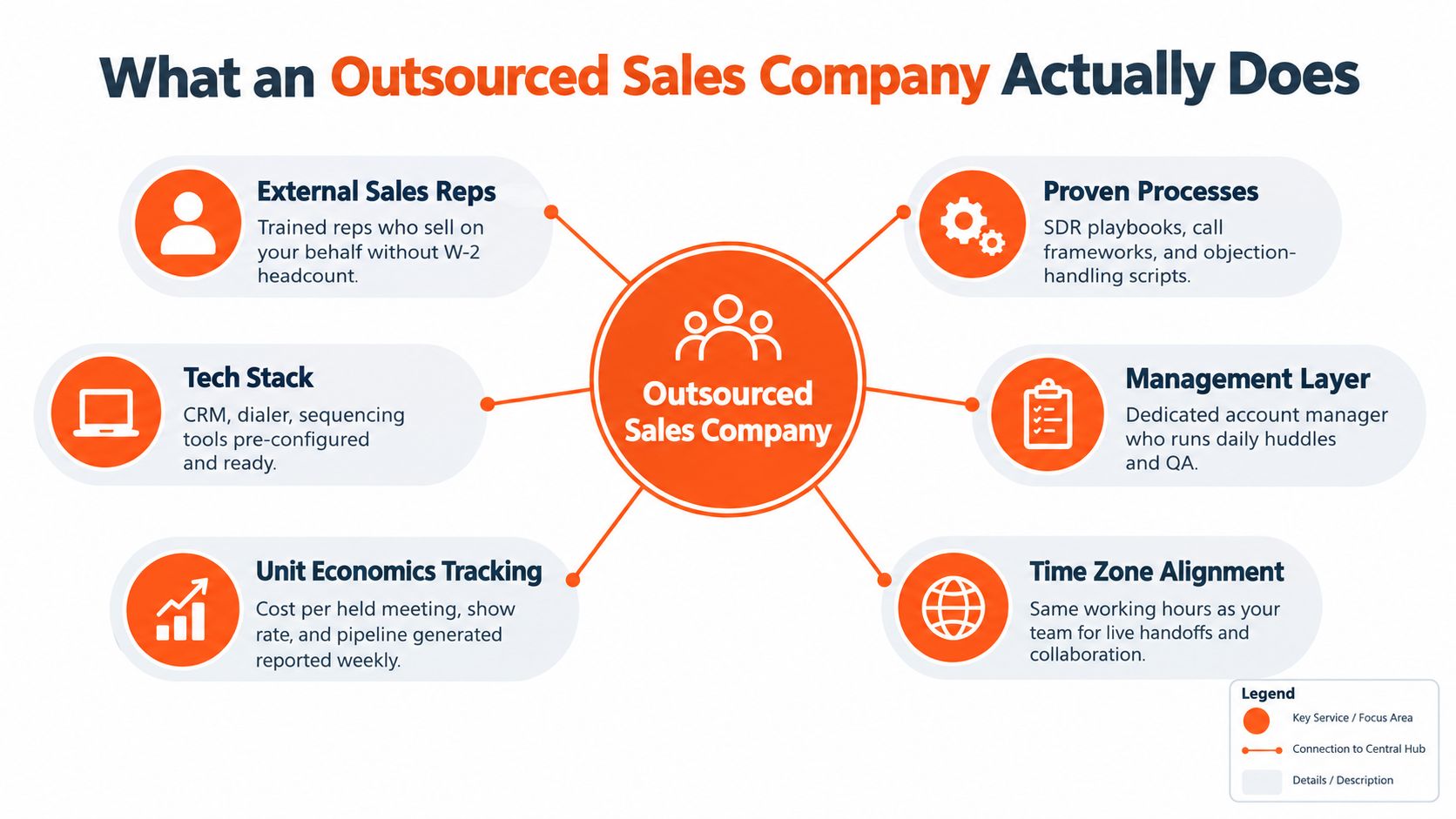
People are only one input. A provider may place SDRs, appointment setters, researchers or full-cycle reps, but the value of a managed service sits in the process around them: defining the role, training reps on your messaging, preparing prospect data, reviewing calls and holding a steady management cadence. The same logic applies to technical roles. You can listen to Jeremy Potoka on SE Rockstars' PreSales Unleashed podcast to hear how fractional presales capacity is scoped. The lesson carries over: external capacity works when responsibilities, handoffs and quality standards are written down.
Check for these deliverables before signing anything:
"Sales outsourcing" gets used for models that behave very differently, and one of the four options below is not outsourcing at all. The cleanest way to separate them is to ask two questions: who owns the playbook, and who manages the reps every day?
Start with the in-house baseline. The Bureau of Labor Statistics reports a 2025 median pay of $76,460 per year, or $36.76 per hour, for wholesale and manufacturing sales representatives, the closest broad BLS category to an outbound rep. The split matters: the May 2025 median was $104,920 for reps selling technical and scientific products and $72,080 for everyone else. The BLS occupation profile projects little or no change in employment from 2025 to 2035, with about 123,400 openings a year as people change jobs or retire. That is the wage alone, before benefits, payroll taxes, recruiting, tools and management time.
| Model | How you pay | Who owns the playbook | Who manages day to day | Best fit |
|---|---|---|---|---|
| In-house hiring | Salary, benefits, payroll taxes, tools, recruiting and replacement costs | You | You | Complex, technical or relationship-heavy selling |
| Remote staffing agency (dedicated remote reps) | An hourly rate per rep; the agency handles payroll and paperwork on the professional's side | You | You | A validated motion that needs more capacity |
| Freelance marketplace | Hourly, project or milestone payments to individuals | You, or nobody | You | Short, well-defined experiments |
| Managed outsourced sales company | Retainer, program fee, performance fee or a blend | The provider, with your input | The provider | No playbook yet, or no one to run it |
Buyers are moving toward models where the provider owns operations. In Deloitte's Global Outsourcing Survey 2024, 50% of respondents were using outsourced services for front-office capabilities such as sales, marketing and R&D. Only 34% named cost savings as the main reason to outsource, down from seven in ten organizations four years earlier, and 67% of executives reported adopting managed or operate services, up from 45% two years before. Read that as buyers paying for expertise and ownership, not only cheaper hours.
Decision rule: if a provider gives you people and expects you to run the process, you are buying staffing. If it owns the process and reports outcomes, you are buying a managed service. Both are legitimate. Pay for the one you actually need.
An hourly rate tells you what capacity costs. It does not tell you whether that capacity creates pipeline. A cheap rep who books meetings your account executives reject is expensive. A pricier program that creates accepted opportunities can be cheap.
Build the comparison from CRM records, using the same qualification rules and attribution window for every option:
Benchmarks help you set realistic inputs. The Bridge Group's 2025 SDR Models & Metrics report, based on a 2024 to 2025 survey of 351 B2B companies, puts the global median monthly quota at 10 held "Stage 0" meetings per SDR and the average SDR ramp time at 3.0 months. Ramp matters: whatever model you choose, the first quarter costs more per opportunity than the steady state.
You can review hourly rates for remote professionals, but treat them as one input to the business case, not the business case.
The Cost-per-Accepted-Opportunity Test prices every sales model on one number: monthly all-in cost ÷ sales-accepted opportunities (SAOs) in that month. "All-in" means every dollar the option really costs you, including your own management time and tools. Run it for each option with your own numbers. The example below shows the mechanics.
Step 1. Put every option on the same hours. A full-time month is 40 hours × 52 weeks ÷ 12 = 173.33 hours.
Step 2. Price each option all-in. Every input marked "example" is an assumption for illustration, not a market price. Replace it with the quotes you actually receive.
| Cost line | A. Managed outsourced sales program | B. Dedicated remote SDR you direct | C. In-house rep |
|---|---|---|---|
| Rep or program cost | $6,000 program fee (example) | $12.41/hr × 173.33 h = $2,151.07 | $76,460 ÷ 12 = $6,371.67 (BLS median wage only) |
| Your tools (CRM seat, dialer, data) | $0 (included, example) | $300 (example) | $300 (example) |
| Your management time at $60/hr (example) | 4 h = $240 | 8 h = $480 | 8 h = $480 |
| Monthly all-in cost | $6,240.00 | $2,931.07 | $7,151.67 |
| Held qualified meetings (example: the Bridge Group median quota of 10) | 10 | 10 | 10 |
| Acceptance rate by your AEs (example) | 50% = 5 SAOs | 50% = 5 SAOs | 50% = 5 SAOs |
| Cost per accepted opportunity | $6,240.00 ÷ 5 = $1,248.00 | $2,931.07 ÷ 5 = $586.21 | $7,151.67 ÷ 5 = $1,430.33 |
Option B uses the median client-side rate for SDR and BDR placements in Virtustant's H1 2026 rate report: $12.41/hr (n=32), drawn from 441 placement starts between January and June 2026. Option C counts the BLS median wage only, so it understates the true in-house cost.
Step 3. Find the break-even. Divide the higher all-in cost by the lower cost per SAO. In this example, the managed program has to produce $6,240.00 ÷ $586.21 = 10.64 accepted opportunities a month to match the dedicated rep. At a 50% acceptance rate that is 10.64 ÷ 0.5 = 21.29 held meetings, a little more than twice the output of one rep at the median quota.
That is the honest read. A managed program is not automatically more expensive. If it runs several reps and channels, brings a list and a playbook that already convert in your market, and skips your ramp, it can clear that bar. Ask the provider for blended, held-meeting and acceptance data from live accounts, then plug its real numbers into the test. If you go the dedicated route, you can hire a remote SDR and run the same math on your first full month.
The cost test tells you which option is cheaper per opportunity. It does not tell you which one your business can run. Use this rule, which we call the Playbook Ownership Rule:
Many teams end up with a split: a dedicated remote appointment setter working inbound and warm leads, an SDR on outbound, and an internal or remote sales closer taking the qualified calls. For a deeper look at the outbound seat specifically, see the pros and cons of an outsourced SDR.
What do companies actually ask for when they hire remote sales capacity they will direct themselves? We counted Virtustant's own search records. Of the 34 most recent client searches for SDRs, BDRs, appointment setters, cold callers and closers opened between September 21 and October 12, 2026:
We excluded two evergreen open-application postings Virtustant runs for its own talent pool and checked each record for reposts of the same search; none were found. The counts cover schedules only.
Two practical lessons follow. First, buyers want reps live during their own business day, which is why time-zone overlap shows up again in the location section below. Second, a lot of real demand is part-time. If your need is 20 hours a week, check whether a managed program's minimum seat or retainer fits before you compare prices.
Selection gets easier in three stages: define success, test the provider's controls, then judge the launched program on CRM evidence. A polished pitch cannot make up for vague ownership or missing records.
Write the ideal customer profile in operational terms: company traits, buyer role, use case, exclusions, trigger events, territory and the conditions that make a meeting unacceptable. Agree on what sales will accept before the first sequence runs. The launch document should also specify:
If you are pricing specialist providers for one slice of the funnel, our breakdowns of appointment setting services and cold calling services walk through how those offers are usually structured.
Ask who owns prospect records, consent evidence, call recordings, enrichment data, CRM history and sequence assets, and what gets deleted when the contract ends. Confirm role-based access, approved sending domains, opt-out synchronization, call-disclosure rules, subprocessors, breach notification and a clean export on exit. Weak governance creates exposure in any geography.
Track connect rate, positive replies, held-meeting rate, acceptance rate, opportunity conversion and pipeline per rep hour, by launch cohort. A provider that reports only dials, emails or booked meetings is withholding the numbers you need for the Cost-per-Accepted-Opportunity Test.
Location affects results when selling depends on live collaboration. A nearshore rep working during your business hours can join handoffs, get same-day coaching and adjust messaging while your US team is online. An offshore team many hours away may cost less per hour, but limited overlap pushes more work into asynchronous updates and slows feedback.
Let the sales motion decide. A company selling a high-touch service, changing its message often and relying on fast founder feedback benefits from overlap: Nearshore hiring in Latin America lets a morning coaching session, a midday call review and an afternoon script change happen on the same day. A company selling a simple, standardized product to a large list may tolerate delayed collaboration if the workflow is fully documented.
Language is necessary but not sufficient. Sales performance also depends on listening, question quality, judgment, written clarity and objection handling. Where executive-facing calls matter, resources focused on helping sales professionals speak clearly can inform your own training standards. Neither geography guarantees quality, retention or conversion, so ask every provider how it tests product knowledge, coaches calls and replaces reps who leave.
Outsourcing sales is a poor fit when the product needs deep founder-led selling, specialized technical discovery or strong references before buyers will engage. It also struggles when the company has not documented its own qualification rules or closed enough business to explain why customers buy.
Before approving any provider or hire, confirm all of the following:
The most dangerous arrangement pays for volume while pretending to buy revenue. Choose an outside model only when it gives you measurable speed, real operating control and a lower cost per accepted opportunity than your realistic internal alternative.
Virtustant is a remote staffing agency, not an outsourced sales company. We do not run your sales process. We find, vet and place dedicated remote SDRs, appointment setters, cold callers and closers who work inside your CRM, follow your playbook and report to your team.
To model the full monthly budget for one seat, see our remote SDR cost breakdown. When your playbook is ready, book a call to hire a dedicated remote SDR and run the Cost-per-Accepted-Opportunity Test on your own numbers.
Outsourcing sales means handing a defined part of your revenue process, usually prospecting, lead qualification and appointment setting and sometimes closing, to an outside team. In a managed model the provider owns the playbook, tools and management. The alternative is a staffing model, where you hire dedicated remote reps and direct them yourself.
An outsourced sales company runs the sales process for you and reports outcomes. A remote staffing agency like Virtustant places dedicated remote SDRs, appointment setters or closers who work inside your CRM and follow your playbook, while the agency handles payroll and paperwork on the professional's side.
Managed providers usually charge a retainer, a program fee, a performance fee or a blend, so ask for written quotes. A dedicated remote SDR through Virtustant starts at $8/hr all-in, and the H1 2026 median client-side rate for SDR/BDR placements was $12.41/hr (n=32). BLS reports $36.76/hr as the 2025 median pay for wholesale and manufacturing sales representatives.
Measure cost per sales-accepted opportunity: monthly all-in cost, including your management time and tools, divided by the opportunities your sales team accepted that month. Cost per held qualified meeting, pipeline per dollar and payback period are useful supporting metrics. Booked meetings and dials alone are not enough.
The Bridge Group's 2025 SDR Models & Metrics report puts average SDR ramp time at 3.0 months, based on a survey of 351 B2B companies. A provider with an existing playbook may produce meetings sooner, but ask for its held-meeting data from live accounts rather than relying on promises.
Choose based on how much live collaboration your sales motion needs. Nearshore reps who work during US business hours can join handoffs and get same-day coaching, which helps when messaging changes often. Teams many time zones away suit simple, fully documented workflows where delayed feedback is acceptable.
It is a poor fit when you have no documented ideal customer profile or qualification rules, when deals need deep founder-led or technical selling, or when no one on your side can review pipeline and approve messaging. Fix those first, or keep selling founder-led until the motion is repeatable.
You get a shortlist of 3 to 5 vetted candidates within 48 hours of your first call, and your hire can start in 72 hours. An account manager then coordinates onboarding, the start date, tools access and the first-week plan.
Virtustant places dedicated remote SDRs, appointment setters and closers that you direct inside your own CRM and playbook. An account manager coordinates onboarding and follows up during the first weeks, Virtustant handles payroll, paperwork and everything administrative on the professional's side, and every placement comes with a lifetime replacement guarantee, month-to-month terms, zero placement fees and one weekly invoice. Visit Virtustant to review the role, rates and terms before you build your scorecard.