What Is an Administrative Task? Examples and What to Delegate
September 2, 2026


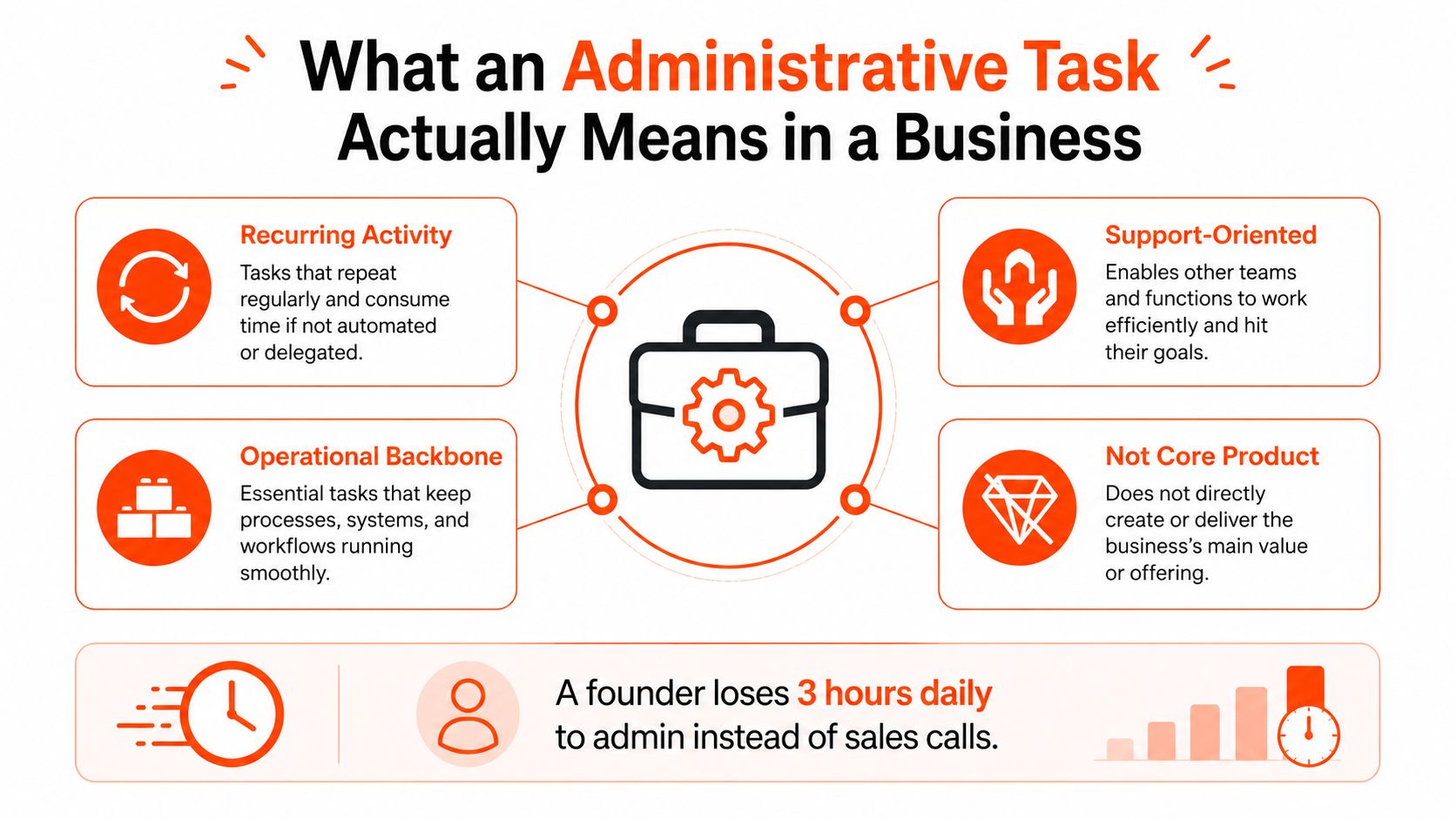
An administrative task is a single recurring support action that keeps a business running without producing the thing the business sells: approving an expense, filing a signed contract, chasing a timesheet, triaging an inbox. It is an action, not a role, and that distinction is what makes it delegable.
Every other page answering this question gives you a list. A list is useful for writing a job description and useless for running a company. The operating question is not what counts as administrative work, it is which of these actions should stay with you, which should be automated, and which should move to someone else, and at what point delegating one stops paying for itself.
This page gives the definition, the examples by team, what the work actually costs in measured hours, and a scoring rule with a break-even test you can apply this week. If the score says delegate, the usual first hire is a virtual assistant from Latin America who takes the recurring layer off your desk.
An administrative task is a recurring support activity that keeps a business operating without producing its primary product or service. Three properties define it, and all three matter for what you do next:
The five categories below are not our invention. They are the five activities measured in a 2026 study of 6,000 office workers and 1,800 decision-makers across six European markets: the UK, France, Germany, the Netherlands, Italy and Spain. Office workers there spent around 15 hours a week on them (Ricoh Europe study coverage). That is European data, not U.S. data, and we treat it as a directional benchmark rather than a figure for your company.
| Category | What it covers | Typical example |
|---|---|---|
| Document and file management | Creating, naming, storing and retrieving records | Filing a countersigned contract where the next person can find it |
| Manual internal processes | Repeating a company procedure by hand | Collecting and submitting weekly timesheets |
| Chasing approvals | Moving a decision through the people who must sign it | Following up on an unapproved expense report |
| Information retrieval | Finding something that already exists | Locating last quarter's invoice for a client question |
| Inbox and message management | Reading, sorting, routing and answering | Triaging a shared support or sales inbox |
What is not an administrative task: a decision only you can make, an exception with no written rule, and anything that requires your relationship with a customer. Those are not delegation candidates; they are the reason delegation is worth doing.
Job descriptions blur these two words, and the blur is expensive. A duty is a functional area a role is accountable for. A task is a specific action inside it. You delegate tasks. You assign duties. You keep accountability.
| Work type | What it describes | How to treat it |
|---|---|---|
| Administrative duty | A functional area owned by a role | Assign it to a named person and hold them accountable for the outcome |
| Administrative task | A specific repeating action inside that area | Document it, then automate, delegate or retain it |
| Exception handling | A case outside the written pattern | Keep oversight, or write the escalation rule that turns it into a task |
Ask what happens if the action is done slightly wrong. If the answer is "we fix it in the next cycle," it is a task. If the answer is "we lose a client, miss a filing deadline or pay the wrong amount," it is an exception and it needs a rule before it needs a person.
This is also why titles mislead. Two people with the same title can hold completely different authority, and that is the distinction we map in detail in executive assistant vs administrative assistant.
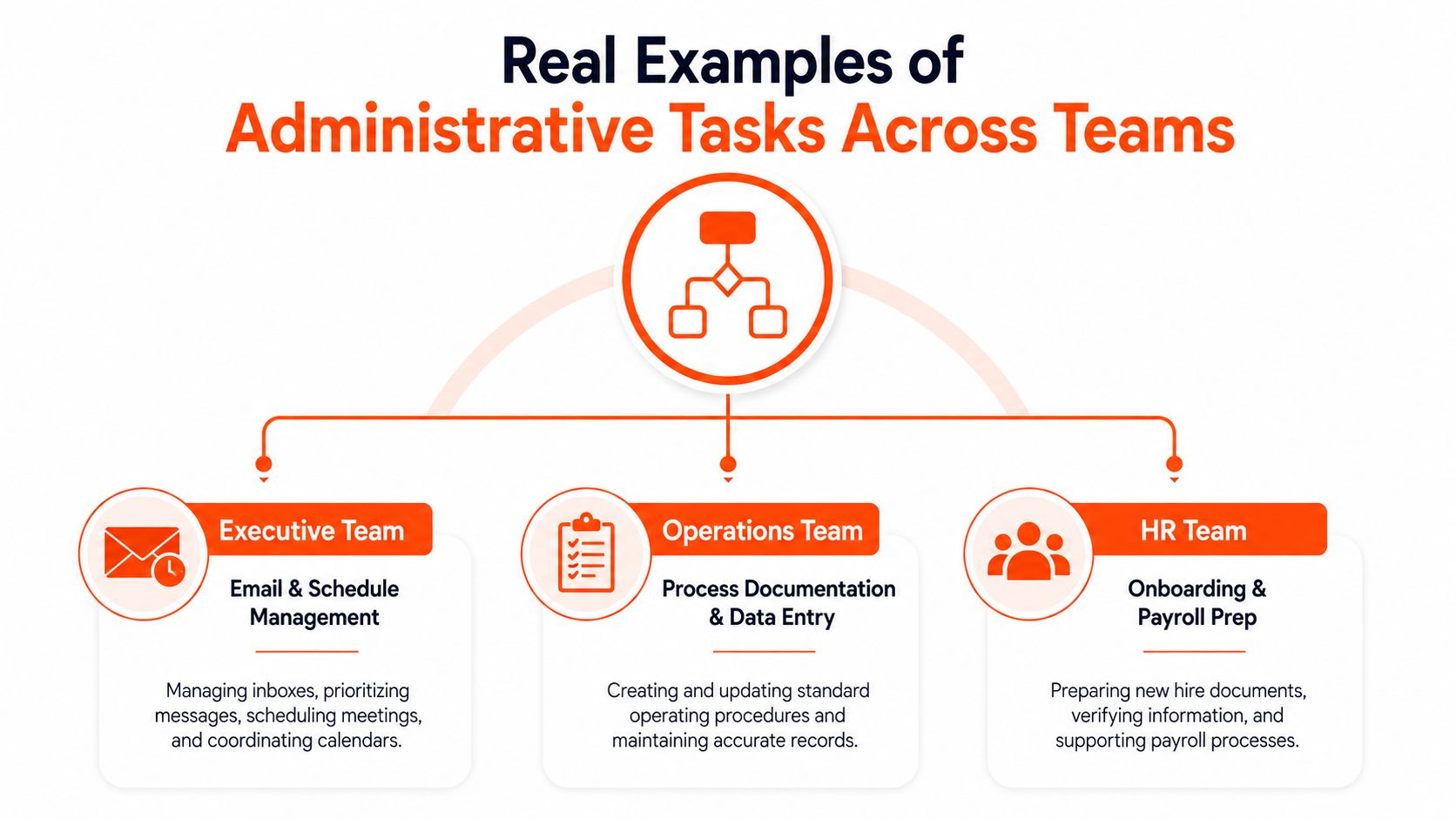
The same five categories look different depending on which function they land in. Here is where they actually show up in a 20 to 200 person U.S. company.
| Team | Administrative tasks that come up most | What usually stays in-house |
|---|---|---|
| Executive and operations | Calendar management, travel booking, meeting notes and follow-ups, document formatting, CRM hygiene, status chasing | Deciding priorities, and any commitment made on your behalf |
| Finance | Invoice preparation, receipt and expense categorization, AP and AR follow-up, reconciliation prep, close checklists | Payment authorization, tax positions, anything requiring a licensed signature |
| Sales and customer | Lead research and enrichment, list building, appointment setting, order and ticket updates, first-line replies from a script | Pricing authority, key account relationships, escalations |
| People operations | Timesheet collection, onboarding paperwork, scheduling interviews, PTO tracking, document requests | Compensation decisions, performance conversations, terminations |
| Marketing | Publishing from an approved brief, asset organization, reporting pulls, link and QA checks, inbox and comment triage | Positioning, brand voice, budget allocation |
For a longer role-specific inventory, see 50 tasks to delegate to an executive assistant and what an executive assistant does.
Two patterns are worth noticing. First, the "stays in-house" column is short in every row. Most admin work is delegable and the exceptions are specific. Second, every item in that column is a decision, not a task. If your keep-list is full of actions rather than decisions, it is a documentation problem wearing a trust costume.
Three independent measurements, each from a different angle. None of them is about your company, and that is the point: use them to decide what to measure, not what to believe.
| Measurement | What it found | Source |
|---|---|---|
| Time on core admin | Around 15 hours a week across five activities, among 6,000 office workers in six European markets | Ricoh Europe, 2026 |
| Productive share of the week | Roughly 30 of 40 hours on productive work, with 3.6 hours lost to internal communication, 2.8 hours searching for information and 2.2 hours in unproductive meetings | APQC figures collected in a productivity guide |
| Small-business repetition | 47% of SMEs report spending over 10 hours a week on repetitive tasks such as receipt processing and data categorization | Automation vendor survey |
The productivity breakdown above comes from this practical productivity guide, which also reports that on coordination-heavy work roughly 60% of the time goes to work about work rather than the work itself. Before you add a person, it is worth asking how much of that 60% is a process problem.
The 47% figure sits inside a broader argument to reduce admin tasks for freelancers through automated capture and categorization. We would put it more bluntly: anything rule-based should be automated before it is delegated, because a person doing a robot's job is the most expensive way to fix a workflow.
Administrative support is not a rounding error in the labor market. The U.S. Bureau of Labor Statistics counted 18.5 million office and administrative support jobs in May 2023, 12.2% of total employment, at an annual mean wage of $47,940 against $65,470 for all occupations. Within that group, secretaries and administrative assistants (excluding legal, medical and executive) accounted for 1.8 million jobs, and executive secretaries and administrative assistants averaged $73,680.
Run the arithmetic before you shop. A $47,940 mean wage across 2,080 hours is about $23 an hour in wage alone, before employer payroll taxes, benefits, equipment, recruiting time and the management hours the role consumes. That is the number every other option gets compared against.
Inventory first. For one week, log every recurring action: what it was, what triggered it, which system it used, who owned it and how long it took. You cannot score work you have not written down, and the log is also the onboarding document later.
Then score each logged task on four questions:
| Lane | Choose it when | Example |
|---|---|---|
| Automate | Rule-based, predictable, no judgment required | Calendar reminders, CRM field updates, receipt capture and categorization |
| Delegate | Recurring, checkable output, context can be written down | Inbox triage, invoice preparation, lead research, filing and retrieval |
| Keep | Unique judgment, sensitive relationship, or an unwritten exception path | Final approval on a contract, a pricing call, a customer escalation |
| Not yet | Recurring but undocumented, or the error cost exceeds your review capacity | Anything you would have to re-explain every week |
This is the test most delegation advice skips. Delegating an hour of work does not save you an hour. It costs you the time to specify it and review it. So the boundary is not an hourly rate, it is a proportion:
If one hour of delegated work requires more than about 20 minutes of your specification and review, the task is not ready to leave. Document it or automate it first. Under that ratio, delegation compounds: your review time falls each week while the output holds. Above it, you have bought yourself a second job.
That ratio is our operating rule from placing remote professionals into U.S. teams, not a published research finding. Measure it in week two, not on day one, because a new professional always needs more review at the start. What matters is the direction of travel: review time falling is a working delegation, review time flat is a documentation gap.
Our virtual assistant onboarding checklist sets out the first 30 days, and seven signs it is time to hire a virtual assistant covers the signals that the inventory is already overdue.
Four options, compared on the things that actually differ. Ranges marked as planning ranges are exactly that: validate against your own market before budgeting.
| Option | What it costs | Time to start | Day-to-day control | If it fails |
|---|---|---|---|---|
| Absorb it yourself | Your own hours, at whatever your hour is worth | Immediate | Total | Founder dependency, and the cost is invisible until it is not |
| Hire locally in the U.S. | About $23 an hour in wage alone at the BLS mean, plus payroll taxes, benefits, equipment and recruiting | A full search and notice period | Total | You re-run the search |
| Freelance marketplace | Variable, priced per task or per hour | Fast | Variable, and you own screening and QA | Continuity and quality vary; replacement is your problem |
| Nearshore staffing agency | An all-in hourly rate that includes payroll, contracts, HR and compliance | 3 to 5 vetted candidates within 48 hours, start in 72 hours | You direct the work daily | Replacement is the agency's process, not your search |
The order matters more than the choice. Automate the rule-based layer, delegate the checkable layer, keep the judgment layer. Doing it in the other order means paying a person to run a process you could have removed, and it is the single most common way a delegation budget disappears without the founder's week getting lighter.
Whichever option you pick, transfer an accountable process rather than a pile of errands. The right way to outsource back office is to hand over a documented workflow with a defined output, then review the output instead of watching the work.
Virtustant is a remote staffing agency. We place named vetted professionals across Latin America who work inside your systems and your calendar, while we carry sourcing, assessment, contracts, payroll, HR and compliance. You keep the management relationship and the daily direction. The usual starting point is a remote virtual assistant for the checkable layer, or a remote executive assistant when calendar and inbox ownership need judgment.
| What we publish | Figure |
|---|---|
| All-in hourly rate, floor | $7.00 per hour |
| Executive assistant support, from | $8.50 per hour |
| Placement, setup and recruitment fees | $0 |
| Typical full-time monthly cost | $1,500 to $5,000 per month |
| Vetted bilingual candidates presented | 3 to 5 within 48 hours |
| Time to start | Start in 72 hours from your first call |
| Onboarding | Up to 72 hours |
| Contract terms | Month to month, with a lifetime replacement guarantee and no time limit |
Against a comparable U.S. hire, you can save up to 70% once payroll, benefits and overhead are counted, and the $23-an-hour BLS wage figure above is the comparison it is measured against. We have worked with more than 1,000 U.S. clients since 2021.
The vetting funnel behind our top 1% claim is published rather than asserted: of everyone who applies, 22% pass the initial screen, 9% pass the cognitive (IQ), skills and English assessment, 3% reach a live interview and 1% are hired. The 1% refers to that full multi-stage funnel.
Time-zone overlap with U.S. business hours is typically within one to three hours of your working day, which is what makes same-day review of admin work practical rather than a next-morning handoff. Our Virtustant nearshore outsourcing benefits guide covers the model at a higher level.
If your inventory says the work is ready to move, the next step is a scoped conversation about the specific role: LATAM nearshore staffing, the published rate card, the remote roles we staff, or hire a virtual assistant. For role-level pricing detail, see what an executive assistant costs in 2026, hire a virtual executive assistant and the US vs LATAM salary guide. Or send Virtustant your task inventory and book a free 20-minute scoping call.
An administrative task is a single recurring support action that keeps a business operating without producing its product or service. Filing a signed contract, collecting timesheets, chasing an approval, retrieving an invoice and triaging an inbox are administrative tasks. It is an action rather than a role, which is what makes it possible to document, automate or delegate one task at a time.
Triaging a shared inbox is a clear example: it repeats daily, it supports revenue without producing it, and the output is checkable. Other common examples are calendar management, travel booking, invoice preparation, expense categorization, timesheet collection, CRM data hygiene, meeting notes, document filing and lead research.
The five activities measured in the 2026 Ricoh Europe study are document and file management, manual internal processes such as timesheets, chasing approvals, information retrieval and inbox management. In a U.S. company those show up as calendar and travel management, invoice and expense work, appointment setting, onboarding paperwork, reporting pulls and CRM hygiene.
A duty is a functional area a role is accountable for, such as bookkeeping or office management. A task is a specific repeating action inside that area, such as categorizing this week's transactions. You assign duties to a named person and hold them accountable; you document and delegate individual tasks. Confusing the two is why job descriptions list areas and delegation plans stall.
In a job title, administrative signals that the role supports operations rather than producing the product or owning strategy. The U.S. Bureau of Labor Statistics groups these roles as office and administrative support occupations, which accounted for 18.5 million jobs in May 2023, 12.2% of total employment, at an annual mean wage of $47,940.
Written communication, calendar and priority management, accurate data handling, familiarity with the company's core systems, discretion with sensitive information, and the judgment to escalate rather than guess. For delegated work specifically, the skill that predicts success is following a documented process and flagging exceptions instead of improvising around them.
Start with tasks that have a clear input, a checkable output and no undocumented context: inbox triage, invoice preparation, lead research, filing and retrieval, and scheduling. Keep decisions, pricing authority, customer escalations and anything requiring a licensed signature. Automate anything rule-based before delegating it to a person.
Use the ratio, not the rate. If one hour of delegated work needs more than about 20 minutes of your specification and review, the task is not ready to leave and should be documented or automated first. Measure it in week two rather than on day one, and watch whether review time is falling or flat.
It depends on the model. A U.S. hire starts from roughly $23 an hour in wage alone at the BLS mean for office and administrative support occupations, before payroll taxes, benefits, equipment and recruiting. Virtustant publishes an all-in rate from $7.00 per hour, no placement or setup fee, and typical full-time roles between $1,500 and $5,000 per month.
Yes, for the delegable layer: scheduling, inbox and document management, invoice preparation, data entry, lead research and reporting pulls. What a virtual assistant cannot do is fix an undocumented process or absorb authority you have not granted. Define the output, the review point and the escalation rule before the first task moves.
Third-party figures are those each source publishes on its own site, checked September 2026. Ricoh Europe data covers six European markets and is directional for U.S. companies. Virtustant figures are first-party placement data.