First Dollar Coverage: What It Means for Employers (2026)
October 20, 2026


First dollar coverage means a health plan starts paying for a covered service with the first dollar of the bill, before the member has met the deductible. That matters more in 2026, when an HSA-qualified high-deductible plan must carry a deductible of at least $1,700 for self-only coverage, per IRS Rev. Proc. 2025-19. First-dollar does not always mean $0: a copay or coinsurance can still apply.
This guide is written for US business owners and office managers who pick, pay for and explain a group health plan. It covers how the payment order works, where first-dollar rules come from, what changed for HSA plans in 2025 and 2026, and a simple test for pricing a first-dollar carve-out before your renewal call.
This article is general information, not insurance, tax or legal advice. Confirm plan details with your carrier, broker or a qualified advisor.
First dollar coverage is a rule about order of payment. In a deductible-first plan, the member pays the allowed cost of covered care until the deductible is met. Only then does the plan start sharing costs. With a first-dollar benefit, the plan pays toward that specific service right away.
There are two versions, and they get confused all the time:
Working definition: First dollar coverage means the plan pays for a covered service before the member meets the deductible. Check separately for copays, coinsurance, network rules, visit limits and eligibility.
For an employer, first-dollar is a design choice with a price. When the plan pays earlier, the cost does not disappear. It moves into the premium, or into tighter limits on which services qualify.
Start with the deductible-first baseline. A quote site's explainer, How deductibles work in policies, describes the deductible as the fixed amount you pay for a covered problem before the insurer pays the rest. In a health plan, coinsurance and an out-of-pocket maximum sit on top of that.
HealthCare.gov's coinsurance glossary entry walks through a high-cost example. The plan has a $3,000 deductible, 20% coinsurance and a $6,850 out-of-pocket maximum. Allowed costs are $12,000.
That is a deductible-first sequence. If the same plan made a given service first-dollar, the deductible step would be skipped for that service only. Everything else in the plan would still run deductible-first.
| Dimension | Deductible-first service | First-dollar service |
|---|---|---|
| Who pays the first dollar | The member, until the deductible is met. | The plan, from the start. |
| Member share | Full allowed amount, then coinsurance or copays. | $0, or a copay or coinsurance if the plan keeps one. |
| Premium effect | Lower, because members carry early costs. | Higher, because the plan carries early costs. |
| Typical use | Most medical spending in high-deductible plans. | Preventive care, listed chronic-condition care, telehealth, some drug tiers. |
| HSA risk | None. | Can break HDHP status if the service is not on the IRS-allowed list. |
The table shows payment order, not total cost. Always trace a service from the first dollar charged: does the deductible apply, does the plan pay immediately, and what member cost remains?
The same principle shows up in very different programs. A preventive-care rule does not work like a workers' compensation claim, and neither works like a Medicare supplement. Look for the covered event and the limits, not the label.
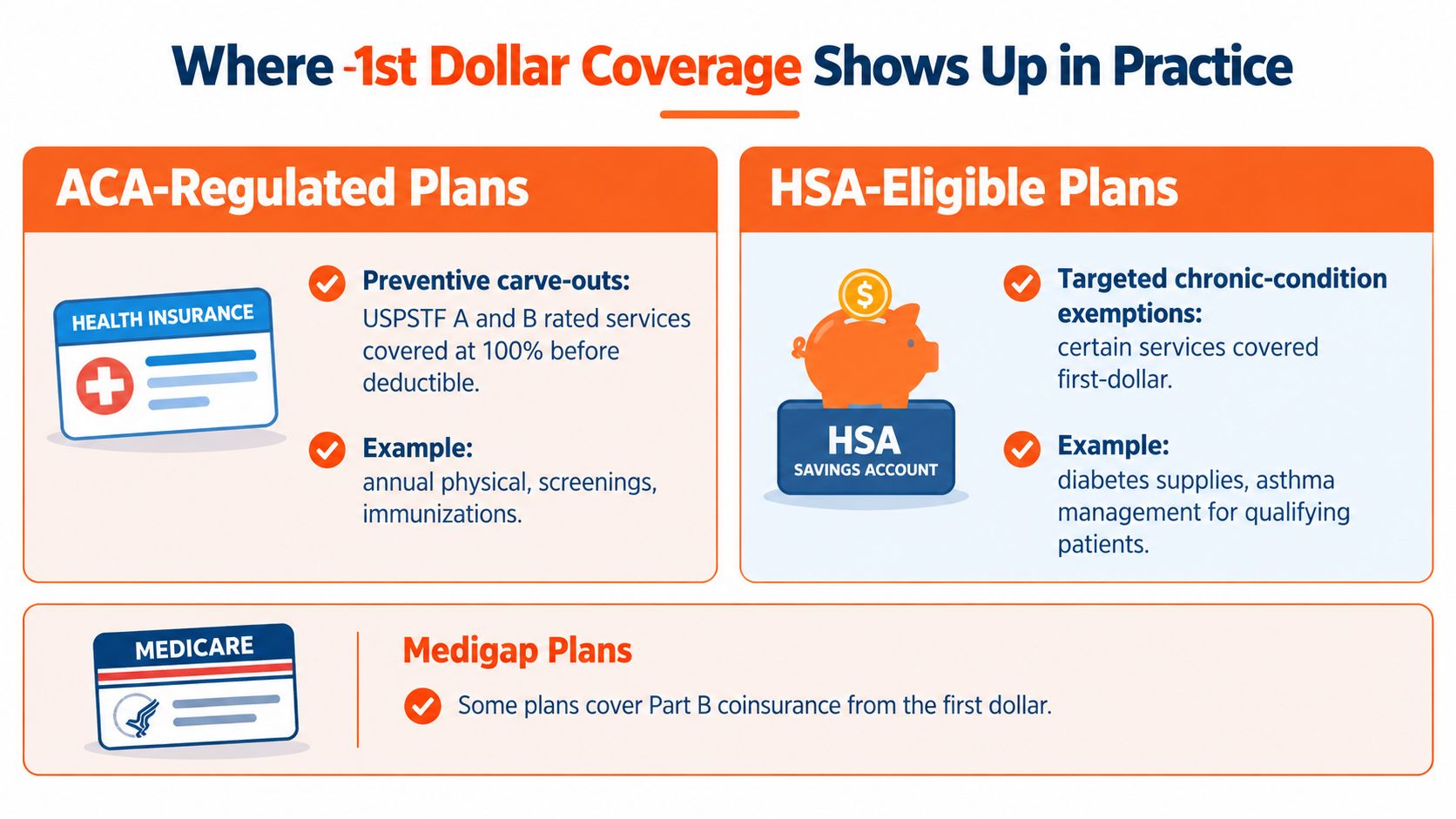
Most non-grandfathered private plans must cover recommended preventive services without cost sharing, meaning no deductible, copay or coinsurance. Per a May 2025 Congressional Research Service brief, that covers services with an A or B rating from the US Preventive Services Task Force (USPSTF), immunizations recommended by ACIP, and HRSA guidelines for children, adolescents and women. Grandfathered plans are exempt, and out-of-network preventive care generally is not required to be covered without cost sharing unless no in-network provider is available.
The requirement survived a court challenge. In Kennedy v. Braidwood Management, decided June 27, 2025, the Supreme Court ruled 6-3 that the Task Force structure is constitutional, so the coverage rule stands. As KFF's analysis of the ruling notes, the HHS Secretary can remove Task Force members at will, so the list of covered services can still change.
An HSA-qualified high-deductible health plan (HDHP) can pay preventive care before the deductible. It generally cannot pay other care first-dollar. IRS Publication 969 says that if you can receive non-preventive benefits before the deductible is met, you are generally not an eligible individual for HSA contributions. Its 2026 figures: a minimum deductible of $1,700 self-only and $3,400 family, and an out-of-pocket maximum of $8,500 and $17,000.
The preventive list has grown. In July 2019, Treasury and the IRS, in consultation with HHS, issued IRS Notice 2019-45. It lets HDHPs cover certain items before the deductible for people diagnosed with specific chronic conditions: for example, insulin and glucometers for diabetes, inhalers and peak flow meters for asthma, statins and LDL testing for heart disease, and blood pressure monitors for hypertension. IRS Notice 2024-75 added over-the-counter oral contraceptives, condoms, all types of breast cancer screening for people not diagnosed with breast cancer, continuous glucose monitors for people with diabetes, and selected insulin products regardless of diagnosis.
The One Big Beautiful Bill Act made three changes that matter here. The IRS explained them in Notice 2026-05 and a December 2025 IRS news release:
Workers' comp is one of the older first-dollar models in US benefits. The Department of Labor review of workers' compensation systems says that between 1911 and 1948, every state developed some form of program, and almost all of the early programs provided first-dollar medical coverage, meaning no deductible. The same report notes that states later added cost controls, including restrictions on first-dollar coverage, fee schedules and utilization review. The injury still has to be work-related, and rules vary by state.
Some of your older staff or owners will deal with Medicare. Per Medicare's Medigap comparison guide (March 2026), only Plans C and F pay the Part B deductible, and you cannot buy C or F if you were new to Medicare on or after January 1, 2020. High-deductible Plan F and Plan G make the policyholder pay the first $2,950 (in 2026) of deductibles, copays and coinsurance before the policy pays. Plan N can charge copays of up to $20 for some office visits and up to $50 for emergency room visits that don't lead to an inpatient admission.
Making a service first-dollar shifts its early cost from the member to the plan. The member sees a smaller bill. The plan sees more claims, and the premium follows.
Use can rise, too. In their 2008 Health Affairs paper "Myths and Misconceptions About U.S. Health Insurance," economists Katherine Baicker and Amitabh Chandra argue that first-dollar insurance coverage encourages the use of care that adds very little benefit, and that greater cost sharing would help reduce discretionary care of questionable value. If your broker proposes richer first-dollar riders, read their argument before your own review of supplemental insurance and cost sharing.
The other side of the argument is targeted carve-outs for care people skip when it costs them money. Eli Lilly's 2019 overview of first-dollar coverage makes that case for chronic-condition drugs. Read it knowing it comes from an insulin maker: it cites a Lilly-sponsored Milliman analysis estimating that exempting insulin from the deductible would add 43 cents per member per month to the premiums members pay. Treat a figure like that as a starting point for your own quote, not as your number.
A service can cost the member $0 at the point of care and still cost the plan money. The premium is part of the same bill.
Before you say yes to a carrier's "add first-dollar sick visits" option, run this five-step test. It turns a vague promise into a per-member monthly number you can hold against the quote. All inputs below are example inputs for a 12-person plan, not benchmarks.
| Step (example inputs) | No copay kept | $30 copay kept |
|---|---|---|
| Uses: 12 enrollees × 2 sick visits | 24 visits | 24 visits |
| Plan pays per visit (example $150 allowed amount) | $150 | $150 − $30 = $120 |
| Annual cost shift | 24 × $150 = $3,600 | 24 × $120 = $2,880 |
| Per member per month (÷ 12 enrollees ÷ 12 months) | $3,600 ÷ 144 = $25.00 | $2,880 ÷ 144 = $20.00 |
| Induced use: 2.5 visits each (30 visits) | 30 × $150 = $4,500, or $31.25 | 30 × $120 = $3,600, or $25.00 |
| Example carrier quote: +$28 per member per month | $28 × 144 = $4,032 a year | Compare with $2,880 to $3,600 |
How to read it: with no copay, the example quote of $4,032 a year sits between the base case ($3,600) and the induced-use case ($4,500). That is in a believable range. With a $30 copay kept, the same quote is $432 above even the induced-use case ($4,032 − $3,600 = $432), so ask the carrier what else it priced in. A quote far above your induced-use case is a question for your broker, not a reason to sign.
The test leaves things out on purpose: members who already met their deductible, carrier admin load, and any savings from earlier care. It is a sanity check, not an actuarial model. Its job is to make sure the number you approve has a reason behind it.
This is the call your office manager will get every January. Someone books an annual physical expecting to pay nothing, then gets a bill. Usually nothing is broken. Preventive coverage does not turn the whole appointment into a $0 visit.
The federal overview of preventive-service coverage rules from the Congressional Research Service explains why. If a service is provided for a purpose other than prevention, it is generally not required to be covered without cost sharing. A diagnostic mammogram for symptoms is the example it uses. Cost sharing for office visits tied to preventive services may or may not be allowed, depending on how the visit is billed. Items integral to a preventive service, such as removing a polyp during a screening colonoscopy, must be covered without cost sharing.
If a bill arrives, compare the Explanation of Benefits line by line with the plan document. Ask the carrier which line triggered the charge, and whether the cause was coding, network status, purpose or eligibility. That is a specific question with a specific answer.
A Summary of Benefits and Coverage (SBC), a Summary Plan Description (SPD) or a Medigap chart will show where payment starts. Find the service row, then read the deductible column and the member-cost column together.
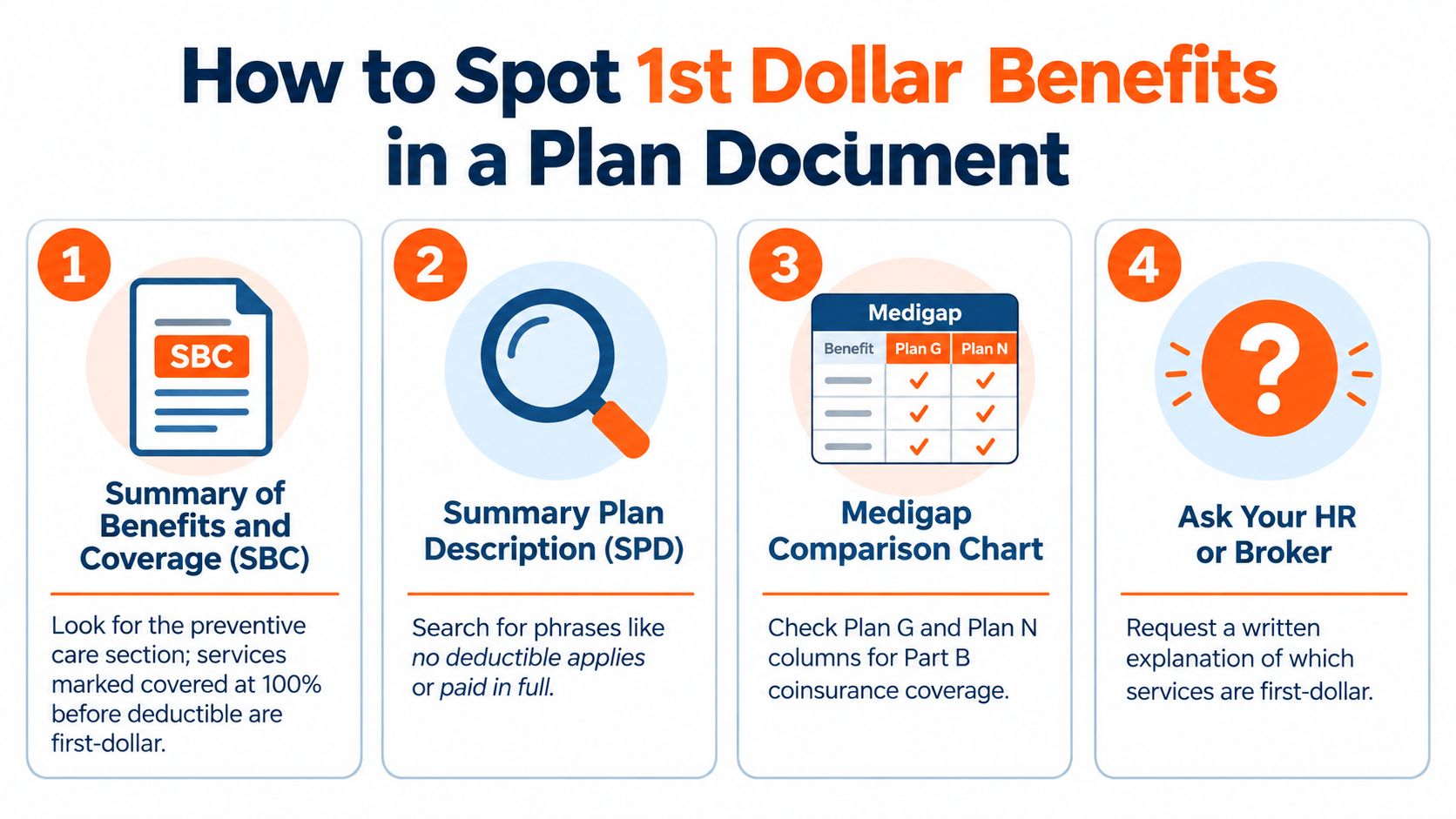
Look for phrases such as "deductible does not apply," "no charge" or "covered before deductible." Treat them as clues, not promises. Then check for limits: visit caps, prior authorization, network-only rules, or a condition the member must have been diagnosed with. If the SBC is not clear, ask the carrier or broker for a written answer.
Finish by marking each row you care about:
At a small company, the plan decision belongs to the owner and the broker. The work around it usually lands on whoever runs the office: collecting SBCs, building the census spreadsheet for the renewal quote, chasing enrollment forms, answering "why did I get this bill" questions and routing claim problems to the carrier. In a lean office, that is often an administrative assistant doing HR admin on the side.
Our own hiring data shows how often that admin work gets bundled into people-ops roles. Of 13 HR, recruiting and office-manager searches that client companies opened with Virtustant between June 1 and October 20, 2026, 6 list new-hire onboarding in the job description, 2 list payroll processing or coordination, and 2 list benefits tasks (one benefits administration with the company's health insurance providers, one answering staff questions about benefits). We counted only the visible posting text, and we excluded Virtustant's own internal recruiter postings, recruiter posts too generic to confirm as client searches, and duplicates. Counts only; small sample.
If that admin load is eating your week, a remote HR assistant can take the logistics under your direction: enrollment paperwork, census updates, document collection, scheduling broker calls and logging carrier follow-ups. Your broker, carrier and advisors keep the plan, tax and legal decisions. For a breakdown of the role, see what an HR assistant does, and for splitting people-ops work see how to hand off HR and payroll tasks without losing control. If payroll is the heavier lift, there is a separate payroll specialist role and a guide to payroll handoff costs. New-hire paperwork follows the same pattern as our remote onboarding checklist.
One boundary to keep clear: your group plan covers whoever the plan document says is eligible. How you engage remote contractors abroad is a separate question, covered in our guide to hiring contractors in Latin America.
Virtustant is a remote staffing agency. We place vetted remote professionals from Latin America; we do not sell insurance, design health plans or give legal or tax advice. HR assistants start from $8/hr all-in. You get a shortlist of 3 to 5 vetted candidates within 48 hours of your first call, and your hire can start in 72 hours. After the hire, your account manager is the main point of contact, coordinates onboarding, start date, tools access and the first-week plan, and follows up during the first weeks. You direct the day-to-day work; Virtustant handles payroll, paperwork and everything administrative on the professional's side. Zero placement fees, a lifetime replacement guarantee, month-to-month terms and one weekly invoice per placement. See pricing or book a discovery call.
First dollar coverage means a health plan pays for a covered service starting with the first dollar of the bill, before the member meets the deductible. The member may still owe a copay or coinsurance unless the benefit is fully covered, as with in-network ACA preventive care.
Common examples are in-network ACA preventive services in non-grandfathered plans, preventive care and IRS-listed chronic-condition items in HSA-qualified high-deductible plans, telehealth in HDHPs for plan years beginning after December 31, 2024, Medigap Plans C and F for the Part B deductible, and, historically, most state workers' compensation medical benefits.
Not always. It only means the deductible does not apply to that service. A copay or coinsurance can still apply, and other services at the same appointment can still run through the deductible.
Yes, but only for allowed services: preventive care, the chronic-condition items in IRS Notices 2019-45 and 2024-75, and telehealth. IRS Publication 969 says that if you can receive non-preventive benefits before the deductible, you are generally not eligible to contribute to an HSA.
Per IRS Rev. Proc. 2025-19, the 2026 minimum deductible for an HSA-qualified plan is $1,700 self-only and $3,400 family, and the out-of-pocket maximum is $8,500 self-only and $17,000 family.
Usually, yes. The plan pays claims the member would otherwise have paid, and lower prices at the point of care can increase use. Estimate the cost shift per member per month and compare it with the carrier's quoted premium change before you approve it.
Part of the visit was probably billed as diagnostic or treatment, a provider or lab was out of network, or the plan is grandfathered. Preventive rules cover the preventive service, not everything that happens at the appointment.
Yes, as admin support under your direction: collecting forms, updating the census, scheduling broker calls and tracking carrier follow-ups. Plan design, eligibility rulings and tax or legal questions stay with you, your broker and your advisors.