Live Chat Support Outsourcing: Per-Chat vs Dedicated Agent Pricing (2026)
September 25, 2026
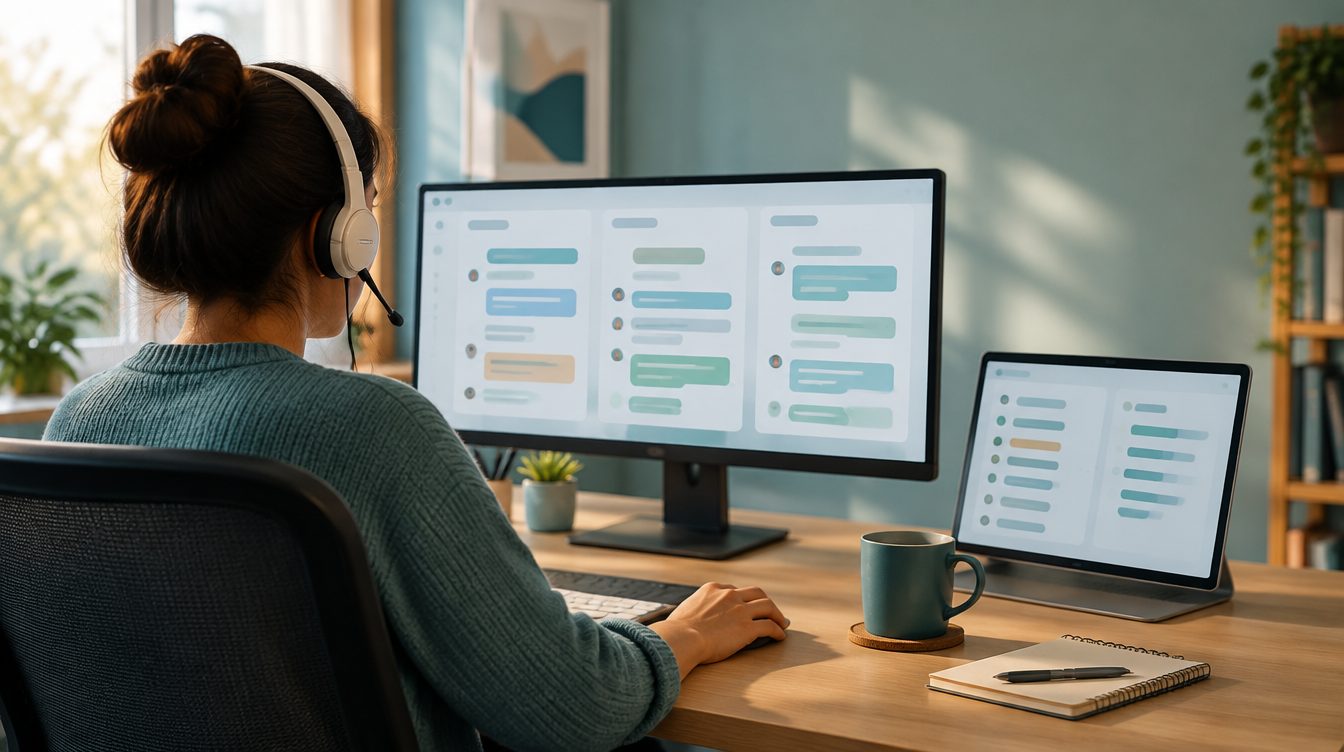
Live chat support outsourcing means paying someone outside your payroll to answer the chat window on your website or app. In 2026 you can buy it three ways. A per-chat answering service, where published plans run from $5 to $10 per chat. A BPO chat team, quoted per agent seat or per hour of coverage. Or a dedicated remote chat agent who works inside your help desk for a flat monthly rate. The price that matters is not the headline: at roughly 360 to 460 chats a month, a dedicated agent becomes cheaper per chat than the lowest published per-chat plan, and past that point the gap widens every month.
Third-party figures are those each source publishes, checked on September 25, 2026. Every figure labelled Virtustant is real, first-party data from Sieve, the recruiting platform we run our client searches and placements through. None of it is estimated or modelled.
The finding that should change how you shop for this: across 31 customer service and support searches opened by 31 Virtustant client companies between June 4 and September 23, 2026, none was titled "chat." Nine named web chat as a channel, and eight of those nine paired it with phone or email. Small and mid-sized companies almost never buy live chat on its own. They buy it inside a customer service seat, next to the inbox and the phone.
A live chat conversation has three parts: someone has to pick it up fast, understand what the visitor needs, and then either resolve it or route it. Outsourcing moves some or all of that to a person outside your company. The part that decides which model fits is the third one. Answering a chat and resolving a chat are different jobs.
If most of your chats are sales questions from new visitors, answering may be enough. If most are "where is my order" or "I was charged twice," you are buying resolution, and the per-chat price stops being the useful comparison.
Few chat outsourcing providers publish prices. These are the ones we could verify at the source, plus the US wage baseline you are comparing against.
| Source | What it publishes | Note |
|---|---|---|
| Smith.ai live chat plans (published pricing) | $10 per chat pay-as-you-go; plans of $140 for 20 chats, $300 for 50 and $600 for 120, then $5 to $7 per extra chat | Only "relevant" chats are billed: ones where a name, email and intent are captured. Spam and incomplete chats are free |
| Chat Agents (published pricing) | $249 to $999 a month, unlimited chats, 24/7 | Flat fee for scripted coverage and lead capture; higher tiers add SMS and phone transfers |
| LiveChat pricing | Chat software from $25 (one user) and $59 or $89 per agent a month billed monthly; $19, $49 or $79 billed annually | The tool a dedicated agent works in. You pay this on top of the person |
| LiveChat Customer Service Report | Average chat lasts 8 minutes 25 seconds; agents handle 84.1 chats a day; first response in 35 seconds; 27.4% of visitors leave the queue before being served | 2 billion chats across 35,000+ companies; last updated in 2024 |
| BLS Occupational Employment and Wage Statistics | Customer service representatives: median $21.53 an hour, $44,770 a year, 2,595,750 people in the role | May 2025 estimates, SOC 43-4051 |
| BLS, Employer Costs for Employee Compensation | Wages are 70.0% of total compensation cost; benefits 30.0% | Private industry, cost per hour worked, June 2026 |
| Virtustant published rates | Customer service from $7/hr all-in; median $14.00/hr across 33 customer service placements, middle half $9.00 to $16.00 | From our pricing page and customer service role page |
For the loaded cost of a US hire, divide the BLS wage by the 70.0% wage share: $30.76 an hour, or about $4,921 a month at 160 hours. That is the in-house number every outsourced option is really competing with.
| Model | How it is priced | What you get | What you still carry | Best fit |
|---|---|---|---|---|
| Per-chat answering service | Per billable chat, $5 to $10, or a flat monthly fee | Fast pickup, 24/7, lead capture, scripted answers | Every chat that needs your systems to resolve | Low volume, mostly sales enquiries, after-hours coverage |
| BPO chat team | Per agent seat or per covered hour, usually with a minimum | A pooled team on your queue, often multilingual, SLA-driven | Training, QA, and the knowledge base the pool works from | High, steady volume with well-documented answers |
| Dedicated remote chat agent through a remote staffing agency | Flat hourly rate, all-in, plus your chat software | One named person inside your help desk and order system, on your hours | Management, approvals and policy decisions | Support that needs resolution, not just a reply, and chat mixed with email or phone |
The row most buyers skip is the last column. Every model leaves something with you. A per-chat service leaves you the resolution. A pool leaves you the training. A dedicated agent leaves you the management. Pick the one whose leftover you are best equipped to carry.
This is Virtustant data, not a survey. We pulled every customer service, customer support and customer success search opened in Sieve between June 1 and September 25, 2026 and read each job description. We collapsed re-posts of the same role by the same company, and excluded internal tests, bulk imports and roles whose description turned out to be sales or dispatch.
| Measure | Result |
|---|---|
| Searches in the window | 34 records; 31 distinct openings from 31 client companies, June 4 to September 23, 2026 |
| Titled "chat" or "live chat" | 0 of 31 |
| Named web chat as a channel | 9 of 31 (29%) |
| Any written messaging (web chat, SMS or Instagram DMs) | 12 of 31 (39%) |
| Web chat roles that also listed phone or email | 8 of 9; 6 of 9 listed phone |
| Named phone | 19 of 31 |
| Named a chat platform (Zendesk, Intercom, Gorgias, LiveChat, Tidio) | 0 |
| Full-time vs part-time | 22 full-time (40 hours or more), 9 part-time, most of them 20 hours |
| Median full-time budget | $1,500 to $2,078 a month (n=22), midpoint $1,733, about $10.83/hr at 160 hours |
| Required bilingual Spanish and English | 3 of 31 |
| Asked for weekend or after-hours coverage | 2 of 31 |
How to read this: Sieve returns a shortened excerpt for most descriptions, so channel and tool counts are a floor, not a ceiling. The direction is still clear. Chat is a channel inside a seat, not a seat. The companies in our data wanted one person who could take the chat, answer the email that follows it, and pick up the phone when the customer calls anyway.
Two more things stood out. Only two searches asked for weekend or after-hours work, which undercuts the idea that small businesses outsource chat mainly for 24/7 coverage. And one client offered two shift options, 9 to 5 or 12 to 8 Eastern, which is the cheapest way to stretch one person across East and West Coast traffic.
Budgets and placement rates measure different things. The budget is what a client opens a search with; the $14.00 median on our pricing page is what 33 customer service placements actually billed. We use both in the test below.
The comparison most pages skip is cost per chat at your real volume. Here is the test we use with clients:
Cost per chat = (monthly seat cost + chat software) ÷ chats handled in the month.
For the dedicated seat we run two cases: the median full-time budget from our searches ($1,733) and the median placed rate ($14.00 × 160 hours = $2,240), each plus $59 a month for LiveChat Team billed monthly. For the per-chat side we use the cheapest combination of Smith.ai's published plans at each volume.
| Chats a month | Per-chat service (cheapest published plan) | Per chat | Dedicated seat at budget median ($1,792) | Dedicated seat at placed median ($2,299) |
|---|---|---|---|---|
| 100 | $600 | $6.00 | $17.92 per chat | $22.99 per chat |
| 250 | $1,250 | $5.00 | $7.17 per chat | $9.20 per chat |
| 500 | $2,500 | $5.00 | $3.58 per chat | $4.60 per chat |
| 1,000 | $5,000 | $5.00 | $1.79 per chat | $2.30 per chat |
| 1,800 | $9,000 | $5.00 | $1.00 per chat | $1.28 per chat |
The break-even lands at about 358 chats a month against the budget case and 460 against the placed-rate case. Below roughly 350 chats, per-chat pricing wins on price. Above roughly 460, the dedicated agent wins, and at 1,800 chats a month, close to what the LiveChat benchmark says one agent handles, the dedicated seat costs a quarter of the per-chat bill.
Two adjustments make the test honest:
And the adjustment that goes the other way: a dedicated agent covers their shift, not the clock. If a third of your chats arrive overnight, you either leave those to an answering service or you pay for more hours.
Vendor pages often promise that one agent can run three, four or five chats at once. The average in the benchmark data is lower. LiveChat reports 84.1 chats per agent per day at an average of 8 minutes 25 seconds each. That is about 708 minutes of open conversation per agent per day. Spread over an 8-hour shift, it works out to about 1.5 chats open at any moment, on average, across 35,000 companies.
That number is our arithmetic, not LiveChat's, and it assumes an 8-hour shift. It is still the right starting point for planning, and it points to three operating rules:
Most of the cost difference between models comes from the hours you want covered, not the rate.
| Coverage you want | Hours a week | Dedicated people needed | What it implies at the $14.00 placed median |
|---|---|---|---|
| US Eastern business hours, Monday to Friday | 40 | 1 | About $2,240 a month |
| 9 a.m. Eastern to 5 p.m. Pacific (8 p.m. Eastern), Monday to Friday | 55 | 1 on a shifted schedule plus part-time cover, or 2 staggered | $3,080 to $4,480 a month |
| 24/7, every day | 168 | At least 4.2 full-time equivalents before breaks, holidays and sick days | $9,408 a month or more |
This is where the models combine rather than compete. A dedicated agent on your business hours, with a per-chat service or a chatbot capturing leads overnight, is usually cheaper than either model on its own at 24/7. Latin American time zones sit within zero to three hours of US time zones, so a remote agent in the region works your day without night shifts or a handoff at 5 p.m.
| Hand off | Keep in-house |
|---|---|
| First response and triage on every chat | Refunds and credits above a written dollar limit |
| Order status, shipping, returns and exchanges within policy | Changes to pricing, terms or policy |
| Account questions, password resets, booking changes | Anything involving payment card data beyond what your platform masks |
| Pre-sale product questions and lead capture | Escalations from strategic or high-value accounts |
| Tagging chats, logging product feedback, updating saved replies | Final say on knowledge base content and tone |
Write the refund limit as a number and the escalation rule as a sentence before the first shift. The fastest way to lose control of an outsourced chat queue is to leave "use your judgment" as the policy.
Virtustant is a remote staffing agency. We do not run your chat as a pooled service or bill per chat. We place a dedicated, pre-vetted remote customer service professional from Latin America who works inside your help desk, your store admin and your order system, on your time zone, under your refund and escalation rules. For the companies in our data, that is what "live chat outsourcing" actually meant: one person who owns chat, email and often the phone.
| Measure | Figure |
|---|---|
| Published customer service rate | From $7/hr all-in; median $14.00/hr across 33 customer service placements, middle half $9.00 to $16.00 |
| What a median full-time customer service search budgeted | $1,500 to $2,078 a month, against about $4,921 fully loaded for a median in-house US representative. You can save up to 70% depending on the role and hours |
| Placement fee | $0. The rate is all-in, with no separate markup to calculate |
| First shortlist | 3 to 5 pre-vetted, bilingual candidates within 48 hours |
| Time to hire | About 3 days median to placement; onboarding within 72 hours |
| Vetting funnel | Roughly the top 1% are placed: 100% apply, 22% clear the recruiter screen, 9% pass skills and English testing, 3% reach a live interview, 1% are hired |
| Replacement | Lifetime guarantee, no time cap. Month-to-month |
How we make money, put plainly: if you pay your agent $10 an hour, we give them $9 and keep the dollar in the middle. Candidates pay nothing to apply or to be placed. How the vetting works in detail is in our candidate vetting process.
To hire, start with our remote customer service specialists or, for online stores, our ecommerce customer service specialists. For the wider decision across email, phone and chat, see our guide to customer service outsourcing and the comparison of customer service outsourcing companies. Online retailers can see how we support ecommerce brands, and the service standards we train to are in our golden rules for customer service. All published rates are on our pricing page.
Live chat support outsourcing means paying someone outside your payroll to answer the chat window on your website or app. There are three ways to buy it: a per-chat answering service that picks up chats and captures leads, a BPO chat team quoted per seat or per covered hour, or a dedicated remote chat agent who works inside your help desk and order system for a flat monthly rate.
It depends on the model. Smith.ai publishes live chat plans at $10 per chat pay-as-you-go, or $140 to $600 a month with 20 to 120 chats included and $5 to $7 per extra chat. Flat 24/7 answering plans such as Chat Agents list $249 to $999 a month. A dedicated remote chat agent through Virtustant starts at $7/hr all-in, with a median of $14.00/hr across 33 customer service placements, and chat software such as LiveChat adds $59 to $89 per agent a month on monthly billing.
Per chat is cheaper at low volume and per hour is cheaper at higher volume. Using the cheapest published Smith.ai plan against a dedicated seat plus $59 of chat software, the break-even is about 358 chats a month at our median full-time search budget of $1,733 and about 460 chats at our median placed rate of $14.00 an hour. At 1,800 chats a month a dedicated seat costs $1.00 to $1.28 per chat against $5.00 on the per-chat plan.
Plan for about 1.5 on average. LiveChat's benchmark data shows agents handling 84.1 chats a day at an average of 8 minutes 25 seconds each, which is about 708 minutes of open conversation, or roughly 1.5 chats open at once over an 8-hour shift. Agents on simple, repeatable questions can run two or three; agents resolving billing or order problems usually run one or two.
Covering 168 hours a week with dedicated people takes at least 4.2 full-time equivalents before breaks, holidays and sick days, which is about $9,408 a month or more at a $14.00 hourly rate. Flat 24/7 answering services list $249 to $999 a month, but they capture leads and give scripted answers rather than resolving issues in your systems. Many businesses combine a dedicated agent for business hours with an answering service or chatbot overnight.
Use a chatbot for questions it can close on its own, such as order status, store hours and simple policy answers, ideally connected to your order system. Use a live agent for anything that needs judgment or a change in your systems: refunds, billing errors, booking changes and unhappy customers. LiveChat's benchmark puts satisfaction at 64.2% across rated chats and 64.7% for chatbot conversations, so the deciding factor is what the chat needs, not the channel.
Yes, and that is how most small businesses buy it. Of 31 customer service searches opened by Virtustant clients between June and September 2026, none was titled chat; 9 named web chat as a channel and 8 of those 9 also listed phone or email. A single agent can cover all three if phone volume is moderate, because chats and emails can wait a minute while a call is answered.
Keep refunds and credits above a written dollar limit, changes to pricing, terms or policy, escalations from strategic accounts, and the final say on knowledge base content. Hand off first response and triage, order status, returns within policy, account and booking changes, pre-sale questions and chat tagging. Write the refund limit as a number before the first shift.
Through Virtustant, you get a shortlist of 3 to 5 pre-vetted, bilingual customer service candidates within 48 hours, with a median of about 3 days to placement and onboarding within 72 hours. There is no placement fee, the rate is all-in from $7/hr, and replacement is guaranteed for the life of the placement.
Virtustant places pre-vetted, bilingual customer service professionals from Latin America who can own your chat, inbox and phone inside your own help desk, from $7/hr all-in, with no placement fee, a first shortlist within 48 hours and a lifetime replacement guarantee. Part-time and shifted schedules are normal. Book a discovery call.