Remote Workforce Solutions for SMBs: 6 Models Compared (2026)
October 15, 2026


Remote workforce solutions are the six ways a company can staff work done outside its office: a remote staffing agency, a freelance marketplace, an employer of record (EOR), a contingency recruiter, your own foreign entity, or a hybrid. Pay is only part of the bill: in June 2026, US private-industry employers paid $14.07 in benefits on top of $32.82 in hourly wages, per the BLS Employer Costs for Employee Compensation release. What differs is which jobs stay on your desk.
This guide is for the buyer, a founder or operations lead who needs a role filled and working. It compares the six models, scores them with a test you can run on any vendor, and shows the cost of the work each model leaves with you.
A remote workforce solution is any arrangement that takes a role from a written spec to a person producing work for you from another location. On the employer side, the question is simple: who finds the person, who signs the paperwork, who pays them, and who fixes things when the hire does not work out?
The first mistake is treating remote hiring like a normal job post with a different location tag. You can publish a role, get applicants, and still end up with ghosting, weak written communication, or a contractor who looks fine on paper but cannot operate inside your systems. The work starts after the post goes live, when someone has to screen English, check role fit, verify references, set up the contract, and decide how payment works across borders.
A remote workforce solution should be judged by how much of that load it takes off you. If a vendor only forwards résumés, you still own sourcing, vetting, onboarding, access control and offboarding. If a provider carries recruiting, assessment, the paperwork and payroll on the worker's side, and replacement, the solution is doing the job a small team actually needs done.
Practical rule: if an offer does not reduce both your screening load and your administrative load, it is not solving remote hiring. It is moving the paperwork around.
If you want a plain-English primer on the category before comparing vendors, start with how remote staffing works. It separates two things buyers often confuse: sourcing a person and legally employing one.
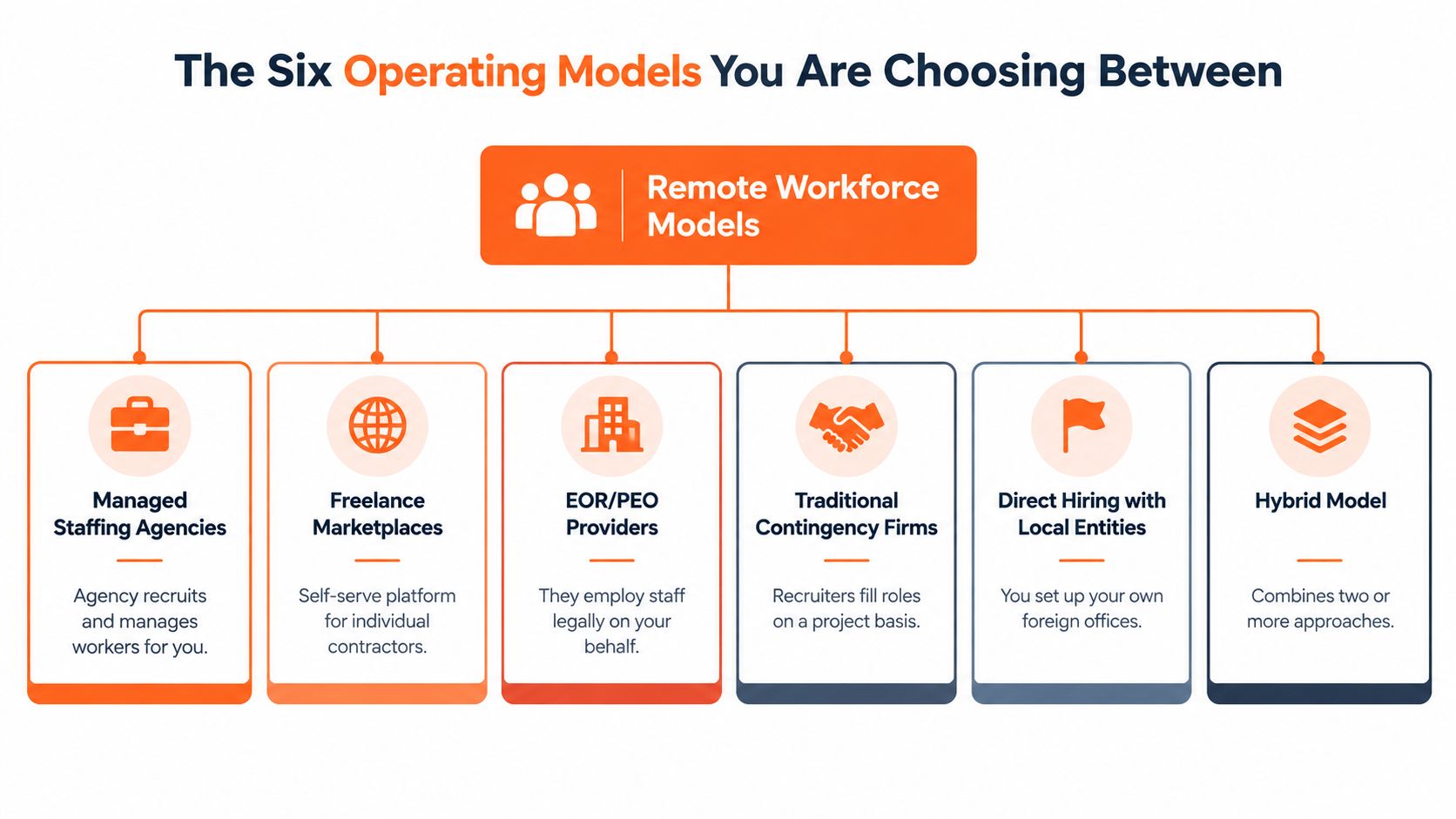
There are six models in play, and most confusion comes from mixing them up.
Remote (managed) staffing agencies recruit and vet a dedicated professional for you, then handle the administrative side of that person's engagement. You direct the work. Virtustant is a remote staffing agency. For a deeper look at the category, see managed staffing services explained.
Freelance marketplaces are self-serve. You post, candidates apply, and you manage almost everything else. That sounds flexible until you realize you are now the recruiter, the assessor, the manager and the offboarding department.
EOR and PEO providers are built for legal employment structure. An EOR employs the worker in their country on your behalf while you direct the work. It is strongest when you already know who you want to hire. It does not source talent by itself, which is where many small businesses get stuck. The trade-offs are covered in our guide to EOR services.
Contingency recruiters work on a fill-the-role basis and are paid when a placement happens. They are useful for narrow, senior or specialized searches. Once the hire starts, you employ the person and run everything that follows.
Direct hiring through your own local entity means setting up a company in the worker's country and employing people there yourself. It gives you the most control and the most setup, legal, accounting and payroll work. It usually makes sense only once you plan a sizable team in one country.
Hybrid models combine an in-house team with contractors or one of the models above. They give you flexibility, but only if your internal manager can absorb the process discipline. Without strong oversight, hybrid becomes a polite word for fragmentation.
| Model | What you buy | Typical cost structure | Who employs the worker | Admin load left on you |
|---|---|---|---|---|
| Remote staffing agency | A vetted, dedicated professional you direct | All-in hourly rate | Not you; the agency handles payroll and paperwork on the professional's side. Ask each agency how it engages its people | Low |
| Freelance marketplace | Access to applicants and a payment rail | Platform fees plus the freelancer's rate | Nobody; you contract the freelancer directly | High |
| EOR / PEO | Legal employment of a person you already found | Per-worker service fee plus the worker's employment cost | The EOR, while you direct the work | Moderate |
| Contingency recruiter | A search that ends at the offer | Fee per placement | You, after the placement | High after the hire |
| Your own local entity | Full control of a team in one country | Entity setup plus local payroll, legal and accounting | You, through the entity | Very high |
| Hybrid | A mix of in-house staff and outside talent | Mixed internal payroll and contractor spend | Depends on each part of the mix | High |
A BPO contract is missing from this list on purpose. When you buy from a BPO, you buy an outcome, such as tickets resolved or calls answered, from a team the provider manages. Every model above gives you a person whose daily work you direct.
Every remote hire has six seams where work can fall through. Before you compare prices, write down who owns each seam in each model. This is the Six Seams Test, and it takes ten minutes per vendor.
Score each seam: You = 1, Shared = 0.5, Provider = 0. Add the column. The total is the number of seams left on your desk.
| Seam | Staffing agency | Marketplace | EOR | Recruiter | Own entity | Hybrid |
|---|---|---|---|---|---|---|
| 1. Sourcing and screening | Provider (0) | You (1) | You (1) | Provider (0) | You (1) | You (1) |
| 2. The contract | Provider (0): you sign one agreement with the agency | You (1) | Provider (0) | You (1) | You (1) | You (1) |
| 3. Payroll and paperwork | Provider (0) | Shared (0.5): the platform moves the money, the tax forms stay with you | Provider (0) | You (1) | You (1) | You (1) |
| 4. Replacement | Provider (0), within the agency's guarantee terms | You (1) | You (1) | Shared (0.5): a guarantee window, terms vary | You (1) | You (1) |
| 5. Access | You (1) | You (1) | You (1) | You (1) | You (1) | You (1) |
| 6. Daily direction | You (1) | You (1) | You (1) | You (1) | You (1) | You (1) |
| Seams left on you | 2 | 5.5 | 4 | 4.5 | 6 | 6 |
The hybrid column assumes an in-house team plus contractors you find yourself. If part of the mix runs through an agency or an EOR, score that part with its own column.
Two things stand out. First, seams 5 and 6 never leave you in any of the six models: you always control access to your systems and you always direct the work. Second, the gap between models sits almost entirely in seams 1 to 4, the work that happens before day one and after a bad hire. That is where a small team with no recruiter and no HR function feels the pain.
Seams are not free. Each one you own takes hours every month, and your hours have a price. The formula:
Seam-adjusted hourly cost = worker's hourly rate + (seams on you × hours per seam per month × your hourly value) ÷ hours worked per month
Here is the arithmetic with clearly labeled example inputs. Replace them with your own.
| Model | Seams on you | Your monthly upkeep | Rate × 160 h | Seam-adjusted cost per hour |
|---|---|---|---|---|
| Staffing agency | 2 | 2 × 2 h × $75 = $300 | $1,120 | ($1,120 + $300) ÷ 160 = $8.88 |
| EOR | 4 | 4 × 2 h × $75 = $600 | $1,120 | ($1,120 + $600) ÷ 160 = $10.75 |
| Recruiter | 4.5 | 4.5 × 2 h × $75 = $675 | $1,120 | ($1,120 + $675) ÷ 160 = $11.22 |
| Marketplace | 5.5 | 5.5 × 2 h × $75 = $825 | $1,120 | ($1,120 + $825) ÷ 160 = $12.16 |
| Own entity or hybrid | 6 | 6 × 2 h × $75 = $900 | $1,120 | ($1,120 + $900) ÷ 160 = $12.63 |
The example leaves out every fee a real model adds, such as platform fees, EOR service fees or placement fees, so it understates the gap. Even so, a marketplace hire at the same $7.00 rate costs you $12.16 per hour once your own time is counted, $3.28 more per hour than the agency column's $8.88.
Part-time hires make the seams heavier. At 20 hours a week, a role works 20 × 52 ÷ 12 = 86.67 hours a month, and the same $7.00 rate comes to $606.67. The upkeep does not shrink with the hours. The agency column becomes ($606.67 + $300) ÷ 86.67 = $10.46 per hour. The marketplace column becomes ($606.67 + $825) ÷ 86.67 = $16.52 per hour.
Rates differ by role, and $7.00 is a floor, not a typical rate. In Virtustant's H1 2026 placement data (441 starts, Jan–Jun 2026), the median client-side rate for a virtual assistant was $10.10/hr (n=24), and role medians range from $9.00/hr (dispatcher) to $12.41/hr (SDR/BDR). The full breakdown is in the 2026 nearshore rate report. At the VA median, a full-time month is 160 × $10.10 = $1,616.
For context on US costs, the BLS puts the median wage for US customer service representatives at $21.53 per hour (May 2025). A $7.00 all-in rate is about one third of that median wage, before any US benefits are added.
Decision rule: judge every provider on the cost per productive hour, including your own time, not on the headline hourly rate.
We pulled the 51 client searches opened in Virtustant's recruiting system between October 7 and October 14, 2026. We excluded Virtustant's own evergreen postings and one duplicate entry, and counted only schedules and role types, not budgets.
Two lessons for choosing a model. About half the demand is part-time, which is exactly where the worked example shows owned seams hurt most. And almost every buyer wants the work done inside their own business day, so daily direction stays with you no matter which model you pick. Plan for it.
Browse the full list of roles we staff on the roles page.
A lot of remote hiring content assumes the world is one giant, evenly distributed talent pool. It is not, and the shape of the supply matters for which model works.
Take Latin America and the Caribbean. According to an IDB analysis published September 21, 2026, between 1% and 7% of job postings in the region offered remote work in 2025, a regional average of 4%. The same piece estimates that about 12% of workers could work remotely, while about 4% actually do. Put simply, about three times as many workers could work remotely as actually do, while remote openings stay scarce. The bottleneck for a US buyer is rarely willingness. It is screening, filtering and pipeline curation.
Candidates are being coached to read your post critically. One current job-seeker guide on how to browse remote positions tells them to search by function and level, check whether a "remote" listing restricts countries or requires overlap hours, and confirm the role on the employer's own careers page. If your post does not state those terms clearly, strong candidates skip it, and you are left screening the rest.

If you post broadly on a generic board, you are asking the market to curate for you. That means more noise, more screening time and a slower path to a shortlist. A prebuilt pipeline moves the filtering upstream so you see fewer, more usable candidates. Virtustant's funnel shows what that filtering looks like: 100% apply, 22% clear the recruiter screen, 9% pass cognitive (IQ), skills and English testing, 3% reach a live interview, 1% are hired. That is what "top 1%" means in practice.
Language screening belongs inside the funnel, not after it. Regional proximity and shared time zones do not prove English capability, and that matters for support, sales, assistant roles and anything customer-facing. Buyers who skip live screening usually discover the gap after the first real customer interaction.
Practical rule: price a talent provider against the funnel it operates, not just the labor it sells. If it is only advertising access to a region, you are still paying to build the funnel yourself.
Run the Six Seams Test on the first call, then ask five direct questions.
1. Pricing. If the provider cannot tell you whether setup, placement and replacement are included, you will pay for the confusion later. Ask: "What is the full all-in cost per hire, and what fees can still appear after the first invoice?"
2. Vetting rigor. Good providers validate language, role fit and references before a candidate reaches you. Ask: "Out of every 100 applicants, how many reach my shortlist, and what live assessments do you run?" If you run your own screening, a culture assessment for remote teams is one way to test for async, self-directed work habits before you make an offer.
3. Replacement terms. A guarantee that expires quickly leaves you exposed if the hire turns out to be wrong after the first month of real work. Ask: "If this role fails, what happens, how fast, and for how long does replacement coverage last?"
4. Security and access. Seam 5 always stays with you, so design it in from day one. NIST's Zero Trust Architecture guidance (SP 800-207, August 2020) states that no implicit trust is granted to assets or user accounts based solely on their physical or network location, and that authentication and authorization happen before a session is established. In practice: individual logins, no shared passwords, least-privilege permissions, and a written revocation checklist. Ask: "When someone leaves or changes roles, who removes access, and how fast?"
5. Who owns compliance. Ask every provider to state in writing what it handles and what stays with you. An EOR is the model built to employ workers and carry the employment obligations that come with that. A remote staffing agency handles payroll and paperwork on the professional's side; it does not act as the employer. If cross-border payroll is new territory for your finance team, read our guide to how to handle international payroll before you assume it can be figured out later.
For a fuller first-call script, use these staffing agency interview questions, and see how to choose a remote staffing agency for a side-by-side checklist.
Seam 6, daily direction, is yours in every model. A remote hire performs well only when the operating rules are explicit. If you do not define overlap windows, response expectations and escalation paths, the team falls back into ad hoc chat and forgotten handoffs. That is how week two breaks: not because the person is weak, but because the system is vague.
Build overlap around the work, not the habit. Use live time for ambiguity, coaching and decisions. Push routine execution into written workflows and one searchable system of record. If most of your work needs same-day answers, time-zone overlap is worth paying for; this guide on how to decide whether time-zone overlap matters walks through that call.
Practical rule: reserve meetings for decisions, escalation and coaching. Everything else belongs in writing.
Measure what survives distance. Track response time, how long tasks sit blocked, handoff errors, and the share of work completed without an unplanned meeting. Those four numbers tell you whether the system is healthy long before a performance review would.
Use the Six Seams Test total and your own constraints to pick:
Before you sign anything, check the public pricing page, run a paid work sample, and get the replacement terms in writing.
Here is where Virtustant fits. Virtustant is a remote staffing agency for small and mid-sized US businesses that want dedicated, vetted professionals they direct day to day. Virtual assistants and customer service reps start from $7/hr all-in. SDRs, BDRs, appointment setters, social media managers and graphic designers start from $8/hr, and executive assistants and bookkeepers from $8.50/hr. You get a shortlist of 3 to 5 vetted candidates within 48 hours of your first call, and your hire can start in 72 hours.
After the hire, an account manager is your main point of contact and coordinates onboarding, the start date, tools access and the first-week plan, and Virtustant follows up during the first weeks. You direct the day-to-day work. Virtustant handles payroll, paperwork and everything administrative on the professional's side. There are zero placement fees, the engagement is month-to-month, you get one weekly invoice per placement, and a lifetime replacement guarantee with no time cap. No single one of those terms is unusual on its own; the combination is the point.
See current rates on the pricing page, compare the remote staffing services we offer, or read how this works for Latin American talent in remote staffing solutions in LATAM.
Remote workforce solutions are the ways a company staffs work done outside its office. The six main models are a remote staffing agency, a freelance marketplace, an employer of record (EOR), a contingency recruiter, your own foreign entity, and a hybrid of these. They differ mainly in who sources the worker, who handles payroll and paperwork, and who replaces a hire that fails.
For a small business without a recruiter or HR team that needs vetted people quickly, a remote staffing agency usually leaves the fewest seams on the owner: 2 of 6 in the Six Seams Test, compared with 5.5 for a freelance marketplace and 6 for running your own entity. If you already found the person, an EOR fits better.
An EOR legally employs a worker you already found and does not source talent. A remote staffing agency finds, screens and replaces dedicated professionals and handles payroll and paperwork on the professional's side, while you direct the daily work. Many small businesses get stuck with an EOR because they still have to recruit.
It depends on the model and the role. Virtustant's virtual assistants and customer service reps start from $7/hr all-in, which is $1,120 for a 160-hour month. In Virtustant's H1 2026 placement data (441 starts, Jan–Jun 2026), the median client-side rate for a virtual assistant was $10.10/hr (n=24). Add the value of your own time on every seam you keep.
With Virtustant, you get a shortlist of 3 to 5 vetted candidates within 48 hours of your first call, and your hire can start in 72 hours. Marketplaces let you post quickly, but screening is on you, and contingency searches start from scratch.
You do. In every remote workforce model, the client directs the daily work and controls access to its own systems. With Virtustant, an account manager coordinates onboarding, the start date, tools access and the first-week plan, and follows up during the first weeks, but priorities and reviews stay with you.
Only some models carry employment obligations. An EOR is built to employ workers in their country and carry the obligations that come with that. A remote staffing agency like Virtustant handles payroll, paperwork and everything administrative on the professional's side but does not act as the employer. Ask any provider to put its scope in writing.
Yes. Of the 51 client searches opened in Virtustant's recruiting system between October 7 and October 14, 2026, 25 were part-time, under 40 hours a week. Part-time roles make owned seams more expensive per hour, so a model that carries sourcing, payroll and replacement matters more for them.