Outsourced Staffing Solutions: 5 Models, Real Costs and How to Choose (2026)
November 24, 2026


Outsourced staffing means a provider recruits, contracts or pays the worker while your team directs the work, and the only honest way to price it is against a fully loaded US seat. In December 2025, private employers paid $46.15 per hour worked, of which $32.36 was wages, per the Bureau of Labor Statistics employer-cost survey (ECEC). That puts a direct US seat at about 1.43 times its wage before recruiting or manager time. Compare every provider against that number.
So I judge outsource staffing arrangements on two numbers instead of one: quality-adjusted output per week, and total cost of management, meaning the invoice plus your own managers' hours plus rework. Below: five models side by side, a cost test with the arithmetic shown, and a 90-day pilot.
Outsource staffing is a three-party arrangement: a provider holds the worker's contract and pay, or runs the whole function, and the client gets the output. Who directs the work decides pricing, control and risk.
Companies use these arrangements as a capacity buffer they can grow and shrink without rebuilding payroll. The buffer is real. A BLS Monthly Labor Review analysis of temp jobs found temp help employment fell 34% during the Great Recession, against an 8% decline for all private employment. That asymmetry is the case for flexible staffing and the warning in one figure. A buffer that absorbs shocks is a buffer you will churn, and churn carries onboarding and management costs that never appear on a rate card.
Each model answers a different need: one specialist for a project, a whole function run for you, a remote professional on your team, a legal employer for someone you already found, or short-term local cover.
| Model | Who holds the contract and pay | Who directs daily work | Typical pricing basis | Best fit | Watch for |
|---|---|---|---|---|---|
| Staff augmentation | Provider or its contractor network | Your manager | Hourly or monthly per person | A skill gap on a defined project | Project end dates that quietly become permanent seats |
| Managed services / BPO | Provider, for the whole team | Provider, against service levels | Per unit, per ticket or fixed monthly fee | A whole function with countable output, such as tier-one support | Service levels that measure activity instead of outcomes |
| Remote staffing agency (Virtustant's model) | Agency handles contracts, payroll and the paperwork on the professional's side | Your manager, during US business hours | All-in hourly rate | Full-time or part-time hires that need time-zone overlap | Vetting depth and what happens if a hire leaves |
| Employer-of-record platform | Platform is the legal employer in the worker's country | Your manager | Monthly platform fee on top of the pay you set | Someone you already recruited and want to hire abroad | You still do the sourcing, screening and replacing |
| Domestic temp agency | Agency employs the temp locally | Your site supervisor | Bill rate above the worker's pay | Short-term, on-site cover in the US | US wage levels plus the agency's bill rate |
Read the second and third columns together: they tell you who absorbs the management cost. Where the provider directs the work, you buy an outcome. Where your manager directs it, you buy capacity.
Practical rule: if you can't write the deliverable as a countable unit, don't buy it as a managed service. Buy the person and manage the work yourself.
The line between models gets blurred in sales conversations, so it helps to compare outsourcing and staff augmentation before you agree to a scope, and to understand how managed staffing services are priced. If you only need a legal employer abroad for a person you already found, our explainer on employer of record services covers that model on its own.
Pricing structure shapes behavior in the managed-services row more than anywhere else. RevGuard's guide to outsourced billing for ASCs notes that revenue cycle fees are usually structured around collections, scope or a defined service bundle, and warns that if the vendor gets paid regardless of front-end quality, denial prevention won't get the attention it deserves. We cite it for the incentive point, not as a vendor recommendation. The question that separates every model is the same: are you managing hours, or managing outcomes?
The remote staffing agency row is the one Virtustant works in. We are a remote staffing agency: we recruit and vet professionals, mainly in Latin America and for some roles in the Philippines and South Africa. You interview and direct them; we handle contracts, payroll and the paperwork on the professional's side. Our nearshore staffing page shows how that works when US time-zone overlap is the reason you are hiring.
Start with the productivity assumption, because most buying cases lean on it. A U.S. Bureau of Labor Statistics analysis of remote work and productivity found that, across 61 industries from 2019 to 2021, a 1-percentage-point rise in the share of remote workers was associated with a 0.08-percentage-point gain in total factor productivity growth. The same article cites other research that found little relationship between an industry's ability to work remotely and its labor productivity.
Say a four-person support team moves to a remote provider. First-response time improves. But every refund over a threshold still needs approval from in-house billing, and that handoff moves from a desk-side question to a ticket comment answered the next morning. Resolution time rises, customers reopen threads, and your billing manager spends more hours chasing context.
The team got faster at its own step and slower at the seam. That is why the measurement unit has to be the end-to-end outcome, not the provider's slice of it. The medical billing vendor behind the Happy Billing outsourcing playbook makes the same point for billing transfers: it lists opaque handoffs as a red flag and says that when two teams are involved, responsibilities must be explicit.
Before you pick a model, answer three questions about your own team: can you count this role's weekly output, who owns each handoff by name, and how many manager hours a week does the current version consume?
In December 2025, private-industry employers paid an average of $46.15 per hour worked, made up of $32.36 in wages and salaries and $13.79 in benefits, per the BLS Employer Costs for Employee Compensation release. Divide total cost by wages and you get the benefits load: 46.15 ÷ 32.36 = 1.426. That multiplier is the backbone of the test below.
The Seat Cost Test puts both options on the same monthly hours (40 hours × 52 weeks ÷ 12 = 173.33 hours) and adds the costs that only show up on one side.
Here it is for a customer service representative. The wage and the rate are real figures. The recruiting cost, manager hours and manager cost are example inputs: replace them with your own.
| Line | Direct US hire | Remote seat via a remote staffing agency |
|---|---|---|
| Hourly wage or rate | $21.53 (BLS median, customer service representatives, May 2025) | $7.00 all-in starting rate (Virtustant, customer service rep) |
| Benefits load | × 1.426 (BLS ECEC) = $30.70/hr | Included in the all-in rate |
| Seat cost at 173.33 h/month | $21.53 × 1.426 × 173.33 = $5,321.54 | $7.00 × 173.33 = $1,213.31 |
| Recruiting (example input) | $4,800 ÷ 12 = $400.00 | $0 (zero placement fees) |
| Manager time (example input, $60/hr) | 10 h = $600.00 | 16 h = $960.00 |
| Monthly total | $6,321.54 | $2,173.31 |
| Remote seat as a share of direct | 100% | 2,173.31 ÷ 6,321.54 = 34.4% |
Three things to notice. First, the $7 floor is about a third of the $21.53 median wage (7 ÷ 21.53 = 32.5%), not a fraction of it, which is why we don't quote bigger savings for this role. The wage comes from the BLS Occupational Outlook for customer service representatives.
Second, the starting rate is a floor, not what most clients end up paying. In our H1 2026 cohort of 441 placement starts, the median client-side rate for customer service was $10.83/hr (n=12), per our 2026 nearshore rate report. Run the test at that rate: $10.83 × 173.33 = $1,877.16, plus $960 of manager time, is $2,837.16 a month, or 44.9% of the direct seat.
Third, the test usually fails on manager hours, not on the rate. At the $7 rate, the remote seat only matches the direct seat if your manager spends 85.1 hours a month on it: ($6,321.54 − $1,213.31) ÷ $60 = 85.1 hours, about 19.6 hours a week. At the $10.83 median, the break-even is 74.1 hours a month, about 17.1 a week. At that point the problem is role design, and no rate fixes it.
The 1.426 multiplier is an all-industry average. Convert any benefits share into a multiplier with 1 ÷ (1 − share). Using the December 2025 shares from the BLS factsheet on the history of benefits in the ECEC:
| Private industry sector | Benefits share of compensation | Multiplier: 1 ÷ (1 − share) |
|---|---|---|
| All private industry | 29.9% | 1.43 |
| Trade, transportation and utilities | 28.6% | 1.40 |
| Professional and business services | 30.6% | 1.44 |
| Financial activities | 34.5% | 1.53 |
| Information (highest in the table) | 35.6% | 1.55 |
For a finance or technology role, the economy-wide 1.43 understates the gap, so use your own sector's row. Our guide to the fully loaded labor rate walks through the other items, such as equipment, software seats and payroll administration, that you can add to the direct side.
Vacancy cost is output you didn't get. At Virtustant, you get a shortlist of 3 to 5 vetted candidates within 48 hours of your first call, and your hire can start within 72 hours of that same call. That is our capacity, not a promise about your calendar: log the date at each stage of your own last two hires and use those elapsed days in your business case.
Sort roles on two axes: can you count the output, and how much real-time coordination does the work need? Countable output with light coordination is where outsourced staffing solutions pay off. Uncountable output with heavy coordination is where the invoice looks cheap and the total cost doesn't.
| Role | Measurable output | English need | Fit | Virtustant starting rate |
|---|---|---|---|---|
| Customer service | Tickets resolved, first-response time, satisfaction score | High, live chat and calls | Strong fit with a live English screen | From $7/hr |
| Sales development (SDR/BDR) | Qualified meetings, reply rate | High, written and spoken | Strong fit when scripts and CRM use are documented | From $8/hr |
| Bookkeeping | Reconciled accounts, close cycle in days | Medium, written | Strong fit with controlled software access | From $8.50/hr |
| Virtual assistance | Tasks completed, turnaround time | Medium | Good fit when processes are written down | From $7/hr |
| Executive assistance | Calendar control, decisions prepared | High | Mixed: judgment work needs close management | From $8.50/hr |
| Software development | Cycle time, defect rate | Medium to high, technical writing | Mixed: coordination overhead can erase savings | From $8/hr, scoped on the call |
Customer service, sales development, bookkeeping and virtual assistance all have written processes, countable output and limited real-time dependence on in-house staff. A ticket has a timestamped start and end; a reconciled account balances or it doesn't. That measurability makes a 90-day review possible. Our list of remote roles we staff is built around the same test.
Executive assistance and software development land in the mixed rows for a structural reason, not a talent reason: the quality bar lives in someone's judgment, and open questions block work. Both can work well, but price the management time before you price the seat.
English capability varies a lot across Latin America, so treating the region as one labor pool is a screening mistake. The 2025 EF English Proficiency Index reports these national scores:
| Country | EF EPI 2025 score | EF proficiency band |
|---|---|---|
| South Africa | 602 | Very high |
| Argentina | 575 | High |
| Philippines | 569 | High |
| Honduras | 553 | High |
| Colombia | 480 | Low |
| Ecuador | 466 | Low |
| Mexico | 440 | Very low |
The index measures national populations, not the person you are about to interview. Use it to weight your sourcing, then run a live spoken screen and a written task that mirrors the job, such as a refund email or a discovery call script, for every bilingual candidate.
Compliance confidence is thinner than most buyers assume. A survey of 700 senior HR and procurement leaders at large enterprises in the US, Canada, the UK, the Netherlands, Australia and India, commissioned by a workforce compliance and payroll provider and reported by EMEX, found 46% lacked full confidence in their compliance with labor laws and classification rules. The top challenges: 28% worker classification risk, 28% poor workforce-data visibility and 27% labor laws that differ across jurisdictions. Each is a question to ask before you sign.
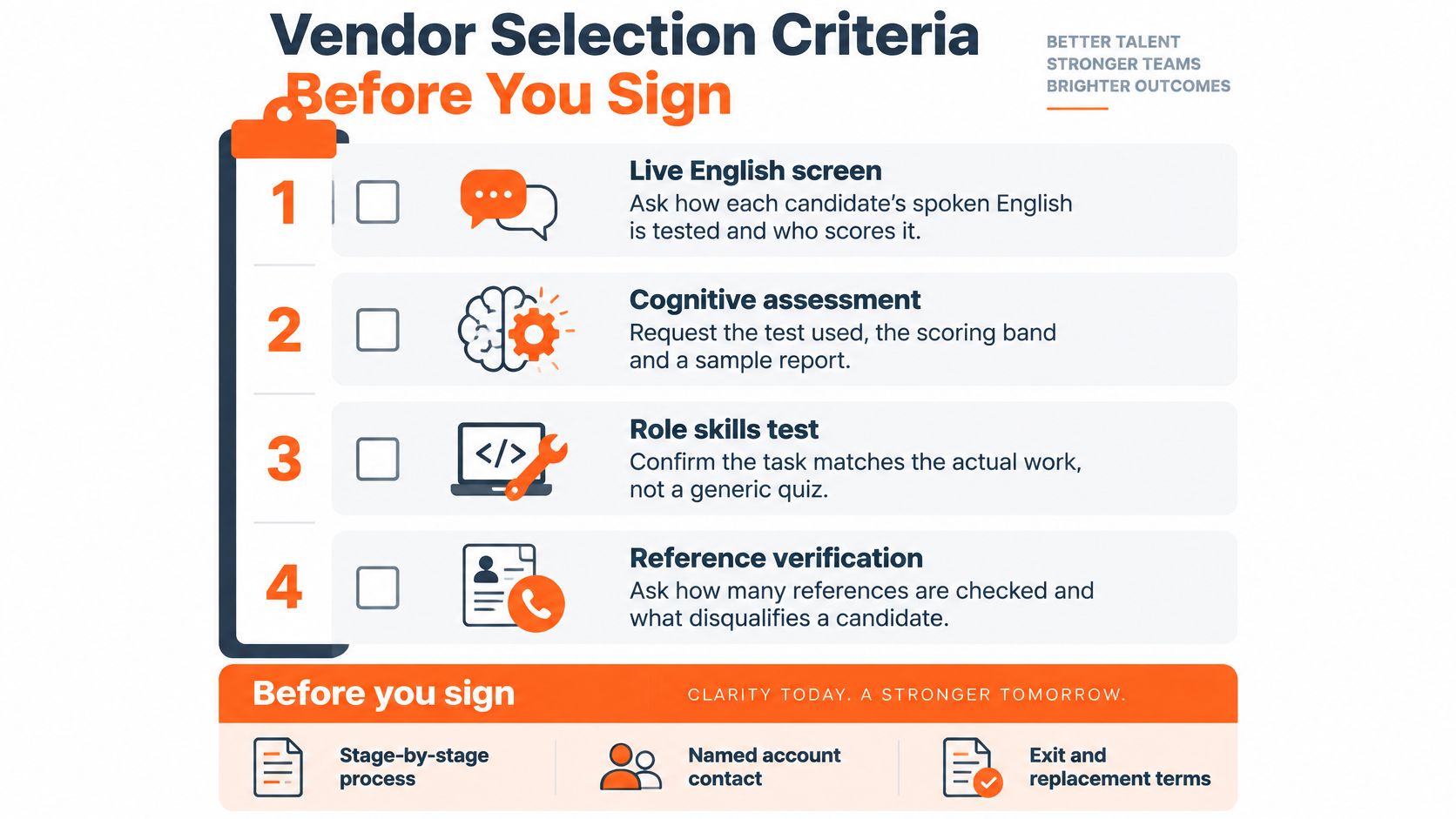
"Vetted" without a number behind it is not a claim you can audit. Ask every agency what happens at each screening stage and what share of applicants passes it, plus a sample assessment report. Here is ours, so you have a benchmark: 100% apply, 22% clear the recruiter screen, 9% pass cognitive (IQ), skills and English testing, 3% reach a live interview, 1% are hired. Candidates complete a live English screen (all are C1 or C2), cognitive testing, a role-specific skills test, and experience and reference verification before they meet you, and each shortlisted candidate comes with a video introduction, résumé and test results. Our candidate vetting process explains each stage.
On transparency, ask how the agency makes money. Our answer is simple: if you pay your agent $10/hr, we give them $9 and keep the dollar in the middle. You can see starting rates by role on our pricing page.
Demand for the remote staffing model has grown through 2026. Our placement records show 657 placement starts from May to October 2026: 73 in May, 101 in June, 94 in July, 125 in August, 132 in September and 132 in October. Monthly starts rose 81% from May to October (132 ÷ 73 = 1.81). These are counts of placement starts, each counted once, not job postings, so our own evergreen recruiting ads are not in the number. Across all years, Virtustant has made 2,000+ placements for 1,000+ US companies, holds 4.9/5 on G2 and ranked on the Inc. 5000 at No. 76 in 2025 and No. 661 in 2026.
The U.S. Department of Labor's guidance on misclassification states that employers are responsible for determining whether a worker is properly classified under the Fair Labor Standards Act, and that covered workers must get at least the federal minimum wage and overtime at 1.5 times the regular rate for hours above 40 in a workweek unless an exemption applies. Those protections do not apply to properly classified independent contractors. A worker doing supervised, ongoing work under your direction can't be labeled a contractor just to make the obligation disappear. Ask every provider, in writing, how the worker is engaged in their own country and who answers if that is ever questioned.
An all-in invoice doesn't move every legal, security or intellectual-property obligation off your books. Before a remote professional touches customer, financial or proprietary data, the agreement should name:
For higher-risk roles, run legal, tax and security review before credentials are issued.
This article is general information, not legal, tax or financial advice.
The decision rule: use outsourced staffing when the role's output can be counted, the handoffs are documented, and managing the hire costs less than recruiting and paying in-house. If any one of those fails, the pilot will produce an argument instead of a number.
The buying market has moved partway toward this logic without finishing the job. Deloitte's 2024 global outsourcing survey found 67% of respondents are adopting outcome-based outsourcing relationships, yet less than half of organizations using AI in outsourced services see productivity and throughput gains, and only about 25% see lower vendor costs or better service quality. Buying outcomes is common. Measuring them is not.
Contrarian point: outsourced staffing raises total cost when your processes aren't documented or nobody has time to onboard. The rate is cheap and your management hours are not.
A customer service seat is the cleanest first pilot, because tickets, response time and satisfaction are countable from week one. Virtustant's starting rates run from $7/hr for virtual assistants and customer service reps, $8/hr for SDRs, social media managers, graphic designers and developers, and $8.50/hr for executive assistants and bookkeepers, all-in.
Pick one role you can count, write the four-week baseline and bring it to us. We will set the 30, 60 and 90-day thresholds with you before your first hire starts. Book a discovery call. It is a free 30-minute call.
Outsource staffing is a three-party arrangement where a provider recruits, contracts or pays the worker, or runs a whole function, while your company gets the output. The five common models differ mainly in who directs the daily work and how you are billed.
No. Using an outside provider or a staffing agency is legal in the US. The legal risk is classification: the U.S. Department of Labor says employers are responsible for determining whether a worker is properly classified under the Fair Labor Standards Act, and covered workers are owed overtime at 1.5 times the regular rate above 40 hours a week unless an exemption applies. This is general information, not legal advice.
Compare any quote against a fully loaded US seat: BLS data put private-industry employer cost at $46.15 per hour worked in December 2025, about 1.43 times wages. Virtustant, a remote staffing agency, starts at $7/hr all-in for virtual assistants and customer service reps, with zero placement fees.
With staff augmentation, a provider supplies a person and your manager directs the work, so you pay for capacity. With managed services, the provider runs the whole function against service levels, so you pay for output.
It varies by model and provider. At Virtustant, you get a shortlist of 3 to 5 vetted candidates within 48 hours of your first call, and your hire can start within 72 hours of that same call. That is our capacity, not a guaranteed average.
Roles with written processes, countable output and light real-time coordination fit best: customer service, sales development, bookkeeping and virtual assistance. Executive assistance and software development need more manager time.
Ask for stage-by-stage vetting pass rates, the fee structure, replacement terms and whether they expire, the minimum commitment and how invoices are itemized. Then run a 90-day pilot with a four-week baseline and decide on quality-adjusted output and manager hours, not the hourly rate.
That depends on the agency and on how much of the client rate reaches the worker, so ask. From the hiring side, a transparent split matters because it affects retention. At Virtustant the rule is simple: if you pay your agent $10/hr, we give them $9 and keep the dollar in the middle.