Reference Check Form: Copy-Ready Template and Questions
November 3, 2026


A reference check form is one fixed record, filled the same way for every referee: permission, verified employment facts, firsthand examples, and 1 to 5 ratings with a cannot-rate option. Reference checks used alone predict job performance at an estimated validity of r = .26, against .51 for cognitive ability tests, according to the OPM Assessment Decision Guide. So the form should collect corroboration, not a verdict. Copy the template below and score only what a referee actually saw.
It is built for U.S. employers hiring remote professionals, including in Latin America, where you never saw the past work and the best referee may be a former client. You get a blank form, a question bank by competency, an anchored scale, a scoring rule we call the Firsthand Evidence Score, a hypothetical completed record, and a decision rule. Speed matters as well: 93% of U.S. hiring managers surveyed in 2025 said hiring takes longer than it did two years earlier, as reported by HR Dive, so a form that defines when a check is finished saves follow-up calls. Peer-reviewed work on structured reference checks appears in the International Journal of Selection and Assessment.
This template is general information, not legal advice. Rules on what you may ask differ by state and country, so have counsel review your final form.
Paste this table into a doc or spreadsheet, one copy per referee. Fill the header and permission rows before contacting anyone, and leave a field blank rather than guessing.
Blank reference check form (one copy per referee)
| Section | Field | Entry |
|---|---|---|
| Header | Candidate name and target role | |
| Header | Caller, date, channel (phone, video, written) | |
| Permission | Referees the candidate approved, date approved, where consent is stored | |
| Permission | May the current employer be contacted? (Yes / No / Only after an offer) | |
| Referee | Name, organization, title | |
| Referee | Relationship code: SUP / PEER / CLIENT / MATRIX | |
| Referee | Dates worked together and how often the referee saw the work | |
| Verification | Employment dates and title confirmed? (Yes / No / Mismatch) | |
| Competency 1 to 6 | Rating: 1 / 2 / 3 / 4 / 5 / Cannot rate | |
| Competency 1 to 6 | Evidence box: situation, candidate actions, result | |
| Competency 1 to 6 | Confidence: High / Medium / Low | |
| Interpretation | Caller's own read, kept apart from the evidence | |
| Close | Would rehire? (Yes / No / Unknown) and the work-related reason | |
| Close | Status code: COMPLETE / POLICY-ONLY / NO-REPLY / BAD-CONTACT | |
| Decision | Firsthand Evidence Score, coverage per competency, Hire / Hold / Walk away, owner of each open item |
Repeat the three competency rows for each job requirement. Four to six competencies fit one call.
The U.S. Office of Personnel Management's reference-checking guidance says that when you ask a candidate for references, you should obtain their permission to contact them. Consent can come through application language, a dedicated form, or orally during the interview. Record where that permission is stored, when it was given, which contacts it covers, and who may make the call.
A phone number isn't permission. Listing a current manager is not consent to an immediate call, especially during a confidential job search. Use "only after an offer" there.
Record the observation window too. Employment dates and the period the referee actually worked with the candidate are different fields.
Keep confidence separate from performance. These are our operating definitions, not a validated instrument:
Use source codes such as SUP for supervisor, PEER, CLIENT, and MATRIX for a dotted-line manager. Keep POLICY-ONLY separate from NO-REPLY. Someone who confirmed employment did respond, even if they couldn't evaluate performance.
VolunteerBadge, a volunteer screening provider, publishes screening guidance for nonprofit volunteer coordinators that also leaves a score blank when the reference gives no example, instead of marking it low. Keep your employment form tied to the paid role.
Define what "complete" means before the first call. HR Management 365, a UK HR software vendor, says reference checking needs a clear owner and a deadline in its write-up of hiring steps that reduce recruitment delays. Apply the same discipline to the form: decide which competencies need firsthand confirmation and who chases each missing field, so a follow-up call answers one defined question instead of restarting the conversation.
References belong beside a work sample and a skills test, not above them. Our guide to the candidate vetting process shows how those checks fit together.
Keep every question tied to the candidate's ability to do the job. The Wisconsin Department of Workforce Development says a question that is prohibited when asked of an applicant is also prohibited as part of a pre-offer reference check, and it frames the test as whether the inquiry gives information about the person's ability to do the job, with or without a reasonable accommodation. That page describes Wisconsin rules, so confirm your own state's.
Leave off age, family plans, health, disability, religion, national origin, and other protected or unrelated personal traits.
Reference check question bank (rate each 1 to 5 or Cannot rate; rehire is Yes / No / Unknown)
| Competency | Core question (ask every referee) | Follow-up probe |
|---|---|---|
| Scope | What did this person own in the last year you worked together, and which of those duties did you see directly? | Which duties did you only hear about? |
| Reliability | Tell me about a deadline they met or missed. What did they do, and what happened to the work? | How often did that pattern repeat? |
| Written communication | Describe a recent written update, handoff, or client email they produced. What was the result? | Did anyone have to rewrite or clarify it? |
| Client or customer communication | Give an example of a difficult client or customer interaction they handled. | What did they say or do first? |
| Teamwork | Describe a disagreement, what the candidate did, and what happened afterward. | What would you have wanted them to do differently? |
| Response to feedback | What feedback did you give them, and what changed afterward? | How long did the change take to show? |
| Remote work habits | How did they coordinate across time zones or work without real-time supervision? | What did they do when they were blocked and you were offline? |
| Rehire | Would you hire this person again for a similar role? What work evidence supports that? | For which kind of role would you not rehire them? |
Ask the same core wording of every referee for every finalist, and accept "cannot rate" as a real answer. Then use the same three probes after each evaluative answer: What was the situation? What did the candidate personally do? What outcome followed? Don't demand an invented metric when the result was qualitative.
For client-facing roles, Eztrackr, a job-search app, lists 10 account management questions with answer frameworks in its account manager interview sample answers. Read them as a map of what candidates tend to claim in interviews, then ask a referee to confirm or correct those specific claims. For administrative roles, our executive assistant interview questions and virtual assistant interview questions translate duties into observable behaviors you can reuse as competencies.
Anchor each number to the evidence it needs and to when you must not record it.
Anchored 1 to 5 reference rating scale
| Score | Anchor | Evidence required | Do not record if |
|---|---|---|---|
| 1 | Below role requirements | A specific miss tied to a job duty | The only basis is tone or dislike |
| 2 | Partially meets requirements | One example with a clear gap | The gap is about a protected trait |
| 3 | Meets role requirements | A routine example of acceptable work | You are guessing from job title alone |
| 4 | Above role requirements | A recent example, actions, and an observable result | The referee offers praise without an example |
| 5 | Exceptional against this role | A comparative example showing rare performance | Prestige of the referee is the only support |
| Cannot rate | Not observed or not disclosed | Relationship unverified or policy blocks detail | You would otherwise invent a middle score |
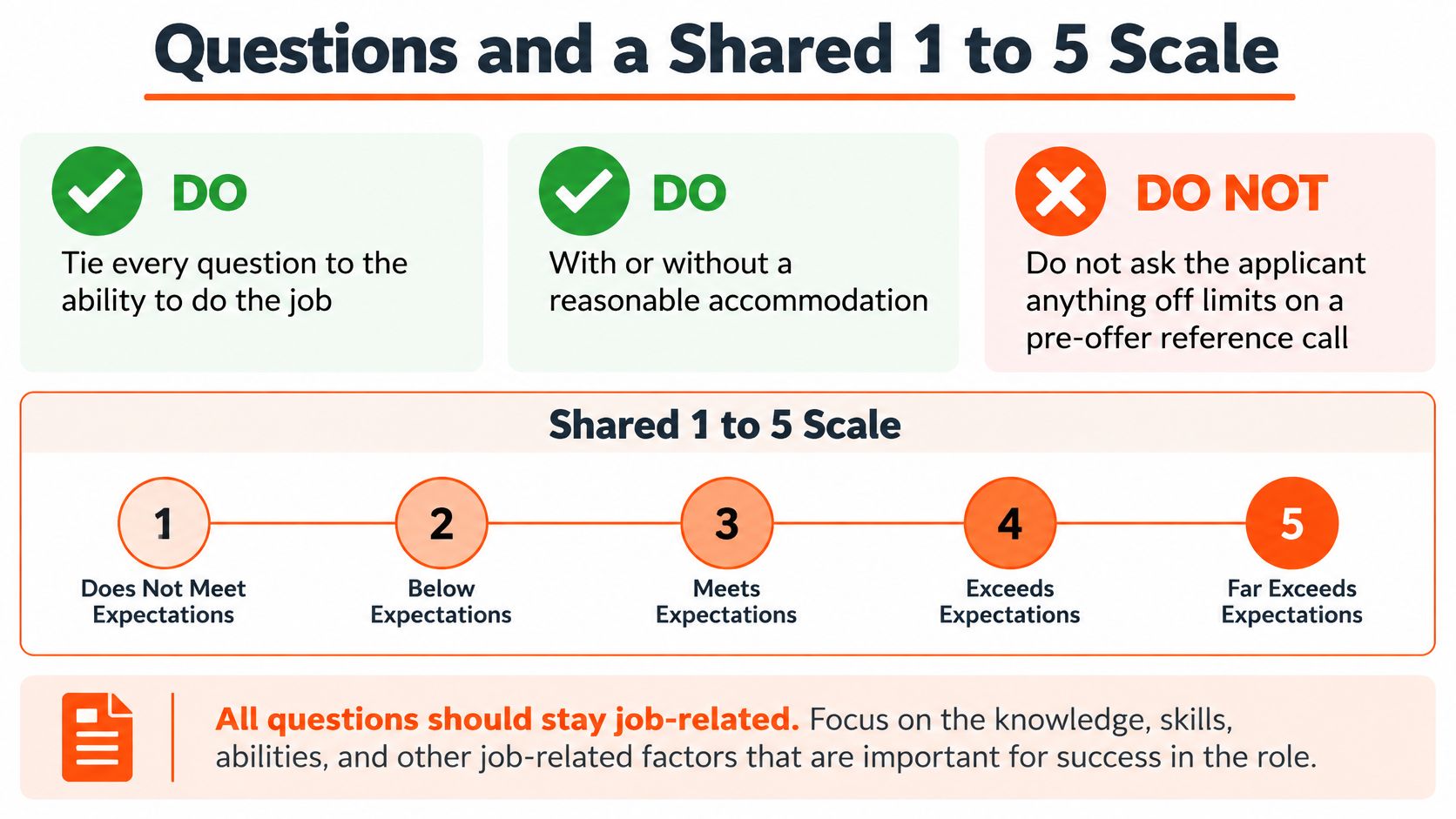
An unsupported high rating stays unscored, and a refusal never becomes an average rating. Keep the individual competency ratings next to any summary so a strong average can't hide a competency nobody observed.
Plain averages hide two problems: praise without an example, and a job-critical competency nobody observed. The Firsthand Evidence Score handles both with four rules.
Here is a worked example. Every name, rating, and date in it is hypothetical, chosen to show the arithmetic, not taken from a real hire. Candidate A is a finalist for a remote customer service specialist role. Three approved referees: a former supervisor (SUP), a former peer (PEER), and a former client (CLIENT) whose company allows only date and title confirmation.
Firsthand Evidence Score: hypothetical worked example
| Competency | SUP | PEER | CLIENT | Points | Coverage | Score | Gate |
|---|---|---|---|---|---|---|---|
| Reliability | 4, High = 4.0 | 3, Medium = 1.8 | Policy-only = 0 | 5.8 | 1.6 | 3.63 | Pass |
| Written communication | 3, High = 3.0 | 5, no example = unscored | Policy-only = 0 | 3.0 | 1.0 | 3.00 | Pass |
| Customer communication | Cannot rate | 4, Medium = 2.4 | Policy-only = 0 | 2.4 | 0.6 | 4.00 | Fail |
| Response to feedback | 4, High = 4.0 | 4, Medium = 2.4 | Policy-only = 0 | 6.4 | 1.6 | 4.00 | Pass |
| Total | 17.6 | 4.8 | 3.67 | Hold |
The arithmetic, line by line:
The gate, not the overall number, decides. Customer communication has the best-looking score and the weakest evidence, so the outcome is Hold until another approved referee gives a firsthand example. A plain 3.86 average would have sent this file to an offer.
The U.S. Office of Personnel Management says reference checks are typically collected by phone using a structured interview format, and that written requests for work histories typically result in low response rates and less useful information. It recommends basing questions on a job analysis and asking applicants the same set of questions. It rates references as better predictors than years of education or experience, but weaker than cognitive ability tests.
For call scripts, red flags, and cross-border privacy, see our companion guide on how to reference check remote hires. To define the work evidence that reference claims get checked against, use these skills assessment test examples.
A glowing call can add corroboration. It can't repair a failed demonstration of a job-critical skill.
This is the supervisor's sheet behind the worked example above. It is a hypothetical record with illustrative names, dates, and scores, not a reported hiring outcome.
Identification and permission
| Field | Completed entry |
|---|---|
| Candidate and role | Candidate A, remote customer service specialist |
| Caller | Jordan Lee (fictional), hiring manager |
| Date and channel | October 14, 2026, video call |
| Permission | Written authorization in the application, dated October 12, 2026 |
| Approved contacts | Former direct supervisor, former peer, former client |
| Current employer | Only after an offer |
The former supervisor confirms title and reporting line and supervised Candidate A from July 2024 through June 2026, reviewing the work weekly: a direct observation basis, not just shared employment.
Evidence and interpretation (one competency)
| Field | Completed entry |
|---|---|
| Competency | Reliability |
| Rating | 4, above role requirements |
| Situation | Weekly reporting across a six-hour time difference |
| Candidate actions | Kept a shared cutoff, checked inputs, flagged missing data before submission |
| Result | No late weekly reports during the six months described |
| Confidence and source | High, SUP |
| Caller interpretation | Referee sounded confident |
| Rehire | Yes, for a similar role |
The referee's confident tone sits only in the interpretation field. The 4 rests on the described deadline behavior and its result.
The former client confirms engagement dates but says company policy prevents performance comments. Record CLIENT, POLICY-ONLY, weight 0 for every competency, and rehire unknown. Leave NO-REPLY unchecked, because a reply was received.
Decision: Hold until an approved referee supplies a firsthand example covering customer communication.
A finalist stays under evaluation until that gap closes. Our explainer on what a shortlisted candidate is covers the difference between shortlist status and a final decision.
Open every call the same way: confirm the candidate approved this contact, name the information you want, say who sees the notes and how long your policy keeps them, and tell the referee they can decline.
Don't promise confidentiality or deletion you can't deliver. A 2025 International Growth Centre policy brief, written about a job-matching platform in Pakistan, flags privacy concerns and the need for secure data-sharing protocols when reference verification is centralized.
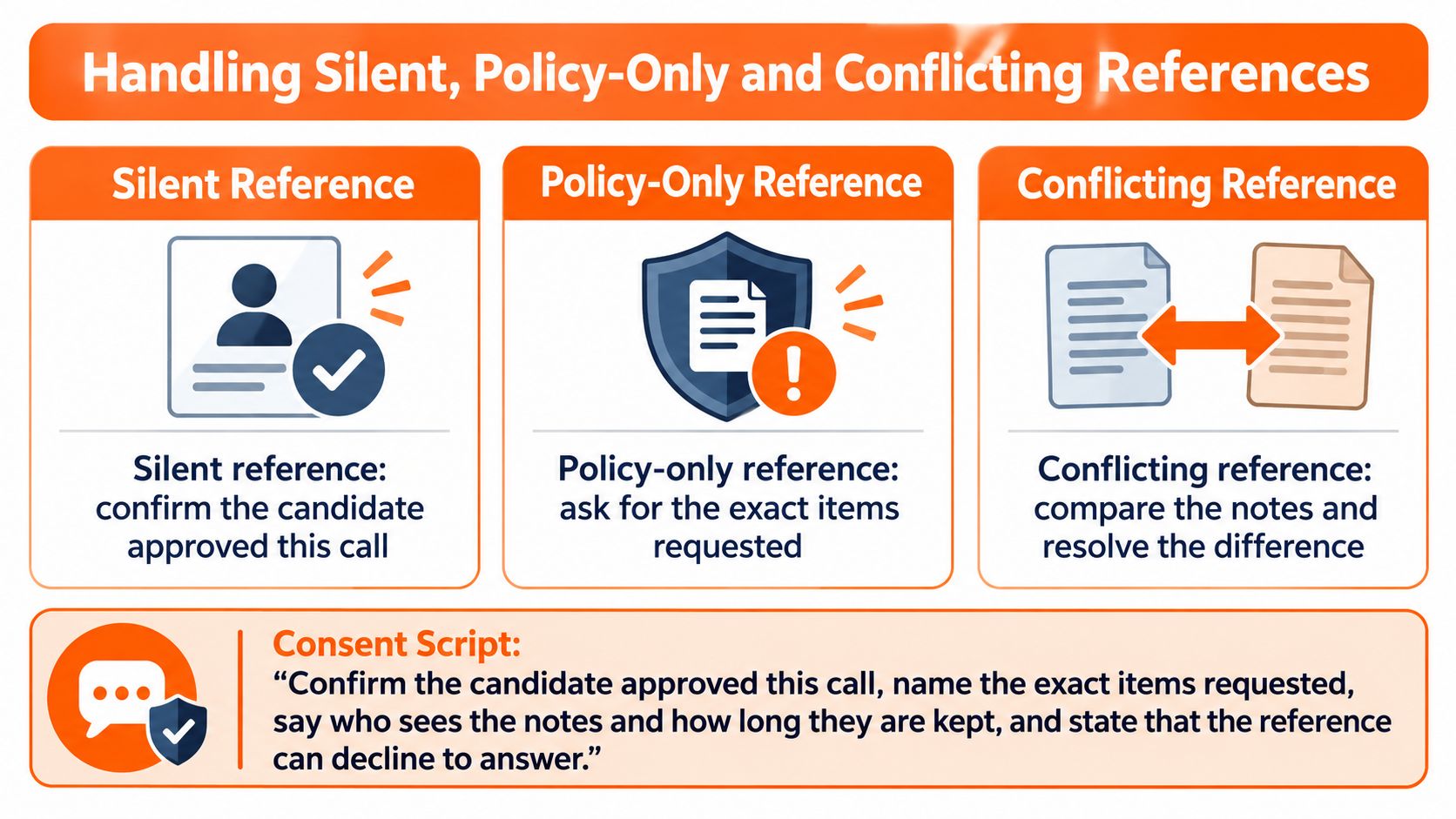
Confirm who you are speaking with before sharing anything. When time zones make a call hard, offer a written option and verify dates and title separately from performance.
Remote professionals in Latin America often worked for several clients rather than under one manager. Accept former clients or matrix managers as firsthand sources, use plain-language questions, and never treat a referee's language preference as a performance rating.
Reference discrepancies and the next move
| Signal | Usual meaning | Next action |
|---|---|---|
| A 5 and a 2 on the same behavior | Different situations observed, or one unsupported score | Ask for the example; leave a 4 or 5 unscored without one |
| Dates or title don't match the résumé | Memory error or résumé inflation | Verify facts before any performance score |
| Praise with no example | Liking, or a scripted endorsement | Store as interpretation only |
| Employment confirmation only | Employer policy or legal caution | Code POLICY-ONLY; do not score down |
| Reference conflicts with a work sample | Weak or biased reference signal | Keep the test result; ask about the conflict in the final interview |
An unverifiable relationship is a verification gap, not proof of dishonesty.
OPM's .26 estimate is a reason for restraint: a reference is neither a pass nor a veto. When ratings diverge, ask what each referee observed and whether the contexts match.
Fix confirmed factual errors and pause the related judgments until the discrepancy is understood. Give every open code an owner and a next action.
OPM's guide puts cognitive ability tests at .51 used alone and .57 when combined with reference checking, roughly a 12% gain (.57 / .51 = 1.12). That is why a positive rehire answer adds context but never replaces the test results. Our primer on what a cognitive assessment is explains how to weigh the two.
If building these files is your bottleneck, this is the part we do before you ever see a name. Our candidates complete a live English screen, cognitive (IQ) testing, a role-specific skills test, and experience and reference verification before meeting the client. Each shortlisted candidate comes with a video introduction, résumé, and test results.
Our funnel is why we say top 1%: 100% apply, 22% clear the recruiter screen, 9% pass cognitive (IQ), skills and English testing, 3% reach a live interview, 1% are hired. Those figures describe our process, not a promise about any one person's future performance.
From our recruiting data: between January 1 and October 31, 2026, our placement records logged 924 placement starts (n = 924), from 53 in January to 132 in both September and October. These are counts of client placement starts only. A professional who started two placements counts twice, and no Virtustant internal positions appear in the data.
You get a shortlist of 3 to 5 vetted candidates within 48 hours of your first call, and your hire can start in 72 hours. That is our capacity, not an average. After the hire, an account manager is your main point of contact, you direct the day-to-day work, and Virtustant handles contracts, payroll and the paperwork on the professional's side, with zero placement fees, month-to-month terms, and a lifetime replacement guarantee. Customer service reps start from $7/hr all-in; see the customer service specialist role, the virtual assistant role, and our pricing.
Want a shortlist where the reference work is already on file? Book a discovery call and tell us which competencies you need verified.
Include a header, a permission block, referee identity and relationship code, verified dates and title, four to six competency rows with rating, evidence and confidence, a separate interpretation box, a rehire answer, a status code such as POLICY-ONLY, and the final decision with owners for open items.
Ask only about the candidate's ability to do the job. The Wisconsin Department of Workforce Development says a question that is prohibited when asked of an applicant is also prohibited in a pre-offer reference check. Rules vary by state and country, so this is not legal advice; have counsel review your form.
Common questions cover scope of duties, reliability, written communication, client or customer handling, teamwork, response to feedback, remote work habits, and whether the referee would rehire the person. Each should ask for a specific situation, what the candidate did, and the result.
Two independent firsthand referees is a sensible operating minimum for roles that matter. With the Firsthand Evidence Score, each job-critical competency needs coverage of at least 1.0, which means one high-confidence example or two medium-confidence ones.
Code the reply POLICY-ONLY, give it zero weight in scoring, and do not score the candidate down. It is verification, not a negative review. Ask the candidate for another approved referee who saw the work, such as a former client or matrix manager.
Treat it as corroboration. The OPM Assessment Decision Guide estimates reference checking validity at .26 used alone, against .51 for cognitive ability tests. A strong reference can support a hire, but it should not override a failed work sample or skills test.
Yes. Virtustant candidates complete a live English screen, cognitive (IQ) testing, a role-specific skills test, and experience and reference verification before meeting the client. Each shortlisted candidate comes with a video introduction, résumé, and test results.