What Are Cross-Border Payments? Rails, FX, Costs and Timing
November 17, 2026


A cross-border payment moves money between a payer and a payee in different countries, usually with a currency conversion and several banks involved. It is still slow and expensive: the World Bank remittance prices site puts the global average cost of sending remittances at 6.36% of the amount sent, and the FSB's 2025 progress report found only 35.4% of retail payment services settle within one hour. For a business paying contractors abroad, what matters is how much lands and when.
The usual advice is to pick the lowest fee or the rail that says same-day. That fails a business owner, because the fee is not the full cost and a fast send is not a usable arrival. Below: the payment from initiation to credit, every cost component, the G20 targets, and a check we call the Landed Pay Test.
This guide is general information, not financial, legal or tax advice.
Cross-border payments are transfers of money between individuals, businesses, banks or other organizations in different countries. They fund trade, supplier invoices, contractor pay, e-commerce and family remittances. The Financial Stability Board's G20 targets page records that in 2021 G20 Leaders endorsed 11 global targets across three market segments: wholesale payments, largely between financial institutions; retail payments, which include business-to-business and business-to-person payments; and remittances.
A domestic transfer is a text message inside one network. A cross-border payment is a letter passed through several post offices. It usually crosses more than one payment system, several banks, two currencies and two regulatory regimes.
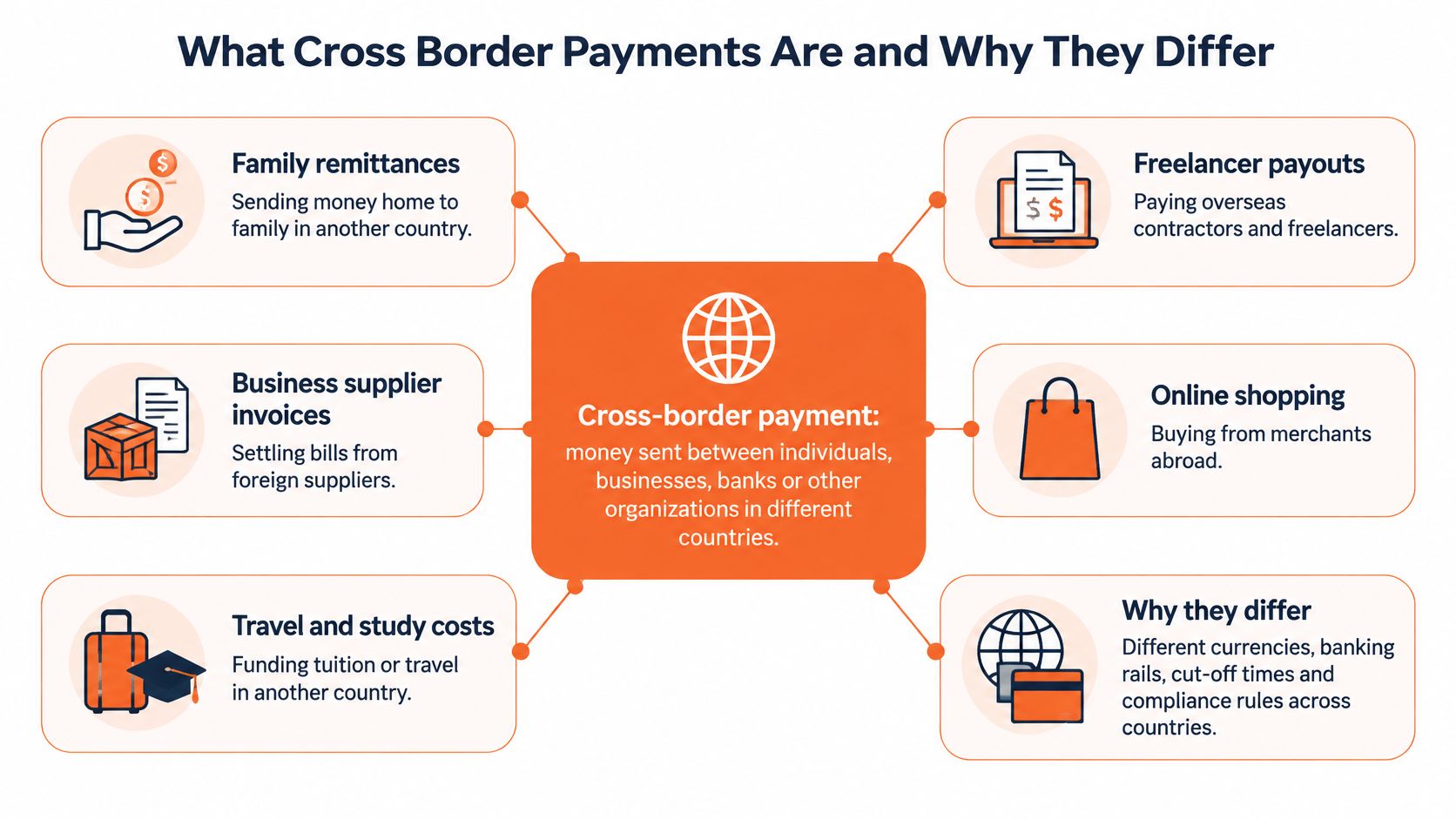
Say a US company pays a Mexican contractor a USD 3,000 invoice. Dollars leave the account, someone converts them into pesos at a rate that includes a spread, at least one intermediary handles the payment, and the contractor's bank credits it under local cut-offs and its own screening. The pesos that land can be worth less than 3,000 dollars, and they can land later than the sender's app suggested.
A cross-border payment is a settlement process, not a digital transfer between two accounts.
Before you authorize the next one, run a four-point check.
The Bank for International Settlements paper on cross-border payments, a July 2021 report to the G20, describes the traditional model as built on correspondent banking, which "can be costly and slow in the case of long correspondent banking chains." It lists unclear FX rates, unclear incoming fees and complex anti-money-laundering checks among the frictions end users face.
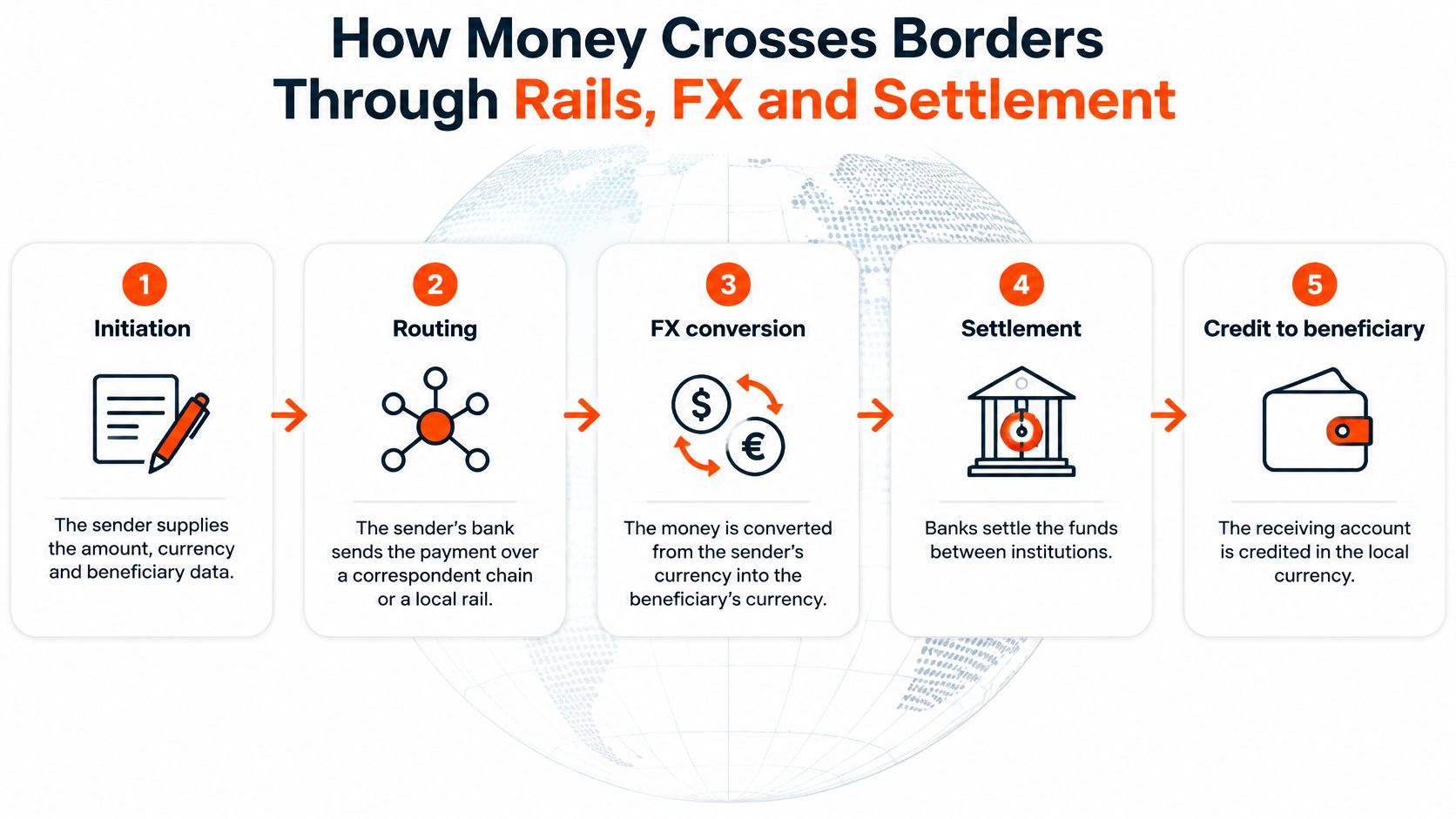
Walk the payment in order. Each of these six stages can add delay or cost.
The BIS report names the structural frictions: fragmented and truncated data formats, limited operating hours, legacy technology platforms, long transaction chains, funding costs and weak competition. Payers feel the first one most. When a field is cut short or reformatted by the next system, the payment falls out of automatic processing and someone investigates it by hand.
A typical business payment uses correspondent banking over SWIFT messaging for the cross-border leg, then a domestic system such as ACH in the US or SEPA in the euro area for the local leg. Those are different systems with different hours. A Friday afternoon send can sit until a local clearing window opens on Monday while your screen already says sent.
The Committee on Payments and Market Infrastructures, in its cross-border payments monitoring brief published in June 2024, groups the work on payment systems into three priority themes: payment system interoperability and extension, data exchange and message standards, and legal, regulatory and supervisory frameworks. Standards such as ISO 20022 and Legal Entity Identifiers are designed to carry richer, structured data so banks can route more payments automatically.
You cannot redesign the corridor. You can control beneficiary-data quality, complete payment details, transparent FX pricing, and the timing of each send against the cut-off. Our guide to paying international contractors shows how those choices play out when you pay people every cycle.
The quoted fee is one input. Compare each cost component separately:
| Channel or cost point | Average cost | Period |
|---|---|---|
| Global average remittance cost, latest on the World Bank site | 6.36% of amount sent | Site updated Aug 18, 2025 |
| Global average remittance cost | 6.65% | Q2 2024 |
| Banks as the provider | 13.40% | Q2 2024 |
| Money transfer operators as the provider | 5.60% | Q2 2024 |
| Sending from a bank account | 8.35% | Q2 2024 |
| Receiving on a debit card | 4.34% | Q2 2024 |
| Digital remittances | 5.29% | Q2 2024 |
| Non-digital remittances | 7.23% | Q2 2024 |
| Sending from the United States | 5.79% | Q2 2024 |
Sources: the first row comes from the World Bank remittance prices site homepage; all other rows from the World Bank Q2 2024 remittance prices report. For newer quarters, the same series continues in Remittance Prices Worldwide, Q3 2025.
These are averages for sending $200 in remittances, not a price for a business payment. They still show two things. The channel matters: in Q2 2024, banks averaged 13.40% while money transfer operators averaged 5.60%. And sending from a bank account, the way most businesses pay, averaged 8.35%, the costliest sending instrument in the report.
Amount matters too. The FSB's 2025 progress report puts the global average at 6.5% for a USD 200 remittance and 4.3% for USD 500, because fixed fees weigh less on larger sends. A business invoice should cost a smaller share than either, which is why you test the quote instead of trusting an average.
Disclosure is improving but incomplete. Per the same FSB report, the share of providers transparent about cost that were also transparent about speed rose 7.3 percentage points to 62.9%. A fee quote without a delivery time cannot be judged.
Practical rule: Compare the amount the recipient receives with the amount you pay.
The same applies to staffing: our fully loaded labor rate breakdown shows what an all-in hourly rate covers.
Providers blur four moments a payer has to keep separate. Initiation is when you submit the payment. Settlement is when institutions move value. Beneficiary credit is when the recipient's bank records the funds. Final availability is when the recipient can use the exact amount.
A payment can look instant at the first moment and stall at any later one. A sanctions hit stalls at screening, before settlement. A missing field or intermediary deduction stalls in the correspondent chain, so settlement is late or short. A closed local window stalls between settlement and credit.
The FSB's 2025 monitoring shows how far the market is from instant. The share of retail payment services settling within one hour rose 1.9 percentage points to 35.4%, a change the FSB says was primarily driven by changes in the sample. Business payments are slower: B2B and business-to-person use cases had less than 45% of payments settled within one business day.
The corridor most relevant to US companies paying contractors is a good example. In Latin America and the Caribbean, the FSB found no B2B services crediting funds within one hour and only 44.5% within one day in 2024. Remittances to the same region did better, with 60.6% of services delivering within one hour.
Card rails feel quicker because authorization is not payment. One card processor's explainer of how card settlement timelines work separates authorization, clearing and settlement, and labels merchant credit T+0, T+1 or T+2 business days before cut-offs, weekends and holidays stretch it.
Ask every provider for four things in writing: the cut-off time for your corridor, the expected credit time stated as beneficiary credit rather than "sent," tracking you can read without calling support, and proof of delivery when the exact amount is available. A service level that only promises initiation speed has not promised your contractor can use the money.
The G20 targets coordinated by the FSB are the reference point for judging a provider. They are targets for the whole market, not today's results.
| Segment and measure | G20 target | Deadline |
|---|---|---|
| Wholesale speed | 75% credited within one hour of initiation (or of the pre-agreed settlement time for forward-dated payments); the rest within one business day | End-2027 |
| Wholesale cost | No target set | None |
| Retail cost (includes B2B) | Global average no more than 1%; no corridor above 3% | End-2027 |
| Retail speed | 75% available to the recipient within one hour of initiation; the rest within one business day | End-2027 |
| Remittance cost | Global average for sending $200 no more than 3%; no corridor above 5% | 2030 |
| Remittance speed | 75% in every corridor available within one hour; the rest within one business day | End-2027 |
| Transparency (all segments) | Total cost including sending, receiving and intermediary fees, FX rate and conversion charges; expected delivery time; payment tracking; terms of service | End-2027 |
Source: the FSB G20 targets page, checked November 17, 2026.
Put today's numbers next to the targets and the gap is plain. Speed: 35.4% of retail services settle within one hour against a 75% target. Remittance cost: 6.5% for a USD 200 send against 3%. Retail cost: the FSB reports person-to-person costs "approximately stable at 2.5% since 2023," against 1%.
The transparency target already describes a good quote: total cost with every fee and the FX rate, expected delivery time, tracking and terms. Ask for exactly that before you authorize.
Global averages also hide your corridor. The FSB puts the average cost of sending USD 200 to Latin America and the Caribbean at 5.7%, already above the 5% the G20 wants as the ceiling for any single corridor by 2030. Keep pay and payment cost apart: our 2026 Nearshore Rate Report covers what a role costs per hour, and rail costs sit on top of anything you pay directly. Then log every payment for 30 days, with initiation time, credit time and amount received. Thirty days of your own corridor beats any "instant" claim.
The Landed Pay Test is the two-part check we use for any recurring payment to a person abroad. It replaces "what does the transfer cost?" with the two questions the payee cares about.
Part 1, the amount. Landed amount = principal − sender fee (if deducted from the principal) − FX spread cost − intermediary deductions − receiving-bank charge. Shortfall % = (invoice − landed amount) ÷ invoice.
Part 2, the timing. Is the money at final availability, not just "sent," on or before payday? Count back from payday through the cut-off, the intermediary hop and the receiving bank's posting time.
Pass rule. The payment passes only if both parts pass: the shortfall is within the tolerance you agreed with the payee, and funds are available on or before payday. The example uses a 1% tolerance, borrowed from the G20 retail cost target. Pick your own number and write it into the contract.
Worked example. Every input is an example, not a quote from any provider.
| Line | Example input | Running landed amount |
|---|---|---|
| Invoice and principal sent | USD 2,000 | USD 2,000 |
| Sender fee deducted from principal | USD 25 | USD 1,975 |
| FX spread, 1.5% of USD 2,000 | USD 30 | USD 1,945 |
| Intermediary deduction | USD 15 | USD 1,930 |
| Receiving-bank charge | USD 10 | USD 1,920 |
The arithmetic: 2,000 − 25 − 30 − 15 − 10 = 1,920. Shortfall = 80, and 80 ÷ 2,000 = 4.0%. The tolerance is 1%, or USD 20, so Part 1 fails. Paid monthly, that is 80 × 12 = USD 960 a year. For context, 4.0% is below the 6.36% global remittance average and four times the G20's 1% retail target.
Timing, with example inputs: payday is Friday. You send Wednesday at 4 p.m., after a 3 p.m. cut-off, so processing starts Thursday. The beneficiary bank credits Friday afternoon, and its posting batch makes the funds usable Monday. Credit landed on payday; final availability did not. Part 2 fails.
The fixes have a price. To land the full invoice, gross up the principal. With USD 50 in fixed charges (25 + 15 + 10) and a 1.5% spread, solve P − 0.015P − 50 = 2,000, so P = 2,050 ÷ 0.985 = USD 2,081.22. Check: 2,081.22 × 0.015 = 31.22, and 2,081.22 − 31.22 − 50 = 2,000.00. That costs USD 81.22 per payment, or USD 974.64 a year. To fix timing, send a business day earlier and before the cut-off, or use a route that commits to beneficiary credit in writing.
Run the test on the first payment to every new payee, then monthly on your log. If finance is stretched, an accounts payable specialist can own the check and the log.
A transfer can leave on schedule and still miss payday. Four reviews can hold it until a person clears it: identity verification of payer and beneficiary, sanctions screening of names and banks, anti-money-laundering monitoring of payment patterns, and fraud controls that watch for changed bank details, which is how invoice fraud usually starts. A missing postal code or a nickname instead of the legal name is enough to trigger a manual review.
Use this sequence on every new payee.
For the hiring-rules side of paying people abroad, see our guide to hiring rules for US founders.
Every payee adds a corridor, bank details and a monthly test. Contractor-payment platforms send the transfers for you but leave you managing each person. Employer-of-record platforms, as a category, become the legal employer in the worker's country and handle local taxes and filings there.
A remote staffing agency is a third route. With a standard Virtustant placement, you direct the day-to-day work and Virtustant handles contracts, payroll and the paperwork on the professional's side. You pay one weekly invoice per placement for the all-in hourly rate and send no international transfers yourself. If you need the professional formally employed in their own country under a local contract, Virtustant also offers an optional employer-of-record arrangement, priced on the discovery call. Standard placements are not that arrangement.
Virtustant recorded 657 placement starts from May to October 2026: 73 in May, 101 in June, 94 in July, 125 in August, 132 in September and 132 in October (73 + 101 + 94 + 125 + 132 + 132 = 657). Each start is a recurring cross-border pay relationship the client does not settle itself, cycle after cycle. These are counts of placement starts from our placement records, not job postings, so our own evergreen postings are not included.
Score the route on what arrives, in which currency and inside which window, not on the fee line.
A one-off supplier payment. A bank transfer is workable once you have priced the full cost, including the receiving charge, and the cut-off still lands inside the date you promised.
A recurring payment to one contractor. Lock one settlement currency and a fixed credit schedule, and run the Landed Pay Test monthly. Repricing FX and rechecking bank details every cycle is how shortfalls build up. A payroll specialist can run the schedule as volume grows.
An ongoing team in Latin America that works your hours. Here a placement takes the transfers off your side. Virtustant is a remote staffing agency that places vetted professionals, Latin America first, with US companies. Roles start from $7/hr all-in, with zero placement fees, month-to-month terms and a lifetime replacement guarantee. Across 441 placement starts from January to June 2026, median client-side rates by role range from $9.00/hr (dispatcher) to $12.41/hr (SDR/BDR), per our rate report. You get a shortlist within 48 hours of the call, and your hire can start within 72 hours of that same call.
Nearshore staffing in Latin America fits when time-zone overlap matters. Our pricing page lists starting rates by role, the zero-fee model explains the hourly rate, and our Argentina hiring guide covers that market.
Whatever you pick, get all-in quotes from two routes and compare the amount credited, the delivery window and who absorbs the FX spread. The route that wins on the fee and loses on the amount or the day is the expensive one.
Cross-border payments are transfers of money between a payer and a payee in different countries, such as a US company paying a contractor in Argentina. They usually involve a currency conversion, more than one bank and more than one payment system, so they cost more and take longer than domestic transfers.
The sender submits the amount, currency and beneficiary details. The sending bank routes the payment through a correspondent chain or a local clearing system, the amount is converted at a rate that includes an FX spread, banks run sanctions and anti-money-laundering checks, value settles between institutions, and the beneficiary bank credits the account.
Cost and unpredictability. The World Bank puts the global average cost of sending remittances at 6.36% of the amount sent, and the FSB found only 35.4% of retail payment services settle within one hour. FX spreads, intermediary deductions, screening holds and closed clearing windows can leave the recipient short or paid late.
It depends on the corridor, provider and amount. In Q2 2024 the World Bank measured an average of 13.40% when banks were the provider and 5.60% for money transfer operators. The G20 target for retail payments, which include business-to-business payments, is a global average of no more than 1% by end-2027.
Anywhere from minutes to several business days. The FSB's 2025 progress report found 35.4% of retail payment services settle within one hour. In Latin America and the Caribbean, no business-to-business service credited funds within one hour and only 44.5% did so within one day in 2024.
Remittances are usually small person-to-person transfers, and the World Bank measures their cost on a $200 send. B2B payments are business transfers such as supplier invoices and contractor pay. The G20 groups B2B under retail payments, with a cost target of 1% on average and no corridor above 3% by end-2027.
One option is a remote staffing agency. With a standard Virtustant placement, Virtustant handles contracts, payroll and the paperwork on the professional's side, and the client pays one weekly invoice per placement for the all-in hourly rate, from $7/hr, with zero placement fees. The client directs the work and sends no international transfers.
If recurring contractor payments are where your fees, FX spreads and late credits keep showing up, look at how a placement changes that workload. Book a discovery call to talk through roles, rates and how the first week is set up.