Customer Support Outsourcing: Models, Costs and How to Choose (2026)
October 5, 2026


Customer support outsourcing means paying someone outside your payroll to answer your customers by phone, email, chat or social messages. The number you are replacing is a wage: the Bureau of Labor Statistics puts the median U.S. customer service representative at $21.53 an hour (May 2025), before benefits. Outside options run from a contact-center seat at $12 to $18 per agent hour (one provider's published range) to a dedicated remote professional from $7/hr all-in.
Which one wins depends on how much of the work lives inside your own systems. This guide compares the four ways U.S. companies staff support today: a BPO or contact center, a dedicated remote professional through a remote staffing agency, freelancers from a marketplace, and an in-house hire. You get a monthly cost model for each, a scored test to pick one, and what 31 real customer service searches opened with Virtustant this year actually asked for.
Buyers use one phrase for four very different models. Each moves a different amount of control and cost off your plate.
A note on the statistics you will see quoted. Many articles open with adoption rates, such as "38% of businesses outsource customer service." That figure appears in this 2026 customer service outsourcing statistics compilation, which credits it to a help-desk vendor's blog; we could not find the number on that blog when we checked it on October 5, 2026. Treat adoption figures as soft and build your decision on your own volumes and quotes.
Market size is easier to pin down. Mordor Intelligence estimates the contact center outsourcing market at $125.73 billion in 2026 and forecasts $189.49 billion by 2031, an 8.55% compound annual growth rate, in its contact center outsourcing market projections. For a buyer, that mostly means more vendors pitching you, which makes a disciplined comparison more important, not less.
The four models are not interchangeable. The real difference is who directs the work each day and who absorbs the administration. Price follows from that.
| Model | Who directs the daily work | How it is priced | What you still manage | Best fit | Main risk |
|---|---|---|---|---|---|
| BPO or contact center | The provider's supervisors | Per agent hour, per seat or per contact | Scope, SLAs, quality reviews, escalations | 24/7 or multi-shift coverage, large or spiky volume | Distance between your team and the agents; scripts over judgment |
| Dedicated remote professional (remote staffing agency) | You | All-in hourly rate for one named person | Direction, coaching, tools access | One to a few seats doing support plus operational work in your systems | You need someone to own direction and coaching |
| Freelancer or marketplace | You | The freelancer's rate plus any platform fee | Sourcing, vetting, contracts, payments, replacement | Short projects, backlogs, intermittent volume | Availability and continuity; replacement restarts from zero |
| In-house U.S. hire | You | Salary plus benefits and payroll taxes | Everything, including recruiting and turnover | Roles that must be onsite or carry regulated U.S. licensing | The highest fixed cost of the four |
A BPO's value is the operating engine: workforce management, supervision and reporting you do not have to build. The trade-off is distance, because the agents report to the provider's supervisors.
A dedicated remote professional is the opposite trade. Virtustant explains remote staffing in more detail, but the buying test is simple: can you manage this person as part of your own team while someone else handles the hiring and the paperwork on their side? If your support work spills into scheduling, dispatch, order changes or renewals, that is usually the better fit, because the person lives in your systems all day.
If you are weighing chat alone, the per-chat answering services are a fifth option worth pricing separately; our breakdown of live chat support outsourcing covers when a per-chat plan beats a dedicated seat. For the broader arguments for and against handing support to a third party, see the pros and cons of outsourcing customer service. This page stays on the model and cost decision.
Headline hourly rates are a weak decision metric on their own, but you need them as the first input. Here is what each model costs for one full-time seat at 160 hours a month, using figures you can verify.
| Model | Rate used | Source | Monthly cost at 160 hours |
|---|---|---|---|
| In-house U.S. rep, wage only | $21.53/hr | BLS median, May 2025 | $3,444.80 |
| In-house U.S. rep, with benefits (estimate) | $30.76/hr | BLS wage ÷ 0.70 (benefits are 30.0% of private-industry compensation, June 2026) | $4,921.60 |
| Nearshore BPO voice agent | $12 to $18 per agent hour, all-in | One provider's published range, Sept 2026 | $1,920 to $2,880 |
| Dedicated remote professional through Virtustant | From $7/hr all-in | Virtustant published starting price | From $1,120 |
| Freelancer from a marketplace | Your quote | Your quote plus the platform's fee | Quote × 160 + fees |
In-house. The Bureau of Labor Statistics reports a median of $21.53 an hour, or $44,770 a year, for customer service representatives (May 2025). That is wage only. The BLS Employer Costs for Employee Compensation release shows that in June 2026, wages and salaries made up 70.0% of private-industry employer costs and benefits the other 30.0%. Applied to the support wage, that gives an estimated $30.76 an hour fully loaded ($21.53 ÷ 0.70), or $4,921.60 for 160 hours. It is an approximation, not a quote for your benefits plan.
BPO. Few contact centers publish prices. One Caribbean and Colombia provider does: its call center outsourcing cost guide lists $12 to $18 per agent hour all-in for nearshore voice programs, last updated September 27, 2026. At 160 hours that is $1,920 to $2,880 a month per agent. It is one vendor's range, not a market average: use your own quotes, and ask whether the rate buys a dedicated agent or a share of a pooled team, and which costs sit outside it.
Dedicated remote professional. Virtustant's customer service representatives start at $7/hr all-in, so 160 hours costs $1,120 a month. Against the $21.53 BLS median wage, that is $14.53 an hour less before a single U.S. benefit is counted, which is how companies save up to 70% at the starting rate.
Freelancer. Rates vary too widely to quote a fair number. Price it as the freelancer's rate times your hours, plus any marketplace fee in that platform's current terms, plus your own time spent sourcing and replacing.
Starting prices are not what most roles land at, so here is the evidence. In Virtustant's H1 2026 placement data (441 placement starts, January 1 to June 30, 2026), the median client-side rate was $10.83/hr for customer service (n=12) and $9.65/hr for the customer service representative title (n=9). At 160 hours those medians come to $1,732.80 and $1,544.00 a month. They are rate benchmarks from placement records, published in the 2026 Nearshore Rate Report, not audited payments. See the published pricing for the rest of the roles.
The rate is only the first line. Every model also costs you management time, launch time and replacement risk. That is what the test below prices in.
We use a two-part test with buyers on discovery calls. Part one scores how much control the work needs. Part two prices each model that passes, per contact, including your own time. We call it the Control-to-Cost Test.
| Question | 0 points | 1 point | 2 points |
|---|---|---|---|
| 1. Does the work happen inside your own business systems (field-service, ecommerce, CRM), not only a help desk? | Help desk only | Some | Most of the day |
| 2. Does the person decide refunds, exceptions or schedule changes under your policy? | Never, scripted | Within small limits | Often |
| 3. Is support bundled with operational work such as scheduling, dispatch, order changes or renewals? | No | Some | Yes, a large share |
| 4. Do your products, prices or policies change monthly or faster? | Rarely | Quarterly | Monthly or faster |
| 5. Do you want to coach the person yourself, in your own channels? | No | Weekly | Daily |
Then size the coverage: seats = hours you must staff per week ÷ 40. A weekday 9-to-5 queue is one seat. Coverage around the clock is 168 hours a week, or 4.2 seats before vacations and sick days.
Among the models that pass, pick the lowest monthly cost per contact: (rate × hours + management hours × the hourly value of the manager's time) ÷ contacts handled.
All inputs here are examples; swap in your own. A home-services company runs scheduling and customer calls in its field-service software. It needs one weekday seat (160 hours a month) for about 1,000 contacts a month and values the owner's time at $50 an hour. It scores 2 on systems, 2 on judgment, 2 on bundled operations, 0 on change rate and 1 on coaching: 7 out of 10, with one seat of coverage. The rules point to a dedicated professional. The cost check:
| Model (example inputs) | Rate × 160 hours | Management time × $50 | Monthly total | Cost per contact (1,000 contacts) |
|---|---|---|---|---|
| BPO voice agent at $15/hr (midpoint of the published $12 to $18 range) | $2,400.00 | 4 h = $200.00 | $2,600.00 | $2.60 |
| Dedicated remote professional at $10.83/hr (customer service median, n=12) | $1,732.80 | 12 h = $600.00 | $2,332.80 | $2.33 |
| Freelancer at $12/hr (example quote, before platform fees) | $1,920.00 | 16 h = $800.00 | $2,720.00 | $2.72 |
| In-house U.S. rep at $30.76/hr (BLS wage with benefits, estimate) | $4,921.60 | 15 h = $750.00 | $5,671.60 | $5.67 |
The arithmetic: 160 × $15 = $2,400 and $2,600 ÷ 1,000 = $2.60. 160 × $10.83 = $1,732.80 and $2,332.80 ÷ 1,000 = $2.33. 160 × $12 = $1,920 and $2,720 ÷ 1,000 = $2.72. 160 × $30.76 = $4,921.60 and $5,671.60 ÷ 1,000 = $5.67. The management hours are example assumptions: a BPO supervises, so it needs less of your time; a dedicated professional or freelancer needs more because you direct them. Change the inputs and the ranking can change.
If a BPO quotes per contact or per minute, compare that quote directly with your per-contact figure. And a cheap seat that creates repeat contacts is not cheap: once you have 60 days of data, divide by resolved contacts, not total contacts.
We pulled the 31 most recent customer service and customer support searches in Sieve, the recruiting platform Virtustant runs client searches through: the 25 latest matching "customer service" and the 6 matching "customer support" opened in the same window, between May 25 and September 23, 2026. A separate query for "live chat" returned no searches. No client names are used.
| What the search asked for | Searches | Share of 31 |
|---|---|---|
| Named phone as a channel | 19 | 61% |
| Phone plus at least one written channel (email, chat, SMS or Instagram DMs) | 11 | 35% |
| Bundled support with operational work (scheduling, dispatch, renewals, order management or admin) | 14 | 45% |
| Named a specific business system the hire would work in | 8 | 26% |
| Named a help-desk platform (Zendesk, Intercom, Gorgias, Freshdesk) | 0 | 0% |
| Required weekend or Saturday hours | 3 | 10% |
Three findings matter for the model decision.
Sieve returns shortened job descriptions, so these counts are a floor, not a ceiling. Still, these companies were not buying a ticket queue. They were buying a person to run part of the customer side of the business, which scores high on the Control-to-Cost Test.
A dedicated professional is not always the answer. A BPO or contact center is usually the better buy when:
If you go this way, buy a defined perimeter: channels, authority limits, escalation path, quality scoring and reports. To shortlist providers, see our customer support outsourcing companies compared; this page does not rank vendors.
Location still matters inside the BPO decision. TDS Global Solutions, a BPO consulting firm, notes in its overview of Latin American call-center outsourcing that working hours overlap substantially with North American customers and client teams, which is the practical case for a Latin American team when escalations need same-day answers.
Time-zone overlap decides how fast an exception gets resolved. If a refund needs your approval at 2 p.m. Eastern, someone working your hours gets an answer that afternoon; someone working overnight waits for your morning, and so does your customer.
LatoJobs, a job board for Latin American professionals, makes the same split in its guide to compare LATAM hiring models: nearshoring suits collaborative work that needs same-day interaction, and offshoring works better for standardized, independent tasks. That maps onto the control score. High-control, judgment-heavy support benefits most from overlap. Scripted overnight queues can live anywhere.
For U.S. managers who need someone working their own hours, nearshore staffing for U.S. companies explains how time-zone overlap works with Latin American professionals. Run a simple test before you sign anything: hand each finalist a billing exception at 2 p.m. Eastern and measure how long it takes to get a correct, documented answer back.
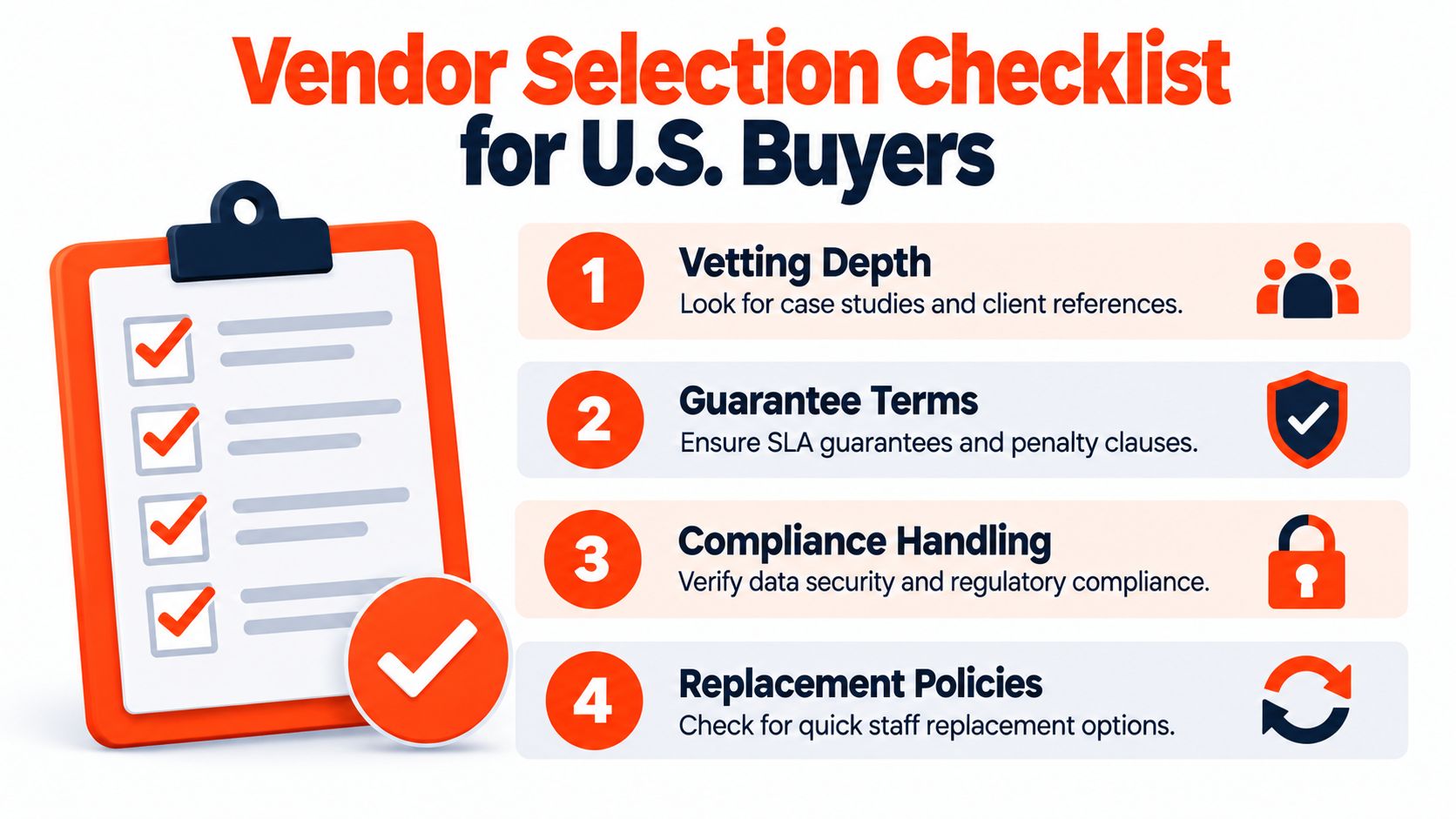
Whichever model you choose, the questions that expose weak providers are the same. Ask each finalist, in the same order:
If you are comparing remote staffing agencies specifically, this short video covers the questions to ask before you sign:
Then run the first 30 days as a pilot, not a full handover.
Our practical guide to customer service ops covers the routines that keep a remote support seat on track after week one, and our guide on how to hire a remote customer support specialist covers vetting, scheduling and the first 90 days in detail.
Virtustant is a remote staffing agency. It is not a BPO and does not run a contact center. If the Control-to-Cost Test points you to a dedicated professional, here is how that works with us:
If your queue lives in Shopify or another store platform, look at the ecommerce customer service specialist role. For everything else, the customer service specialist role page lists what a hire handles and the questions buyers ask. Virtustant holds 4.9/5 on G2 (70 reviews) and 4.5/5 on Trustpilot (163 reviews) across 2,000+ placements with 1,000+ U.S. companies.
Ready to price your own queue? Book a discovery call and hire a dedicated customer service specialist; bring your weekly hours, channels and the systems the person will work in.
It depends on the model. One nearshore contact-center provider publishes $12 to $18 per agent hour all-in, or $1,920 to $2,880 a month at 160 hours. A dedicated remote professional through Virtustant starts at $7/hr all-in, or $1,120 a month at 160 hours. An in-house U.S. rep earns a median $21.53 an hour in wages alone (BLS, May 2025).
Often, but compare per contact, not per hour. Add your own management time to each model's monthly cost and divide by contacts handled. In our worked example, an in-house rep at an estimated $30.76 an hour with benefits cost $5.67 per contact, against $2.33 to $2.72 for the outside options.
A BPO runs the support operation for you: its supervisors direct the agents, and you buy service levels. A remote staffing agency finds and vets a dedicated professional who works only for you, inside your tools, and you direct the day-to-day work while the agency handles payroll and administration on the professional's side.
Start small. Hand off frequent, documented, reversible work such as order status, appointment changes and overflow, and keep refunds above a written limit and strategic accounts in-house. If the work runs through your own systems and mixes support with operations, a dedicated professional usually fits better than a contact center.
Yes, at moderate volume. Of the 31 most recent customer service and customer support searches opened with Virtustant between May 25 and September 23, 2026, 19 named phone, and 11 of those 19 paired it with a written channel such as email, chat, SMS or Instagram DMs.
Through Virtustant, you get a shortlist of 3 to 5 vetted candidates within 48 hours of your first call, and your hire can start in 72 hours.
Not necessarily. None of the 31 recent customer service searches we reviewed named Zendesk, Intercom, Gorgias or Freshdesk; 8 named the business system the hire would work in instead, such as field-service, insurance-agency or ecommerce software. Give the person access to wherever your customers' records already live.